
Yesterday, Thursday, October 22, a tanker carrying diesel departed from a Russian port bound for the United States, according to Moscow. This marks the first shipment of this kind linking the two countries since the ban on imports of Russian oil and petroleum products imposed by the Biden administration in March 2022, two weeks after the start of Russia’s large-scale invasion of Ukraine.
- The delivery was announced by Russian Deputy Prime Minister Alexander Novak. It follows the October 9 agreement between Trump and Putin, which provides for the shipment of more than 1.8 million tonnes of Russian diesel to American and global markets by the end of the year.
- While the Kremlin’s spokesperson, Dmitri Peskov, had stated on October 11 that Moscow would be able to sell diesel on world markets without issue, given the strong demand for petroleum products, Novak was more cautious.
- Indeed, he stated on Wednesday that Russia would meet American needs “within the limits of its capabilities.”
This initial shipment is likely modest: Novak mentioned a 40,000-ton ship, whereas Trump had announced an “immediate” delivery of more than 300,000 tonnes, followed by a further 500,000 tonnes in November, in the hope of pushing diesel prices down ahead of the midterm elections.
- If the small volumes can also be explained by the absence of a finalized contract signed between Washington and Moscow — Novak indicated that the signing was still “in the final phase” — they reveal, in fact, the deteriorated state of Russia’s oil industry.
According to several sources close to the matter, the repeated repairs demanded by Ukrainian drone strikes weigh heavily on Rosneft’s operations, the country’s leading oil producer, and push costs higher. Privately, group officials deem these costs unsustainable in the long term, particularly for the complex refining units whose parts had previously been sourced in the West.
- Their substitutes from Russia or China indeed take months to arrive, and are not always compatible with existing facilities.
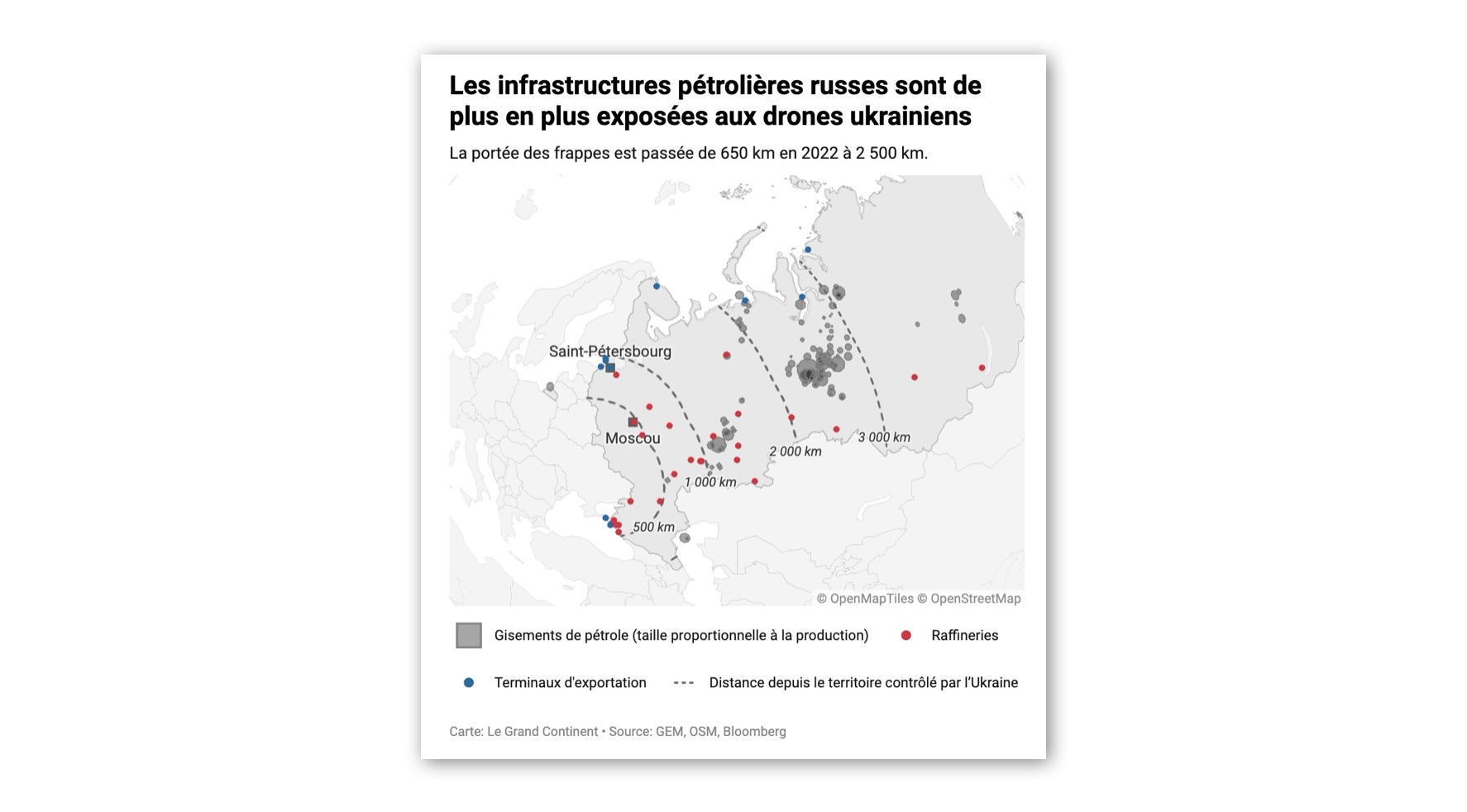
- Moreover, the need for new parts continues to rise as Ukrainian strikes intensify and the reach of drones expands. It has grown from about 650 kilometers in 2022 to 2,500 kilometers this summer.
- At least 114 strikes against Russian refineries have occurred since January, more than double the figure at the same point last year.
The difficulties faced by the Russian oil sector are affecting the country’s current production: output is expected this year to fall to its lowest level since 2009, dropping from 511 million tonnes produced in 2025 to 494 million. Moscow’s risk is also that the funds spent repairing existing infrastructure will limit resources available for developing new oil fields.
- The majority of Russia’s major oil fields have been in operation since the Soviet era, and their production is declining, making the development of new reserves increasingly necessary.
- However, initiatives such as the Vostok Oil megaproject, developed by Rosneft in the Russian Arctic for nearly $50 billion, have fallen several years behind due to the war and Western sanctions.
The war challenges Russia’s status as a petroeconomy. Although the country remains the world’s second-largest oil producer, behind the United States, the share of oil and gas in its GDP has fallen markedly. It dropped from 20% in 2022, the first year of the war against Ukraine, to 13% in 2025.