
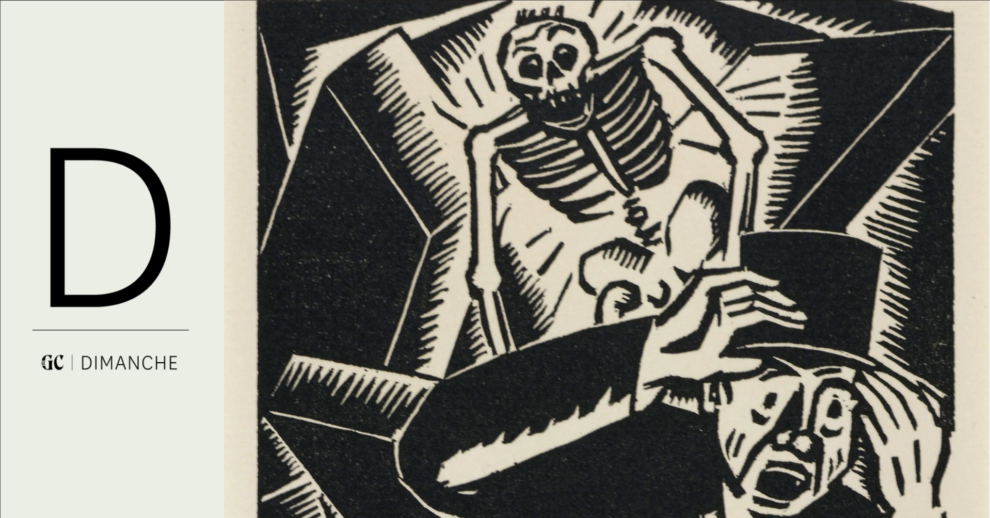
Talented painter and printmaker, Frans Masereel already enjoyed a certain renown before the war. Born in 1889 in Blankenberge, Belgium, this engaged artist moved in anarcho-socialist circles. As an illustrator, he contributed to numerous small avant-garde journals. A friend of libertarians, humanists, and pacifists, he shared their antimilitarist culture. He also counted among his close circle international figures such as Stefan Zweig and Henri Guilbeaux. Guilheaux, though less well known, nonetheless played a significant role in circulating libertarian artists before and during the war.
The war caught Masereel by surprise while he was in France. Returning to Belgium, he discovers that he has been erased from the population records. At twenty-five, he could have been mobilized, but he never is.
At the outset of the conflict, being a pacifist is hardly welcomed. A refugee in Geneva at the end of the summer of 1915, Masereel undertakes volunteer translation work for the International Prisoners of War Agency of the International Committee of the Red Cross. There he meets a man who will exert a decisive influence on his path: the writer Romain Rolland. A towering figure of international pacifism, Rolland is notably the author of Au-dessus de la mêlée, an essay published on September 22, 1914 in the Journal de Genève, later released as a collection in 1915. This manifesto leaves a lasting mark on Masereel.
The “Boche Art” in the Face of the “Return to Order”
Like many anarchist artists, Masereel is horrified by the massacres of the war. He draws sustenance from the testimonies, correspondence, and narratives that appeared about the conflict.
Yet World War I was not a high point of artistic production; historians often call it a period of the “return to order.” Indeed, at the dawn of the 1910s, painting and, more broadly, academic art had been unsettled by the rise of post-impressionism, cubism, and other avant-gardes. During the conflict, this academic stance regains the upper hand and pushes back avant-garde experiments. An enlightened architect even went so far as to write: “Finally, cubism is dead.”
The works that sold and circulated widely at the time depicted battlefields, military scenes, or ruins. There is also a spirit of revenge: that of artists whom the prewar avant-gardes had “outdated.”
It is in this context that Masereel published in 1917 two series of wood engravings. The first, from which the plate reproduced here is taken, is titled Debout les morts ! with the subtitle Resurrection infernale. This series fully belongs to the avant-garde aesthetic: far from the “return to order,” the engraver aligns himself with a cubist, or even expressionist, lineage. By its very style, Masereel practices what the academic artists, who had regained favor during the war, called “Boche art,” that is to say avant-garde art.
“Stand Up, the Dead!”
Let us pause on the title of the series. Masereel here distorts a formula that had become widely circulated from 1915 onward, borne by the testimonies and narratives that forged the legend of the Great War. It includes the story of Adjutant Jacques Péricard. In April 1915, at the place known as the “Bois-Brûlé,” while his men are surrounded by the Germans and on the verge of annihilation, he shouts to rally them: Stand up, the dead! This heroic act earned him a promotion, and his phrase was taken up in a patriotic and martial frame. If Masereel appropriates it, he does so not to heroize but to render a profoundly tragic version.
The plates in the series indeed depict the tragedy of the trenches and the “atrocities” spoken of at the outset of the war. We see, in particular, a soldier entangled in barbed wire, another shot, a woman assaulted, and children and civilians massacred. The plate that concerns us stands out, for it is the only one in which the vision of death is rendered with such blunt directness.
A Frightened Capitalism, Prey to Revenge
In the foreground appears capitalism, rendered in the iconography of anarchism: a man in a frock coat topped with a high hat. One of the originality of this image lies, in my view, in the fact that this capitalist fears not a revolution or a threatening proletariat as in many other depictions, but a dead man. This death is a skeletal figure menacing, placed in the background and seemingly rising from his grave. One seems to read on his face a longing for vengeance against the capitalist.
This engraving clearly communicates Masereel’s reading of the war as an anarchist-socialist. It is standard in these circles: capital is identified as the principal cause of the conflict. This responsibility, in turn, calls for retaliation.
Nothing in the vignette explicitly states this, and we do not know the exact date, but one can link it to two events in 1917. First, the Bolshevik Revolution: even if the engraving is not precisely contemporary, there is a connection to the idea of vengeance embodied by the skeleton. Then, 1917 is also the year of the April–May mutinies. One already senses a form of awakening among the soldiers confronted with the painful reality of their experience. Behind this awakening of the living looms the dead, who demand vengeance or accountability.
This idea of resurrection also echoes Catholic painting that saw a revival during World War I, where the theme is frequent. In the mouth of an anarchist, this is, of course, a subversion of that religious motif for the sake of revolution.
In the lower right corner of the vignette, one can discern a crown bearing the inscription “Aux morts.” This detail suggests that the dead rises to frighten the capitalist at a solemn moment, such as a ceremony of homage to the fallen, like Remembrance Day. Yet instead of the silence and contemplation that usually characterize those moments, riot and vengeance erupt.