
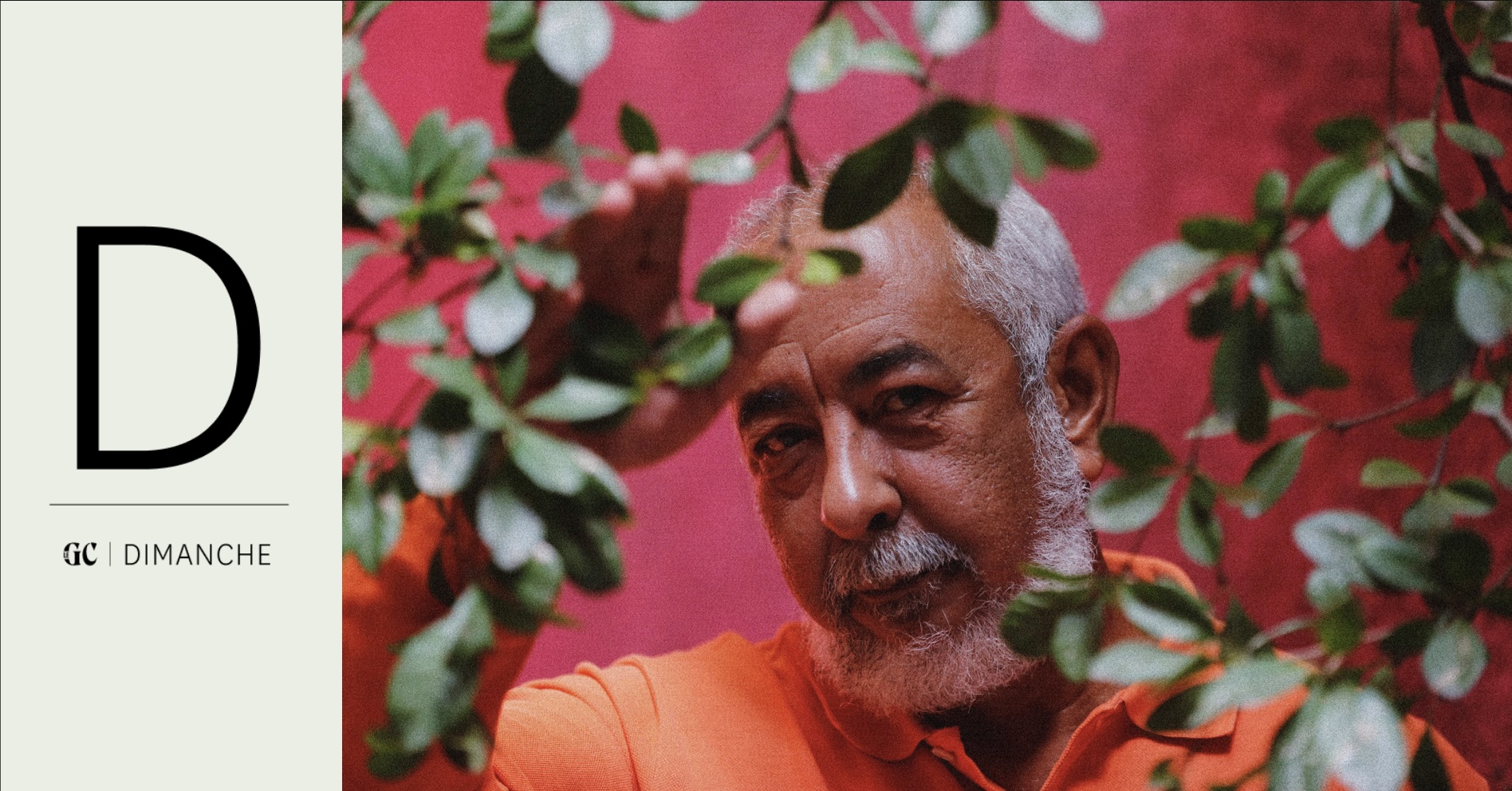
The Cuban writer Leonardo Padura published in 2009El hombre que amaba a los perros (The Man Who Loved Dogs), a novel tracing the eleven years of Trotsky’s exile and the recruitment, then the training of his future assassin, the Catalan communist Ramón Mercader. At the heart of the narrative lies a kind of alter ego of Padura: Iván Cárdenas Maturell, a marginal Cuban novelist who must face the dangers of writing on his homeland.
This interview, originally scheduled for the edition of this Sunday on Odessa , was to be published on Friday, August 21. Recurrent internet connection problems in Havana caused it to reach us late. We publish it today.
In your foreword to The Man Who Loved Dogs, you explain what your objective was in writing this novel. Would you say that it is a perfect example of the novelistic method: the particular story (that of Trotsky) enabling the discussion of a universal story (that of the “equalitarian utopian model of real socialism”)?
The objective is what I call the “why” I write a novel. It is the intention that governs the writing project even before I put pen to paper.
What do I mean this time? It’s like a compass guiding me through the vast sea of possibilities opened by a novelistic universe. In this case, it was about evoking the process of perversion of the great egalitarian utopia, and it seemed to me that the preparation and assassination of Trotsky constitute a process illustrating the point of no return of this perversion orchestrated by Stalin.
Was there another aim?
Trying to tell this story that happened eighty years ago, my true aim was to speak about my own experience as an individual who lived in a socialist country and endured many of the inherent trials of that condition.
That is why there is a Cuban character, Iván, a frustrated writer, a man of my generation, who is the one who receives and renders History while telling his life and dramatizing, in his personal existence — which is both generational and national — the harshness of this process. In short, it turns out that Trotsky and his adventures provide the broad frame for an intimate story, which in many ways is my own story.
This method almost resembles a Voltairean trick to bypass censorship. Did you conceive it this way as well?
I did not worry about censorship, because if I had, I would not have been able to write this novel — and I think that is true for many of the works I have written and am writing now. I think the “why” I mentioned earlier is clear enough in the novel.
And what is curious is that the book was published in Cuba, even went through two editions, had a public introduction, it received the 2011 Critics’ Prize… and after all that, silence fell upon it.
But it was already written and I had said what I needed to say. And, of course, there exist literary resources to express ideas, for this is not a political propaganda document, even though it carries a strong political dimension.
What can the history and path of a man—Trotsky—say, represent, or even symbolize, through revolutionary utopia, with all the political intrigues behind it—that you illuminate precisely?
Trotsky was a full-time revolutionary, I would even say a revolutionary fanatic who committed his life to it, up to the very end. He strongly believed, I think, in the possibility of creating a better society, one in which people could live with the greatest freedom and maximum democracy. Yet the society he helped found never existed.
When we speak of the dictatorship of the proletariat, we refer to a society that excludes those who are not proletarians; when governed by a single party, other social and political viewpoints are marginalized or even banned; and when the party is even supra-constitutional, the exclusion of others is all the more evident. This does not mean the majority benefits from the social process, but this majority should not dictate its law to others, even if they are a minority.
True democracy, true equality, is inclusive. And I do not know whether it exists, with all its conditions and risks, in any human-made society.
Have you ever been to Odessa?
No, I have never been there, although I have visited many other places where Trotsky stayed. Notably the Princes’ Islands near Istanbul, where he lived for several years. And, of course, on several occasions in the fortress-house of Coyoacán, in Mexico.
As he is on his way to exile, you recount the moment when Trotsky re-crosses Odessa and his memories stream by…
I simply report what Trotsky himself said about his relationship with Odessa. It is his fault, not mine.
If you had to choose the most important moment in Trotsky’s life, which would it be?
I think the October days of 1917 were the most spectacular of his life. The seizure of the Winter Palace, where he showed such leadership, marked one of the pinnacles of 20th-century history and history in general, and he was one of the protagonists.
How did you research Trotsky’s stay in Odessa?
By reading. There is no secret.
What is for you Trotsky’s most important text?
It would be difficult, even unfair, to pick a single one. But his History of the Revolution is indispensable; The Revolution Betrayed is a revealing book; and his Stalin is overwhelming.
However, the text I value most is not signed by his own hand. It is the appeal to progressive intellectuals worldwide, signed by Diego Rivera and André Breton, but practically drafted by Trotsky, in which a man as doctrinaire as he calls for total freedom for art… even beyond the revolution. Incredible, isn’t it?
You said you were surprised by the reception and success of the novel, especially in Cuba. Did that also cause you trouble?
I was not surprised by how readers welcomed it, but by the fact that it was printed and distributed. At the book fair where I presented it, I said I was witnessing an event I never would have believed possible, and which was happening. The following year, I also received the National Literature Prize, the highest distinction a writer can receive for their body of work in Cuba, even though I was not yet 60. Then silence settled in.
I live in Cuba and it’s as if I do not exist: I’m not interviewed, I’m not mentioned, and my books aren’t even published here anymore; people have to obtain them when someone abroad sends them or through pirated digital copies. Yet, truthfully, many people read me.
You stated that writing The Man Who Loved Dogs was “the most complex, demanding, and riskiest literary adventure I have undertaken in all my years of work and creation.” Is that still the case?
It remains the case. Merely the research needed to obtain the essential information and to build the plots, to define the characters, to master the specifics of very different historical periods and sometimes as complex as the Spanish Civil War or Mexico’s revolutionary era of the 1930s–40s, posed a colossal challenge.
Tracing Mercader’s life was a major challenge, because Mercader has always been a phantom, a construction. And attempting to step into Trotsky’s head was a madness from which I’m not sure I’ve emerged unscathed. Everything was complicated because, to top it all, in this story everyone lied, absolutely everyone.
The novel is a literary feat; you had a fairly clear goal (“to reveal a process of perversion of the utopian project”). Why did you want to write a novel about this subject (and not an essay), and how did you manage to stay strictly within the novelistic register?
There are already many essays on the subject. And I am not a historian. What interests me is another type of research, the one that the novel makes possible, which, as is known, is the literary form that best reveals the workings of the human condition. Thus, the thesis of my book is subordinate to human behaviors, to the decisions and indecisions that haunt us, and to the fact that we are all subjects of History.
We live in History and history determines us, for every moment in time unfolds within History and within a historical and social context that tyrannizes us. Each protagonist in the novel, Trotsky, Mercader, and the Cuban Iván, is a historical being shaped by his era and rooted in historical contexts. That is the key.
Can the precise and violent manner in which Trotsky is assassinated also tell us more, in a broader sense, about his fate—and above all about all that led there?
I wouldn’t say it that way. The way Mercader attacked him was a personal decision, and reading symbolism into it, such as claiming that the ice axe is a synthesis of the hammer and sickle, is rather risky. What’s certain is that it was a brutal act, even more brutal than the famous gunshot to the back of the neck of those condemned in the Lubyanka during Stalin’s era.
Did it have to be a Cuban writer who tells this story?
Yes, this story, as told here, well yes, only a Cuban…
Living in a socialist country isn’t something you learn from books. You can grasp the major frustrations, even the repressions, but the experience of daily life with its many subtleties, its details, the feeling of abandonment and, consequently, fear, must be lived to know how to feel it and attempt to write it.
This knowledge of a context such as Cuban socialism does not reside only in The Man Who Loved Dogs, but it runs through all my fiction, which is an attempt to write a possible chronicle of contemporary Cuba from the viewpoint of my generation.
Tell this story, know it, seems to be a first step. What would the second be?
It’s simple: try to write it.