
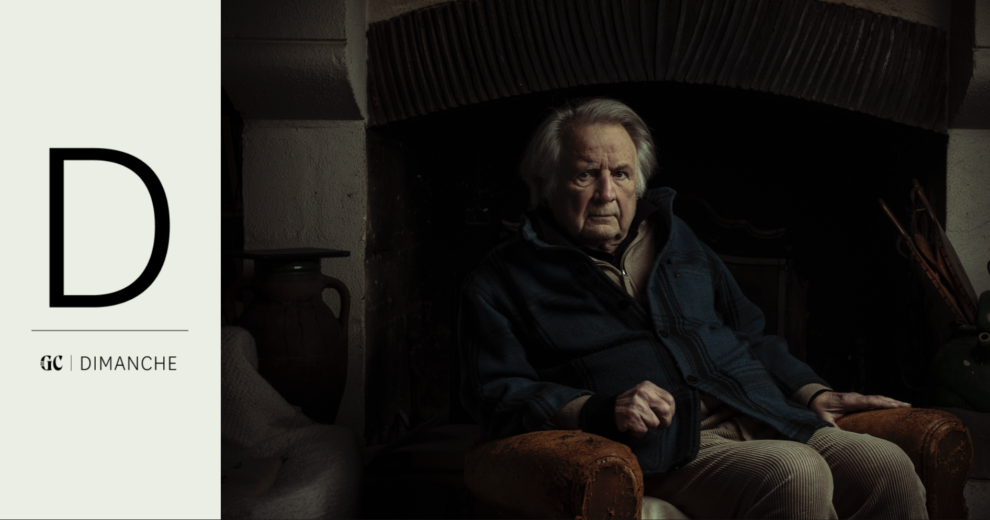
Debray sits still, after having moved so much. He doesn’t really like talking about the America he fought against, and he is still forbidden from entering the country. He doesn’t really like talking about Che.
And yet, after lunch, when we settle into a large drawing room where two armchairs await us on either side of an old stone fireplace to drink coffee, he says: “I don’t know for whom you really work, but you’re a good agent, you’re well informed. You’ve done a good job.”
And it is when he erupts in that nasal, electric laugh unique to him that one senses a somewhat different kind of interview may begin.
The revolutionaries have little sense of humor
We also know that just before entering the Élysée in May 1981, Régis Debray was fighting alongside the Sandinistas in Nicaragua, a few miles from El Salvador. He would never go there himself, but he would witness arms transfers to aid the Salvadoran guerrilla fighting nearby.
He was also very close to a Salvadoran poet-revolutionary with a Tarantinesque name, Roque Dalton. He recalls an anecdote he told us once: Cuban secret services called Dalton “el jodedor” (the jokester). “That’s very accurate,” replies a suddenly dreamy Debray. His memories come back. “Roque was an extraordinary person, with a good mood and a contagious sense of humor…,” He stops and adds in a whisper: “Well, not so contagious, perhaps.” What does that mean? “I’ll tell you, without wanting to sadden you, that revolutionaries have little sense of humor.” Dalton was eventually executed by his own fellow fighters, four days before his fortieth birthday. They accused him of being a double agent for the CIA. “That was false, of course.”
That story is not as anecdotal as it might seem. “Roque’s murder was for me very emblematic. I understood at that moment that something wasn’t right.” We are in May 1975, so it isn’t the first time Debray questions things. “But still, that shock touched me deeply, and that such a thing could happen made me reflect on the a priori conditions of revolutionary knowledge.” He ends by murmuring, nostalgic: “He’s one of the men I would most like to see again from that era.”
The last book
Naturally, the temptation is too great. We also know he no longer likes talking about that much. But there is a sense of opening. And would Che, too, like to see him again? He hesitates. Neither yes nor no. He does not answer. That is not the right question. We try another path. Did Che also have a sense of humor? “No, not really.”
Debray is elsewhere, thinking of something else. Other memories resurface. “I never understood the choice he had made or the one that had been made for him.” We do not immediately understand this enigmatic sentence, but we do not interrupt him. “Why did he choose that region which had absolutely no characteristics?”
He speaks of Bolivia in 1967, as if he were there still. He snaps back. “To tell you the truth, I never really understood how that happened, that time.”
He repeats: “I never really knew.” One senses that these questions still haunt him. In November 1966, Che, who entered the country under false papers, chose to go to Ñancahuazú, in southeastern Bolivia, “a place I found incredibly hostile, both geologically and especially in its total population vacuity. There were a few caseríos here and there, but essentially, nothing much.”

“While in the north of Bolivia there were many supporters, many people were very favorable. It is very puzzling; I never quite understood it.” Was he misled, perhaps deliberately? He doesn’t know, but does not exclude that possibility. Then he offers a hypothesis: “I think he was subconsciously drawn to Argentina. There was this attraction toward the Argentine border, even though Che didn’t talk about it. But you could feel it.”
Perhaps he sensed the end was near, hence this desire to draw closer to his homeland? Who can say. In Bolivia, Che (who called himself Ramón there) asks Debray to bring him, on his next trip, The History of the Decline and Fall of the Roman Empire by the English historian Edward Gibbon. Between ambushes, Che read a lot, and his Bolivian Journal keeps the list of his readings.
“Che probably thought the American Empire would be like the Roman Empire. In any case, he wanted to read the book.”
Debray will never have time to hand it to him. “His intuition was perhaps good, by the way. I’m giving the American Empire another hundred years.” He adds, putting his hands in the pockets of his multi-pocketed jacket, where proudly still lie pens of all kinds: “I’ll come back to see.”
The Revenge of History
The appointment is thus set for 100 years from now. But in the meantime, what to do? Trump and his clan want to make us their vassals, or even push us out for good. They don’t even hide it. What does the man who, he says, still cannot travel to the United States because of his associations “with Latin American terrorist organizations,” recommend?
“How to resist?” he repeats, amused. The disillusioned Debray (he admits it himself) resurfaces. Let’s call him Mr. Hyde.
You will not be disappointed: “To tell you the truth, I think it’s doomed.”

Is our conversation any different? We do not give up. And nor does he, really. “I think the Americanization that starts from both bottom and top has made us into an American province that grumbles now and then, but for show. The most heroic thing we do is to abstain from intervening, for example in Iran. Dare to be absent.” He can sense our perplexity bordering on disappointment, so he clarifies: “You know, I no longer concern myself with politics at all. But what really strikes me is that in the Gaullist period NATO was something nauseating. It had to be left. And I now see that people speak of NATO as the reference for drift.”
He asks us if we find him defeatist. Hard to deny it, and he doesn’t deny: “I may have a somewhat defeatist tendency, but honestly I consider it finished. We have become a province that can no longer rebel against the Empire’s capital, which no longer thinks about it, except for a few lunatics.”
We wouldn’t be wrong to be those lunatics, we remark. But then very serious polls—like our Eurobazooka series—show that we are far from being “a few lunatics.” He concedes it, but he is not convinced that it can translate into political energy. “I think we are truly integrated. I answer you like a Greek facing a Roman of the third century. When asked if the Greek would rebel a little, he says, ‘well, it’s the Empire, my friend.’ In my time, young intellectuals gathered in Rome or Milan, and today they gather in New York or on the West Coast. It’s like that; there is a kind of quasi-physical or magnetic phenomenon, the course of civilizations.”

They tell him that, well, Donald Trump’s America isn’t exactly a dream. This time he nods in agreement. And as proof of his still-sharp eye, he offers a new reading: might the United States be Latino-Americanizing? He thinks for a moment and settles: “It’s becoming a country of Latin America.” Before adding a subsidiary hypothesis: “One could see Trump as a caudillo.” He is pleased with his finding, and for good reason. “A Latin-Americanization of the United States, that’s funny anyway. It’s history’s revenge.”
Carpentier, García Márquez, Vargas Llosa and the others
Trump as caudillo—the image would not have displeased the great Boom writers of Latin America who made the dictator novel something of a nearly perfect literary form. He could be a character in Vargas Llosa’s La fiesta del chivo (The Feast of the Goat), for instance. “Absolutely. We must revise our classics. Resistance must also come from below.” Besides having known many of these writers, Debray is a keen connoisseur of this literature. It is even the trigger for his first trip to Latin America. He talks to us especially about one author and one book: Alejo Carpentier, El siglo de las luces. “I have a passion for Carpentier. The Century of Lights completely bewitched me. It’s wonderful that you brought him up; it will be mentioned in my next book, to try to lay some of them on the table.” He pauses. Like earlier, when he was in Bolivia, he seems this time to wander through Carpentier’s magnificent pages. He returns somewhat changed, and shows his readerly sensibility: “It’s a pity you want to make me cry, because I was in a good mood.”

We protest, on the contrary. This journey must make him enthusiastic. He recalls: “Carpentier was Franco-Cuban; he spoke Spanish with a rolling ‘r’ that has no rival but mine.” And perhaps Cortázar, we may add. “That’s true, but Carpentier… with a name like that already. He spoke Spanish truly without that jota, which has always been for a Frenchman something extraordinarily difficult. I was always very happy to see him. He was a fairly modest, rather surly man. I moreover attended his funeral in Havana, in 1980. A number of French people had come.”
He also remembers García Márquez, “a funny man, not in a vulgar sense. He didn’t impose it, as one says.” And Vargas Llosa, who had died a while ago, he speaks warmly of, though the two men rarely agreed on much. “I first knew him as pro-Cuba. The last time we met was at the moment of his entry into the French Academy. He was fraternal and very smiling, even though we knew he could be very harsh and unfriendly in his positions.”
There is no doubt, this is the first time Debray has been so smiling during the interview. He even admits it. “It’s rare to be able to talk about these subjects in France. I’m very happy because it brings back to life people we care about without necessarily remembering them. There is perhaps a kind of ‘will to live’ that resurfaces. All this is so distant to me, and at the same time, when I talk about it, it becomes quite close again.”
We point out that not everything is so dark. He counters by asking where those great writers are now. He searches and finds: “There are still small ebullitions, an inventiveness we see today.” Who does he think of? “The Cuban writer Leonardo Padura, for example.”
Hope
Yet he wants to tame any ardor. Mr. Hyde returns: “To tell you the truth, fifty years ago I still had an old Gaullist reflex saying that America is very good, but it isn’t us. I had high hopes that France could play a singular and perhaps contagious role toward other countries. In short, I had illusions.”

Speaking of the Gaullist reflex, they go all out. We ask if he has seen Antonin Baudry’s La Bataille de Gaulle. “I went to see it; I found the film extraordinary.” Here is Dr. Jekyll’s return. “I was not convinced by everything, but it’s magnificent. It’s very curious.” What do you mean? “It awakens in us a kind of patriotic archaeology. The film’s success is symptomatic of that.” In what sense? “We have such frustration today with mythology, with great men, that I was glad to see here, in the audience of the nearby small town, that there were people.”
The optimism does not last very long. “Who are, or rather, where are the great men today?” The question lingers between the thick walls of the house. Debray laments the mediocrity of the political class, he only praises Dominique de Villepin, whom he admires but who “for the moment, has not run.”
He will say no more, so let us return to literature. What is he reading at the moment? Gracq. “I tell myself that his language is truly rich, subtle, and sensually striking, and completely anachronistic. Anachronistic, but given that he lived in such retreat, so detached from everything, perhaps he didn’t realize it.” He adds, in a breath growing shorter: “Although, from what he told me, he was quite pessimistic about his future.”
“Is the interrogation finished, Mr. Commissioner?” he asks gently. But when Debray poses that question, even (or especially) with irony, the question is loaded with histories. In any case, it is not trivial. He is aware of it, and even proud to provoke a little friendly embarrassment.

“Alas, it would seem that yes, the interrogation is finished” is all we can answer. “Damn, it was a nice interrogation,” he ends by saying as he gets up and walks us to the door.
Rather than having truly heard him say it, we will cling to these words that Debray writes when he speaks of resurrection: “One can always keep hope.”