
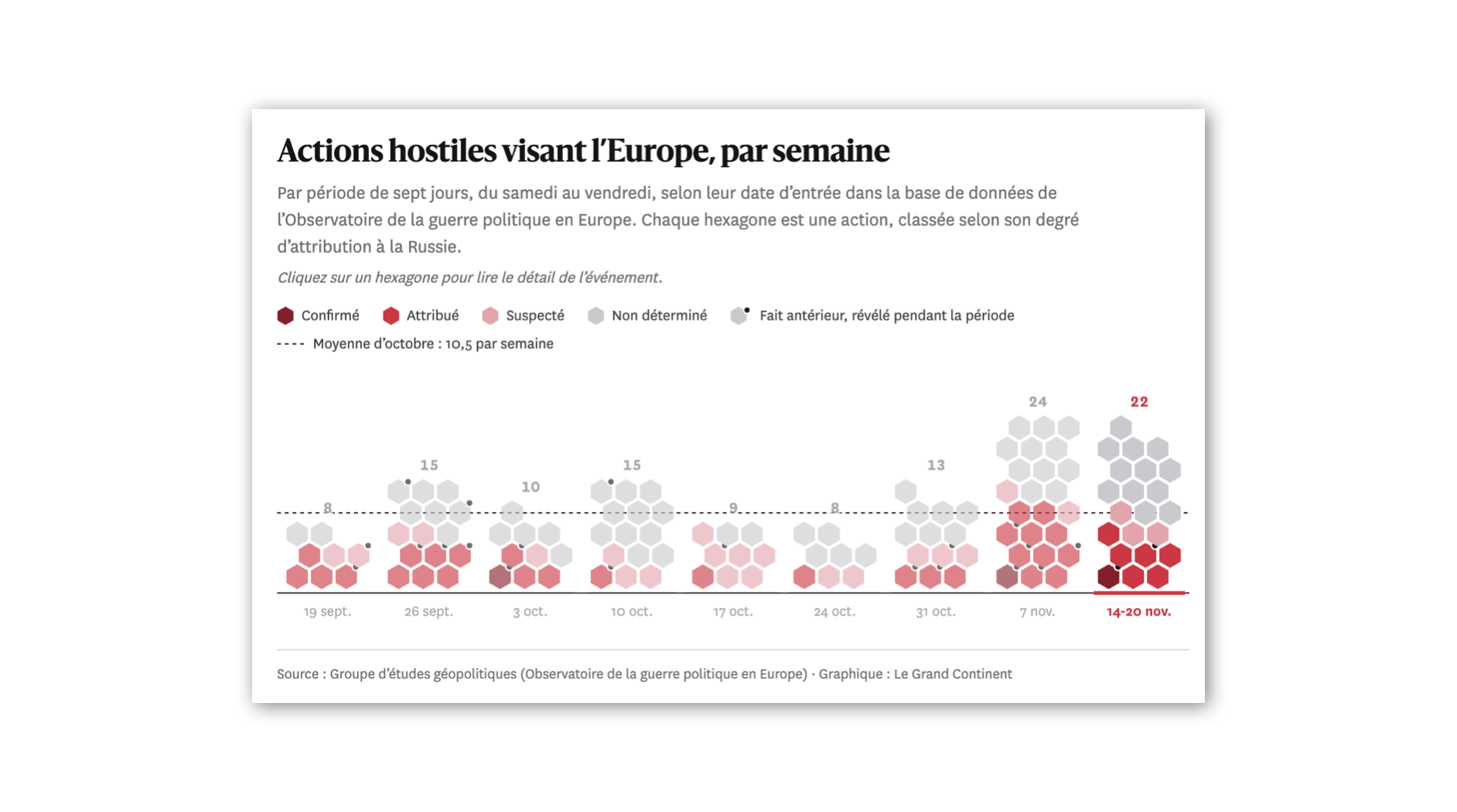
From November 14 to 20 at 14:00, the review recorded 22 hostile actions targeting Europe, either recently occurred or made public in recent days. Ten are attributed to Russia or suspected of being so, and no perpetrator has yet been named for the remaining twelve. The tally includes five strikes against merchant ships (seven ships hit in total), five aerial incidents, three of them involving drones or Russian missiles, three interference operations, one arson attempt, a sabotage, an espionage operation, four cyberattacks, GPS jamming, and a wave of bomb hoaxes.
This is more than double the October average (10.5 actions per seven-day period).
- The eastern part of the continent bears the brunt: 14 of the 22 reported actions involve Romania (4), Poland (3), Bulgaria (3), Hungary (2), and Moldova and Estonia (one each).
- Between November 13 and 17, six merchant vessels were struck by drones off the coast of Romania and Bulgaria, at least two of them inside Romanian territorial waters. On Monday, November 16, a wheat cargo ship capsized off Cape Kaliakra following a naval drone strike, and the following day, a propane-carrying tanker sank off Byala.
- A seventh vessel, the Mariam M cargo ship, hit by a Russian drone in September in the Ukrainian sector of the Danube delta, ran aground on November 16 on Vadu Beach in Romania.
The remaining eight actions impacted Western and Northern Europe: France (2), the United Kingdom, Spain, the Netherlands, Belgium, Norway, as well as Germany and France, jointly targeted by disinformation campaigns conducted by the Social Design Agency, an outfit linked to the Kremlin.
- These are mainly cyberattacks and intimidation attempts, such as the AI-assisted cyberattack against the Commission, the assault on the Norwegian energy group Equinor, GPS jamming that disrupted dozens of aircraft over the North Sea, or the wave of bomb threats in Spain when Madrid’s emergency services received 30 bomb warnings within 36 hours.
- None of the four cyberattacks recorded during the period has been attributed; investigations are lengthy and their conclusions are not always made public. In Bulgaria, an intrusion that went undetected for five years could not be linked to any foreign government.
- The use of publicly accessible AI tools, such as the one pirates are said to have employed against the Commission according to a European official, could further complicate attribution.
In the night from November 19 to 20, two missiles, including a Kh-101, and a drone, most likely jet-powered according to the Polish defense minister, fell in Poland during a major airstrike against Ukraine. The day before, Thursday the 19th, the embassies of the Netherlands and Austria in Kyiv were damaged during Russian strikes on the Ukrainian capital.
Following these strikes, the Union announced the summons of the Russian representative in Brussels, and France requested a meeting of the United Nations Security Council.
- It is not the first time that Russian missiles have fallen in Poland, as in July last year in the Lublin region, but Warsaw sees this as a deliberate gesture this time.
- Prime Minister Tusk spoke of an “intentional provocation,” and the defense minister believes Moscow “continues to push new boundaries.”
- For the first time since the large-scale invasion began, the control tower of Rzeszów-Jasionka Airport, a major transit point for military aid to Ukraine, was evacuated.
To follow day by day the Russian political war against Europe, our Observatory is updated daily with the latest information.