
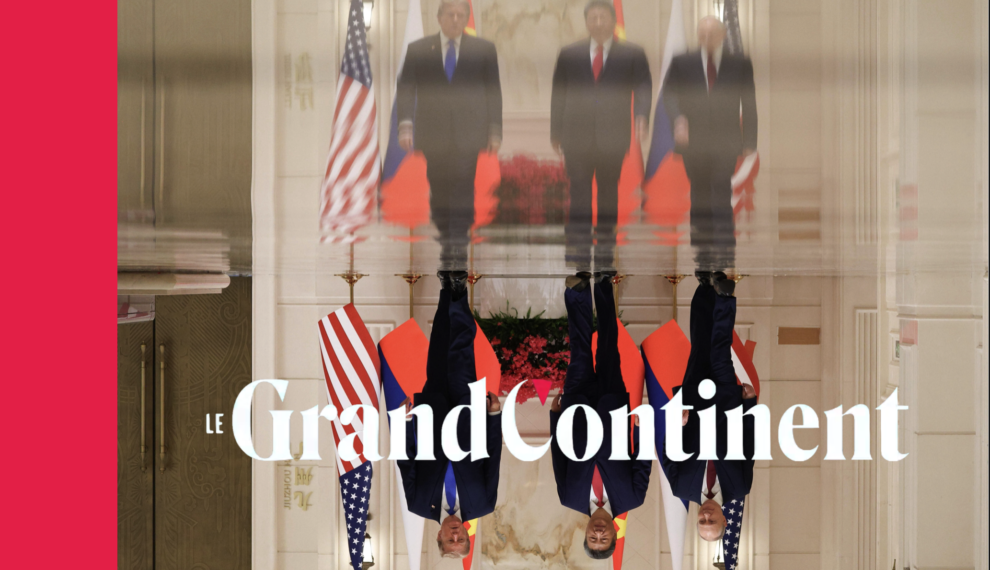
Chinese, American and Russian leaders issued a joint statement at the conclusion of the trilateral summit, which wrapped up Thursday, November 19, in Shenzhen, China, on the margins of the APEC summit. The conflict in Ukraine and Iran is not mentioned, and the document sticks to broad formulations that call for future clarifications.
The meeting, which had been billed as a “Yalta 2.0,” lasted about ninety minutes, shorter than the bilateral session that had preceded it between Putin and Xi Jinping. The three leaders pledged to promote UN reform and to boost the production and supply of refined petroleum products, judged that the International Criminal Court should not “abuse” its jurisdiction, and committed to future discussions on reducing nuclear risks. Together, Russia and the United States account for roughly 83% of the world’s stock of nuclear warheads.
The Shenzhen joint statement underscores the divergence in goals among these three powers, which struggle to agree on a common agenda, despite the unusual protocol Beijing used for the arrival of Donald Trump. The Russian president had sought to project an image of strength and close military cooperation between China and Russia, having on Tuesday the 17th moved two Tu-95 bombers capable of carrying nuclear weapons from Russia to Vietnam, traversing Japanese airspace and the South Korean and Taiwanese air defense identification zones.
The leaders’ remarks before the exchanges also offer important insights into their worldviews: according to the Chinese state-run Xinhua News Agency, Xi outlined four principles guiding the relations among China, Russia, and the United States—mutual respect, peaceful coexistence, mutually beneficial cooperation, and dialogue. He framed this trilateral meeting as essential to avoiding a new world war. “History teaches us that when great powers live in peace, the world is secure; when great powers clash, the world descends into chaos,” he said, recalling World War II, and describing China, the United States, and the Soviet Union as “the pillar of the global anti-fascist struggle.” Putin, who has been aggressive in Ukraine since Russia’s 2014 annexation of Crimea, also invoked World War II to call for accountability: “Our three countries are united not only by their status as World War II victors, but, above all, by a shared responsibility to maintain peace and international security.”
Meanwhile, the American president emphasized the historical significance of the gathering and an unprecedented convergence: “I will propose means to safeguard the sovereignty of our nations against uncontrollable globalist organizations, such as the International Criminal Court, which has become unaccountable.”
Peace Declaration by the Leaders of China, Russia and the United States
The Chinese president Xi Jinping, the Russian president Putin, and the American president Trump met on November 19, 2026 in Shenzhen. The leaders of Russia and the United States thanked China for organizing this historic meeting. The heads of state of the three countries conducted an in-depth exchange of views on the current international situation and committed to preserving strategic stability and international security.
I. China, Russia and the United States, as permanent members of the United Nations Security Council, commit to promoting the reform of the United Nations to enable it to respond more effectively to global challenges and to fulfill its fundamental mission of maintaining international peace and security.
II. The three countries plan to increase the production and supply of refined petroleum products for the benefit of all nations worldwide. They reaffirm the importance of stable energy flows.
III. The leaders of the three countries acknowledged that the principle of state consent and the respect for the immunity enjoyed by state leaders are of paramount importance, and they agreed that the International Criminal Court, along with other similar institutions, should not abuse their jurisdiction.
IV. The leaders reaffirmed that a nuclear war cannot be won and must never be fought. The three countries will engage in a dialogue on reducing nuclear risks and preventing proliferation.