
Testez le Grand Continent. Les idées et les analyses qu’on ne trouve nulle part. Mais que vous verrez bientôt partout. Dans votre boîte mail à partir de 8 euros par mois
In your book Making the World Again , you recount how Churchill, Roosevelt and Stalin built peace at the end of the war. After the meeting between Trump, Xi and Putin in Shenzhen, are we witnessing the emergence of new “Three Greats,” or is this analogy misleading?
I don’t think this analogy is very pertinent; it distracts. In 1945, the three Allies had fought the Axis powers together and still needed to unite their forces to defeat Japan. They had already reached some agreements on the future of Europe, which perhaps resembles what Russia would like to propose today. Moscow is clearly working to credit the idea of a second Yalta, where the great powers meet and decide Europe’s fate without Europeans having a say.
But Europe is very different today. The three powers gathering in China are by no means allies. And Russia is not a great power: it has been seriously weakened by the war in Ukraine and now depends much more on China. The Russians would like us to believe that this is simply how great powers behave.
What could unite three countries that are most often in competition?
Russia and China maintain links – Putin has visited China five times in recent years and has thus frequently met Xi Jinping. But there are historical tensions: in the 19th century, Russia seized many territories that China considered its own, and in the 20th century, notably during Mao’s era, relations deteriorated sharply. They have not always been friendly. Because of the war in Ukraine, Russians are now much more dependent on China; they clearly figure as a second‑tier partner.
Between the United States and China, tensions will endure. What is feasible is that these three powers reach some kind of understanding. It will not be written down, but there could be a tacit agreement on spheres of influence: China will assume it can dominate its neighborhood, Russia will strive to dominate Eurasia, and the United States—or at least President Trump—would want to dominate the Western Hemisphere. He has mentioned a “Donroe Doctrine,” aimed at keeping the Western Hemisphere free from outside interference. So it is possible, but I see no genuine friendship or alliance among these three countries. They share certain ways of acting and similar objectives, but it has nothing to do with an alliance formed to wage war.
In Nixon and Mao , you described how Washington played Beijing against Moscow during the Cold War. Has this triangle inverted, and to whose advantage?
I think it is now China that plays the United States against Russia. Xi Jinping would very much like to be seen as a moderate statesman. The image he aims to project is one where he stands at the center, between Trump and Putin: China at the heart of the game. He has shown great caution. He has supported Russia to some extent – China has provided intelligence to him and sold weapons – but Beijing has kept somewhat at a distance from the war in Ukraine and chose not to get directly involved, which says a lot. At the same time, Xi is willing to dialog with Trump. China thus sits at the top of the triangle.
Chinese nationalists regard Shenzhen as the sign of an American capitulation and the end of American hegemony. Is this merely a posture, or is there something that escapes Western commentators ?
In a sense, Trump has capitulated, as he treats Putin as a very dear friend. The body language is revealing: he laid his hand on Putin’s arm, shook his hand, and repeated that he was a great friend. For Putin, that means recognition as a top statesman. He had been ostracized in recent years because of his invasion of Ukraine, and this summit allows him to reappear at the forefront. It is difficult to find a precedent for such a summit.
In what sense?
Summits have always dealt with thorny issues, but this is not a genuine discussion or a negotiation. We do not know the agenda, and nothing indicates it was seriously prepared. Normally, when leaders meet to negotiate, the gathering is prepared months in advance. This one was not, and it is very hard to know whether it will really move anything forward.
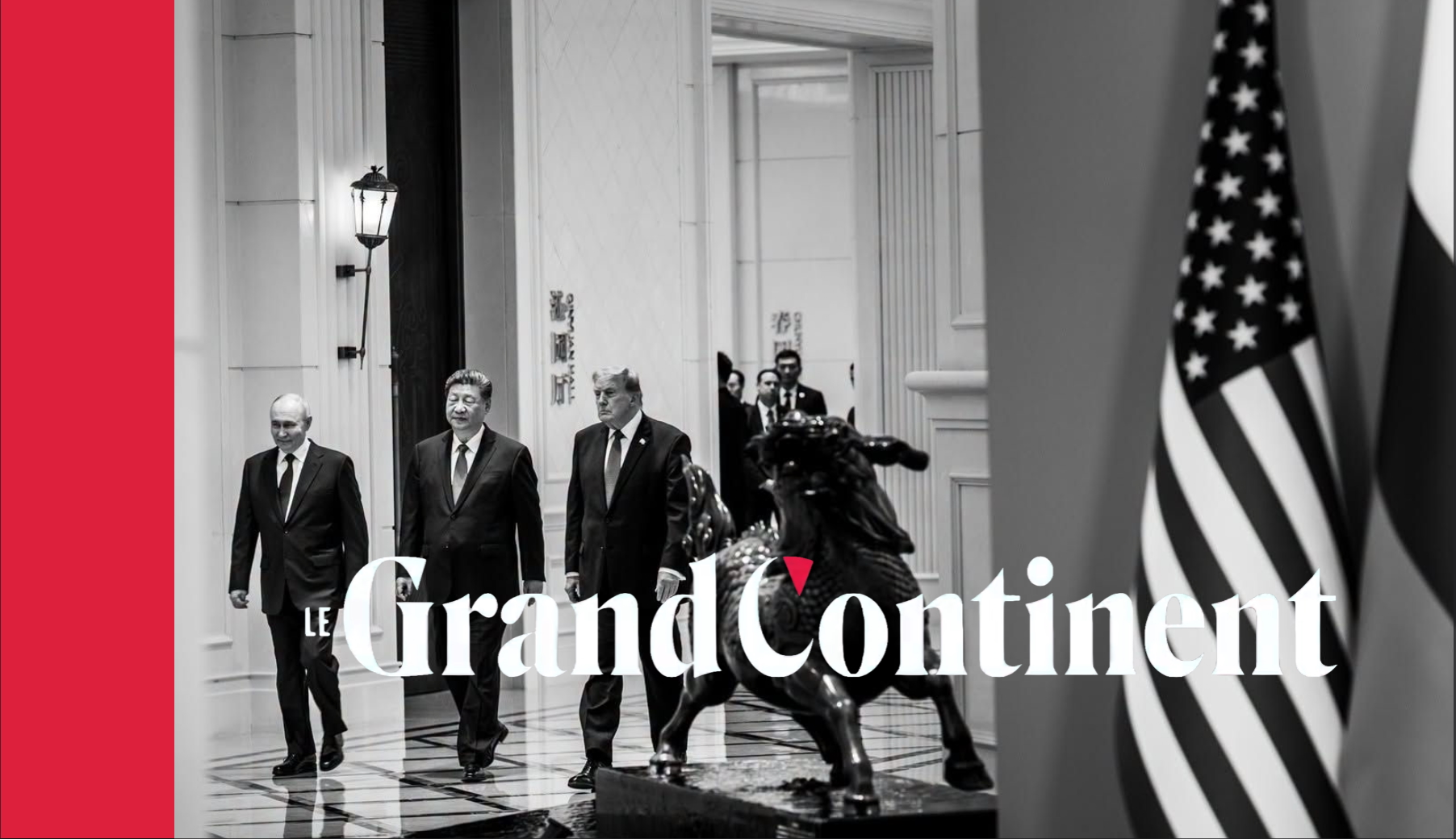
Tehran, Yalta and Potsdam in the past; today, Kylin Villa, a lakeside residence in Shenzhen, where Xi hosts as master of the house. Should we read this diplomatic choice as a geopolitical signal?
We are witnessing ad hoc diplomacy. The Chinese have prepared themselves very well, and Putin arrived with a list of demands, but we know absolutely nothing about what the United States wants. Meetings without an agenda seem to be more improvisation than serious negotiation.
Leaders love summits. They feel important: fanfares play, crowds cheer—Xi Jinping welcomed Trump with music and dance. They thereby escape their problems and domestic politics. But do these summits really lead to much?
What truly enables international deals are tough and painstaking negotiations. They can take a long time and require experts, people who truly master the subject. You do not negotiate lightly over a nuclear disarmament deal: there are so many technical details to understand—the vectors, the type of bomb—and inspections must be put in place, as was done for the major arms control accords of the 1970s and 1980s. I see little sign of that today.
Meetings like this lend themselves to propaganda, and Moscow is trying to manipulate European public opinion about the Ukraine situation. How can we report it lucidly?
We need to underline what did not happen. There are photo ops; Trump already declares that it was “the best meeting of all time” and that he loves Putin and Xi Jinping. What we must do is ask: what was actually achieved? What changed in reality? Why present it as a grand triumph? As the adage goes, the devil is in the details: that is where one must look. I do not think there will be a major agreement that truly moves us forward or makes the world calmer.
Roosevelt thought he could “manage” Stalin by betting on a personal relationship. When Trump calls Xi and Putin his friends, is he fooling himself with the same illusion?
Trump has always believed in personal relationships. Roosevelt overestimated his own ability to win Stalin to his view, but he served a higher purpose: he wanted to build a United Nations that would prevent future wars. He invested enormous energy in it, and establishing the UN structure as well as the Bretton Woods institutions—the International Monetary Fund and the World Bank—required monumental effort. The goal, as articulated in the UN Charter, was to rid the world of the scourge of war. Roosevelt knew that Stalin was not a democrat—nobody was surprised—but he hoped to work with him and bring the Soviet Union into the community of nations. And Stalin was willing to join the United Nations, convinced that it would serve the USSR’s interests. In 1945, the Soviet Union was the largest military power in Europe, but it had been badly strained by the war. It needed to rebuild, and as far as we can judge, Stalin was ready to cooperate peacefully with other nations. I see nothing like that today.
And what is Trump seeking to achieve?
I do not see what Trump’s worldview is. Like Roosevelt, he believes he can win over anyone by charming them and giving them a pat on the back. And he has a purely transactional approach: he seeks to know what Putin and Xi want, or do not want, and he strikes a deal. That is how he seems to conceive foreign policy. As far as one can judge, he does not listen to his advisors and he has hollowed out the State Department, where many people have been fired. Apparently, his corridors are now empty. He is not trying to build another world. He is trying to strike deals, assuming everyone has a price.
In their statement, the three leaders pledged to reform the United Nations. Are we today witnessing the dismantling of this post‑World War II heritage by the very power that conceived it?
The United States played a key role in creating the United Nations. In 1945, they were the world’s leading economic power as well as a major military power—indeed more powerful than the Soviet Union, which was a military power but not economic. Britain stood clearly in third place, as it was beginning to lose its empire. There have always been tensions and problems with Washington, but the United States, which had been the principal backer of the United Nations and of the idea that nations can work together for peace, has now become a troublemaker.
Trump has made clear that he does not hold the United Nations in high regard; he treats it with contempt. He enjoys delivering speeches there, but the address he gave this year did not really address world peace. He mostly stressed that he had not lost the election—a rather depressing diatribe. Even if they have made mistakes and sometimes ignored the international order, the United States had supported that order almost uninterrupted since 1945. Under Trump—during his first term and even more so in his second—the situation shifted. They reduced their support for institutions such as the World Health Organization, which is part of the UN system, and pulled back: Trump says he is defending American interests. The question for the future is whether it will be possible to rebuild some form of international organization, and whether another American administration will pursue it. There are two difficulties. The United States has weakened its own capacity to conduct diplomacy and to collaborate with other nations, and has alienated many long-standing allies.
What have been the consequences for trust between the United States and its allies, and what can they do?
Let me speak as a Canadian. We have been neighbors of the United States since the creation of Canada, and even before. We have known tensions, but since the early 20th century we have drawn closer ever since. We have come to regard Americans not as a threat but as friends, as members of the same family. We no longer see them that way. We have lost trust in the United States, and trust does not rebound overnight. In Ottawa, some say it will take at least a decade, perhaps longer, before we can again trust them on defense, on trade, or simply as neighbors. You cannot suddenly reverse course and say, “That was a mistake, let us be friends again.” The other question is whether, as our Prime Minister Mark Carney stated, middle powers – which collectively weigh heavily, economically and militarily – can come together. This is a prospect of interest for Canada, but also for Japan, Australia, a number of Southeast Asian countries, and European nations. For those who do not want a world divided into rival blocs, the task is clear: they must rally within some kind of organization. It will not be easy.
Washington suspended a arms sale to Taiwan, and Europeans worry about Ukraine. Has a great power already renounced its guarantees in favor of an agreement with its rivals?
The NATO treaty is peculiar: it is a defensive treaty concluded in peacetime and binding a very large number of nations. But there are examples of great powers renouncing an advantage. In 1890, Emperor Wilhelm II let the Reinsurance Treaty with Russia lapse. Under this secret agreement, each power pledged to remain neutral if the other entered a war against a third party. Renouncing it was imprudent. Russia became an increasingly formidable enemy at a time when it was expanding rapidly and shared a border with Germany. Germany thereby made an enemy unnecessarily.
What is the best frame of reference for understanding the period we are entering: the pre-1914 Europe you describe in Towards the Great War, or the 1930s?
It is a blend of both. History never repeats itself exactly: people, countries, and technologies change. But I certainly see similarities with the period preceding World War I: rising nationalism, growing distrust among nations, and an arms race that remains destabilizing, as one side gains the lead and the other fears being left behind. That can be extremely dangerous. And there were unpredictable leaders, like Emperor Wilhelm II, who wanted “a place in the sun” for Germany and unsettled their neighbors.
And the 1930s?
There are also parallels with the period preceding World War II, when leaders were willing to break the rules—sometimes the laws, sometimes simply the norms. Hitler annexed Austria to Germany despite the prohibition in the Versailles Treaty. He seized part of Czechoslovakia, promising not to touch the rest, before taking the rest in 1939. Mussolini invaded Ethiopia. Since World War II, there is a norm, and even an agreement, that sovereignty over territory seized by force from a neighbor is not recognized. That norm is now being violated. It was ignored when Israel annexed part of the Golan Heights, and when Russia seized Crimea and occupied part of Georgia. And it will be again. Some leaders are willing to break the rules, without, it seems, paying the price. Putin pays the price—he did not expect to be mired in a war that has dragged on for nearly five years—but others might follow these examples, which is very dangerous.
Russia continues to formulate maximalist demands even as the war turns against it. What can we learn from negotiations with the Soviet Union about Putin’s tactics?
I have studied many negotiations conducted before and during World War II, and today one finds exactly the same pattern. The Russians formulate maximalist demands: “we want this, we want that, we want this country, NATO must withdraw its forces behind the line agreed during the Cold War.” And they negotiate in a very belligerent fashion. Molotov, the Soviet foreign minister during and after World War II, was nicknamed “Mr. No” because he simply said no to everything. The Russians end up settling for something, and then use it as proof that they cannot trust their interlocutors: everyone treats them unfairly. That is what is happening today. The demands put forth by Putin seem, at the very least, astonishing, coming from someone who is losing a war. He claims territories in Ukraine that Russian forces have not even occupied. In many ways this is a product of the Soviet era: he grew up in that era and served in the KGB. Apparently – we do not know all the details – Russia also demands that Britain and France stop offering a nuclear guarantee to Europe if the Americans withdraw, and calls for the departure of NATO troops. If they obtain even part of what they demand, they will use it as propaganda: “It’s so unfair, you never get what you want.” In reality, if they have not already lost the war, they are not far from it. We now have a fairly good sense of Russian losses; they are enormous and probably unsustainable.
If you had to advise European leaders in the wake of Shenzhen, what would you tell them?
As the saying goes in English: get your act together — in other words, pull yourselves together. Decide who speaks for Europe. There has been some confusion at the very top. Kaja Kallas, the EU’s top diplomat, should speak for Europe, but there is also Ursula von der Leyen, who believes it is her role, not to mention the Finnish president meeting Putin in a private setting. The upcoming elections raise many questions. This lack of a clear stance on defense and foreign policy is regrettable, because collectively Europe is very strong. It is the world’s third-largest economy after China and the United States, with considerable capabilities. It is strengthening its militaries and increasing defense spending. But without agreeing on what it wants to do and how it intends to deal with Putin, it will face serious difficulties.
As a historian, what do you see that is often neglected?
I keep thinking about the importance of human nature in all of this. Trump starts from a faulty premise: that everyone has a price, that people only seek to negotiate, that all nations have interests and merely strive to promote them. How we define our interests varies. It depends on culture, on history, on what we have endured. Russians do not view their past or their neighbors the same way as other peoples. It is part of their history, and the same goes for every country. France, I have always thought, bears part of Napoleon’s burden, that period when it dominated Europe under a remarkable leader. The British bear the burden of their empire, of the time when they were the world’s greatest power. That can be hard to live with. It is essential to understand what is unique to each nation.
Does the personality of leaders still matter as much?
Knowing who is in power in a powerful nation matters greatly. If Trump were ruling Albania, he would build awful casinos and probably face protests, just like Edi Rama today. But he would not overturn the world in the same way. Yet he leads what is still likely the world’s most powerful nation, and that makes all the difference. Putin leads Russia, which can still do a great deal of damage, even if it has been weakened. And Xi Jinping still seems to have Taiwan in his sights. The problem is that they are all aging, and they want to leave their mark on history. When leaders start thinking about posterity, they can do many foolish things.