
Test the Grand Continent. The ideas and analyses you won’t find anywhere. But you’ll see them everywhere soon. In your inbox starting from 8 euros per month
Donald Trump’s statements about the war with Iran have, for nearly nine months, been a total mess, ranging from premature victory proclamations to promises of annihilating Iran, followed by announcements of an imminent deal. Yet it was last year, in the opening hours of the ceasefire that followed the “Twelve Days’ War,” that he offered his most pertinent analysis of the ground situation.
“In essence, we have two countries that have fought each other for so long and with such ferocity that they no longer know what they’re doing.” He was referring to Israel and Iran. In reality, Israel and Iran know very well what they are doing and why – we even know when their showdown began.
But Trump should have spoken about the United States itself, which Iran has exasperated and confounded since 1979, the year the country became an Islamic Republic and shifted from an ally to an enemy with the seizure of the American embassy in Tehran and the 444-day hostage crisis. Even when Europe tries to chart a different path, France and Europe in general have not always managed to bend Iran’s expansionist policy. The Epic Fury operation, which began on February 28 and continues with the blockade and economic embargo of the Iron Gate operation, is not a war in isolation: it is the culmination of a four-decade confrontation that took a violent turn on the shores of the Mediterranean in the summer of 1982. In June, Israel invaded Lebanon with the declared aim of driving out Palestinian armed groups firing rockets at the north of Galilee; barely a few days later, Iran sent fighters to Lebanon to confront Israel and launch its own project to imprint its mark on the Middle East. A few weeks later, the Reagan administration dispatched Marines to Beirut without a mandate or clear timetable. This turning point marked the start of a bloody standoff.
Delving back into the 1980s in Lebanon helps explain why, four decades later, the United States has not managed to overcome this enmity or extract itself from it, and above all why the Middle East is caught between a retreating and repressive Islamic Republic and an inflexible Israel. To get out of this impasse, a deep change of mentality and leadership in both Israel and Iran will be required – but so too must the festering wound of the Palestinian question be treated.
1982, the Turning Year
When I began my research on the four-decade face-off between the United States and Iran, and on how it took a bloody turn in Lebanon, I did not expect to give more than a superficial amount of attention to the Palestinian question or to the details of Israel’s invasion of Lebanon in 1982. The starting point of this narrative was meant to be the arrival of a contingent from the Islamic Revolutionary Guard Corps (IRGC) in Syria and Lebanon, only a week after the first Israeli tanks crossed the Lebanese border. Drunk on a recent victory over Saddam Hussein, two years after the start of the Iran-Iraq War, Iran had embarked on a Mediterranean venture that marked the birth of its regional project with the creation of Hezbollah, that Shiite armed group conceived as a fusion of the IRGC, a paramilitary force, and the Bassij, the guardians of the religious order.
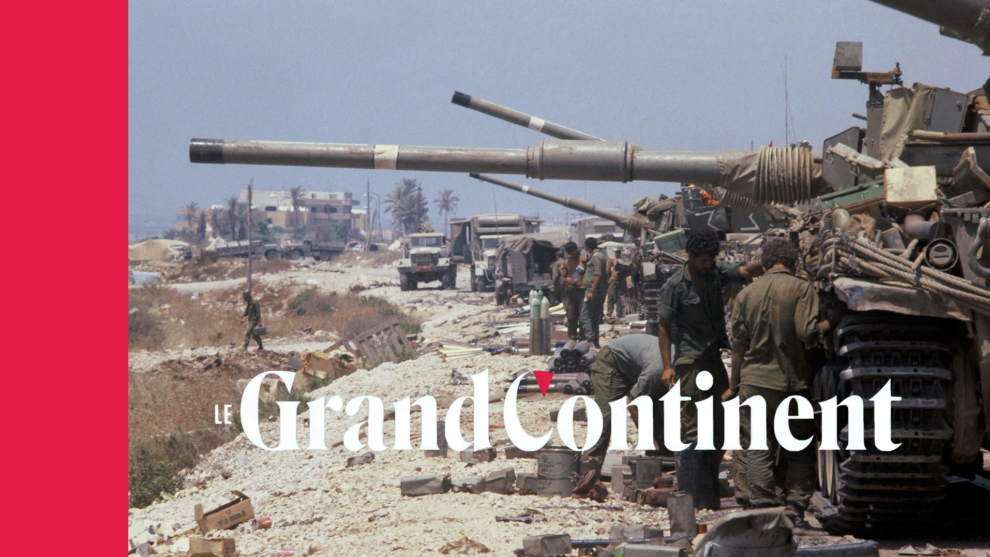
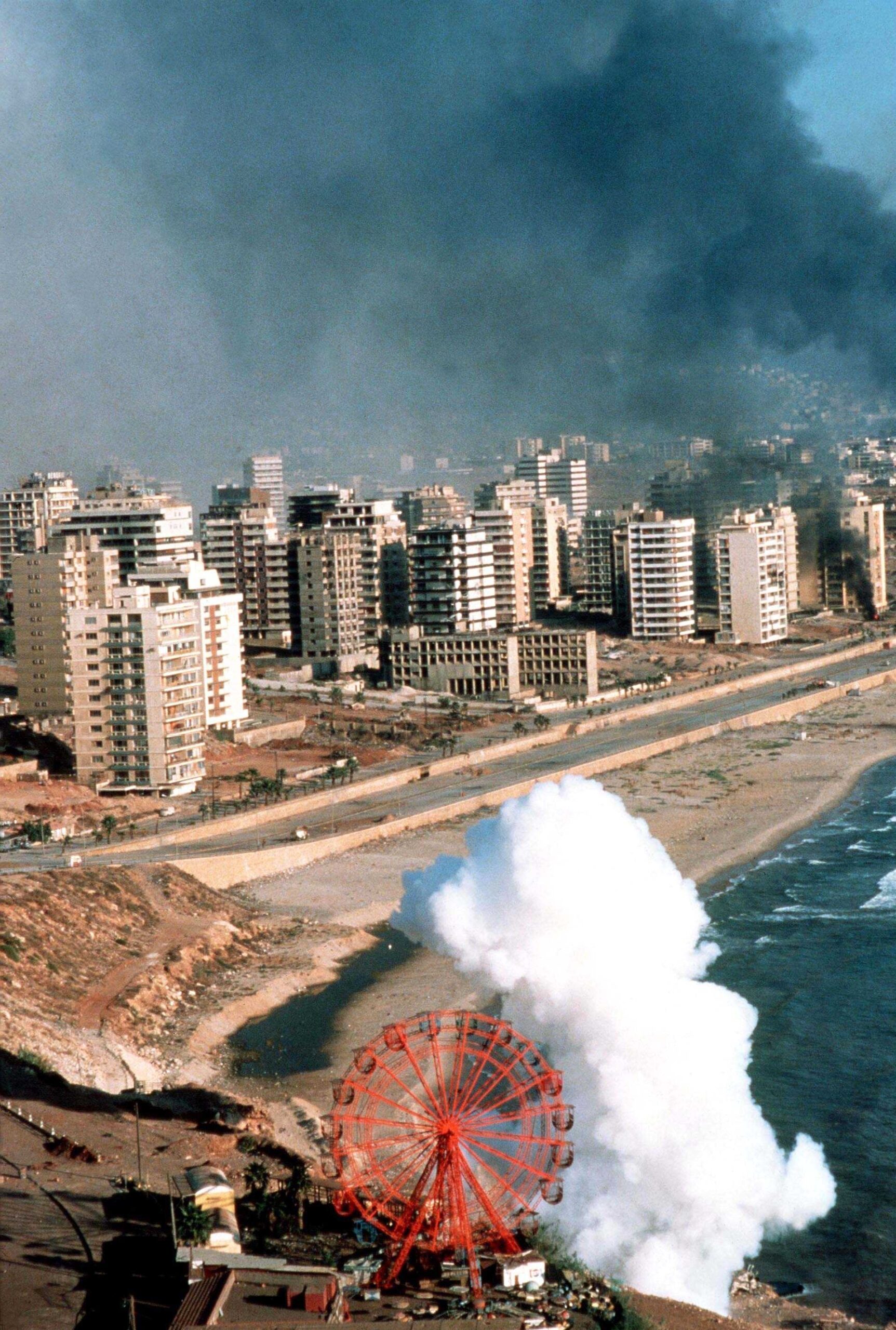
I launched my project in 2022 and, after a year spent rummaging through archives and tracing the broad outlines of this narrative, it became evident, by the summer of 2023, that one could not fully understand Iran’s ascent to hegemonic power without reconstructing the whole context that led to Israel’s 1982 invasion. With this operation, nicknamed “Peace for Galilee,” Israel plunged into Arab territory as deeply as ever; for the first time, it besieged and bombarded an Arab capital in a sustained fashion, including carpet bombs – the invasion left roughly 17,000 dead. After that, everything seemed permitted, from Beirut to Jenin, then to Gaza.
The objective at the time was not only to expel Palestinian fighters who used southern Lebanon as a base to fire rockets at Israel, but also to put the pro-Soviet Syrian regime of Hafez al-Assad back in its place, to install a friendly power in Beirut, and to sign a peace agreement with Lebanon. Defense Minister Ariel Sharon hoped this would inaugurate an era of Israeli supremacy and bury the Palestinian cause, whose leaders were sent into exile in Tunis. For a few weeks, things seemed to be proceeding as planned.
But the summer of 1982 was about to mark a decisive turning point for the United States, Israel, and Iran.
The new hostility between the United States and Iran could have remained at the level of a rupture in diplomatic relations, sanctions, and asset freezes. Yet, as early as 1983, the name Beirut became synonymous with the first large-scale bombing attack against American targets in the Middle East. In the rubble of the American embassy and the Marine barracks, as well as in that of the Drakkar building housing French paratroopers in Beirut, Iran’s hatred of the United States and the West took a decisively violent turn.
Hezbollah would likely have emerged even without the Israeli invasion, but it would not have become such a powerful force without it. Khomeini had long championed the Palestinian cause, an Arab cause, to confer legitimacy and reach to his revolution beyond Iran’s borders and the Shiite community. The Israeli invasion of Lebanon and the arrival of the Marines transformed this into an operational opportunity. The Islamic Republic and its Shiite followers in Lebanon could now confront their enemy face to face and anchor themselves to the logic of resistance. Iran’s anti-American program became inseparable from its anti-Israeli campaign – both finding echo in the Arab and Muslim worlds.
Kerr, Seurat, Kassir
Malcolm Kerr, a leading Middle East scholar, had issued this warning in 1977, just after Egyptian President Anwar el-Sadat’s surprise visit to Jerusalem: “Because of the connotation of injustice and shame [linked to the dispossession of the Palestinians], so overwhelming in their eyes, the Arabs have never been able to abandon this question. Because it challenges the very foundation of Israel’s creation, the Israelis have never been able to face it.”
Kerr was born and raised on the campus of the American University of Beirut (AUB); his parents had come to the Middle East just after World War I and settled in Lebanon in 1925 to teach at the AUB. The Kerrs formed a family of intellectuals and humanitarians, in the tradition of American teachers and missionaries who had been coming to the Middle East since the late 19th century. Kerr was capable of hearing the viewpoints of all sides and to be just as critical of each. Though deeply attached to the Palestinian cause, he also counted friends and former students in Israel. While living and teaching in Egypt, he had visited Jerusalem and Tel Aviv, traveling by road from Cairo as soon as peace accords had opened borders. By the end of the summer of 1982, Kerr, fluent in Arabic, was living in Lebanon, where he chaired the AUB, a mission he had accepted despite the dangers, out of devotion to the university and to the country. Barely a year and a half after taking office, he was assassinated on campus – the first targeted political assassination of a prominent figure carried out by Iran-backed auxiliaries in Lebanon. His love for the region and his support for the Palestinian cause did not shield him from those who wanted to reduce America to the figure of the enemy. Reconstructing the reasons for this assassination and identifying its author forms the through-line of the investigation conducted in The Best Kind of American. Another thread that emerged during my investigation of the assassination was the indispensable acquiescence of Hafez al-Assad’s regime in Syria.
As a key actor enabling the Islamic Republic to take root in the Mediterranean, the Syrian dictator Hafez al-Assad is often forgotten when recounting how Beirut became a bloody theater for the United States in the 1980s. He regarded Lebanon as his fief, kept thousands of soldiers on his neighbor’s soil, and used his Lebanese allies and their militias, among which the nascent Hezbollah, to thwart American and Israeli plans in Lebanon. Few writings have dealt with the tacit yet crucial permission granted by Assad, without which the IRGC would not have been able to operate in Lebanon, to run training camps in the Bekaa Valley, east of the country, to create Hezbollah, and to sponsor the hostage-takings and hijackings carried out by this group during that period. Assad was then the principal partner in this enterprise, keeping Tehran on a leash in Lebanon. Iran’s on-the-ground involvement offered Assad the possibility of plausible deniability in his dealings with the West. Among those who understood early the role of Assad in this joint project was the political scientist Michel Seurat, taken hostage in Lebanon in May 1985. Seurat, who wrote under a pseudonym, described the Assad regime as an “State of Barbarity” – the phrase became famous – and paid the price, dying in captivity. He became a victim not only of his captors, who did not release him even when he was gravely ill, but also of the electoral calculations in Paris during the 1986 legislative elections, which delayed negotiations for the release of French hostages held in Lebanon, among them him. Like Kerr, Seurat disturbed not only the Assad regime with his writings, even if anonymous, but also Iran and its allied militias in Lebanon with his role as a link between the Arab world and the West.
Two decades later, Samir Kassir, a Lebanese-Palestinian leftist intellectual and journalist, would also pay the price for his sharp critiques of Assad’s regime. Kassir had long understood the importance of liberating Syria from Assad’s dictatorship and Lebanon from Syrian occupation, even if he had not yet grasped the dangers tied to Iran’s ascent. Kassir was harassed and threatened by the intelligence services for years, but he never yielded – until he was killed in a car bombing in Beirut in 2005. Kassir was lucid about the treachery of the Assad regime and did not let himself be misled by its anti-imperialist and pro-Palestinian stances. He never censored his criticisms of Damascus in the name of solidarity with the Palestinian cause. He had advanced a triad without which the region could not prosper: democracy for Syria, independence for Lebanon, and freedom for Palestine. Far from being an absolutist or exclusive slogan, it was a call for serious negotiations between Israelis and Palestinians that would bring peace and, above all, a life free from fear for both sides.
Today, Syria is finally freed from Assad’s dictatorship, even though it is far from a democracy – but, at least, as President Emmanuel Macron declared in December 2024: “The State of Barbarity has fallen.” Lebanon, too, has been freed from Damascus’s grip, though Iran’s influence, via Hezbollah, persists. Nevertheless, the fall of Assad’s regime in December 2024 delivered a devastating blow to the architecture that the Islamic Republic had patiently built over four decades, a strike whose regional impact remains underestimated. If some of the dynamics rooted in the 1980s unwind, others continue to hold the Middle East hostage.
Since Hamas’s massacre on October 7 and the start of Israel’s devastating offensive against Gaza, echoes of 1982 resonate everywhere.
Besides similar remarks about the deprivation of water, food, and supplies inflicted on Beirut yesterday and on Gaza today, Prime Minister Benjamin Netanyahu promised that the war “would change the Middle East,” just as Sharon had promised in 1982 that the invasion would reshape the region.
Netanyahu, who was Israel’s deputy ambassador to the United States in 1982, wrote in December of that year in the Washington Post that after the “recent Israeli victory in Lebanon,” Israel should preserve military control over the West Bank to guarantee its long-term security. Israel’s tactical victory in 1982 turned into a strategic misstep, but that did not stop Netanyahu from pursuing what he saw as the unfinished task of that era.
The day after the launch of Epic Fury and the assassination of Supreme Leader Ali Khamenei, Netanyahu triumphantly declared that this military campaign was what he had aspired to do “for forty years.”
Israel and Iran, Two Mirrored Obsessions
For reasons that are historically very different, the Islamic Republic of Iran and Israel feel surrounded by enemies and have vowed never again to be vulnerable to invasion or external attack. For Iran, the scars of the devastating Iran-Iraq War, which also unfolded in the 1980s and during which the United States and much of the West supported Saddam Hussein, have firmly shaped Tehran’s psyche and, for decades, its regional policy. In response to this sense of encirclement, it developed a strategy of forward-based defense, first in Lebanon, then in Iraq when the American invasion of 2003 conveniently removed Saddam Hussein, and finally in Syria. Where Tehran once boasted of controlling four Arab capitals, Netanyahu speaks of prevailing on seven fronts, while the Israeli army pursues a policy of buffer zones made uninhabitable around Israel, from Gaza to southern Lebanon and the Golan Heights.
As Israel and Iran confront each other in an endless war, neither offers a constructive way forward for the future nor a viable vision for its neighbors – or for its own people. But they share another trait: “Neither believes in a two-state solution.” That was the blunt statement by Iran’s foreign minister, Hossein Amir-Abdollahian, in December 2023, five months before he died in a helicopter accident. Some will see in it proof of the regime’s intent to eliminate Israel. In reality, it is a confession: the Islamic Republic has never given real support to the Palestinians beyond lip service.
Today, among those who observe or analyze the Middle East, many tend to treat the protagonists and their behavior in isolation. Some argue that all problems stem from Israel’s occupation of the Palestinian territories and its refusal to allow the creation of a Palestinian state, to which one adds its regional belligerence, all with American backing. Too often, out of anti-imperialist reflex, they willingly overlook or excuse the region’s horrors inflicted by anti-American powers such as Iran, Hezbollah, the Houthis, or, until recently, the Assad regime. Others focus exclusively on Iran’s repressive, expansionist project, as well as the militias it has deployed for years to shield itself with a “circle of fire.” They point to 1979 as the root cause of all regional instability and claim that a change of regime in Iran would suffice. But they deliberately disregard history: when Israel invaded Lebanon, Iran was not yet a threat.
Yet these two questions have become inextricably linked over time. The Palestinian cause remains at the heart of the Arab psyche, as Kerr noted in 1977, and the horrors and devastation of Gaza make it ever more urgent. Kerr added, with remarkable prescience, that “the efforts of either side to bury or evade the issue are always suspect. It is the common curse of all the parties involved, including the Palestinians themselves. It is the main reason why separate (Arab-Israeli) agreements in the Israeli-Arab conflict risk dissolving.”
Yet peace between Egypt and Israel has endured, thanks to the massive flow of American dollars in military and economic aid, just as the Jordanian-Israeli peace treaty did, which benefited from a similar stream of American aid. If the Abraham Accords of 2020 remain in force, Hamas’s calculus behind the October 7 atrocities partly aimed to counter normalization efforts between Saudi Arabia and Israel.
The Kassir triad still lacks an answer to the Palestinian wound; but extending it today makes it equally clear that without change in Iran itself, the region can advance only partially – and that change requires freedom for the Iranian people, a freedom that can only come from within. The path has been long and painful for the Iranian people, now caught between their repressive regime and the American-Israeli war machine, under a American president who remains unable to define the objective and strategy of the war he helped trigger.
Israelis, for their part, indeed have the freedom to choose their future leaders and their place in the region, far from Benjamin Netanyahu’s belligerence and his far-right allies, who failed to deliver the security they promised – and they handed him a rebuke in the recent elections. It remains to be seen whether Gadi Eisenkot, a former army chief, can form a government with the support of Arab parties in the Knesset and choose to break with this new security doctrine of perpetual war, to give diplomacy with the Palestinians and the Arab world a chance. In the meantime, Netanyahu, the outgoing prime minister, continues to campaign for a new round of war against Iran.
Faced with those in Tehran as well as in Jerusalem and Washington who conceive the region’s future only in terms of war, it is clear that in order to open a better path for this region we will need more of the clarity, empathy, and integrity that characterized Malcolm Kerr, Samir Kassir, Michel Seurat, and countless others who stayed in the shadows and paid with their lives for the region they loved and for the future they believed it deserved. Others are walking in their footsteps today, and we owe it to them to listen.