
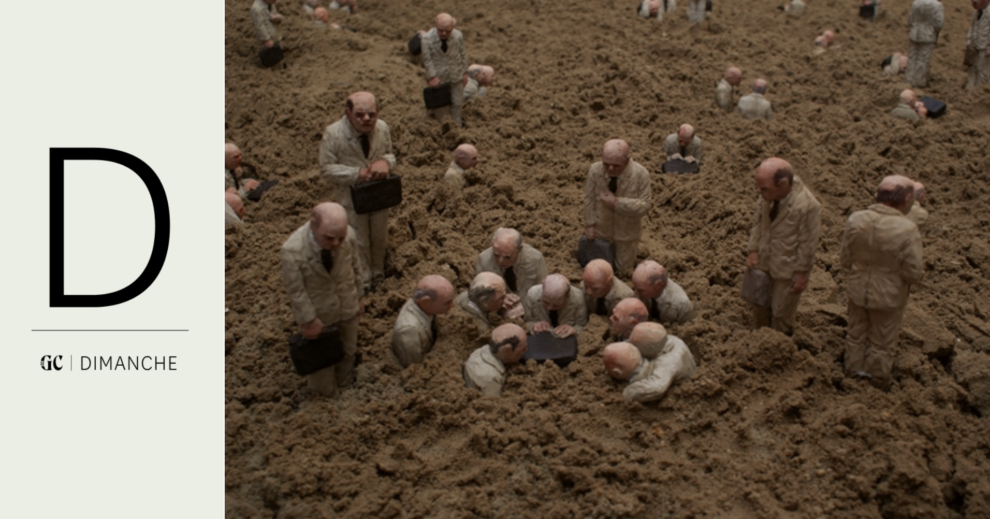
I have dedicated my entire career to science fiction. Is it because I grew up in California, with the sense that the future was sweeping over us? Since childhood, one impression has stayed with me. The world is a science fiction novel that we all write together. And, as Shelley noted in one of his finest essays, the future projects onto the present “the mirrors of gigantic shadows” — “the mirrors of the gigantic shadows which futurity casts upon the present” — which weigh heavily, especially in this era of climate change.
A Slippery Slope
Here, in a few strokes, is perhaps the most important aspect of the current climate situation. Under the influence of the El Niño phenomenon, 2027 will probably be the hottest year ever recorded. Even though it seems to fall under weather, this kind of progression is forecast almost like an eclipse, with considerable certainty. It’s not weather: it’s the climate. And given the amount of CO₂ in the atmosphere, periods of extreme heat are inevitable.
Johan Rockström, from the Potsdam Institute for Climate Impact Research, emphasizes that what is worrying, to the point of becoming genuinely dangerous, is that no one knows how close humanity is to losing control of the Earth system and tipping into a “Greenhouse Earth” scenario — a self-perpetuating, accelerating runaway.
Rockström is very clear on this point. Talking about a greenhouse runaway does not mean that the Earth would become a new Venus, because such a scenario is physically and chemically possible only on a planet much closer to the Sun. The runaway would rather lead us toward a “Greenhouse Earth,” that is, toward a climate akin to the Pliocene, or even to periods even earlier when the planet was entirely ice-free.
In other words, there could come a moment when fossil carbon released into the atmosphere produces a greenhouse effect strong enough that we face not a tipping point but a slippery slope, steepening with time. On this slope, the risk is to enter a positive feedback loop that works against us, to the extent that even if humanity were to unanimously decide (which is unlikely) to combat climate change and reverse the trend, it would not succeed. It would lack the physical capacity: neither the means nor the energy to reverse a runaway greenhouse effect once it has progressed far enough.
How far away is this loss of control of the Earth system?
No one knows. Even Johan Rockström doesn’t know. But it is approaching. And the consequences would be catastrophic. A world without ice is an extreme scenario, and it would take centuries to reach. Yet in that case, sea levels would rise by about seventy meters. Paris itself sits only about 35 meters above sea level.
One can easily imagine what that would mean: nothing less than the collapse of civilization. Not the extinction of the human species—clever and technologically advanced enough to survive such an event—but civilization itself might not survive. In any case, it would leave future generations with a world of struggle and suffering difficult to imagine. We must avoid it at all costs.
The problem is that since no one knows how close the slippery slope, the tipping point, the derailment are, we must act now as if in an emergency. There. That is what defines our era: catastrophe is too close. This threat must therefore be taken seriously, far beyond what is currently done.
Once this situation is posed, we have what the old Marxist dichotomy called the infrastructure, on which the superstructure rests — or, to take a Parisian image, the sewers, the catacombs, the entire underground network.
It is the fundamental physical reality, the one that conditions everything that unfolds culturally. Indeed, education, science, culture, and society at large rest on a physical substrate: material reality, Earth’s geophysical and biological systems. It does not matter if some challenge it or deny it.
Reality is reality: it does not disappear when you stop believing in it. Once pretenses are abandoned, once denial is set aside, once appearances fall away, it remains there, and we must face it.
That is the political problem of our era: convincing enough citizens that humanity faces a kind of durable state of emergency that will outlast the life of anyone among us. The idea has a contradiction: we readily associate emergency or crisis with a specific moment. Yet a century of emergency is opening up, and we must get used to it. How to face it?
How to act?
The current political system rests on a bundle of nation-states, a construction inherited from the seventeenth century and the Westphalian treaties, where each is sovereign on its own territory.
The economic system is, for its part, globalized late-stage liberal capitalism. It governs the world with an iron hand according to a single law: profit, i.e., the highest possible rate of return.
These two systems together form the contemporary political economy. They go hand in hand, yet they continually wrestle for control in a standing fight: the state, finance, corporations, the government.
None of the components of this dual system are well suited to a global geological-biological problem. This problem cannot be solved within the scope of a single nation, nor under the current rules of capitalism.
A World of Promises
What to do, then?
There exists the regime of international treaties. In each country, people are entrusted with dealing with the rest of the world: diplomats, officials of all sorts of governance bodies. There are the United Nations, of course, but also the World Trade Organization, the International Maritime Organization, the OECD, and many other treaty-derived organizations. All rest on mutual trust and on promises that states make to one another, like marriage vows. They commit to doing certain things, but they are only promises. A promise can be broken. You can divorce, and no one will throw you in prison. A system of mutual promises thus requires trust among its members.
From this arises an evolution, and an interesting possibility: when nation-states become member states, sovereignty is altered, since each nation cedes part of its sovereignty to a broader organization.
The European Union is a remarkable example. This governance experiment is of immense importance in world history, even if this assessment may seem depressing given how divided and pessimistic the Union can feel for its current members. Yet it must be repeated: it represents a crucial milestone in human history. There can also exist something less integrated than the Union, which extends the European logic to other international organizations, collaborative and voluntary, to which one freely subscribes.
That is where the word “promises” comes from. Mary Robinson, who was President of Ireland and then United Nations High Commissioner for Human Rights at the turn of the century, once challenged it. A jurist, and a formidable one, she objected: “I don’t like that word, ‘promises.’ They are binding legal obligations.”
It’s hard not to smile, because these obligations are not as binding as they might seem. Her courage, or stubbornness, in arguing that a binding legal obligation is far more than a simple promise, commands admiration. Up to each person to see it that way. But in reality, there is neither police, nor prison, nor even fines.
Even the World Trade Organization, the most powerful international organization, meant to levy penalties for violations of its rules, actually had little bite: its “teeth” were only baby teeth, and they have since been pulled. For individuals as well as nations can break their promises, and one returns to a state of war of all against all: each nation-state defends its own interests, in the manner of a tribe. “I stay loyal to my tribe. I defend my tribe.” It’s a primitive reflex dating back to the Paleolithic: you can trust only your tribe. And even then, only your family. And ultimately, to no one.
Trust must therefore be built. It’s true that, in human history, trust has sometimes extended to the international scale. It’s rare. It happened in 1945, with the UN, an experiment launched in the wake of the catastrophe of World War II, with its massive destruction and countless deaths, to declare: “We must find a better way. Then let us make promises.”
That is the tool we have to move forward. It is impossible to devise a new system that goes beyond promises — a kind of global police state straight out of H. G. Wells’s utopian novels. Those novels remain masterpieces of literature, the work of a stubborn man who, from 1905 to 1945, kept writing positive futures. It is this kind of stubbornness that we need.
The planet today houses 8 billion people. It is a governance achievement, founded on mutual trust among these 8 billion individuals. But it is also a scientific achievement: what English speakers sometimes call STEM—science, technology, engineering, and mathematics, with the “M” sometimes covering medicine as well. Science arose from a utopian attempt to reduce suffering.
The scientific enterprise rests on a nearly Buddhist foundation, dating back to Galileo and even to the Paleolithic: understand how the world works, then act upon it once understood, to create a world where humans suffer less, are healthier, and live longer. Medicine occupies a central place in the entire history of science.
Today, the STEM fields have created the material conditions — the substrate, the infrastructure — that allow us to nourish and sustain eight billion people, though not always perfectly, and to keep them alive for varying lengths of time. It’s worth remembering that this is almost a surreal feat, both technologically and collectively. The planet itself isn’t naturally equipped to meet such demands. It’s also a makeshift, a Babel tower, a tower of prostheses invented by humanity, at the top of which we live. And this tower is as precarious as the image suggests. Nothing guarantees that it will function. It is a continuous improvisation of human cooperation, from individuals to groups, then to nation-states, and up to the international level.
Those who deny science know, deep down, that they are lying. Proof: when they fear for their lives, when they fear dying, they turn to a scientist, namely their doctor. The pandemic proved it. A climate-skeptic, a foolish politician who somehow ends up leading an entire country, will say: “Oh, I don’t believe in science,” and then, at the slightest throat ache or the mildest dizziness, will rush to a scientist begging: “Save me.” In fact, trust in science is widespread.
How can we rely on this trust to carry it from the individual scale to the collective scale? When the doctor says: “I’ve taken your temperature, you have a fever, you must take this medicine now, otherwise you risk dying. We must bring the fever down to treat the underlying problem,” the individual replies: “Very well, give me the medicine.” But what about nation-states? Societies? How to make this leap — a metaphorical leap, a leap of imagination — from the individual to the group, then to the planet?
All Authors of Science Fiction
That is where utopia and dystopia come into play.
Each person is the science fiction author of their own life. In other words, everyone contemplates their own future: “If I do this, my future will be favorable. If I study hard, I’ll land a job that will allow me to provide for myself, even in the precariousness that is the lot of almost everyone on this planet. I might meet someone who will share my life.”
If each person carries a utopian imagination, then implements it in the present, each also carries a dystopian imagination at another moment of the day, or at another time in life.
In the middle of the night, you wake up, you worry. Certain brain chemicals are missing, which makes you somewhat irrational. It’s better not to listen to yourself between 2 a.m. and 6 a.m. The reasons for worry are real: money, health, and so much more. So everyone is a dystopian science fiction author when thinking about the future, and a utopian science fiction author at other times or in other stages of life.
Writing science fiction, in this sense, is innate and natural. It is part of the human condition. It is our way of thinking. It is what distinguishes humans from perhaps luckier relatives—the animals, dogs, wild animals—who seem deeply anchored in the present, without a deep sense of the future.
This is not humanity’s lot, which constantly prepares its future actions. Thus, a long narrative, a novel whose action unfolds in the future, will take a utopian or dystopian turn, or perhaps blend both, as reality blends them. Nothing there is unfamiliar.
Everyone tells stories. But most of them—from what we tell each other at a restaurant—if written down, would be only two pages, five if the teller feels expansive. And 600-page stories? They belong to a specific art, where a multitude of stories weave together and unfold over time to form something larger: the novel.
The novel has the remarkable feature of enabling two aspects worthy of science fiction that usually do not occur in real life. The first is telepathy: being inside someone else’s mind. Everyone dreams of it. It never truly happens. You don’t know what others think, not even your own partner, sitting beside you at night. But in a novel, you suddenly inhabit a character’s mind, and you see them think. It’s a kind of miracle: “Finally, I’m grasping someone else’s thoughts, as if I had telepathic powers!” The second is time travel. You’re suddenly immersed in a collapsing Roman Empire, or on the moons of Jupiter, where going out is dangerous. You travel through space and time, to other moments in human history, and you discover what they were like. All of this is possible thanks to imagination: mere black marks on a page, and in the reader’s head, events unfold.
A distinction must be made here. In cinema, a film hits the viewer full force. The viewer is a witness: the experience can be traumatic, it can be exhilarating, but it remains a witness. A novel reader, by contrast, co-creates it: it is up to their own imagination to give it life. Not all humans have this capacity. Many admit: “I don’t read novels. They don’t speak to me. It’s only a long string of lies. Why waste time?” Everyone is hooked on stories, but not everyone reads novels. For those who do engage, however, reading a novel becomes a genuine gift: living a thousand lives in a single existence. With sufficiently powerful imagination, one leaves a novel with these experiences in mind, as if one had lived them, after slipping into someone else’s mind. And this is a well-known philosophical, psychological, and everyday-life question: what does another’s experience actually look like? Since one can never truly live it, one can imagine it by reading novels, and tell oneself: “There, now I know what it is.”
A recent example: a trilogy of novels recounting the story of a young girl living in the 1930s on an island off the Norwegian coast, where subsistence life is led. As you read, that experience becomes hers: an extraordinary resilience experience. Such is the power of the novel, which deserves defense — first because it is my trade. But I defend it also as a reader: I am a reader before a writer, because my reading experiences have been so vivid. And “vivid” is the right word: these stories live inside me. Readers of novels will know what I mean.
Utopia as Process
Now suppose we choose the utopian route: to write a novel in which the next thirty years go well, but credibly, without miracles or magic, simply making a way, perhaps with difficulty, toward a better future. Something that could happen. The reader of this novel never thinks, “I don’t believe it. It will never happen.” They believe it at every moment; and yet, after 500 pages covering thirty years, things have turned out well. They can close the book and say: “My individual efforts will not be enough. I am only a brick in a wall that contains 8 billion bricks. But the wall stands, and I can shoulder my share of the burden.”
That is why it matters to write utopian science fiction, and also to read it. This is the project of The Ministry for the Future, after several other utopian novels: a constant commitment throughout a career. Masters like Ursula K. Le Guin, friends like the Scottish writer Iain M. Banks opened the way: they were utopians, wondrous beings, and their books will endure.
There is also a literary utopia tradition marked by an important evolution: the idea that utopia is not a perfect place where everything goes right and nothing changes. This view stems from a misreading of Thomas More’s Utopia, or Plato’s Republic, by the way. H. G. Wells, for his part, argued that utopia is a dynamic process: the name given to a story that moves in the right direction. Then, with Ursula K. Le Guin’s The Dispossessed, one of the first great examples of a utopia that is also a great novel, by the usual standards of the genre, appears. It is within this tradition that The Ministry for the Future sits.
In the novel, the Ministry is an organ of the United Nations, established under the Paris Agreement. That agreement indeed provides that the Conference of the Parties may, if it wishes, create permanent subsidiary organs that operate year-round. This “Ministry of the Future” is therefore, in a way, authorized by the Paris Agreement, and it is from there that the story unfolds. The book has, incidentally, enjoyed a certain reception at the UN, for a reason that is obvious: the UN saves the world there. The scenario may not seem very plausible, especially right now. And yet, as noted above, what other option exists? A set of promises carried by the UN and many other international organizations on a voluntary basis and without compulsion. The UN is, in this sense, a model of what the world needs today. It cannot possibly achieve it alone: it will require international agreements across the board to make it possible.
Some national leaders engage, in a sense, in a game, what science fiction would call “cosplay,” a dressing-up game. They play the role of heads of state without knowing what they are doing: they are merely simulating. Some even stage a genuine Götterdämmerung, a twilight of the gods: since they must die, they want the entire world to die with them. A form of narcissism. In this context, the UN plays the role of the adults who must tidy up after the children. This is especially true of its emergency services. Children dressed as giants roam about, pretending to rule the world, with no real seriousness. They do not even try to do well. The current U.S. government is, of course, a primary target. But the horror of this “cosplay” is that death is real: even if they pretend, people die, and it then falls to the UN to repair the damage. In that sense, when reality asserts itself, the UN becomes more important than ever.