
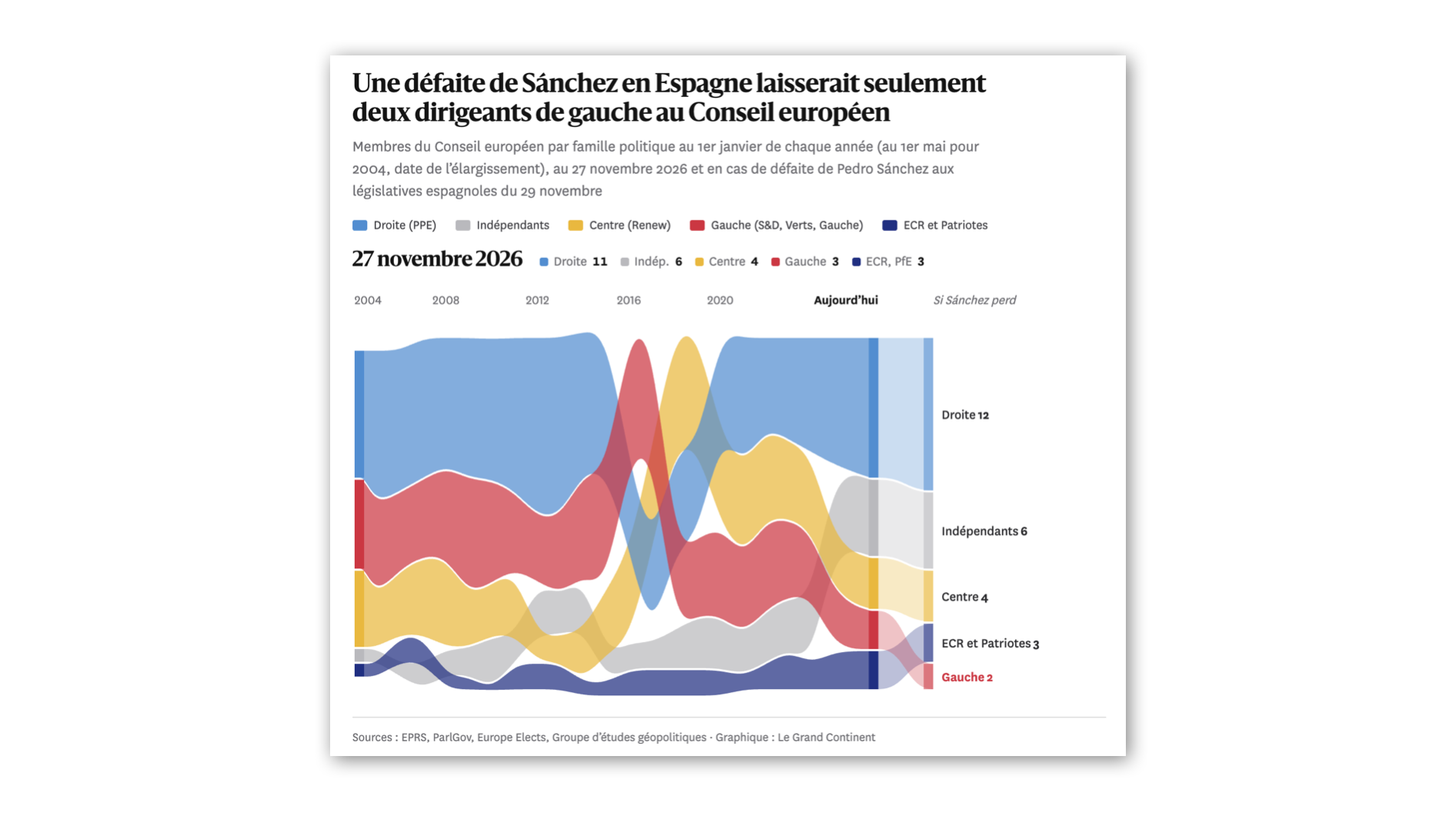
According to polls, the Spanish Prime Minister Pedro Sánchez could lose power after the general elections on November 29. The possible ascent to power of the leader of the Popular Party (PP), Alberto Núñez Feijóo, would leave only two leaders from left-wing parties on the Council — their lowest level since at least 2004.
- The latest poll aggregations place the PP at the head of voting intentions, around 31%, about 4 points ahead of Sánchez’s PSOE (27%).
- According to the latest Cluster 17 survey, conducted from November 10 to 13, a coalition pairing the PP with Vox could muster 190 seats, 14 above the absolute majority threshold in the Congress of Deputies.
- This scenario rests on a substantial electoral breakthrough by Vox, which would be able to obtain 18.4% of the votes – compared with 12.4% in the 2023 elections – notably thanks to strong support from young voters aged 18 to 24.
Among the 27 leaders currently sitting in the Council, only three come from left-wing formations: Pedro Sánchez, Mette Frederiksen of Denmark (Social Democrats) and Robert Abela of Malta (Labour Party).
- It is the leaders from right-wing formations, grouped within the European People’s Party (EPP), who are in power in the greatest number of EU countries: 11, as of November 27.
- Next come the independents – Radev in Bulgaria, Christodoulides in Cyprus, Kulbergs in Latvia, Nausėda in Lithuania, Dan in Romania and Fico in Slovakia –, followed by the Renew liberals: Michal in Estonia, Macron in France, Martin in Ireland and Jetten in the Netherlands.
- Three leaders hail from parties to the right of the EPP’s mainstream: Meloni in Italy, De Wever in Belgium and Babiš in the Czech Republic.
The electoral cycle opening up in the Union, with elections scheduled for 2027 in France (in April), in Poland and Italy (by the end of 2017), but also in Estonia, Finland, Slovakia and Greece, could profoundly alter the bloc’s political balances.
- If the candidates and parties currently leading the polls win these elections, the far right would win France with the National Rally, replacing Renew.
- The right would take Estonia with Isamaa (PPE), at Renew’s expense, but would lose Finland to the Social Democrats.
- Renew would win Slovakia with Progressive Slovakia, replacing Robert Fico. Greece would keep its current leader, as would Poland and Italy if the outgoing coalitions prevail.
The European left could, for its part, regain a seat on the Council: in Finland, the Social Democrats lead the polls. In Denmark, Frederiksen’s party topped the latest March 2026 elections, but with its lowest share in more than a century (21.9%).