
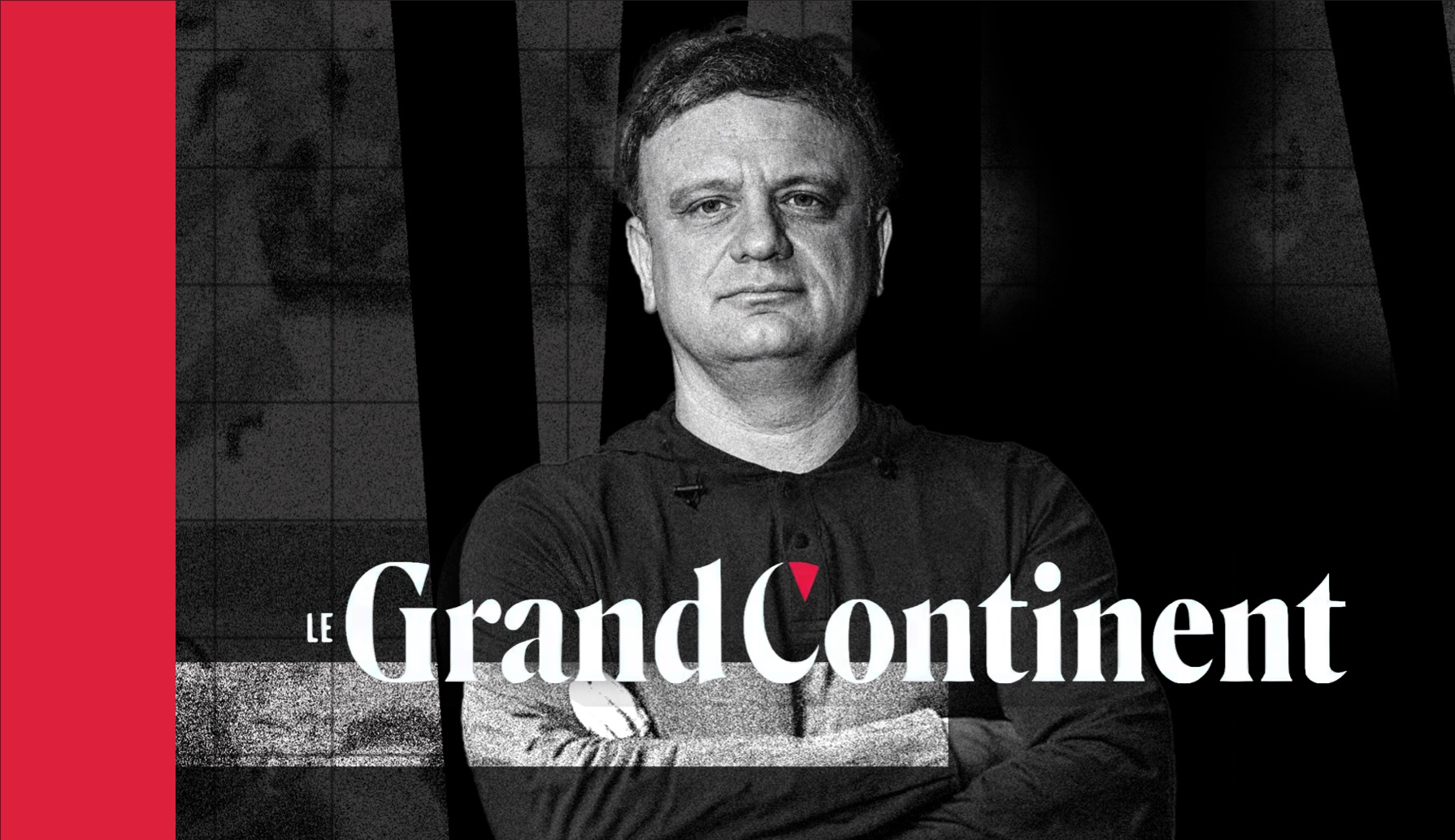
Test the Grand Continent. The ideas and analyses you won’t find anywhere else. But you’ll see them everywhere soon. In your inbox from 8 euros per month
Restaurant “Frida,” Plaza de la Memoria Trans, in Madrid’s “Chueca” district. An incongruous place for an interview with Miguel Ángel Quintana Paz this Friday, November 20. “Frida” nods to Frida Kahlo, the Mexican artist, feminist icon, bisexual and Mexican communist activist; the Plaza de la Memoria Trans, with LGBT demands; and Chueca as Madrid’s gay quarter. Odd symbols and an astonishing meeting place for a man who has made “wokism” an existential fight.
Miguel Ángel Quintana Paz has a taste for transgression. Being at Frida amuses him. He is one of the reference intellectuals for Vox, the far-right party that could enter government, aided by an early dissolution, a high-stakes move by the socialist leader, and current prime minister, Pedro Sánchez. The elections take place this Sunday, November 29, and polls at this stage foresee a victory for the People’s Party that would ally with Vox’s far-right wing. A first, if confirmed.
Purple shirt, hair in grayish curls beginning to lighten, is Quintana Paz Iago or Prospero? Brutus or the fool in King Lear? Or simply—and more in the local color—a kind of Don Quixote of politics? Ah, what a strange character sits in this Madrid restaurant, facing me.
Miguel Ángel Quintana Paz has an obsidional mindset. This is not the first time I have been struck by his constant sense of being besieged, surrounded, or threatened by external enemies, real or imaginary. His obsessions accumulate and, clustering like beads on a rosary, eventually sketch a frightening world that inevitably verges on paranoia.
The enemies are clearly identified: the “globalists,” the elites, Europe’s “technocratic” glare, and, therefore, “wokeness” (the word comes up dozens of times in our exchanges). He also cites George Soros—a recurring target of European far-right conspiracy theories.
A Weak, Volatile European and Foreign Policy
Vox is a far-right party, nationalist, eurosceptic, anti-immigration, anti-environmentalist, and anti-feminist. It can be roughly situated to the right of the National Rally and even to the right of Giorgia Meloni’s Fratelli d’Italia, yet it appears more moderate, in some respects, than Germany’s AfD. Some historians label it neo-Francoist or post-Francoist; others, pointing to its singularity, prefer not to subscribe to that lineage.
In the European Parliament, Vox is still finding its place. The center-right European People’s Party is more divided than ever into three groups: the “European Conservatives and Reformists” that include, for instance, Meloni’s Fratelli d’Italia or Marion Maréchal’s Identité et Libertés; the “Patriots for Europe” group that gathers the National Rally, Matteo Salvini’s Lega, and Viktor Orbán’s Fidesz; and finally “Europe of Sovereign Nations” where Germany’s AfD and Reconquista! led by Sarah Knafo and Éric Zemmour reside. Vox joined the “Patriots for Europe” but in practice is sometimes closer to Meloni’s party or to Marion Maréchal’s group. And tensions run high. Nearly all claim to defend Europe—the broad Europe, the European idea, the “Civilization”—against the European Union. Yet the nationalism that powers the far-right at home deeply divides them at the European level. To the point that they do not always vote together and are split among three irreconcilable factions.
During our conversations, Quintana Paz opens up and shares confidences that have not leaked to the press. Santiago Abascal, Vox’s leader and possible future Spanish vice-president, allegedly hosted Marine Le Pen for a soirée at his home during her last visit. The same for Giorgia Meloni. “Meloni and Abascal are close friends. She stays at his place when she comes to Spain, and she speaks Spanish because she did Erasmus here,” he tells me.
Quintana Paz himself maintains a privileged relationship with Marion Maréchal Le Pen, with whom he exchanges in Italian. He has taken charge of the Spanish branch of her school, the ISSEP, which today constitutes, he confirms, his main activity and source of income. The aim is clear: facing a Spanish government technostructure beholden to the two historical parties, to the right the People’s Party, to the left the Spanish Socialist Workers’ Party (PSOE), the far-right intends to build new elites to govern. With ISSEP, Quintana Paz hopes to participate in this work of political “regeneration.”
The model for this power-grab that claims gramscian inspiration was long Hungary’s Viktor Orbán (his fall in April 2026 was a hard blow for Vox) and Donald Trump’s America. Orbán’s think tank, Mathias Corvinus Collegium (MCC), served as an ideological compass for many European far-right parties and perhaps as a cash desk. Trump’s methods proved valuable strategically, Vox maintaining active relations with Donald Trump and the MAGA movement. They remain Vox’s preferred reference, owing to the ultra-right advances of Trump’s second term, but the midterm losses are already prompting Vox to reorient toward JD Vance and a distancing from Trump’s egocentric theatrics. According to several sources, Vox is also close to Secretary of State Marco Rubio, whom Vox strategist Kiko Monasterio hosts at his home in the presence of Santiago Abascal, the party’s president. One might suppose, however, that since the Trump ship has sunk, Vox is navigating by sight and its American, love-hate vision is quite opaque.
(On China, Quintana Paz reveals that the Chinese Communist Party tried to reach out to Vox, to forge links and build bridges, but the Vox party politely refused such rapprochement for now.)
Vox’s Latin American vision is more structured. It can be summed up in one line: the aim is to save the Hispanic world from “communism”—which is another way of defending an idealized West, at the risk of embracing a certain neo-colonial attitude, advocated by Stephen Miller. Here, the far-right party sees its Latin American bloc as a perfect negative of Podemos, currently flagging in public support—latest projections suggest Podemos might only win one or two seats in the new legislature. While some Podemos members are identified with Venezuelan chavismo, and even worked for it (Juan Carlos Monedero, a Podemos veteran, confirms in an interview that he was employed by Caracas), Vox has aligned with the other camp. The far-right has forged close ties with Javier Milei in Argentina, with José Antonio Kast in Chile, and more recently with Abelardo de la Espriella in Colombia. The anti-globalist international network thrives between Vox’s Spain and these three leaders who are in power in Latin America.
(According to my information, Vox has links with the Heritage Foundation, a staunchly conservative American think tank that has drafted a plan to counter Latin American lefts.)
In Brazil, Vox naturally maintains active links with the Bolsonaro clan. But here too, communications sometimes trump ideology. The recent, embarrassing US-leak involving Brazilian candidate Flavio Bolsonaro has made engaging with the family radioactive. As for Javier Milei, when he recently visited Madrid, Vox’s Santiago Abascal chose not to meet him in person, opting for a video call, as if it were better to avoid appearing with the “chainsaw-wielding” leader to please moderate Spanish voters.
When I ask Miguel Ángel Quintana Paz to explain who Vox labels as the “communists” in Latin America against whom Vox intends to fight, he mentions Lula in Brazil, Gustavo Petro in Colombia, the sub-commandant Marcos and even AMLO and Claudia Sheinbaum in Mexico. It doesn’t take much to coax him into drawing a historical line connecting all these forces.
Vox’s international policy is driven by ideology as well as opportunities, communication, and above all “campism”: the enemy of my enemy is my friend.
Thus, with Israel: at the beginning of October, Quintana Paz visited Jerusalem to participate in the National Conservatism Conference, Nat-Con, an initiative of the Edmund Burke Foundation, organized by Israeli philosopher Yoram Hazony, a key figure in bridging Zionist far-right circles with Benjamin Netanyahu.
The Spaniard felt aligned with the Israelis for longstanding reasons and a Western solidarity, but also because the far left today embraces the Palestinian cause and has cast the Hebrew state as its enemy.
A Double Agent
During another lunch, on October 18, Miguel Ángel Quintana Paz suggests joining me at the eco-restaurant “MO de Movimiento” – yes, that’s its name – in the Ríos Rosas district, also in Madrid. Between sips of organic wine, the man talks about himself and reveals more: the philosopher, the Catholic, the gay man.
What tears him apart, what splits him, what makes the character intriguing are these disruptive elements: radical Catholicism and homosexuality. Quintana Paz pretends not to make the gay question a calling card, while knowing it is, if not a badge of anti-fascism, at least the sign of a certain nonconformity and transgression behavior. He plays with it, a bit. He openly acknowledges his sexual orientation without flamboyance or “pride,” in tandem with his Catholic faith. Difficult reconciliation?
A critical voice on Europe, Quintana Paz lived in Rome thanks to the Erasmus program. He speaks Italian and has also stayed in Turin, where his relationship—an openly heterosexual one—with Italian philosopher Gianni Vattimo, who defined himself as “communist, Catholic and gay,” was a well-known secret.
Vattimo, a major figure of postmodern thought and inspiration for the theory of “pensiero debole” (weak thinking), directed Quintana Paz’s postdoctoral research in Turin. A long intellectual and personal relationship, despite a 37-year age gap, continued until Vattimo’s death in 2023. In our interviews, Quintana Paz repeatedly pays homage to Vattimo and cites him as his “master.”
His doctoral thesis dealt with Wittgenstein, tempered by Vattimo. The young philosopher was brilliant, fluent in Spanish and Italian, and also reading German, English, and French. But in front of Vattimo, the quintessential postmodern philosopher, Quintana Paz gradually became anti-modern. The student surpassed the master, on the right.
From this background, less atypical than it seems—several far-right parties, starting with the National Rally and the AfD, count openly gay officials in high positions—Quintana Paz and I quickly lay out red lines. And when I ask if he is a “gay fascist,” he laughs and replies: “I’m a double agent: among the gays and among the fascists.” Here he almost does two coming-outs.
Vox’s discourse and Quintana Paz’s stance on women, sexuality, and gays is ascetic, constricted. Their dream of order and their hatred for anything that overflows, anything that exaggerates—Spain as it is today—turn them, at best, into boogeymen and, at worst, sour-puss scolds. How can they hope to seduce or govern a country real, so far from the fantasies they entertain? They reject the liveliness of Spaniards, the sensuality of flamenco, the gaiety of Almodóvar cinema, the raw talk of reggaetón, and above all women. “Women are the secret of Spain,” writes Michel Del Castillo in his Dictionary of Love, and this is precisely the blind spot of this anti-feminist thought in a Mediterranean country: the sexuality and vitality of women, the fatal cigarette-smokers and the Celestines, Cármenes and all those “nervous breakdown” women. Does Vox truly think it can change Spain without women? It would be a lost cause.
Same thing on the gay question where Quintana Paz spent a long time hedging, maneuvering, and navigating. He sought his bearings for a long time. A strange repression in La Mancha of Almodóvar’s Bad Education! Wokeness sums up all the party’s prohibitions and that of our man, not without recalling Jean‑Marie Le Pen’s famous line: “There may be homosexuals in the Front National, but there are no furies.”
Trans people and the LGBT movement are out. Queer activism is firmly rejected, as are all debates on the “trans” question, without regard for concrete cases or individual situations. The feminist movement, #MeToo, Greta Thunberg, the European Union, ecological politics and Black Lives Matter, among many others, are treated as enemies. They are Antichrists!
It must be said that Catholicism strongly permeates Vox’s ideology, although the Spanish episcopal conference today tends to distrust the far-right’s ideas. In the past, the conservative and “ultra” wing dominated Catholic circles in the country, around the reactionary views of cardinals Antonio María Rouco Varela and Antonio Cañizares, or the integralist bishop Juan Antonio Reig Pla. But those who tilled the soil for Vox now have faded speed. Francis’s papacy has enabled clean-up, especially under Barcelona’s archbishop, the very moderate Juan José Omella Omella, made cardinal by Francis (and president of the Spanish episcopal conference from 2000 to 2024). Leo X continues this movement of re-centering. Not to mention the sexual abuse within the Spanish Church—and particularly its ultra-branch—still largely shielded, which Francis has begun to expose and which could soon make front-page news in Spain.
When Quintana Paz presented his latest book, Things I’ve Learned From Interesting People, at the Pablo VI Foundation in 2025, Vox’s leader, Santiago Abascal, attended, and Archbishop Luis Argüello, new president of the Spanish episcopal conference, was present. Argüello also participated in the ISSEP seminars hosted by Marion Maréchal, at Quintana Paz’s invitation; but he fears a too-visible rapprochement with the far-right party. Among various disagreements, Vox’s immigration proposals clash with the papal message, both Francis’s and Leo X’s.
Geopolitics of the Iberosphere
On this strong political marker, Quintana Paz stresses Vox’s unique feature among Europe’s far-right parties. “You must be Spanish to understand. For us, the West is not the United States; it is the Iberian identity and what we call the Iberosphere in Spanish. It is about reclaiming our identity and what connects us: Latin culture, Catholicism, ties to Latin America, and, above all, the Spanish language. The Latin Americans living in the United States are our allies in this struggle. But our occidental identity is not tied to Uncle Sam: we want to escape their globalization and their Protestant influence.”
I try to understand: is he talking about the Spanish nation—but why include Latin America in this nationalism? Is he rather referring to the Spanish-speaking community, risking dissolving the very idea of Spanish nationalism? And what about Portugal and Brazil in this grand re-foundation? How to address the Spanish colonial past: an inheritance to claim or to condemn?
(Spoiler: Quintana Paz regards it as benevolent: “It was cooperation,” he tells me, and denies that Spain was ever colonialist, unlike France or England—something many historians dispute.)
The “Iberosphere” is Vox’s grand concept, and Quintana Paz tries to explain its subtleties. An idea like this existed and was disseminated within Disenso, Vox’s think tank, in which he participates, and in the journal La Gaceta de la Iberosphere, in which Quintana Paz writes.
Vox’s people call Colombians “our compatriots” but not Italians, which is surprising. Yet an immigration policy emerges: as with many European far-right parties, Vox fights Maghrebin or African immigration. This hostility to the “Moors” is now fanned in a country, which more than any other in Europe, was shaped by the Reconquista story and the harshness of Cordoba’s caliphate.
The Ceuta affair, that Spanish enclave on the Moroccan coast, at the heart of a serious migratory crisis in July 2026, is now one of the campaign’s main axes. In this way, Morocco becomes enemy number one (as Algeria often is for France). Vox, however, shows more moderation on Latin American immigration, particularly Venezuelans, Mexicans, or Cubans, victims of “communist” regimes. If Latinos work and integrate, they are generally not a problem for Vox, which confirms the party’s religious and cultural prejudices, if not their racism. The reasoning is counterintuitive: they speak Spanish. Vox therefore tries to attract them to Catalonia or the Basque Country to curb regional language autonomy projects.
Because Vox also aims to defend regionalism in Spain against left-wing parties and the People’s Party. Santiago Abascal, Vox’s president, comes from the Basque Country and grew up in a family threatened by ETA, which he accuses of being a terrorist organization. More than defending Catholicism or critiquing Europe, Vox makes Spain’s unity one of its main battles, denouncing regional autonomies—Catalan and Basque, of course, but also Galician, Navarrese, Valencian, or Canarian. Vox’s project is to slow regional autonomy and curb decentralization of powers. Central to the fight: the Spanish language.
Cultural warrior
I uttered the word that stirs: “incompetence.” Until then Quintana Paz answered questions calmly, somewhat pedantically, with rare benevolence for a far-right figure. But when I suggest that Vox’s contradictions and those of my interlocutor would not withstand power and that there was a form of populist unpreparedness, Quintana Paz becomes angry. This usually composed man now has hot blood. He raises his voice, louder, more agitated. The waiter stares, and I, who had awaited this moment, begin jotting notes at a furious pace.
Incompetence? Vox’s detractors, numerous in Spanish intellectual circles and among journalists, portray it as neo-Francoist, misogynist, and national-populist. During our talks, Quintana Paz works to dismantle that image as an anti-modern philosopher.
Quintana is a great reader. He loves Solzhenitsyn’s Harvard speech since I mentioned it at a previous lunch, and he says he finds the text “remarkable.” He admires Ben Shapiro’s The Right Side of History, which defends the West—where, for Shapiro, “the West is special”—and attributes its greatness to Judeo-Christian values, opposed to modern hedonism and moral relativism.
For Quintana, the battle must be fought in the name of Western values against wokeness, punitive ecology, and using Gramsci’s ideas. He even defines himself as a “gramscián Spaniard”—if that expression makes sense. “One of my aims is to liberate the anti-woke camp in Spain from metaphysical and religious excesses,” he explains with mischief.
We also discuss a rather strange novel: José Saramago’s The Stone Raft, the Portuguese Nobel laureate and a major figure of the anti-globalization movement. Quintana Paz had not read it when we first met; he has since done his homework. “When I was young, Saramago was a communist, anti-globalization figure, and so left-wing that he eventually bored me. Perhaps that’s why I drifted away from his novel at the time,” he tells me.
Part of Saramago’s work can be read as a bitter meditation on Portuguese identity, reluctantly carried into the European Union after Salazar’s long dictatorship. For Saramago, Europe has always remained the enemy. In this respect, he merely repeats the Portuguese Communist Party’s line dictated by Moscow: European construction is a bourgeois, ultra-liberal project to be opposed at all costs.
Long before Quintana and Vox thought of it, Saramago imagined the Iberian Peninsula detaching itself from Europe. That was precisely the subject of The Stone Raft, an allegorical fresco published in 1986: Portugal and Spain literally sail away from the European continent toward Brazil and Africa, while Europe sinks.
The metaphor is clear: Saramago feared Portuguese identity would dissolve in Europe. The writer would express this even more explicitly in an article: “Spain and Portugal have nothing to do with Europe.” This communitarian idea oddly aligns with Salazar’s dictatorship, with Portugal’s Chega party, and with Vox’s Iberosphere project. Yet Saramago stayed left-wing, aspiring to be the Portuguese voice of the anti-globalization movement and what later would be called the Global South, unlike Quintana Paz.
Regime Change
Certain Iberian far-right themes overlap strikingly with those of Portugal’s and Spain’s communist parties or Podemos’s radical left: hostility toward Europe, rejection of liberalism and political pluralism, mistrust of NATO, and fierce critique of mainstream media. In short: radical anti-globalism. These themes are also taken up by Putin and seep into Vox’s ideology. Some right-wing intellectuals on the Spanish far right continue to watch with interest Russia’s battles in the name of Christian Western values.
The back-and-forth between the far right and radical left makes the ideological ground feel prepped as if some European communist parties long prepared it for the far right. I remark this to Quintana Paz, who is surprised: “We do not share the same values or view of the West as the communists. As for Podemos, they do not love Spain. They do not believe in the Nation or in the West. They believe in feminists, in Basques, in Catalans, in trans people… We believe in Spain.”
Our man has studied Nietzsche and Heidegger so much that he is not exactly a philanthropist. Has he read too many political books to understand politics? After spending a lot of time trying to understand him, I better grasp the character’s uniqueness, his folly, and the scope of his delusion. His critics accuse Miguel Ángel Quintana Paz of harboring resentment. Perhaps. But he is mainly on the verge of great disillusionments.
His problem, in my view, is not so much the idealization of the past as the idealization of the future. And the gap opens wide. It is the famous rift between theory and practice, ideas and power, the scholar and the political. His proposals and Vox’s are so impractical in contemporary Spain that they could only fail if they came to power on November 29. I tell him so. He senses it. But he refuses to imagine it.
Quintana Paz is an ideologue somewhat lost. He believes politics is about ideas. So he sometimes moderates his language and tells me, naïvely, without gauging the thread of the anecdote, that when he prepares an article or a speech, inherently too radical, he has it corrected by an AI, asking it to tone down his words: the AI tames his rage!
Dreaming of crusades, obsessed with the past and with his biases, Quintana Paz imagines expeditions and expulsion decrees—without seeing that these two movements are inherently contradictory. A Don Quixote-like solitary figure, he has mounted his own Rossinante, a mount named Vox, to reconcile his dreams with reality. But in power, his ideas will not make any dent. He senses that. And indeed, Quintana Paz tells me he would prefer Vox not to enter government in coalition with the People’s Party. He would rather wait for an absolute majority, perhaps to postpone the day of his misfortune: disenchantment.
Let’s begin with your role and your work. How do you situate yourself in the Vox galaxy? Some call you “the Vox intellectual.”
I am indeed, in a way, what you’d call an “intellectual”—even in the pejorative sense of the word. I am not a politician. I am close to the Vox party but I am not its strategic advisor, nor its ideologue, nor its official adviser. That is more the job of Kiko Méndez-Monasterio, who is, in a sense, Santiago Abascal’s strategic adviser. He’s an excellent adviser and my friend. But that is not my role.
What is your role then?
I am the academic director of ISSEP in Madrid.
And with regard to Vox?
To explain my role, I often compare it to my father’s occupation. He was a trader, a wholesaler of stationery, selling supplies to bookstores: paper, ink, pens, all sorts of products. But was my father responsible for what people wrote on the paper he sold, with the ink he provided? Of course not. He simply gave them paper and ink.
And you, do you do the same?
Yes. But I do not sell paper or ink. I sell ideas.
And you sell them to them, and they do with them what they want?
Exactly. I offer ideas. Some people buy them. Others do not. Obviously, I would prefer as many people as possible to buy them, ideally everyone! That would also be excellent for me, including financially. But some people appreciate my ideas, others hate them. That suits me perfectly. It is true that the people who buy them mostly belong to Vox’s universe…
Do you sell them to Vox? Do you work for them?
I provide services, articles, to Vox, and they pay me for them. In that sense, yes, I work for them. But I am not a member of Vox. I do not belong to the party, and I do not wish to join it.
What place does Vox give to ideas and intellectual work? What is the role of the Fundación Disenso to which you contribute or the La Gaceta de la Iberosphere journal in which you write?
Vox placed emphasis on intellectual work early on, and Disenso and La Gaceta play that role. Among Spanish political parties, I do not think there is another that gives so much room to intellectual labor. This work also involves collaboration with other Latin American parties, leaders like Javier Milei in Argentina, José Antonio Kast in Chile, and more recently Abelardo de la Espriella in Colombia.
These two missions, domestic and international, complement each other particularly well. To establish political relations with parties across the Atlantic, you must rely on new ideas that can create convergence and allow a new synthesis.
La Gaceta de la Iberosphere, Vox’s journal, includes the term “Iberosphere” in its name. Why emphasize “Ibero-sphere” or “Iberian America” rather than “Latin America”?
In Spain, the term “Latin America” is often seen as somewhat misleading, even historically inaccurate. We speak of “Latin America,” while in reality, no one spoke Latin in the Americas. The main cultural influence over this vast space—from the Rio Grande to Patagonia and Tierra del Fuego—is mainly Spanish and Portuguese. That is why we prefer the expression “Hispano-America” or, better still, “Ibero-America.”
And that matters greatly because our sovereignist approach concerns not only the Spanish nation but also the former Spanish Empire and, more broadly, the entire cultural and linguistic space formed by Spanish- and Portuguese-speaking populations. There is a will to give this entire bloc its autonomy and its own voice, in the face of a Western world that has become overly dependent on the United States.
Intellectual Formation, Philosophy and Literature
Which authors have influenced you most? Which right-wing thinkers do you read?
At university, I first specialized in Wittgenstein’s work. I was deeply interested in the European intellectual history from the late 19th to the early 20th century, especially the Vienna scene. Then I realized we were living in a very particular historical moment at the end of the 20th century. So I also turned to postmodern authors.
At that time, many of them were still alive: Jacques Derrida, Richard Rorty, Jean-François Lyotard, among others. I even tried to study with Richard Rorty, but he had gone to Australia. Ultimately, I chose Gianni Vattimo, with whom I worked for two years.
Did he supervise your thesis?No, my postdoctoral research. My doctoral thesis was completed twenty-four years ago, in 2002.
And your thesis was on Wittgenstein and Vattimo?
Yes, but I increasingly focused on Gianni Vattimo. I read all of his work. And by spending time with him, I could deepen and consolidate the political and ethical conclusions of my thesis.
So you read Italian and German?
Yes. I speak Italian and English; I read German and French.
Did you read a lot of Nietzsche and Heidegger too?
Yes, enormous amounts of Nietzsche. Vattimo was indeed one of Italy’s leading specialists on Nietzsche and Heidegger. Nietzsche particularly interests me. In Spain, as elsewhere, there exists a way of interpreting Nietzsche from a Christian perspective. That may seem surprising, but the tradition does exist. And it is, to some extent, my own view. I think certain Christian thinkers can draw a lot from Nietzsche. Some failings of Christian institutions, especially churches, could be corrected if Nietzsche’s insights were better understood and some of his analyses were applied to Christianity.
And on literature? Which writers matter most to you?
It’s hard to pick just a few. Over a long life I have read a great deal, in very different fields. For ten or fifteen years I read mostly philosophy and essays, hardly any novels. Recently, I returned to literature. I was asked to write the afterword for a new Spanish translation of The Camp of the Saints by Jean Raspail. I read that novel and enjoyed it so much that I did not stop there; I read a lot of Raspail and found it resonated with what I admired in Michel Houellebecq.
What do you appreciate about Michel Houellebecq?
I am one of the few Spaniards who can pronounce his name almost correctly! Here people mispronounce it in all sorts of ways, not only the pronunciation. My favorite book is probably Submission, though I read him somewhat out of order: I started with The Elementary Particles, then went back to his early works, including his first novel, Extension of the Domain of a Lie, which deeply moved me. I also greatly enjoyed his collection of essays, Interventions, especially the short piece “The World as a Supermarket.”
Have you read Renaud Camus?
Yes, of course. I discuss his ideas in my book Things I’ve Learned From Interesting People. I even engaged with him, because I wrote an article about what I saw as the true meaning of his “great replacement” theory. For me, this theory is not just about populations or immigration. It fits into a much broader view of the contemporary world in which everything becomes replaceable. Friendships are replaceable. Workers are replaceable. Objects are replaceable. Everything now has a limited shelf life.
That broad diagnosis of our era interested me. I tried to explain it to a Spanish audience, showing that the “great replacement” isn’t only a theory about immigrants or populations but touches many other dimensions of our existence.
Somehow, my article reached him. He read it and contacted me on Twitter. We began exchanging private messages. I would love for him to come here one day to present his ideas.
How did you meet Marion Maréchal? And how did you become the head of her school’s Spanish branch?
The school initially started in France. Then Spaniards wanted to create a similar institute here in Spain. They reached out to Marion Maréchal—and me as well to advise on academic matters.
When did this happen?
At a very particular moment: in March 2020, at the outset of the Covid lockdown. We had been confined for two weeks when the idea of creating this new school emerged. I was hesitant to leave university to join them, but I found their project very compelling. I began to get involved gradually. They invited me to preparatory meetings they held in Madrid. It was in that context that I met Marion Maréchal.
What attracted me to ISSEP, above all, was the intellectual project: to offer an education different from the official Spanish university system, to prepare students to understand the world in which we live and to fight it. I found Marion Maréchal’s approach particularly remarkable. She had been a member of the French National Assembly and had become its youngest member in history. And she had decided to leave politics to devote herself to reflection, ideas, and intellectual training. To me, this was exactly what Vox aims to do.
How many students and teachers do you have today? What is the true size of your institution?
If you read the left-wing press, you might think we host a thousand or two thousand people each year and that we produce, as they claim, thousands of fascists ready to transform Spain completely! In reality, we are quite small. We do not even have one hundred students. We have exactly seventy.
Seventy students each year? And is the training one year or several years long?
The main training lasts one year. We offer several programs. The first is aimed at young people who want to start a political career, work in political communication, or hold public responsibilities. The second is designed for mid-career professionals—doctors, entrepreneurs, sometimes political leaders—who do not wish to change their field. They simply want to understand the world better through the lens we provide. There is a third program that allows students from the first two tracks to continue their studies and reflection. Finally, there is a supplementary program for those who want to stay connected with us for a third, fourth, or fifth year. This last program is fairly light: just one day per month. It mainly serves to maintain ties within the intellectual and educational community we have built.
But our fundamental ambition remains the same: to offer young people an education different from those provided by official university curricula.
Is it because you believe the Spanish educational system leaves too little room for conservative thought?
Certainly. We want to fill an intellectual void and offer an alternative vision of the world. I wouldn’t only call it conservatism. We represent the entire spectrum of right-wing thought. We have conservatives, libertarians, liberals, traditionalists, and, to some degree, reactionaries. As Ernst Jünger asked, what good is conservatism today if there is nothing left to conserve, because we have already lost most of what we cherished and loved? So we welcome all these sensibilities.
The right, not only in Spain but across the Western world, has long neglected intellectual work. It has not invested enough in training, in thinking about the world, or in producing ideas. It has been mainly a managerial right, more concerned with running things than with ideas.
Our first objective is thus to address this weakness, but we have another goal. If Vox ever comes to power, it will need a network of professionals, of technocrats in the proper sense, an elite capable of governing. We want to train people who can take on responsibilities. As we develop this intellectual training, we also improve the skills of people from the right so that they can hold positions and perform tasks for which we previously did not have enough qualified candidates. We needed these people. We needed to train them. That is why we created this institute.
An International Reactionary Network of Ideas?
When we first met, we spoke about Solzhenitsyn’s Harvard speech. You hadn’t read it yet.
I discovered it after our conversation and found it extremely interesting and relevant.
That speech has had a considerable influence on some strands of conservative thought.
Yes, I’ve realized that since then.
Have you read Brazilian Olavo de Carvalho, the intellectual that Jair Bolsonaro looked to, who he offered the post of Minister of Education to, which Carvalho refused? He later died of Covid after denying the illness…
Olavo de Carvalho did not have a major influence on me. I read some of his theses and took note of the criticisms leveled against him, but he is not a major reference in my trajectory. I think the reason Solzhenitsyn’s Harvard speech and Olavo de Carvalho did not strongly influence me is simple: in Spain, when we seek conservative or traditionalist authors, we have a vast national intellectual heritage to rediscover. There exists a long list of Spanish authors who have been forgotten, neglected, invisible, largely because the Spanish right long neglected theory and intellectual reflection. We must rediscover these authors.
It’s not only about nationalism. It’s also about usefulness and relevance. These thinkers wrote about our country. They reflected on our problems, or at least the roots of our problems. Their analyses are often more directly applicable to our situation than those of a contemporary Brazilian intellectual who is mainly concerned with Brazil’s realities. I say this with all due respect to Olavo de Carvalho.
Personally, I was trained in a Western academic environment that was quite progressive, as is often the case today. I had a fairly standard bibliography, the kind one finds in contemporary universities, with authors from John Locke to John Rawls.
And French Theory as well: Foucault, Derrida, Lévi-Strauss, Lacan…
Yes, of course. I was interested in postmodernity. And to understand postmodernity, you must know French Theory. Without it, you don’t understand much. But my main reference was, as I said, what one might call the Vattimo school of thought.
Take, for instance, Diego Fusaro, an Italian author about a decade younger than I am. He too was a student of Vattimo. I was particularly drawn to this Italian tradition that links Heidegger and Nietzsche while remaining deeply attached to hermeneutics and the reading of great texts.
It’s about rereading these texts in a new, more creative way, given that we are in a postmodern perspective… It’s not so much about deconstructing them, as Derrida did, but about regaining the possibility of choosing among different intellectual traditions. We should not remain prisoners of the modern mentality that one must belong to their era and assume that everything that preceded is outdated or wrong.
The fundamental idea of conservatism is precisely that we are heirs to a history and a vast heritage: books, authors, a classical thought, traditions. Of course we must be creative. But we must also recognize that we are children of this heritage. I am myself an heir of the Western world, and more precisely of Christianity. I’m talking here about Christianity as civilization, more than as religion. Even if you are an atheist, agnostic, or believer, you remain an heir to this Christian civilization. It’s a hermeneutic perspective, in the philosophical sense.
And it’s a perspective that Vattimo would have shared. He would have drawn very different, perhaps radically different, conclusions from mine. But we have always shared the same general intellectual framework. That sets us apart, to some extent, from French Theory, especially as it was exported to the United States, where it took a much more hostile stance toward the West.
Have you read Julius Evola? Alexander Dugin? Have you taken an interest in Steve Bannon?
I’ve read Evola, yes. But he didn’t exert a major influence on me. And not Douguine either. I mentioned him a few times on social networks, and that provoked a huge controversy. By contrast, Steve Bannon has interested me a lot, especially at the start of his career. I admired his ability to understand that the world had changed and that new ideas, new methods, new attitudes were needed. Bannon perhaps understood, before others, that we had to change the way we dealt with journalists and the media, adopt a more provocative, more insolent style, especially in the social networks universe. I think his diagnosis was brilliant, and I believe he influenced, on this point, the entire spectrum of the “alternative right.” But beyond that, for strategy, his concrete activities interest me less.
And the British philosopher Roger Scruton?
I’ve read him. I even wrote the introduction to the Spanish edition of his major book on ecology (green philosophy), and Santiago Abascal signed the foreword. I also take an interest in Chantal Delsol’s writings in France.
Now, let’s talk about Elon Musk and Peter Thiel, who are not thinkers, even if Thiel sometimes pretends to be. Do their ideas or strategies seem to you to contribute to changing politics?
In my view, both are essential. Let’s start with Elon Musk. With Twitter becoming X, he gave us a space in which we can express ourselves freely. Before him, Twitter was a platform dominated by woke ideology. You could be suspended for tweets that were absolutely trivial. I myself was suspended for a week for a completely harmless joke. Elon Musk changed that. And what makes the Left furious today is not that they can no longer express themselves on X—they can, freely. You can be woke on X today. What bothers the Left is that others can express themselves there too.
So you think there was a problem of freedom of expression on Twitter?
Absolutely. A major problem.
Only on Twitter or more broadly across the public debate?
Everywhere. We have this problem in traditional mainstream media, but also, unfortunately, on social media. Even the European Union seeks to control these platforms. And against it, we have, fortunately, Elon Musk, who can resist such control. He manages to keep open a space the EU would rather see closed. Because of him, I am today freer to speak than four years ago. He has given us a space to speak.
As for Peter Thiel, he is among those capable of introducing into this space ideas that are intellectually interesting. I think, for example, of his contemporary reflection on Christianity. His mentor was René Girard, with whom he had an intellectual bond. And I myself am quite Girardian on certain points.
The Obsession with “Wokeness”
I’ve read you, and you sometimes draw a link between Christianity and what many right-wing figures call “wokeness.”
That’s correct: I think wokeness, fundamentally, is a European phenomenon born from a transformation of certain Christian ideas. Christianity gave disproportionate importance to victims, the weak, the poor, the sick. There’s a resonance here with Nietzsche. But wokeness has diverted this Christian idea. It has created new sacred victims from victims and the vulnerable. Now, if someone presents themselves as transgender, or a woman, or a Black person, everything they say must be accepted simply because they belong to a group that has suffered oppression. This is a distortion of the original Christian idea, and it is understandable only within a Christian heritage.
One of my goals is to liberate the “anti-woke” camp in Spain from metaphysical and religious excesses. And that is where René Girard helps us: the true Christian message concerns the victim and this victim, perfectly innocent, unjustly persecuted, is, of course, Christ. This is what Girard emphasizes. No victim deserves to be a victim. But if you remove Christ, if you remove God, you forge a multitude of new gods. This aligns with Chesterton’s idea that men who stop believing in God end up believing in anything.
We could say that those who stop believing in the Christian God, in that God who becomes weak, end up believing all those who claim to be victims. We then witness a competition among victims, each seeking to prove she or he is more of a victim than others. The objective becomes to obtain supreme victim status, because that status confers a particular privilege—and this strikes me as deeply wrong. When the oppressor appears as the oppressed, it becomes problematic. Some victims even become invisible because they don’t fit the recognized categories: police officers during riots, abused men, conservative students silenced…
There is another fundamental dimension. In Christianity, forgiveness plays a central role. After a conflict, forgiveness represents the ultimate hope of reconciliation and repair. Yet in wokeness, forgiveness no longer exists. Instead, the former victim group, or the group historically considered a victim, is granted an eternal right to revenge. It’s not even necessary to have personally suffered any injustice. Take women, for example. A woman can be very wealthy in Spain and still claim oppression. But since women have historically been victims, she can claim this collective condition. The formerly oppressed group gains the right to avenge itself and, in turn, victimize those who were once its oppressors.
Back to the origins of “wokeness.” Many will agree that there have been radicalizations, errors, or even derangements within what you call the woke movement. But the original idea of the concept—born in Black American slang—was to be alert, sensitive, and awakened to avoid racism, misogyny, and homophobia. Are you really going to defend racism, misogyny, or homophobia?
I am fully aware of that. These are Christian principles I defend—and they are also Enlightenment principles and part of our civilization. No one wants to erase them.
What is false in woke discourse is the claim: “We are the first to oppose discrimination against women. We are the first to refuse to mistreat them. We are the first to want to protect animals.” That is absurd. All these concerns existed long before woke.
The woke propaganda claims that you cannot genuinely support women without accepting all of contemporary feminism’s principles. It’s a black-and-white view. You can reject certain feminisms while rejecting violence or discrimination against women. And if we push this to the extreme, in a creative sense, we could even interpret it in performative terms, like Judith Butler…
Have you read Judith Butler?
Yes, of course. I think she foreshadowed, already in the 1990s, some ideas that appear today in Spain’s legislation. For example, the notion that you can present yourself to an administration and say: “Tomorrow I will be a woman,” and the next day you are legally recognized as such, simply because a word was put on a document. I do not want to become something I cannot be. I do not want to be Superman. I do not want to be God. Unlike Nietzsche, who, in one of his later texts, lamented this.
Staying in the United States. What do you think of Donald Trump, especially since American voters rejected his policy in midterm elections? Is he still a compass for Vox?
We talked about Steve Bannon or Peter Thiel. But beyond them, there needs to be someone capable of turning these ideas into practical politics. That man is Donald Trump. In this sense, I could say what I said about Bannon. Let’s make an historical comparison: I think Donald Trump plays, to some extent, a role similar to Emperor Constantine in the fourth century. Constantine was a warlord who became emperor. He was not morally impeccable. He probably did not fully understand Christianity, at least until the end of his life. He wasn’t baptized until a few days before his death. Yet his role was decisive. It was with him that Christianity began to become—not merely a religion but a civilization. The Christian religion existed long before Constantine. But Christendom truly begins with him.
I think Trump plays a similar role today. Of course, he isn’t here to introduce Christianity—Constantine already did that. But he is about reclaiming, restoring, or defending this Christian civilization that is now under attack, notably by woke culture.
Is the Republican Party’s midterm defeat a source of concern for you and for Vox?
In any case, even if the midterms had gone well for him, Trump would have had to step down in two years. I therefore try to view his eight-year presidency as a legacy in the making. What interests me most is what he accomplished from 2016 onward. Up to that point, it seemed we were doomed to witness a gradual decline of the Christian heritage. A decline that could be slow or much faster. Trump slowed this down and showed that we did not have to accept that decline, nor the new civilizational project embodied by woke. We could change course, revisit some choices, and attempt to reclaim what we were losing. Trump had that intuition, and it proved right. Many people reject decline; they want to regain certain things they value, whether in moral, political, or cultural domains. That is, to my view, Trump’s essential contribution.
Is Vox pro-American or anti-American? I’m having trouble understanding.
That’s normal! You have to be Spanish to understand! Because, from Spain’s perspective, the United States is not an entirely foreign country as in the rest of Europe. They sit within our cultural universe.
The United States is the second country in the world by the number of Spanish speakers. There are actually more Spanish speakers in the United States than in Spain. And, for a seemingly incidental example, we now have a Hispanic-origin secretary of state, Marco Rubio, who holds a crucial position and could become a serious US presidential candidate. Therefore, there is, above all, a sense of proximity in Spain, a real willingness to cooperate and work with that country.
Do you follow MAGA figures, bloggers, podcasters?
I occasionally listen to Joe Rogan. And I even occasionally listen to Nick Fuentes, if you want to know the truth. I find it interesting, albeit highly political. Some of my students are also very politicized.
But, for my part, I am more interested in Spain’s problems than in American politics.
But aren’t you worried about what people call the “technological oligarchy” and the power of GAFAM or AI giants?
Not really! I’ve told you: what I have seen is that one of these self-proclaimed tech oligarchs bought a social network that was hostile to free speech and dominated by a particular ideology, and he opened it up. He allowed us to express ourselves.
That is, in fact, one of the major themes of today’s Spanish political debate. Pedro Sánchez recently argued that we faced a terrible technological threat, with companies that would govern and dominate us. But for me, more than that threat, I see opportunities, the freedom that social networks and AI can give us. And while I recognize their project to control us, I also see the risk in politicians like Pedro Sánchez or Ursula von der Leyen! It’s true that tech companies hold a terrible instrument of control. But nothing is final, and we can protect ourselves by ensuring there are several AI giants and not just one in a dominant position: Grok, Claude and ChatGPT are not identical!
You yourself are Catholic, aren’t you?
Yes.
Where do you stand regarding the last three popes: Benedict XVI, Francis, and now Leo XIV? Who is closest to your sensibility? Personally, I’d pick Francis, as you know. But I suppose you don’t necessarily share my view…
It isn’t very Catholic to pick one’s pope! And why should one choose only among the last three, rather than among all the popes in the history of Christianity? The pope today is Leo XIV. That’s my pope.
But when a man becomes pope, does that mean we must agree with everything he says? On politics, football, immigration, Lula da Silva, migrants, the climate, mother-in-laws—who knows! Francis talked about everything! I would be unable to name a single topic he has never addressed! But must we necessarily agree with him on all these questions? I don’t think so. In acting this way, he may have sometimes overstepped his role, risking to weaken it. My understanding of papacy is different. Of course, the papal office has evolved over the two millennia of history. But before the 20th century, Catholics knew little of the pope’s opinions on every current issue. For centuries, the faithful were unaware of almost everything about the pope’s thoughts, except that he was Catholic. And that did not stop them from believing. Being Catholic is not about following the pope in all things: it is about following Christ.
Europe, Christian Civilization and the European Union
Now, Europe. I understand you believe it has, in some sense, lost its identity and its DNA, in particular due to immigration and excessive technocratic control. You also reproach Brussels for not defending Western values enough. But ultimately, are you for or against the European Union?
I wouldn’t use the DNA metaphor, which is biologically questionable. I would say Europe suffers from a kind of cancer affecting its DNA. We are heirs to a civilization, a way of understanding the world, great books, fundamental values. And we have distorted this heritage. We have transformed it to the point of opposing its most fundamental principles.
You’ve said that, but I don’t quite understand what you mean. How is Europe opposing our values and principles?
Take the Christian idea of the victim. We have transformed it into victimhood, turned into a competition to see who is the most victimized. That is exactly what we were discussing earlier. And this transformation has been encouraged by a certain technocracy. But note: I am not talking about technocracy in the sense of a neutral, objective administration of rules. It is the opposite. I’m talking about people who feel they have a historic mission and think that mission is to govern and lead us toward a better world, that they alone understand and define. And we, ordinary citizens, are laypeople, incapable of grasping this truth.
What should Vox’s strategy toward the European Union be? Suppose Vox enters government in Spain and wields decisive influence on European affairs. It might not get the foreign affairs ministry, but it could still influence European policy. Should Vox act as a Trojan horse inside the EU? Try to adapt it? Transform it from within? Or dismantle it? What would be the right strategy?
It’s not about fighting Europe; it’s about defending Europe! And we don’t do so covertly! When a movement like Vox represents so many people in dissent with European elites, I don’t think it’s appropriate to call it a “Trojan horse,” as you put it. A Trojan horse is something hidden, discreet, relatively small. Vox is a major and visible political force, and if you add up all the parties that sit to the right of the first group, the “People’s Party,” it becomes the second largest political bloc in the European Parliament.
One must then distinguish clearly between Europe and the European Union. They are different realities. We simply want to rebuild an alliance among various nations. That was, in fact, the idea that originally underpinned the European Communities: to unite nations so they could stand stronger against economic powers and geopolitical giants. These nations also share a common heritage. And that heritage is neither Muslim, nor Chinese, nor Hindu. It is Christian. That is how Vox envisions Europe.
Which European model seems closest to Vox’s vision? Meloni’s Italy, Le Pen’s France, or Orbán’s Hungary?
I’m not sure our model exactly matches any one of those leaders. But I think there is a common thread among them: a Europe that recognizes the true democratic space is that of each nation. We don’t have a common public opinion. We don’t even share a common language, whereas a shared language is necessary for a real European demos. So there is no single European polity in the sense of a unified people. Therefore, what we want to democratically organize should be done at the national level. I lean toward a Europe that could be described as confederal. A Europe where different countries strike agreements on the many issues where they share interests and are, I would say, on the same historical side. But on other questions, particularly those touching on fundamental values, how each people understands itself, education, or the family concept, each country should be free to choose its own path.
concretely, what would Vox’s European strategy be if they entered government?
I think the strategy would be one of a Europe of nations.
Ultimately, do you support Vox entering government? Which ministries would they claim if given the choice?
To be honest, I am not in favor of Vox entering government in a coalition with the People’s Party. I consider that not a good alliance, especially if Vox is in the minority. The PP is, like the PSOE, a kind of social-democratic party. They think the system works fairly well and there isn’t much to change. That is not my analysis.
As for the ministries Vox should obtain, I have no idea.
Do you find the People’s Party too moderate?
I find them mostly nihilistic. They say: “Let’s stop here. Let’s not go too far.” That’s what the center-right has been doing for ten or fifteen years. They’re merely trying to slow down certain evolutions, without proposing a real alternative.
Vox’s Evolution on Immigration
Immigration became in 2026 one of Vox’s main campaign themes, whereas it wasn’t so clear a few years earlier. Vox favored Latin American immigration, for example. How do you analyze this evolution?
Traditionally, Spain has experienced far less immigration than other European countries. As late as 1999, the immigrant population represented a very small portion of the population. I remember, when I traveled in Europe, to Paris, Milan, or Germany, noticing the immigration’s significance, including second and third generations. In Spain, however, it wasn’t yet a debate.
Then, very quickly, from around 2004 or 2005, Spain became one of the world’s countries that, relative to its population, welcomed the most immigrants. We subsequently experienced much higher immigration levels.
At first, this recent immigration did not cause particular problems. But today, in 2026, we can already see the difficulties it creates. We have not yet reached the level of problems seen in many other European countries. But that is precisely what’s at stake: we must not wait to replicate others’ mistakes to begin seeking solutions. I believe many Spaniards realize they do not want their country to follow the same path as France, Germany, the United Kingdom, or Italy. If we want to avoid going down a path some consider inevitable, we must act now and implement solutions.
But is Vox in favor of Latin American immigration, especially since it shares the Spanish language and part of the Hispanic culture?
I think there is currently, within Spain’s own patriotic right, a genuine debate on this question. And that is a good thing. When a political movement grows, it is natural for a plurality of positions to surface. The best way to manage this plurality is precisely to organize the debate.
Two positions now contend. The traditional stance held that Hispanic immigration was good immigration. We spoke of the Iberosphere—one of Vox’s favorite terms—and we believed it could even be beneficial to our country, that it was particularly easy to assimilate and that it would strengthen our identity, since the Spanish identity is also a Hispanic identity.
But others now advocate a different position. They argue that after two centuries of separation, since the Latin American independence movements, Iberian-American countries have built their own nations that are distinct from Spain. Therefore, the populations coming from them would not assimilate as easily as previously imagined. So that’s the debate currently traversing Vox’s new right. In principle, there is broad agreement on reducing immigration, but should this reduction also cover Iberian-American immigration, or should we instead grant it a special treatment? That remains an open question today.
If I understand you correctly, the threat you see, namely Moroccan immigration, Maghreb or African immigration, would be more serious than Latin American immigration?
That’s correct. But we must say we do not have the same relationship with Islam as in France. Spain is a country that, for eight centuries, has been involved in reclaiming territory against Islam. The idea that Islam constitutes an alternate civilization is therefore deeply embedded in our history and identity.
Regional Nationalisms and Decentralization
Beyond immigration or relations with Latin America, there is a central issue in Spain: autonomous communities, regions, decentralization. Vox seems very hostile to this movement, doesn’t it?
Vox’s leader, Santiago Abascal, who comes from the Basque Country, faced not only Basque nationalism but also terrorism. His father and family were threatened for a long time: they even faced attacks.
These regional nationalisms essentially say: “We want nothing to do with this country, Spain. We want to form our own nation.” This movement also links to woke and post-colonial discourse.
So far, Vox’s strategy in response to these movements has been overly juridical and positivist. The argument was basically constitutional: “The Constitution does not allow organizing an independence referendum,” or, “We already have a democratic constitution. Why create another democracy—the Catalan or Basque—when we already live under a democratic regime?” It was a primarily legal argument.
Vox’s strength lies precisely in not sticking to this legal approach, which they regard as secondary. The essential thing is to recover a Spain that is attractive in itself; rebuild a Spanish identity that is no longer burdened, no longer ashamed of itself. An Spain capable of responding on equal terms to regional nationalisms and defending the true nation: the Spanish nation. For, in the sense used by the United Nations, which nation exists today? It is Spain. And you cannot understand Catalonia’s history, nor that of the Basque Country, without placing them within Spain’s and the Spanish Empire’s history. These are the arguments we must oppose to regional nationalisms, rather than merely reminding them of the Constitution’s existence.
How has Vox evolved more generally since its creation?
I believe Vox, when founded in 2014, was more oriented toward conservative liberalism. At that time, the People’s Party had somewhat abandoned that political space—conservative on moral issues and liberal on economic ones. Vox positioned itself there. But in its early years Vox scarcely achieved electoral success. From 2017 onward, and more emphatically later, the party moved toward the classic themes of the new right, found across Europe and the Western world.
It has thus become a party more centered on patriotism, without fully relinquishing the liberal economic dimension in which the state should not be too heavy. This is a view shared by Javier Milei and Donald Trump. It is not about abandoning liberalism or conservative identity, but about the best way to defend both aspirations—fighting an intrusive state and preventing the disappearance of core principles—by leaning on patriotism. In short, a recognition of one’s identity and what one wants one’s country to continue being.
There are critics who say Vox lacks the skills to govern…
Thanks in large part to the work we do at ISSEP Madrid, we now have many capable people. Let me give you an example: one of the most capable political leaders today, both technically and politically, is Carlos Hernández Quero. He is 35, a young Vox leader, former ISSEP student, and he works on housing issues. And what he proposes has nothing to do with the simplistic recipes often heard. He does not say, as some liberals do: “Leave everything to the market and all problems will be solved.” He does not say, either, as some socialists do: “Leave everything to the state, build a million homes and all will be well.” Instead, he offers a complex, detailed program that takes into account the real difficulties of the sector.
So I am frankly at odds with your question about Vox’s competencies. I’d rather flip the question: do other parties truly have competent people? Because when I listen to their proposals, I often find them so simple, so simplistic that it’s hard to believe they’re based on serious expertise. I’m willing to concede they have experts. But I don’t see them.
Let’s end with two international questions. After hearing you on Europe’s decadence, Christianity, and woke, one thinks of Vladimir Putin’s and Viktor Orbán’s speeches. Where do you stand with them? Is Putin an ally? An enemy? A dangerous man?
Christianity has always cultivated a critical self-awareness, and our civilization possesses the same capacity for self-critique. Putin criticizes our civilization. But the fundamental question isn’t simply whether we should be critical or not. We must be capable of reasonable, constructive self-criticism. Putin believes that the entire Western civilization has erred, especially in its treatment of women, transgender people, animals, other peoples and races. He sees the way Western Europe has shaped its historical legacy as fundamentally erroneous, and draws a deeply destructive conclusion about our own heritage.
So, is Putin an ally or an enemy?
An ally or an enemy for whom?
For us, Europeans.
I believe he is plainly an enemy.
Because of his military policy, his geopolitical aggressiveness? Not necessarily because of his ideas?
No, also because of his mentality. He shares, like Douguine, the belief that the West is irrevocably lost. Yet I am Spanish, European, and Western. And I don’t think Spain, Europe, or the West are irrevocably lost.
So you think some things must be corrected, the European system changed but not destroyed?
Exactly. I view Europe as a sick individual. But that doesn’t justify killing the patient. I am not in favor of euthanizing the individual or the civilization! We must heal the sick to regain health. Not perfect health, of course: Europe has never been perfectly healthy. I know that very well. But I want it to regain better health. This is a completely different stance from Putin’s. I do not think he wants to kill us all. At the very least, he wants to subjugate us. And he would use our weakness to place us in a subordinate position. That, I absolutely refuse.
Another international question: what do you think of Benjamin Netanyahu and the war in Gaza? And what is Vox’s position as Gadi Eizenkot tries to form a more centrist government?
I think we are witnessing a significant evolution in 2026. It is particularly evident in the United States. What is called woke is changing its essence. We had what I would call Woke 1, which focused mainly on sex, gender, transgender issues, LGBT rights, even though they touched on other topics too. They had read Judith Butler. And here, for this interview, we are in a café on a Madrid square memorializing “trans” history, while there is still no corresponding square in Madrid commemorating Black history.
But now we have Woke 2, which has emerged since October 7, 2023. They have read Frantz Fanon; they venerate Zohran Mamdani. They criticize the West in a radical manner and reconnect with an intellectual tradition dating back to the 1960s.
To the Vietnam War?
Exactly. It is the idea that the West would have been fundamentally colonial, oppressive, and domineering toward other peoples. And in that perspective, Israel becomes the main enemy because it is considered—wrongly, in my view—the last country that can still be labeled as a colonial power. I certainly do not regard Israel as colonialist. I believe that diagnosis is completely erroneous. It implies that, like the old ideological premises of the 1960s, the West would be fundamentally guilty, other nations its victims, and we should pay for past sins.
Thus, in woke “Woke 2,” Israel in particular and Jews in general are targeted. The rise in anti-Semitism over the past three years has been significant. In American universities, for example, many Jewish intellectuals and professors were very supportive of woke in its first version. But woke “2” has turned against them: they are now directly affected. For my part, my fundamental position hasn’t changed. It’s more our alliances that have evolved: some people who were our allies against woke because they rejected the ubiquity of sexual and identity questions now stand on the other side; conversely, many Jewish professors, previously woke, are now with us.
Yet there is Gaza. I understand your desire to defend Israel’s legitimacy and share it. But what happened in Gaza, and Israel’s crimes in Gaza, must also be subject to critique.
That’s a controversial issue, one we could debate for hours. But what I reject is the reasoning that because Israel acts in a certain way in Gaza, I should accept Spain hosting ten million Muslims. That is precisely the type of reasoning I criticize, and in the name of historical guilt. We would all be guilty. Spain would be guilty. France would be guilty. Everyone would be guilty. And we would thus have to accept certain transformations of our societies to atone for that guilt.
You emphasize this post-colonial dimension. Is the approach different in Spain?
We want to recover our Spanish past, and that naturally leads us to challenge what we call the “Black Legend.” The Black Legend involves portraying the Spanish Empire and colonialism as a system of domination and oppression, a civilization essentially oppressive. It is notable how closely this interpretation aligns with woke ideology.
This view is quite present in the various Lefts of Iber-American identity movements, and also on U.S. campuses. Yet things did not happen that way. The Spanish Empire might have committed errors or crimes, but it did not exploit colonies. It saw itself more as a center of civilization, from which Spain sought to spread a culture across the American continent. The goal was not to build an oppressive system but rather to constitute a vast civilizational whole.
To conclude, after our interviews, how would you define Vox’s ideology?
I believe it is a particularly interesting blend of several ideologies, which come together to address the specifics of our era. There is a Catholic dimension, certainly, but you cannot simply transplant traditional Catholicism into today’s world without adaptation. Yet you can and should draw lessons from Catholicism.
Similarly, you cannot simply adopt Anglo-Saxon conservatism or the traditional Spanish conservative line, which has sadly been interrupted long ago, and apply it unchanged today. You cannot simply take anti-globalist discourses and adopt them as they are.
Therefore, Vox’s hallmark is precisely this intellectually stimulating, highly contemporary blend that fuses conservatism, sovereigntist thought, the will to recover identity, and fidelity to Catholic tradition. That is how I would define its ideology.