
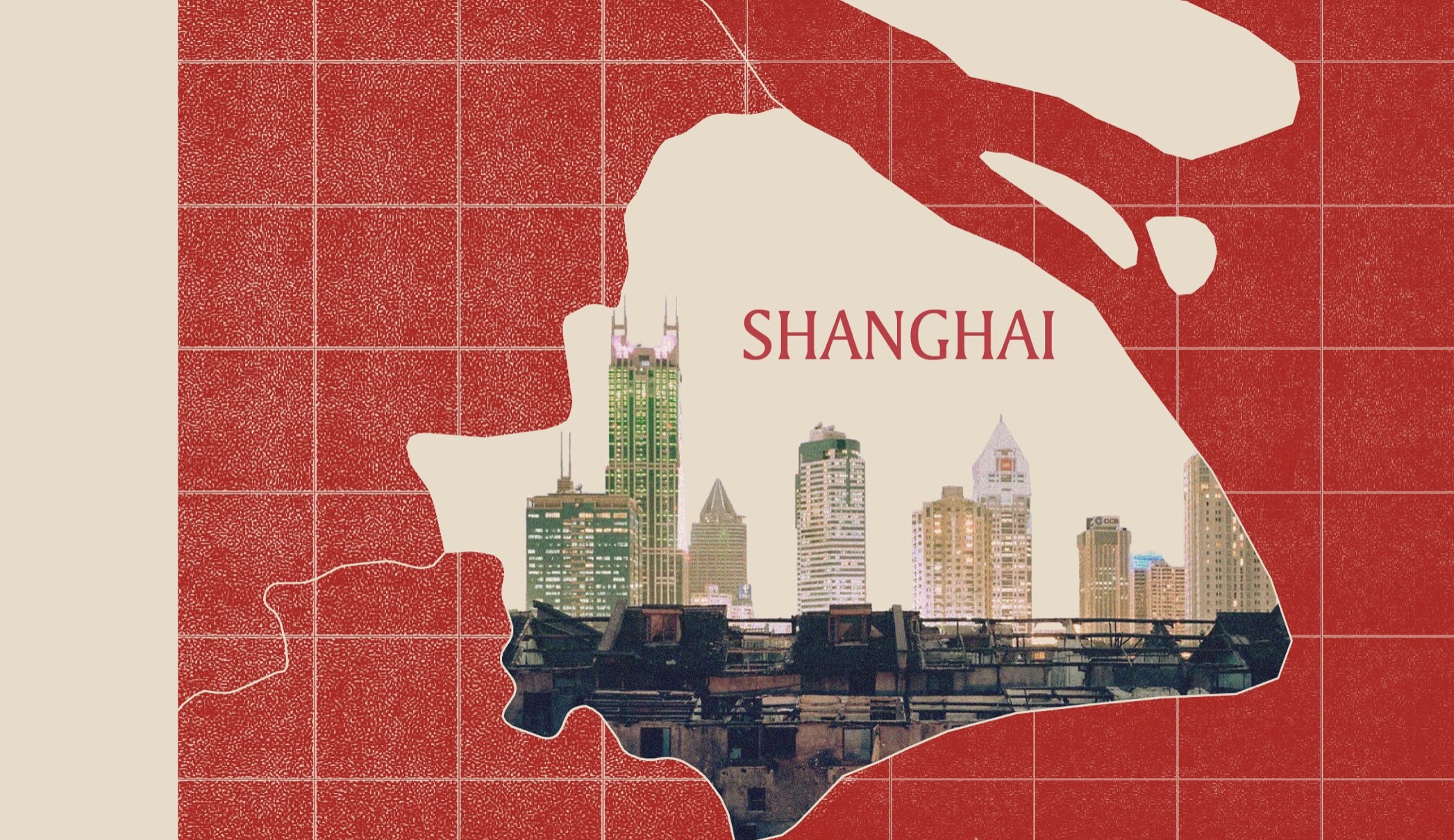
Do you know three Chinese provinces? To understand Xi’s China, you have to step beyond Beijing and Shanghai. Our new series goes to meet the spaces where another face of the future is being built. To receive this series, which has already carried us to Sichuan, Zhejiang, via Guangxi and on to Hunan, subscribe to Grand Continent. In your inbox from eight euros per month
While Shanghai has grown for half a century on its terraces of rice, it can now only expand by tearing itself down. At the end of 2025, the municipality had consumed 3,139 km2 of developable land out of the 3,200 km2 that its master plan authorizes mobilizing by 2035 — a deadline moved up to 2030 in July of the previous year. To give a sense of scale, after constructing the equivalent of 53 Manhattan districts, it now has only one more tranche for the coming decade, i.e., 61 km2 to be allocated among housing, industry, infrastructure, and the five new towns.
Can one make something new out of something old? In Shanghai, this question is above all political, the municipality having been mandated to invent the post-expansion Chinese city. In 2017, two months after the 19th Party Congress, the State Council approved the master plan “Shanghai 2035.” It is the first Chinese urban-planning document of this scale to imagine a form of decline: the footprint is capped; the population is stabilized around 25 million inhabitants; and more than 60% of the territory is devoted to ecological spaces. The plan carries far-reaching political implications for a city that, at the national level, exercises substantial economic and administrative powers.
Shanghai is not a “city” in the European municipal sense, but a directly governed municipality under the central government, sixty times larger than Paris intra muros, with rural areas, islands, and deep-water ports. In 2025, its GDP reached 5,670.9 billion yuan — about a quarter of French GDP and around 4% of the European Union’s. As its growth model based on sprawl and land reaches a peak, the metropolis is caught between three pressures: competitiveness, budget, and demography. Indeed, in China’s growth model of the last three decades, land has become one of the main assets and financing levers for local governments. Capping a municipality’s building footprint thus amounts to trimming its financial capacities. Moreover, one might ask whether land constraints genuinely spur urban innovation, and whether the city can stay at the forefront.
To answer these questions, one must look closely at the plan and its objectives. It sets out three: to adapt to international trends, to implement national strategies, and to ground itself in residents’ expectations. The world imposes, the nation commands, the residents suggest. While a public consultation yielded about sixteen thousand responses, these inputs still operate within a political framework already shaped by Xi Jinping’s thinking.
Adapting to the World: Aligning with International Trends
The master plan opens with an assessment of the global condition and identifies three trends that Shanghai must conform to. The first is geostrategic interconnection: globalization is coupled with a strong regional rooting. To exist, the city must be a global hub connected to financial and commercial flows, and a regional node through a networked cooperation with neighboring cities such as Suzhou and Hangzhou. The second trend is the rise of an economy driven by artificial intelligence and, more broadly, by innovation. Future growth is envisioned through the creation of advanced technologies, beyond basic assembly lines. The third trend is the world’s entry into an ecological civilization era (生态文明), i.e., an alignment of economic growth with the planet’s physical limits. At the urban scale, this translates into respecting resources and soils, reducing pollution, and focusing more intently on residents’ well-being. The shift from a quantitative logic to a qualitative one signals a broader turnover, where retreat could be seen as an advance over other metropolises. This assessment, crafted between 2014 and 2017, existed in a world of expanding networks. In just a decade, geopolitical upheavals have driven greater controls on semiconductor exports, tightened foreign-investment restrictions, and a dramatic fragmentation of value chains.
Attention to international trends translated into a concrete industrial policy aimed at specialization. The megacity stands out among major global financial metropolises as still one of the largest industrial bases and a leading hub in China. Three sectors were designated as priorities: integrated circuits, biomedicine, and artificial intelligence. By 2024 these sectors together generated about 1,800 billion yuan in revenue, roughly 230 billion euros. The city’s transformation toward cutting-edge industries occurs while it preserves for the sixteenth consecutive year the top position in global container handling: 55.06 million TEUs in 2025, nearly four times Rotterdam’s volume, the leading European port. Shanghai’s foreign trade reached 4,510 billion yuan in 2025, turning the city into a gigantic platform where capital, raw materials, and finished products circulate.
The conjuncture has belied the promise of a happy globalization. The “five centers” strategy—making Shanghai an international hub in five key domains: economy, finance, trade, maritime transport, and scientific and technological innovation—required an open environment in which interface positions were advantageous. Yet three signals indicate the limits of this model’s sustainability.
The first concerns export controls that target the first of the three priority sectors. Since 2022, the United States, the Netherlands, and Japan have progressively tightened restrictions on equipment needed to manufacture advanced semiconductors. The United States has also restricted China’s access to certain cutting-edge chips and to technologies enabling their production. Yet, semiconductors—the plan’s most strategic sector—suffer from a lack of tools. Designed as the demonstration that Shanghai could attract global science, Zhangjiang, the technology district nicknamed the “Chinese Silicon Valley,” has ultimately become a site where China strives to produce domestically and move toward self-sufficiency. Import substitution replaces the logic of openness and becomes the new criterion for success.
The second signal is internal competition. Cities like Hangzhou, and its “six small dragons” — Shenzhen and especially Hefei, the provincial capital that long puzzled observers but has become a major hub of venture capital and future industries thanks to public investment funds — are drawing a growing share of talent and capital. The megacity must therefore also defend itself against domestic rivals.
Finally, local government revenue signals the third constraint, with a growth of 1.5% versus 5.4% real GDP growth in 2025, well short of the economy’s nominal expansion. Land revenues — whose revenue stream cannot help but dwindle once land is no longer opened for urbanization — have not yet found a substitute.
Circumventing the Cap: The Sea as an Outlet
Nevertheless, the land constraint can be circumvented, for example by moving the growing zones. A few tens of kilometers away, Lingang and Yangshan illustrate how Shanghai can reorient its development within its new geographical constraints.
Established on August 20, 2019, the Lingang Special Administrative Area sits at the southeastern tip of the municipal territory, about seventy kilometers from the Bund, on land reclaimed from the sea. It covers 873 km² within its planning perimeter, including 119.5 km² under early development, and aims for 800,000 residents. This is where Tesla installed its Gigafactory, China’s first automobile plant owned entirely by a foreign automaker. Lingang belongs to Shanghai’s administrative jurisdiction and thus counts toward the 3,200 km² cap. The operation repositions space use: the center city’s densification is not prioritized; rather, the coastal periphery is developed. The last buildable hectares thus serve industry more than housing.
As for the deep-water Yangshan port, it rests on a more radical logic. The islands on which it sits belong administratively to Shengsi County in the Zhoushan archipelago, Zhejiang province. Linked to the mainland by the Donghai Bridge, opened in 2005 and spanning 32.5 kilometers, they are nevertheless operated by Shanghai. In 2017 the city opened the world’s largest fully automated container terminal. A decisive factor: Shanghai’s claim to the top global rank rests on soil that does not strictly belong to it.
These two ventures illustrate how Shanghai handles and circumvents limits (caps, thresholds, and binding indicators). The city has simultaneously gained ground over water and borrowed from a neighboring neighbor, extending by technical and diplomatic means the characteristics of its exceptional zone.
Implementing National Strategies: 落实国家战略
Let us return to the Shanghai 2035 plan. Following the second objective, Shanghai must be guided “by Xi Jinping’s thought on socialism with Chinese characteristics for a new era,” and assume “the national mission and historical responsibility” to pull the region into international competition. Xi Jinping’s thought on socialism with Chinese characteristics for a new era was first enshrined in the Party statutes in October 2017—less than two months before the plan’s approval—and later in the Constitution of the People’s Republic in March 2018. This ideological framework is organized around fourteen principles covering all public action—from national defense to environmental protection—and places each domain under a single doctrinal authority. Its practical effect is to demand alignment: every planning document opens with a reference to this thought, and compliance becomes a criterion for evaluating cadres just as much as economic results. Thus, this mechanism concentrates the legitimate interpretation of reality in the hands of a single author, pre-empting the decisions that lower levels might debate.
With the objectives set at the highest level, Shanghai’s urban invention primarily concerns the means to achieve them. This top-down decision-making hierarchy is evident in several ways. The document forbids any department or individual from altering the plan and obliges the municipal government to adhere to it. This subordination also appears at the governance level—the careers of those who implement it depend on meeting the goals. In this respect, Shanghai has long been a real springboard for Chinese leaders: the Party secretary’s post that dominates local hierarchies has previously been held by several figures who later rose to the central apex, such as Han Zheng and Li Qiang. The plan was drafted under Han Zheng’s secretariat, approved a few weeks after Li Qiang’s arrival as Shanghai Party chief, a little over five years before his appointment as premier. It has been implemented since October 2022 by Chen Jining, an engineer and environmental specialist, former president of Tsinghua University in Beijing and former Minister of Environmental Protection.
This succession illustrates a broader feature of the Chinese system: big cities serve as showcases for national policies and as testing grounds for cadres who are meant to rise within the Party’s hierarchy. The environmental dimension of the project therefore finds a concrete embodiment: Shanghai’s ecological red line is now championed by a former environmental minister. This choice is not incidental and responds to a constant logic under Xi Jinping: to rely on scientific and technocratic profiles to lead the country’s strategic priorities.
Two core formulas shape urban policy: “high-quality development” and “people-centered urban planning,” which later inspired the term “city for the people.” The former sets the economic priority and provides doctrinal justification for moving away from expansive growth; the latter aims to define the starting point and the end goal of urban action.
Shanghai occupies a unique position when it comes to heritage protection — one of the important dimensions of high-quality development. The city is, after all, the birthplace of the Party. Red culture is among the three cultures officially recognized by the municipality, alongside Shanghai’s own urban style and Jiangnan culture. It is treated as a resource for urban design by the plan. At the Memorial of the First Congress of the Communist Party of China, Young Pioneers’ students participate in transmitting the Party’s history through a corps of young guides called “Hong Laba,” with materials in Mandarin, English, and Shanghainese. In the Hongkou district, a bus transformed into a “mobile red class” tours neighborhoods to deliver “mobile Party lessons” on revolutionary history. Revolutionary heritage thus becomes an integral part of the urban fabric through tools of transmission, education, and storytelling.
The second formula, the “city for the people,” stemmed from a Shanghai urban requalification operation. The Yangpu district, in the city’s northeast along the Huangpu’s western bank, was formerly one of Shanghai’s industrial cores. Textile factories, a power plant, a gas plant, warehouses, and port facilities formed a long industrial facade that made the district a stronghold of the working class. After 1990s relocations, these activities gradually gave way to a large brownfield, long separated from the river by the walls of old factories. From the mid-2010s, the municipality began its refurbishment, and instead of erasing this industrial past, it preserved dozens of buildings and transformed about six kilometers of riverfront into public, cultural, and promenade spaces. In 2019, this operation took on a broader political dimension when Xi Jinping visited the new riverfront spaces and articulated a principle that would become a national doctrine: “The city for the people is built by the people; the city for the people serves the people.” This phrase, picked up in national plans and Chinese urban policies, turns a local redevelopment experience into a model of public policy.
Rooted in Residents’ Expectations
The third objective rests on the idea of making Shanghai a city designed around the daily needs of its residents. During the preparation of the “Shanghai 2035” plan, among the roughly sixteen thousand responses gathered through the public survey on future urban life, residents expressed a desire for an ecological city (17%), a global city (15.2%), culturally diverse and inclusive (12.8%), supportive (12.1%), and, above all, pleasant, safe, technological, and innovative. The requests were specifically about the environment, housing, local services, elder care, and access to healthcare.
The plan responds to these demands particularly through the principle of “proximate service circles.” The objective is for residents to access the essential daily services — 99% of public facilities — within a 15-minute walk of their home. It also envisions 4 m² of neighborhood public space per person, including parks, small squares, and corner green spaces. The typical distance for everyday needs would thus be limited to 2.5 km.
This pledge must be implemented very close to the ground, through a complex administrative chain. By 2026, Shanghai is divided into sixteen districts, then into 109 subdistricts and 107 towns — themselves connected to 5,120 residents’ committees and 1,551 village committees. Subdistrict offices form one of the main liaisons between the municipality and residents: they organize portions of public services and deal with very concrete issues, such as aging.
In the Face of an Aging Population
Behind the grand ambitions of the “city for the people” lies a much more ordinary policy: to enable an elderly person to eat nearby, access care, or find help within their neighborhood. By the end of 2025, the city had 2,498 elder-care dining facilities and 557 community centers offering senior services. If Shanghai is the Chinese city with the most Michelin-starred restaurants (52), it is also the city where public action seeks to guarantee affordable meals for seniors.
Consider, for example, hongshao rou (红烧肉), a Shanghai specialty — pork braised in soy sauce and sugar. Variants exist across many parts of China, from Hunan to Jiangsu. It is also linked to the poet Su Dongpo and his Ode to Pork (“猪肉颂”), or to a Mao braised pork version where a portion costs about 6 to 10 yuan, roughly around one euro.
This focus on aging also reflected residents’ expectations voiced in the 2016 public survey. The responses translated into tangible measures: beyond improvements to water and air quality and riverside promenades, there was a rise in elder-care provisions. By the end of 2025, the municipality counted 694 elderly-care facilities and 178,000 licensed beds. The model leans more toward a network of proximate services than wholesale housing. It resembles the systems developed in Japan and South Korea to address aging: keeping elderly people in their daily environment as much as possible by combining housing, care, meals, and home assistance.
Yet the scale of aging places substantial pressure on local services. At the same date, Shanghai counted 24.85 million residents, including about 9.75 million from other regions who lack a local hukou, the residency permit that still conditions access to certain local public services. Aging is particularly pronounced among registered residents: 60 years old and above account for 37.6% of the population. Meanwhile, births have been lower than deaths: 4.31 per 1,000 people vs 6.61. The city thus approaches its 25 million population cap set by the master plan just as its population is aging and starting to decline.
The problem also concerns the workforce: fewer young workers means fewer contributors to finance pensions, while the number of people needing care rises. Shanghai has thus launched a plan involving 28 administrations to promote senior employment and develop roles suited to elderly workers. Japan, faced earlier with aging and demographic decline, has already made senior employment a structural component of its response: in 2024, 53.6% of Japanese people aged 65–69 were still working. The government aims for 57% by 2029. Shanghai seems to be following a similar path. While housing, roads, and transport long stood as priorities to accompany growth, Shanghai now must learn to run a city that is no longer growing. It must care for more older people, with fewer births, while integrating a sizable mobile population into local services.
With the “City for the People,” Old Neighborhoods Disappear
A more livable city for its residents does not necessarily mean a city that preserves its places of life. The same policy promising closer services to the people also transforms districts deemed too old, too dense, or too deteriorated. In the old Huangpu district, the “city for the people” has meant the departure of its oldest residents. The land freed by renewal now hosts housing sold around 170,000 yuan per square meter. The Confucius Temple closed in 2021 for a restoration of 13,162 m² expected to last two to three years. The works planned the demolition of “illegal constructions,” namely stalls from the book market and some administrative buildings. This market had operated since 1986, initially four times a year, then every Sunday. Its sellers relocated to the second basement of a shopping gallery.
The disappearance of the market coincided with the completion of a broader operation: the old housing clearance program concluded in July 2022. In total, 30 million square meters were processed; about 1.3 million households were rehoused. The residents concerned were largely elderly and long-established in lilong neighborhoods lacking private bathrooms; many were relocated to the periphery. Freed plots now host projects of another kind, such as the Jinyuan program, which develops 230,000 m² distributed across 533 apartments and 151 villas. Many residents had long demanded better living conditions. While it is difficult to measure the approval or opposition of these projects, urban life and lifestyles have evidently been deeply transformed.
“Shanghai 2035”: A Project by or for the People?
Almost ten years after its adoption, the “Shanghai 2035” plan has enabled the renewal of the old through the new. On industrial lands, the city pursues a revitalization approach, conditioning any redevelopment on retaining productive use. Heritage has also undergone significant changes, through the protection of historic buildings, landscape zones, and cultural remnants. However, the cost of these operations is visible in the municipality’s social geography, where redeveloped neighborhoods have changed inhabitants. In a 2020 article on reshaping the Huangpu Riverfront, researchers Yifei Li and Xiaohua Zhong show that this project, though framed as a popular initiative, was carried out in a top-down fashion by local authorities and their partners, with no real citizen participation. This hegemonic approach leads to the conclusion that a “people’s” project is not necessarily realized “by the people.” The plan also leaves unresolved tensions that it had not anticipated.
The master plan assigned Shanghai two of the three global trends to pursue simultaneously: innovation and ecological civilization. A decade later, these two are in tension. Shanghai’s 160 data centers consume 3% of the city’s electricity, compared with 1.7% on the national average. The city, which has drawn red lines, will soon have to arbitrate between two of its own priorities.