
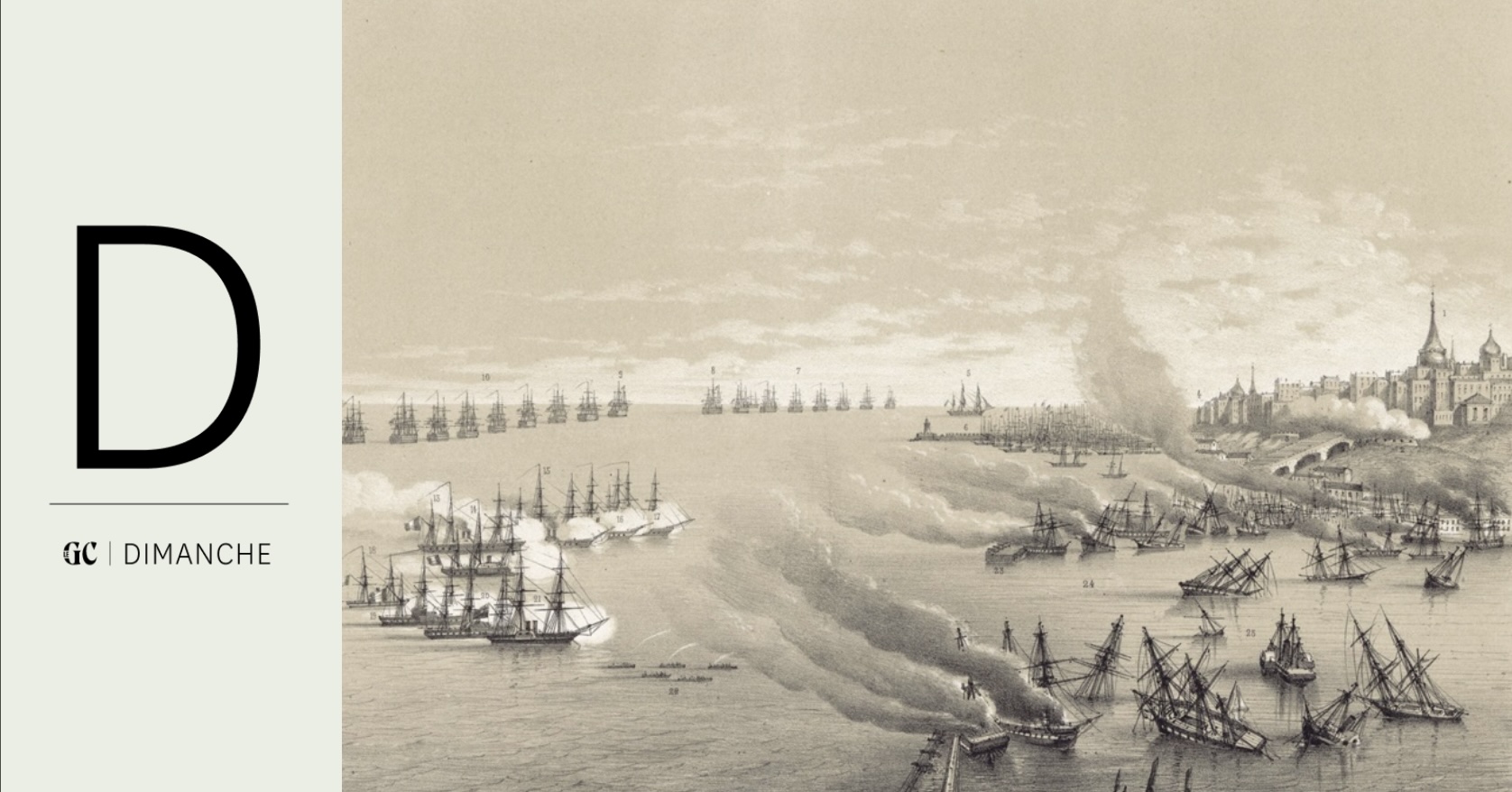
The fate of Odessa may have been sealed much sooner than anyone imagined. It was 1 a.m. on July 20, 1936, at the Palace Hotel, when ten diplomats signed the Montreux Convention, establishing Turkish control over the Bosphorus and Dardanelles straits. Three days earlier, the Spanish Civil War had begun, and around the Swiss table neither Italian fascists nor German Nazis were present. Instead, Maxim Litvinov, the People’s Commissar for Foreign Affairs of the Soviet Union, had fought to the end against Lord Stanley, the British Secretary of the Admiralty, in order to guarantee his fleet permanent access to the Mediterranean. Under the gaze of Tevfik Rüştü Aras, Turkish Foreign Minister and special envoy of Atatürk, who had triggered a revision of a clause that had proven unfavourable to the Turks, signed in 1923.
This Ankara diplomatic victory was simple and effective, and it enabled the Ukrainians of 2022 to save Odessa: only the Turkish navy can control access to the Black Sea. The littoral states (Russia, Romania, Bulgaria, Georgia, Ukraine) enjoy near-unlimited passage rights for their war fleets in peacetime, while warships from other countries (France, the United States, the United Kingdom, etc.) are subject to strict tonnage ceilings and a maximum stay of 21 days. Yet the most interesting rider for Odessa concerns “the time of war.” Article 19 of the Convention provides that in wartime, if Turkey itself is not belligerent, the Straits are closed to warships of the powers in conflict. Another article, 21, also allows them to close to all military vessels if Turkey perceives an imminent danger of war. Ankara’s political move was precisely to label the Russian invasion as a “war” (and not an “operational phase”) to trigger Article 19. On February 28, 2022, four days after Russian troops entered Ukraine, Ankara closed the Bosphorus and the Dardanelles to warships of belligerent states. Concretely, and in strict application of the agreements, Turkey also invoked the port-of-registry exception. Warships could pass the straits only to return to their home ports, and Russia could not bring ships from its Baltic or Northern fleets into the Black Sea to strengthen its presence. Likewise, Russian ships that had departed the Black Sea before the decision could not pass back in the opposite direction.
This is doubtless what allowed the Ukrainian general staff to win the naval battle. As we write, Russia appears to lack the means to seize Odessa. The Russian Ministry of Defense methodically claims strikes on the city and its ports, presenting them as targeting “military targets”: fuel depots “destined for the Ukrainian army,” sites for the production and assembly of drones, “ships carrying military cargo.” Remember that Putin declared in mid-December 2023, at his annual press conference, that “Odessa is a Russian city” and that the southeast of Ukraine is “historically a Russian territory.” When the Kremlin is contradicted by facts, orders are given to destroy. Russia has been waging against the Odessa ports the strongest campaign since 2022—so intense that on July 22, 2026, for the first time since the Ukrainian corridor opened in August 2023, not a single commercial ship passed through. Moscow intends to “kill” Odessa as a port—a strategy of attrition deterrence that raises questions about maritime security guarantees in any future settlement.
But Kyiv did not wait to retaliate. On June 26 of last year, Volodymyr Zelensky approved a plan entrusted to the SBU, the Ukrainian security service: forty days of deep strikes to “press Russia to end the war.” The formula sounds almost flat, but the military campaign is entirely the opposite. While Russian missiles strike the cranes of Odessa, Ukrainian drones—airborne and naval—are moving up the arteries of Russia’s war economy: refineries, fuel depots, air-defense radars, up to the tankers of the “ghost fleet” that sluice oil under sanctions. On July 8, the commander of the Unmanned Systems Forces, Robert “Madyar” Brovdi, claimed twenty-one ships struck in seventy-two hours, including nineteen tankers, in the Sea of Azov and up to the Kerch Strait. Early July, the Ukrainian general staff claimed to have disabled nearly 43% of Russian refining capacity—eight refineries struck in a month, more than sixty tanks destroyed, $13.5 billion in cumulative losses for the oil industry since August 2025. These figures are, for the moment, difficult to verify. But the testimonies from residents of Crimea arrive: fuel is rationed there, Russian vacationers have fled, and black smoke can be seen around several major Russian cities, including Saint Petersburg. For Putin, this is both a personal defeat and a strategic humiliation.
This face-off on the shores of the Black Sea sketches a form of war Europe had not yet seen. Russia can no longer take Odessa; Ukraine cannot retake Crimea. So each side squeezes the other’s flows. Moscow bans bread, Kyiv bans oil. The Black Sea has become a space that closes day by day, ship by ship, insurance premium by insurance premium. This is deterrence by attrition. For shipowners, simply, an uninsurable risk. In this flux war, the front is nowhere and the blockade is everywhere. Odessa has become both hostage and symbol.
Because what transits through Odessa does not belong solely to Ukraine. Before 2022, more than 90% of Ukrainian agricultural exports—wheat, corn, sunflowers—had left by sea, chiefly through the three grand Odessa ports: Odessa, Chornomorsk, Pivdenny. When the invasion shut this artery, the world learned that a country at war feeds part of the planet. The Grain Initiative of July 2022, brokered by Turkey and the United Nations, allowed the export of about 32 million tonnes of grain in a year. Then Moscow, feeling deceived, slammed the door in July 2023 and bombed the terminals. Once again, Ukraine demonstrated its resilience and ingenuity. Its most improbable strategic move was to open alone, in August 2023, its own maritime corridor, skirting along Romanian and Bulgarian waters, under the protection of its drones and anti-ship missiles. Without a war fleet, Ukraine moved nearly 200 million tonnes of cargo, including 117 million tonnes of grain. This was the great economic victory of the war, one that this summer’s battles may be in the process of undoing.
On July 19, the Golden Leo, a bulker under the flag of Guinea-Bissau, crewed by Indian and Syrian personnel, left the corridor with its grain cargo when three Kh-59/Kh-69 cruise missiles struck it. The strike killed ten. The vessel sank a week later. Between June 20 and July 20, Ukrainian prosecutors counted twenty-eight ships hit. Maersk and Hapag-Lloyd suspended calls to Chornomorsk; export capacities fell by a third, from six to four million tonnes per month; and on July 22, at the harvest peak, the corridor was empty. Global wheat prices rose again. The price of this attrition war will not be paid to Odessa, but to Cairo, Dhaka, Nairobi, in this Global South that Moscow courts even as it starves the markets. And this is the double effect of Russia’s food weapon: each terminal destroyed at Odessa makes Russia, the world’s leading wheat exporter, the substitute supplier for the gap it created.
The fate of Odessa will be central to all future negotiations. The first discussions among Americans, Russians, and Ukrainians began in Riyadh, in March 2025. The very first principle agreement precisely concerned a maritime ceasefire, which Moscow immediately conditioned on lifting restrictions on its own agricultural exports and fertilizers. Grain, already, served as diplomatic currency. But it is now agreed that no maritime security architecture in the Black Sea will hold if it does not durably guarantee that Odessa remains Ukrainian and connected to the world. Yet guaranteeing Odessa cannot be reduced to a textual clause. Who will patrol the corridor? Which insurer will cover hulls with such high ballistic risk? Which nations will be able to escort in a sea where the Montreux Convention forbids non-riparian fleets from basing themselves? A potential ceasefire that would leave Russia the ability to reopen the hunt for bulk carriers at will would not be peace, but a blockade that does not name itself.
Ninety years later, one would have to return to the Palace Hotel lounge. The Montreux paradox remains intact: the text that saved Odessa in 2022 by closing the straits to the Russian fleet is also the one that forbids Western navies from coming to protect the city. Its security therefore rests, as in 1936, on the Turkish arbiter who juggles Moscow and the West, and on riparian states such as Romania and Bulgaria, now charged with mine clearance and surveillance. In 1936, Litvinov fought to allow the Soviet fleet to exit the Straits; its Ukrainian heirs are now fighting to allow Ukrainian grain to pass the threshold. It is the reversal of our history: the city Catherine II founded to open the Russian Empire to southern seas has become what Russia persists in closing. Odessa’s fate, indeed, is decided not only in Odessa but also in the straits and on the world grain markets. More than ever, Odessa is global.