
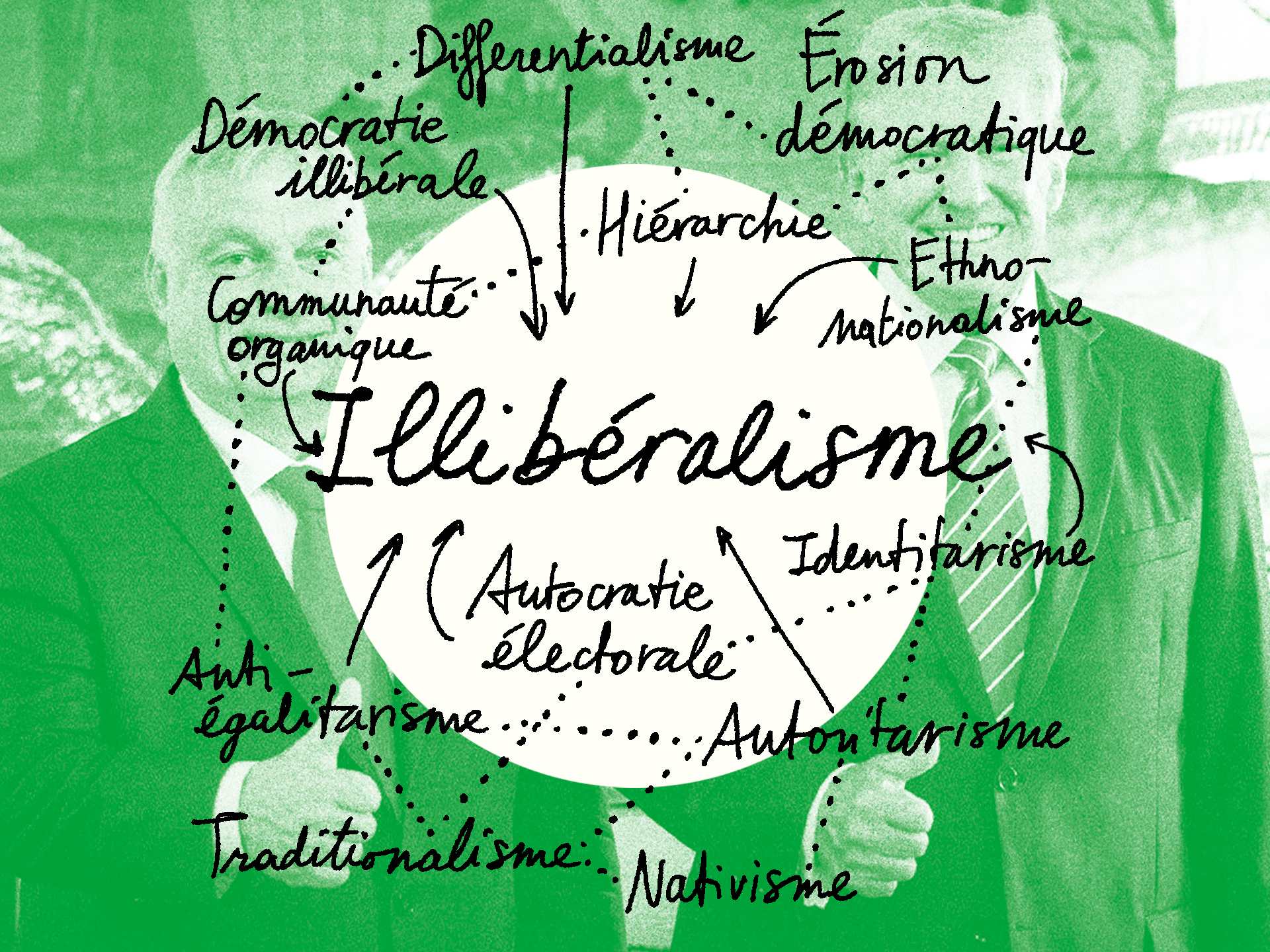
Throughout August, Le Grand Continent publishes in open access The Vocabulary of the Far Right, a product of collective work by a group of researchers — sociologists, historians, political scientists, sociolinguists — from across Europe under the direction of Steven Forti. To receive each lemma in your inbox and support the work of an independent editorial team, subscribe
The notion of illiberalism has broadened the scope of studies on conservatism and the far right, enabling a clearer grasp of new objects of inquiry as well as older manifestations tied to these ideologies. It emerges at a historical moment described by the literature as one of a “democratic backsliding” (democratic backsliding) or an “autocratization” , in which liberal democracy, to borrow Wendy Brown’s phrasing, undergoes a process of “hollowing out” (hollowing out). Beyond the strictly institutional domain, yet closely linked to it, a “cultural backlash” , understood as a conservative reaction against values associated with individual freedom of choice and self-expression, accompanies these trends within a broader context of a rights-oriented shift. While actors ranging from the right to the far right have used the term as a form of self-identification, adopting an emic stance, illiberalism mostly operates in an etic form, as a meta-ideological analytic category that seeks to render comprehensible this ongoing democratic regression, which several works connect to recurring episodes of financial crisis.
Jusqu’à très récemment, les études sur l’illibéralisme se sont largement confondues avec les recherches sur l’autoritarisme et les régimes autoritaires . L’une des raisons de cette approche tient, dans une certaine mesure, à l’influence de l’article de Fareed Zakaria « The Rise of Illiberal Democracy », publié dans Foreign Affairs, en plein débat de l’après-guerre froide sur la « fin de l’histoire ». Même si le terme avait déjà été employé par d’autres chercheurs dans le contexte du débat sur les valeurs asiatiques (Asian values debate) , dans un sens proche de celui que lui donnera Zakaria, sa notion d’illibéralisme faisait écho aux analyses d’un problème particulier au sein de certaines démocraties : alors que des gouvernements sont choisis et formés par des processus électoraux, ils peuvent ignorer, voire, chercher activement à démanteler, le constitutionnalisme libéral, la séparation des pouvoirs et les systèmes de freins et contrepoids qui protègent les droits et libertés individuels . Des exemples de ces pratiques peuvent être observés au Salvador de Nayib Bukele, où le gouvernement a maintenu un état d’urgence semi-permanent pour combattre la violence des gangs , sous lequel de graves violations des droits humains ont été documentées, ainsi que dans les attaques de Donald Trump contre le pluralisme médiatique aux États-Unis .
However, political thought and ideological analysis have remained largely absent from this field of study. Contributions that explore the ideological dimension of illiberalism, rather than its institutional aspect, prove especially useful for understanding these dynamics of political and cultural regression in times of economic crisis. In this area of analysis, the work of researchers such as Marlène Laruelle, Raphaël Demias-Morisset and Julian G. Waller offers descriptive and explanatory tools to grasp the tensions inherent to illiberalism.
How, then, to define illiberalism as an ideology? Far from reducing to a binary opposition between defenders of liberal democracy and authoritarian populists, politics appears more complex. One of the main points of agreement in the literature is precisely that illiberalism is not a single, coherent ideology, but rather a “cluster of ideologies” (cluster of ideologies), nourished by a heterogeneous “thought collective” that operates from nearby premises while integrating contradictory elements. Because it can be mobilized to describe phenomena linked to the political center, or even to the left , some might even contend that its scope is too broad to grant it genuine analytical value . Yet, at the same time, perhaps that is precisely where its strength lies. In any case, certain common motifs can be identified in illiberal ideological productions. Almost systematically, the whole bundle of ideas that structures illiberalism articulates a conservative-majoritarian reaction against liberalism. In this sense, when reflecting on the relationship between liberalism and illiberalism through the etymology of the former term, Laruelle asserts:
“The semantic ambivalence of the term illiberalism is intrinsic. The prefix ‘ill’ is the assimilated form of the Latin prefix ‘in-,’ used before words starting with ‘l’; it thus means simultaneously not, contrary to, and without. It can also designate something bad or maladapted, as in “ill-prepared,” for example. Literally taken, illiberalism can thus mean not liberal, a-liberal and ‘inadapted to liberalism,’ all of which are fundamental ambiguities that should constitute the starting point of any scholarly exploration of the term.”
In this regard, although illiberalism can present itself explicitly as the opposite of liberalism, that is, as anti-liberalism, it more often engages in dialogue with the latter, radicalizing some of its premises through conservative thought. Versions of liberalism that actively promote minority rights for racial, gender and sexual groups, that distance themselves from religion and other forms of spirituality, or that defend a vision of progress opposed to an idealized and nostalgic view of manners and tradition are almost systematically rejected. In one way or another, illiberalism opposes modernity as a social and philosophical paradigm. It rejects unitary anthropological conceptions of humanity grounded in universality, opting instead for a reactionary form of cultural and national relativism.
Actors who have explicitly identified themselves as illiberal, or who adopted the label at some point, often adhere to this set of ideas and values. A frequently studied example is Viktor Orbán, who, on July 26, 2014, in his speech in Băile Tușnad before the Hungarian minority in Romania, described the Hungarian system as an “illiberal democracy,” citing as examples non-Western, non-liberal systems that he viewed as effective: Singapore, China, India, Turkey and Russia . According to Orbán, Hungary would not merely be a collection of individuals or citizens in the liberal sense, but an organic community in which Hungarians are placed above social minorities such as migrants or LGBTIQ+ persons, perceived as a threat to the country and its people, understood in an ethnic sense. The nation and the state claim to embody a particularism that directs their political trajectory away from liberal universalism.
Conscious of the negative connotations of the term, Orbán subsequently reformulated his system as a democracy grounded in the nation-state and the “Christian values.” In the continuation of this reasoning, Alain de Benoist, a major figure of the French Nouvelle Droite, invoked Orbán’s 2019 discourse at a conference organized by the Iliade Institute, a progeny of the far-right identitarian current founded in homage to Dominique Venner. He argues that Europe as a whole should follow the Hungarian example, illustrating how far-right policies and Nouvelle Droite thinking can converge through illiberalism. Other figures, such as the ideologue Alexandr Dugin, also deploy the term while linking it to their multipolarity theory. Starting from the idea that different “civilizations” hold distinct conceptions of reality rooted in tradition and a rejection of modern thought, Dugin states: “That is, essentially, illiberalism: the principles of the Western liberal civilization are rejected as a universal model.”
The geopolitical dimension of the phenomenon remains central. Theorized by Zakaria at the moment when the triumph of liberal democracy seemed assured, illiberalism later becomes the language of a multipolar world. On the eve of the Osaka G20 summit in June 2019, Vladimir Putin could thus declare to the Financial Times that the liberal idea had become “obsolete,” in apparent contradiction with the interests of the overwhelming majority of the population. Rogers Brubaker showed how a segment of European populist right-wing forces could shift from nationalism toward a “civilizationalism” defined initially by opposition to Islam, while the rise of “state-civilizations” claimed by powers such as China, Russia, India, or Turkey provides Western illiberals with the proof that liberal modernity is merely one provincialism among others. Illiberalism thus operates both as a challenge to internal checks and balances and as a challenge to the liberal international order from the outside.
Without explicitly invoking the concept of “illiberalism,” several political leaders today mobilize a similar register. Against modern liberal values such as universalism and rationalism, criticized as abstract principles, J. D. Vance, then a candidate for the U.S. vice presidency, stated in July 2024 that “America is not just an idea. It is a people with a shared history and a common future,” and that “people will not fight for abstractions, but they will fight for their home.” Here, the “America First” principle of the Donald Trump administration takes on an organic and differentialist form, asserting America’s distinctiveness against any modern conception of what illiberals would call “globalism” . In Europe, though often now associated with a more mainstream conservatism, Prime Minister Giorgia Meloni has defended several core illiberal principles in her speech at the NatCon conference in Rome in 2020, titled “God, Fatherland, Family.” In this intervention, she stressed “the necessity of reembedding conservatism within its traditional sphere of national identity” .
In terms of economic organization, illiberal phenomena can take different shapes. Some thinkers of the Nouvelle Droite, such as Alain de Benoist, advocate for a pre-capitalist economic order built around gift-giving, reciprocity, and rooted forms of social belonging, founded on communal and organic principles . Aleksandr Dugin and, in a different register, techno-libertarian figures such as Peter Thiel , have been associated with neo-feudal imaginaries. They envision a retreat from liberal-modern forms of political and economic organization in favor of hierarchical, segmented, and quasi-medieval authority structures. Yet, although the utopias they imagine differ from one another as well as from other archèofuturist or corporatist models, they share a common trait: even when not capitalist or liberal in the strict sense, they remain societies deeply structured by class relations. This is hardly a coincidence, since their ideas draw on authors such as the Kronjurist of the Third Reich, Carl Schmitt, and his eschatological view of liberalism, or the esoteric traditionalism of Julius Evola.
Precisely, the favored model of post-liberals, another current shaping today’s illiberal thought, rests on a form of religious corporatism that would shape the economic relations of their ideal social model. Authors such as Patrick Deneen, Rod Dreher and Adrian Vermeule, some of whom identify with Catholic integralism and advocate a return to traditional Christianity, have voiced a virulent critique of liberalism. Deneen, the most well-known of these writers, argues in Why Liberalism Failed that the individual rights granted by liberalism inevitably lead to individualism and thus to the erosion of traditional institutions such as family, community, and religion.
From what appears to be the left–right opposite end of the spectrum, political actors and ideological currents can also exhibit illiberal tendencies while aligning with progressive traditions. Regimes such as Nicaragua, Burkina Faso or Venezuela claim to embody certain left-wing values, particularly in economic and geopolitical domains, by seeking to free strategic resources from the grip of powers they label neocolonial like the United States or France. Yet, in West African and Bolivarian cases, this resource nationalism appears more embedded in market logics than in a genuine redistributive or planned model. At the same time, these regimes have developed conservative ideological positions toward gender and sexual minorities, sometimes presenting them as expressions of a Western “imperial West,” while maintaining, in Burkina Faso as in Venezuela, opportunistic relations with forms of national religiosity that they instrumentalize for political ends. In the broader framework of illiberal anti-colonialism, similar tendencies are observable in certain currents of decolonial theory and activism. Some authors and political figures associated with decoloniality present modernity as inseparable from colonialism and capitalism, and reject it in favor of a more essentialist and differentialist conception of humanity.
Yet these positions remain marginal in practice: most illiberal actors today endorse neoliberalism as the economic system best suited to their envisioned society. While there are positions ranging from protectionist models to more libertarian configurations, they tend to converge around an instrumental use of the state in service of economic power, in line with the analysis offered by Quinn Slobodian. This trend is visible in the ideological space that stretches from the center-right to the far right, which some authors have called “the epicenter of the illiberal phenomenon” . In this porous space, right-leaning conservatives who identify as liberal while attempting to strip liberalism of its progressive content coexist with far-right actors who openly attack liberalism while benefiting from market capitalism, financial deregulation, and the weakening of social rights.
More generally, illiberalism sees its main opponents in both progressive or technocratic liberalism and in moderate conservatism. From illiberal perspectives, these actors belong to a detached capitalist caste that would have placed the economy at the pinnacle of political priorities, while imposing progressive policies and neglecting the moral conditions assumed to guarantee the existence and reproduction of majority and traditional institutions: the family, the distinction between men and women, the nation, religion, and civilization itself. The illiberal right and far right likewise oppose conservatives who, in their view, have allied with the postwar international order of rules, to the detriment of national interests, understood in a nationalist sense. More recently, echoing the “cultural Marxism” conspiracy theory, Argentine president Javier Milei invoked this narrative in his Davos speech in 2024, when he asserted that progressive liberals, “neo-Marxists” in his eyes, “have managed to capture the common sense of the Western world” by appropriating “the media, culture, universities and international organizations” . Milei argues that progressive liberalism, operating clandestinely, has become hegemonic in key spheres of society. The picture painted by several available works is more nuanced, and defenders of liberalism have rarely succeeded in pursuing redistributive reforms, expanding the democratization of individual rights, or promoting progressive values without facing resistance, more or less categorical, from conservative actors. Nevertheless, illiberals present these advances as having been imposed from above, almost in a totalitarian and secretive manner .
To trace the historical arc and development of illiberalism, especially the ideas that critique liberalism from this perspective, the in-depth analysis of illiberal thought proposed by Demias-Morisset locates its starting point in the 1950s and 1960s. In broad terms, after World War II, libertarian authors such as Ludwig von Mises (1881-1973) and Friedrich Hayek (1899-1992), alongside traditionalists like Russell Kirk (1918-1994), developed complementary critiques of postwar liberalism shaped by Keynesianism. To their view, the Keynesian economic model fostered redistribution of wealth and investment in public services in a way that weakened traditional institutions responsible for the reproduction and cohesion of society, such as the Church and the family. At the same time, the postwar Keynesian era, from the end of World War II through the 1970s, produced a profound transformation of social values, linked to gender equality, sexual freedom, multiculturalism, and increasingly anti-authoritarian attitudes toward traditional figures of authority: the father or the priest were challenged. In this sense, mainstream conservatives and right-wing liberals were seen as not doing enough to contain this progressive wave and, in the context of the Cold War, as making concessions that gradually pushed societies toward socialism.
Although this seminal illiberalism did not fully crystallize during this period—perhaps because profit rates in major capitalist economies remained relatively favorable—the situation began to change with the 1970s oil shocks and the emergence of stagflation, which steered economic policy away from Keynesianism toward neoliberalism. At that moment, the staunchest conservatives were actively spreading moral panics around feminist, anti-racist, and LGBTQ movements. To borrow Ronald Inglehart’s terminology, if a “silent revolution” of manners and social values had shaped a more progressive and mobilized society, a “counter-revolution” , studied by Piero Ignazi, began to emerge. It was characterized by “the rise of a new neoconservative cultural mood”; a trend toward radicalization and polarization; the political system’s legitimacy crisis and, above all, the crisis of the party system; [as well as] questions of security and immigration” .
The backlash against this “silent revolution,” which promotes a return to authority, order, patriotic nationalism, the traditional family, and moral values, accompanies the rise of right-wing and far-right formations such as the Front National, today Rassemblement National, in France, or the FPÖ in Austria during the 1980s. But even before that, several of its traits were already at work in at least three countries where this current came to power either by coup d’état or through electoral means: Chile under Augusto Pinochet (1973-1990), the United Kingdom under Margaret Thatcher (1979-1990), and the United States under Ronald Reagan (1981-1989). The neoliberal political economy was implemented, by these figures and to varying degrees, in concert with a new way of doing politics based on ethnonational populism, power concentration, traditional values and institutions, and opposition to the liberal-technocratic international order. This is neither a coincidence nor an anomaly: writers such as Friedrich Hayek, for example, strongly defended border controls and immigration restrictions to align “culture and economic efficiency” . In its origins, neoliberalism was deeply rooted in conservative thought and, at times, illiberal—despite Hayek’s explicit rejection of the label of conservatism.
The illiberal forces consolidated as a major political and ideological axis from the 2010s onward. Extrapolating to other contexts what the work of sociologist Arlie Russell Hochschild demonstrates, one can hypothesize that this consolidation occurs at a moment when the material security and financial stability of broad segments of the working and lower-middle classes begin to wobble in the wake of the 2007-2008 financial crisis. This new episode of economic precarity was accompanied by the loss of a particular form of capital within what Hochschild calls the “economy of pride”: individuals who had built their self-image on a positive working-class identity no longer possessed the tangible and symbolic resources necessary to sustain it.
This context of cultural and economic insecurity became fertile ground for the rise of figures such as Donald Trump, Marine Le Pen, and Viktor Orbán, who acted as catalysts for this malaise of identity. The resulting wave organized transnationally, whether in the European Parliament or through international gatherings such as the National Conservatism Conference (NatCon) and the Conservative Political Action Conference (CPAC), where influential ideologues such as Yoram Hazony and Ryszard Legutko nourished national-conservative thought and linked it to the global right. Their main target is immigration, presented both as a material threat to national prosperity and to the working classes, and as a cultural threat to national identity. In a more or less conspiratorial register, immigration would be facilitated by an internal enemy: so-called “woke elites” whose stance would not be endangered by migrants, and who would be accused of promoting the dilution of traditional values and Western civilization.
Although they differ from national conservatives, neoreactionaries are also part of the illiberal thought collective. They form a sub-group of scholars, writers and bloggers who blend white supremacism, traditionalism, and techno-solutionism. Also known as the Dark Enlightenment (Dark Enlightenment), neoreactionaries have gained influence among figures close to the White House through a synthesis of classical reactionary thought and postmodern, libertarian sensibilities. This syncretism can be observed in the work of Nick Land, a former philosophy lecturer at Warwick University, who formulated the very concept of the Dark Enlightenment and advocated a society organized around a form of unbridled technophilic capitalism, driven by its own accelerationist logic. In Land’s view, accelerated capitalism would require an autocratic and “dark enlightened” social order, since democracy is seen as a brake on acceleration. Likewise, Curtis Yarvin, another central figure of the neoreactionary movement and a thinker close to the political milieu of J. D. Vance, defends a monarchic and neo-cameralist model of government, in which nations are governed more like enterprises than as democratic states. These ideas have also influenced major figures in the tech industry, including Peter Thiel, a supporter and financier of Trump, who has framed attempts to regulate technological development in terms of the figure of the Antichrist and the Schmittian motif of the katechon.
In sum, the actors ranging from the right to the far right who have identified themselves as illiberal, or who have argued in favor of illiberalism, defend a conservative and majoritarian vision of society. They view nations and civilizations as organic entities built around traditional values opposed to modern progressive thought. Yet this remains a concept that is widely perceived as negative or vague, which helps explain its relatively rare use by these actors themselves. Overall, it is primarily a category that allows analysis of phenomena manifesting across the left–right spectrum. In principle, it consolidates and strengthens in moments of material and existential crisis. Consequently, further research is needed to understand how this ideology affects our contemporary societies, in which rising competition among individuals, intensified by scarcity in the distribution of wealth, can nourish forms of resentment that weakened social bonds struggle to absorb.