

Test The Grand Continent. The ideas and analyses you won’t find anywhere else. But you’ll see them everywhere soon. In your inbox starting from 8 euros per month
We’ve all been there. A device we’ve depended on for a long time breaks down: a refrigerator, a car, a mobile phone. It must be repaired or, if it’s too damaged, replaced. Yet every repair hinges on four distinct elements coming together: information, time, money, and spare parts. Someone (rarely us) has to know how to diagnose the breakdown and bring the device back to working order. This requires time—for procuring a replacement component and installing it—and that time must be compensated. Today, finding a reliable repairer is rarely straightforward; worse, the information asymmetry that accompanies any repair places the owner “in the hands” of the person who performs it. The cost can also be prohibitive. But it is the last element that determines the entire drama: the spare part. In 1943, a military supply officer testified before a U.S. Congress commission: “We need the parts. Without the parts, we have nothing.” Ultimately, without spare parts, everything stops—both in households and in armies.
The spare part is an eminently modern problem: it is the offspring of interchangeability, that turning-point advance which makes it possible for a standard part, kept in stock, to bring a machine back to life. The difficulty of obtaining spare parts grew from the late 19th century, peaking during the postwar “Glorious Thirty” era, before gradually subsiding under later and contradictory trends: modularity, durability, and disposability. To trace this long arc, we can first examine the “prehistory” of spare parts, before addressing, on the one hand, the crucial role of parts on the battlefields and home fronts of World War II in the United States and the USSR; and on the other hand, their central place in postwar American capitalism and Soviet socialism, as well as in the struggles for the development of postcolonial nations. This study is the key to understanding contemporary military strategies and consumer markets.
From Mills to the Ford Model T
In the Middle Ages and the early modern era, watermills and church organs had parts that wore out or cracked. But no supplier then kept stock of wooden gears or metal pipes; in case of a breakdown, millwrights and clerics called upon artisans to fashion new parts. Mill leases often included plots of woodland destined to provide the raw materials necessary to replace wheels, axles, or valves. By the eighteenth century, the steam engine embodied a new European trend: pre‑planning spare parts, in the metropolis as well as in the colonies. In Cuba, for instance, the contracts of sugar mills began to require builders to deliver crates of spare parts with their machines, so that a breakdown during harvest, a crucial period, would not interrupt cane processing. By 1900, American manuals devoted to steam-powered machinery already catalogued the parts most likely to fail, so that doubles could be kept on hand. If not, local machine shops could manufacture nearly identical copies of broken parts, which would then be filed and ground down until they fitted. Catalogues of industrial machines also offered lists of parts (sometimes with prices) for looms, machine tools, or sawmills, so that the companies that kept such inventories could minimise downtime caused by failures or accidents.
In the early twentieth century, World War I provided a proving ground for new military technologies: aircraft, machine guns, tanks, and trucks. All of these machines were complex, composed of hundreds, even thousands, of mass-produced parts that always broke at the worst moment. In every camp, the manufacture and delivery of spare parts routinely exceeded the production, information, logistics, and communication capacities of the armies, driving improvisation, salvage, and even outright theft of parts in combat zones. Without parts, the result was dire, unacceptable: aircraft grounded, tanks bogged down in mud, trucks abandoned behind the lines. After 1918, military planners drew technical lessons from the Great War with varying seriousness; many of its grave errors would be conscientiously repeated after 1939.
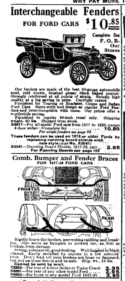
The interwar period was marked by the rapid ascent of the automobile in the United States and the spread of domestic electrical appliances, led by the radio. The Ford Model T seemed simple enough for owners to repair themselves, in the American tradition of DIY; and most early radio enthusiasts mastered the basics of assembly, adjustment, and testing. Yet, as car and radio ownership grew to millions, waves of breakdowns opened up opportunities for maintenance specialists, employed at dealerships and retailers or running their own shops. Keen chiefly on producing and delivering cars, Ford sought to control its production parts entirely, but refused to manufacture spare parts that would divert machines and production capacity from complete vehicles. Because it did not patent its components, the company opened the door to hundreds of metalworking firms that began producing “parts for Ford,” whose lists filled pages in automobile-supply manuals. Manufacturing vacuum tubes and reliable condensers proved harder, but the industry structure allowed the spare-parts problem to be resolved.
In the 1930s, a few giants like RCA and General Electric produced millions of mass-produced parts for radio sets (Zenith, Emerson), as well as spare parts for repair shops across the country.
Panzers against T-34: The Spare Parts War
After 1939, the technologies of mobile warfare tested a generation earlier—aircraft, tanks, and heavy vehicles—became decisive. In a mechanized war, having the right parts, in the right place, at the right time, became crucial. After occupying France, for example, the Nazis requisitioned Renault and Citroën military trucks for the Eastern Front. They were good trucks, well built. But in their haste, the Wehrmacht did not procure spare parts for them: every breakdown in mud or snow turned a vehicle into an inert hunk of metal. This error echoed throughout the Reich’s tank (and aircraft) production system. Attaché to quality, the Nazi regime produced complex but extremely sturdy tanks—the Panzers. Yet, pressed to rush them to the battlefield, factory managers rarely set aside even a fraction of the components available to build spare‑parts reserves. Damaged or broken Panzers thus remained immobilized, awaiting repair crews themselves ill-supplied. The Soviet T‑34s, by contrast, were far simpler machines, but no less robust and well designed. When they were struck or destroyed, recovery teams dismantled them to salvage usable parts: tracks, cannons, and, if possible, engines. A 1943 photograph shows Soviet mechanics lifting a gearbox with a portable crane to reuse it. Thus, while Moscow organized the cannibalization of damaged tanks to put them back into service, Berlin pursued a “total front” logic which, lacking spare parts, culminated in tactical failure.

Across the Atlantic, once American industry was fully mobilized for the war effort, U.S. forces quickly had everything in ample supply. The problem was not quantity but timing and geography: shipments did not reach the right place on time, due to truly nightmarish logistics, especially in the Pacific where distances were colossal. Equipment and spare parts had to leave ports like San Francisco and Seattle and then move west by rail from Midwest and Northeast industrial regions. Behind the Asian fronts, repair units were highly dispersed, specializing in planes, tanks, ships, or trucks; planners in the United States aimed to load each ship with material destined for a single category. Unfortunately, material of all sorts arrived scrambled in the stockyards. Waiting to assemble a full cargo of aircraft parts was rarely feasible, even for lack of storage space. Shipping managers ended up deciding, in effect: “Everything that arrives tomorrow goes on the next ship; we do not control either what it will be or where it will land.” Spare parts therefore often did not reach the places where they were needed, and spontaneous rerouting chains emerged to redirect crates and boxes. These incessant re-shipments consumed substantial time and effort and continued until 1945. Under pressure, managers of one link in the chain made pragmatic decisions that sowed chaos and forced improvisation at the other end.
The American Home Front: Seven Ways to Find a Spare Part
Coordination between the different military and civilian structures constantly hindered spare-parts provisioning for the war effort. It also posed a persistent difficulty on the home fronts, in the United States as in the USSR, because war brings shortages of goods as well as spare parts. After Pearl Harbor, preserving American steel was paramount; unsurprisingly, car manufacturing came to a halt, with auto-parts and assembly plants repurposed for war matériel. Americans owned some 30 million cars and trucks; a third of them were aging, with ten years or more on the clock. Keeping hundreds of models in service potentially required some half a million part references: mechanical (engines, gearboxes), electrical (batteries, ignition), decorative (bumpers, hood mascots) or accessories (heaters, radios). For brands that had disappeared (Pierce-Arrow, Reo), parts had long been scarce; and now war would force Ford, General Motors, and Chrysler to halt production of spare parts. How could dealerships, garages, and owners cope with such constraints?
Seven supply routes opened, six legal and one illegal: stockpiling, salvage, repair, exchange, substitution, government-approved spare parts purchases, and, of course, theft. Even before new car production stopped, firms and individuals began stockpiling, stacking parts in their garages. Drivers took to bringing their own parts to the mechanic to have them installed—an absolute necessity when wholesalers’ shelves were empty. Salvage could supply needs as they arose. The country’s 30,000 “automobile graveyards” offered used parts, provided you hit the right make and model. Some firms purchased wrecks to salvage parts, and amateur mechanics did the same.

The situation grew so dire that old-car owners bought a second vehicle of the same make and model to ensure spare parts would be available. Yet the state soon moved to compete with them. In February 1942, the War Production Board (WPB) began purchasing all automobiles from the country’s automobile graveyards located “within a reasonable distance from metal consumers.” The WPB targeted carcasses already stripped of usable parts, but the Office of Emergency Management intervened, demanding that 600,000 wrecks be delivered to foundries within 90 days. The draining of these “scrap yards” deprived consumers of salvageable parts: more than half of these depots closed within a year. Replacing worn-out parts was another option, but welding cracked pistons or boring cylinders individually yielded only marginal effects. Similarly, swapping parts between dealers as their stocks dwindled was only a stopgap, but usually preferable to substitution, which involved trying to fit a part from a Chevrolet to a Chevrolet from a different year. Annual model changes thwarted such attempts. Theft remained. As today, bands of criminals would steal and dismantle cars to resell the parts in bulk to complicit garages. More sophisticated were the diversions of new parts within the factories assembling cars or military trucks; the most significant “network” dismantled by the FBI had stolen $10 million worth of components from Ford plants in Detroit. In 1944, as raw materials anxiety subsided, the WPB began allocating steel and other metals to federal agencies to meet the needs of the home front. The Office of Defense Transportation directed materials toward companies producing “authorized” auto parts; the Agriculture Department supplied inputs to manufacturers of agricultural equipment. The grip began to loosen as the war neared its end.
The Soviet Home Front: Harvesting with the Scythe
The contrast with the Soviet home front, here considered through the lens of agricultural equipment parts, is striking. When a country is invaded and bombarded, sowing and harvesting—let alone managing spare parts—becomes an almost unimaginable challenge. The Wehrmacht’s eastern offensives ruined Stalinist mechanization of agriculture, especially in Ukraine: in one year, the invader destroyed 112,000 tractors and 45,000 combine harvesters, and reduced six large agricultural equipment factories to ruins. From 1942 to 1944, Soviet production of new tractors barely exceeded 2,500 units. At the height of the crisis, two-thirds of the country’s 1.8 million rural mechanics were mobilized to drive or repair trucks and tanks. Soon, all rural machine shops in Kazakhstan were declared out of service. Worse, the leftover agricultural equipment was worn to the bone: in 1941, a tractor averaged ten years of life, and no new spare parts would be manufactured before 1944. The supply and repair conditions of tractors became “unparalleled in severity.” As stockpiles of spare parts dwindled, Party militants mobilized Komsomol youths to scavenge repairable parts and scrap metal. Rural mechanical workshops were ordered to repair old parts, but their pedal-operated lathes were ill-suited for making new components. Lacking suitable materials, such as alloy steel or cast iron, workers improvised with bits of rusted metal, plastic, wood, and bronze, or fragments from discarded machines. These parts worked, but did not endure; tractor breakdowns multiplied.
The message eventually reached the top. In March 1944, a Politburo resolution authorised the production of 65.3 million rubles (13 million dollars) worth of spare parts and entrusted their manufacture to armament factories. The task was simplified by the fact that only a half-dozen tractor models were in service at the time. Another favorable factor was the camaraderie that formed between city factories and rural repair workshops, beginning with 160 Moscow metallurgical enterprises that assigned personnel and machinery to produce parts that were beyond the reach of rural workshops. With deliveries increasing in 1945, kolkhozes and sovkhozes were finally able to put the entire fleet of machinery back to work. Moreover, as the Germans retreated, Soviet tractors they abandoned were repaired or salvaged for their parts. Yet, with the tractor fleet halved since 1940, the machines could perform only about 50% of the autumn plowing in 1944, less than 30% of the winter sowing, and 20% of the grain harvest. Part of the harvest was brought in by animal- or human-drawn equipment, but the sickle remained predominant. Hopes for abundant harvests after the war quickly faded. Despite explicit orders from above, chronic shortages of spare parts resurfaced after the war. If making spare parts was crucial, Soviet factory directors did not always see it that way: they tended to neglect it to focus on tractor production. This flaw persisted. All told, fortified by abundant resources, the United States faced wartime tensions over spare parts with flexibility, experimentation, and on-the-fly corrections, while the Soviets ultimately mastered their spare-parts crisis through heroic resilience, improvisation, and collaboration.
The Soviet Television Fiasco
If, after the war, the management of spare parts for agriculture remained deficient, preventing sovkhozes and kolkhozes from reaching their yield targets, the USSR’s push to mass-produce and distribute consumer goods such as television sets turned into a fiasco. Soviet televisions were meant to be standardized—a good socialist principle. But the political reality of the Union made it difficult: each republic’s government wanted its own television, fronted by symbols proclaiming: “This is an Uzbek television.” A multitude of models thus appeared, each with its own internal components and arrangement. As with tractors, television factories had little incentive to manufacture spare parts; leadership and worker bonuses depended on the number of sets completed and shipped (whether the sets worked or not mattered little). The technologies for fabricating and testing components were not fully mature either. The result: buyers found themselves with devices that broke down after a few weeks or months, then spent ages in state repair workshops waiting for parts, only to break down again once retrieved.

In the early 1960s, a television catastrophe began to loom in the USSR—especially damaging given that the set was to illustrate Khrushchev’s campaign “We are catching up with the capitalists.” The affair transformed into a chasm swallowing millions of rubles, while furious users dragged their sets from place to place to try to find parts, legally or illegally. Soviet radio- and television-focused journals saw engineers bitterly complain: “Why can’t we organize anything properly?” Eventually, after national conferences where everyone could air grievances—and where Polish televisions, reputedly more reliable, were cited repeatedly—the Council of Ministers intervened in 1962 to order the Communications Ministry to fix the problem. The ministry quickly compelled the republics to adopt three standardized internal-component models, while allowing them freedom in the chassis design. The transition took several years, but it yielded results. Recurrent spare-parts shortages remained a nuisance, even if nomenclatures were greatly simplified; yet, thanks to this technical simplification, televisions broke down less often and socialist consumers were less angry.
From the 1950s onward, owning a television first signified growing prosperity in America, on par with owning a car or a radio in the interwar period. But unlike cars and radios, televisions were ill-suited to DIY repairs. Ten times more complex than radios, they used a fragile vacuum tube that could implode at the slightest crack, and they were far more dangerous, with voltages that could reach up to 10,000 volts, versus around 200 for a radio. A clumsy screwdriver strike could electroshock the eager hobbyist—this did happen. When a set failed (as it did often), it was wise to call in a repair technician. Yet the repair difficulties lay in the very prosperity the television symbolized. In the 1950s, before competition eroded the market, more than eighty companies assembled televisions, each with its own internal component arrangement (its own schematics). In all, hundreds of models vied for space in American living rooms, dozens of which were replaced every year by newer and improved successors. The result was a profusion of models and a cascade of parts—a perverse reversal of interchangeability, since only a part that was precisely identical could do the job—enough to drive repairers crazy. Consumers, for their part, worried about the cost of parts and the technician’s skill, which remained unknown until the repair was finished, whether it went well or poorly. To repair effectively, one needed to know the model’s schematic, perform tests to diagnose likely failures, and have quick access to spare parts; technicians carried the most common parts in portable cases, their increasingly heavy load giving them back and shoulder pain.
Parts provisioning for televisions piggybacked onto the American radio‑equipment distribution network, particularly because both devices used a range of vacuum tubes, resistors, capacitors, and other similar components. Traditionally, component manufacturers sold spare parts to regional wholesalers, who resold them to “jobbers,” local semi‑wholesalers who stocked parts to meet repair shops’ occasional demands. This well‑ordered chain was brutally disrupted by new competitors seeking to capture repair revenues and by device owners seeking to cut costs. In the early 1960s, department stores and mail‑order companies advertised a wide choice of television tubes at prices attractive to both repairers and individuals, bypassing jobbers. Manufacturers celebrated these volume sales to new distributors, much to the wholesalers’ dismay. At the same time, publishers released dozens of repair manuals offering consumers schematics, parts lists, and safety instructions. But how could one know which tube had failed? This was when a cohort of small electronics firms appeared with freely available tube testers that were sold or rented at supermarkets, drugstores, and hardware stores.
The owners could remove the tubes from their sets, identify via the tester which ones were defective, and replace them immediately using drawers in the store clerks’ stockrooms that staff would unlock for them.

In a decade, some 50,000 self-service testers appeared across the country, shrinking the clientele of repairers correspondingly. The dangers of such competition gradually decimated their ranks: the profusion of spare parts and the multiplication of competing distribution networks deprived the trade of stable profitability.
When the Television Becomes a Module
By the late 1960s, color TV broadcasting had further complicated diagnosis and parts-finding; shortly after, the shift to modular, semiconductor electronics led to the closure of roughly 25,000 workshops, more than 90% of which were sole proprietorships. First‑generation color televisions were markedly more temperamental than black‑and‑white sets; convergence adjustments for the red, green, and blue beams frequently drifted, producing surreal images. Maintenance required mastering a new body of electronic knowledge, but only a minority of solo repairers could devote the time and money. By the mid‑1960s, RCA, whose models dominated the American market, began offering annual maintenance contracts, with labor and parts covered by its own technicians. Regular training accompanied the ongoing evolution of color television, leaving most independents out of the game. At the same time, the rise of semiconductors in television—carried forward by the transistor boom—favored both modularity and disposability. A half‑dozen semiconductor boards replaced clumps of plug‑in tubes and soldered capacitors: they took less space and lasted much longer. But the failure of a single sealed component within a module required replacing the entire module—a simpler operation but more expensive, the higher cost offset by maintaining a maintenance contract. In 1974, an industry observer prophetically noted: “Pushing logic to the absurd, one could even begin to treat the television itself as a module: when it fails, you discard it and replace it with a new one.” We have reached that point.
Developing countries often faced different spare-parts supply challenges than market or planned economies: the formidable task of maintaining and updating import‑heavy inherited systems. One example suffices. Cuba’s old buses, as is often said, are cited, but few commentators recognize how much the maintenance of buses and trucks mattered for the national economy more than private cars. In 1961, Havana’s 2,000 aging General Motors buses, inherited from Batista’s regime, suffered 8,000 breakdowns per month, paralyzing commuting. Faced with a U.S. embargo on spare parts (among other things), cannibalizing junked vehicles became widespread, as did repairing worn parts or obtaining spare parts via Britain or Canada. Another equally crucial issue: the sugar factories depended on boilers, tanks, presses, and grinders from the United States. In April 1962, 30% of the sugar factories halted operations. The socialist bloc then took over: the Soviets supplied engines and transmissions for heavy trucks (and centers with staff to adapt American vehicles to receive them), while the Czechs supplied new Škoda buses and cane-processing equipment (accompanied by entire pallets of spare parts) and set up programs to train production of components on the island. Czech aid was especially valued since its technicians learned Spanish, and Prague hosted a group of Cuban mechanics who mastered Czech enough to use the indispensable manuals. Transatlantic solidarity mattered.
The End of Spare Parts?
This history of spare parts ends around 1980; but, in the following half-century, the landscape of spare parts and repair has continued to evolve. This transformation owes much to three trends: modularity, durability, and disposability. As dozens, then thousands of components were sealed into modules, diagnosis and repair surrendered to “plug and play”: you remove the faulty unit and plug in a new one, a pattern now widespread in household appliances and consumer electronics. Meanwhile, advances in materials and production techniques have substantially extended the lifespans of vehicles, as well as heating and cooling equipment, telecommunications and lighting. In the 1970s, drivers changed spark plugs every 8,000 to 16,000 kilometers; today’s plugs are designed to last 80,000 to 160,000 kilometers. Some sources suggest that components of electric vehicles should last much longer than those of internal-combustion cars.
Conversely, the proliferation of single-use, disposable products in both developed and emerging economies has inflated global waste flows. Laptops, mobile phones, and flat-screen televisions are expected to be replaced within a few years by newer and more capable models; the resulting e-waste, amassed worldwide, has spurred a global scavenging rush. In military field practice, during Russia’s invasion of Ukraine, disposable drones and missiles humiliated once-formidable tanks, whose repair and maintenance remained indispensable, costly, and logistically complex. The range of devices requiring spare parts narrowed in the 21st century; but in capital-intensive systems where reliability is essential—electric grids, water and information networks, subways, railways, ships, airplanes—spare parts remain indispensable. As the repair movement gains traction, guerrilla repair shops that fix mobile phones in Asia and Africa have opened new spaces for creativity and improvisation to salvage parts and restore connectivity, running counter to the planned obsolescence promoted by global electronics giants. In sum, the spare-parts problem, a hallmark of modernity, persists, even as continuities and novelties interweave.