
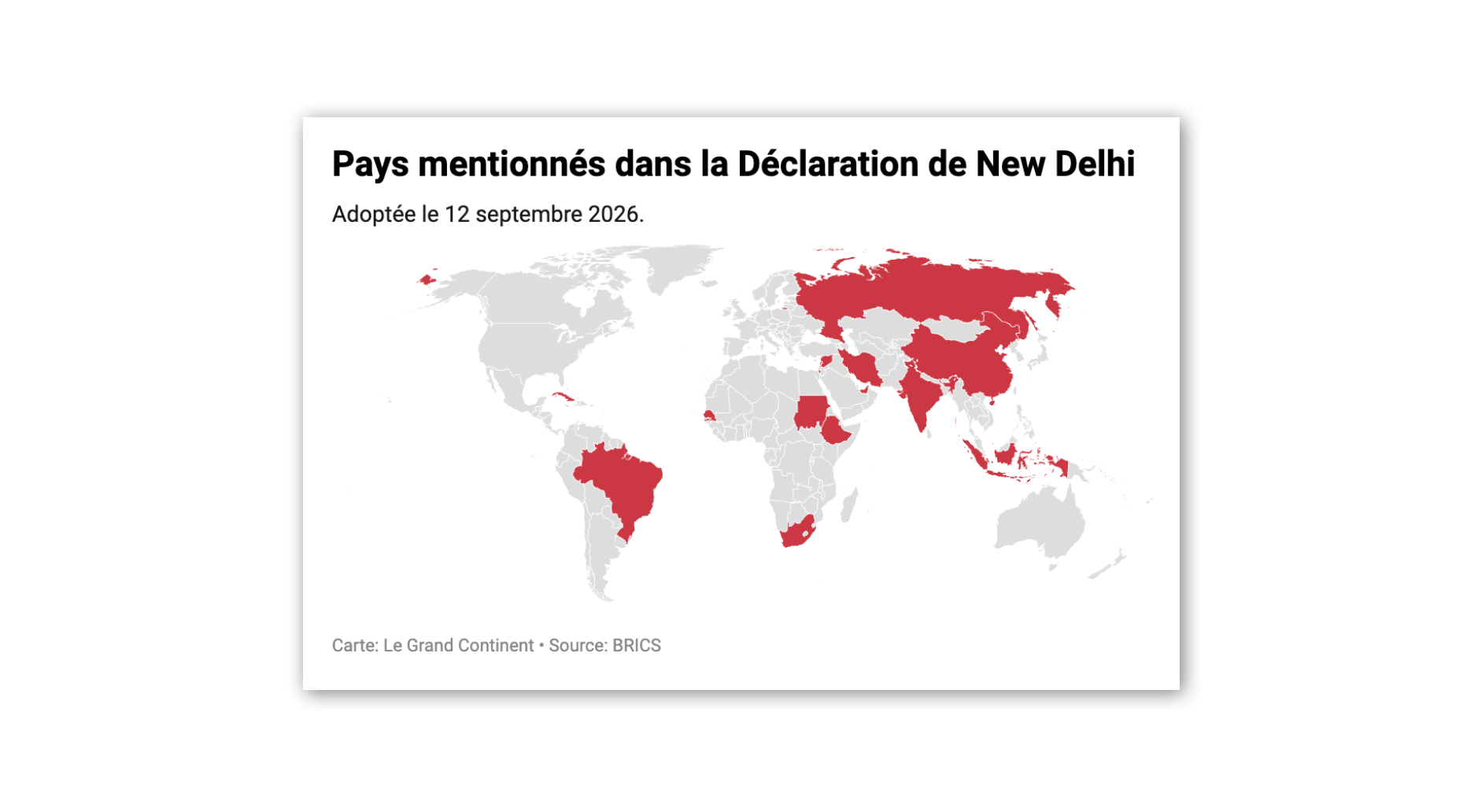
Over a two-day summit in New Delhi that concluded yesterday, Sunday, September 13, BRICS unanimously adopted a record-length declaration: 140 paragraphs, i.e., 14 more than the 2025 Rio declaration and twice as long as the Xiamen declaration (71 paragraphs) in 2017. It is thus almost twice as long as the nine texts adopted by the G7 in Évian, in June.
The document translates both the group’s priorities and its positioning, as well as the various compromises that had to be made: BRICS had failed to adopt a common declaration on two occasions this year, during ministerial-level meetings.
- The major absences from the declaration are Europe and the war in Ukraine, which do not appear at all in the 45 pages .
- The Iran, which joined the group in 2024, is mentioned only once in a paragraph supporting the country’s accession to the WTO, alongside Ethiopia, a BRICS member since the same year.
- The declaration calls for “restraint” in the war in the Middle East, language that allowed both Tehran and the United Arab Emirates, a Washington ally targeted by Iran since February, to sign on.
The “Global South” is mentioned ten times.
- The document counts 7 mentions of the Gaza Strip, one of the West Bank and 5 of Palestine.
- Among the major regions, Africa is the most mentioned (21 occurrences), followed by Asia (6), Latin America (4) and the Caribbean (3).
Russia and Israel are the only countries of the “North,” according to the classification used by UNCTAD, mentioned in the document.
- Moscow is however a founding member of the group, and its president, Vladimir Putin, is the only leader alongside Xi Jinping who has attended all the group’s summits since 2013.
- Mentions of Israel in the document appear in paragraphs calling for a peaceful solution to the Israeli-Palestinian conflict, respecting the delivery of humanitarian assistance to Gaza, and the withdrawal of the IDF from South Lebanon.
- India is the bloc’s main ally of Israel within the group.
The New Delhi declaration remains deliberately vague on certain points. If BRICS members condemn, in paragraph 21, “the blind rise of tariffs and non-tariff measures, or protectionism disguised under environmental objectives” (a veiled reference to the European Union), the United States are thus never specifically targeted. Donald Trump had threatened last year a 10% tariff on countries that “align with” BRICS.