
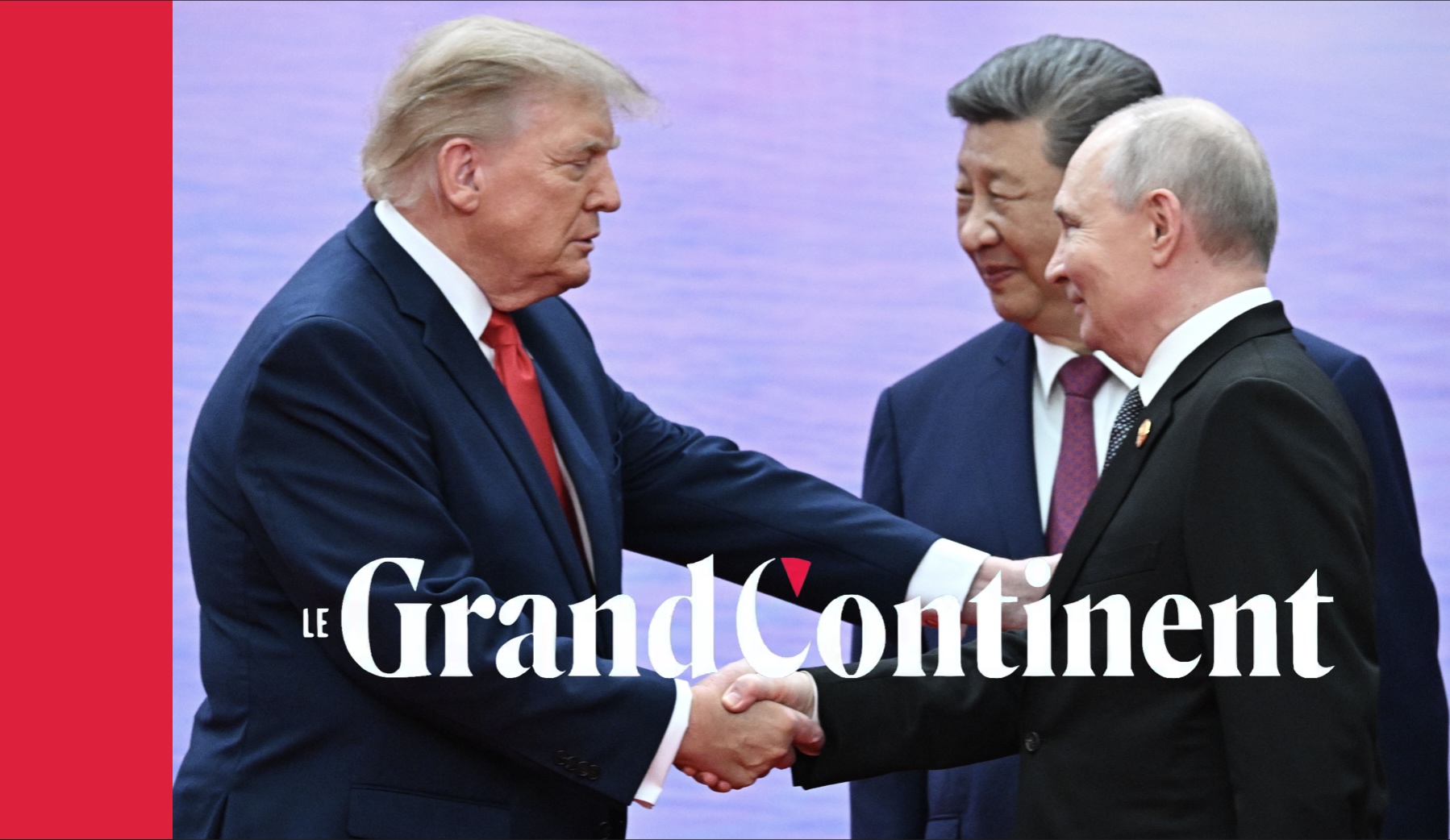
“He who is not at the table ends up on the menu.” As Donald Trump, Xi Jinping, and Vladimir Putin convene in Shenzhen for an unprecedented trilateral meeting, a text has been circulating widely on Chinese social networks.
Its author, Rong Ping, runs one of the most-followed nationalist accounts in China. Often incendiary, yet tolerated by the regime, he belongs to a group that constantly tests the official line and offers readings that go beyond the Party’s soothing discourse.
While he mentions Yalta—a sensitive analogy for the Chinese imagination and one rejected by the state press—Rong Ping emphasizes another aspect, little commented on in Europe: what Shenzhen would reveal is the capitulation of the United States.
“Today, the global geopolitical stage officially turns a page. […] This meeting marks the end of American hegemony and the world’s entry into the multipolar era of the three kingdoms.”
According to Rong Ping, Donald Trump did not travel to Shenzhen by choice.
The White House’s retreat on tariffs against countries that “rose up” was its first confession. After the “strategic humiliation” with Iran, the consolidation of the Russia–China alliance, and an Asia-Pacific setup reduced to “an empty shell,” the United States “cannot contain, cannot fight everything, and cannot endure.”
For the first time in their history, the United States sit at the table with the great powers because they are “pressed and forced.”
In this three-way world, Europe would have no seat and no voice. It is even noted only for the way in which it “slumps.”
Because this thesis says much about how the moment is read in China and the place they reserve for us, and because it hides fundamental dimensions of the moment—such as Russian impotence in Ukraine and the capacity of republics to stand up to empires when they choose to fight—we translate it and comment on it line by line.
Today, the global geopolitical stage officially turns a page.
I am not exaggerating. Former U.S. Secretary of State Blinken once said that, in the international system, the one who is not at the table ends up on the menu. Looking at how Europe is sinking day by day, who remains seated at the table? Surely three countries. These are the three nations present in Shenzhen today for this trilateral conference.
Some will say these are merely three leaders of great powers meeting. For the Yalta conference of 1945, surely some would have thought the same. And yet, Yalta directly set the postwar order for the next forty-some years after World War II. Major events often unfold without warning, and you and I may well be witnesses to history without realizing it.
Let us return to this meeting. For China, Russia, and the United States, it is, more than eighty years after the end of World War II, the first real face-to-face encounter.
It is neither a chance cross-pollination of two sessions nor a polite exchange at a grand multilateral conference, but a closed-door strategic gathering whose date, venue, and agenda were deliberately fixed, and in which all three parties attend of their own accord.
That is the first reason this meeting makes history.
Why does one say that geopolitics is opening a new chapter? The reason is simple. This meeting marks the end of American hegemony and the world’s entry into the multipolar era of the three kingdoms.
History itself bears this out.
During World War II, to fight fascism, conferences among the great powers multiplied, but China, Russia, and the United States—or more precisely China, the United States, and the USSR—never sat together. In Cairo, it was China, the United States, and the United Kingdom. In Tehran, it was the United States, the United Kingdom, and the USSR. The reason is straightforward. The United States, at its zenith, deliberately kept China and the USSR apart and refused, at any price, to allow a three-way dialogue that could establish a mechanism of triple dialogue, so as to retain permanent control over global discourse and the prerogative to interpret the world order.
With the Cold War, the American–Soviet face-off and the Sino-American split, the world divided into two camps, and the chance to sit together vanished even more.
After the Cold War, the United States reached its unipolar apex and the global configuration became transparent. The United States dictated minor and major affairs, allies followed, and adversaries were isolated, crushed, or militarily overwhelmed. The color revolutions in Ukraine and the Middle East, the protracted Afghanistan conflict, the Gulf War, the American blockade and containment of China, Russia, and North Korea, etc., are all indicators present before us.
During this period, American diplomacy had a single objective: to prevent China and Russia from forming a bloc and to exclude any tripartite co-management. The tactic was to divide and harvest on both sides. Against China: a trade war, a technology war, encirclement by the South China Sea and the Taiwan Strait. Against Russia: maximal sanctions, expansion of NATO to the East, and strangulation by military and geographic advantage. What the United States dreaded most was that China, Russia, and they themselves would stand on equal footing and that they would lose part of their “right to rule.” Now, the Shenzhen trilateral meeting ends the unipolar dominance long sustained by Washington. This is the second reason why this meeting makes history.
So, why did the United States concede, or, to put it differently, accept reality? It is not magnanimity but a resigned compromise imposed by the balance of power. Indeed, three irreversible facts now shape the global scene.
First, Sino–Russian relations are at the best they have ever been: political trust high, economic ties closely knit, diplomatic alignment strong, and the United States can no longer outpace them one by one.
Second, America’s global lines are being pulled in every direction: the Middle East, Europe, and the Asia–Pacific; they no longer have the strength to contain it all.
Third, the multipolar turn of the world is a given; unilateral sanctions and hegemonic rules lose bite. The Trump era tariff policy is a typical example: some countries “rose up” and eventually compelled the United States to seek a peace of sorts.
In short, the United States can no longer contain, cannot fight everything, and cannot hold out. It has little choice but to take a seat at the negotiation table, compelled and coerced.
That is the most profound historical significance of this meeting. It may signal the end of a unipolar world and the official establishment of a completely new order, three-handed.
So a new question arises: why can China and Russia sit at the table? The answer rests on one word: power.
First, Russia has broken free from its geopolitical siege. After years of conflict with Ukraine, not only has it not been crushed by the West, it has, out of necessity, severed its energy dependence on Europe, completed its transformation toward a war economy, and strengthened its strategic depth on the Eurasian continent. The NATO aim of absorbing Ukraine has been thwarted; Russia is no longer on the defensive but is actively shaping the pace of the game.
Second, China has broken the American blockade. The situation in the Taiwan Strait remains under control; the DPP cannot spark large waves; consultations in the South China Sea proceed regularly; the Philippines are signaling a shift as well; and the “first island chain”—the tiny enclaves of Asia–Pacific strategic circles carefully assembled by the United States—has become nothing more than an empty shell. Add to this China’s industrial breakthroughs, technological progress, and upgrading of its military, and the United States is forced to regard China as an equal and to seriously assess its own strength.
The decisive factor is the upheaval in the Middle East. As noted, the United States is experiencing strategic humiliation there. Iran’s deterrence pays off; American garrisons withdraw passively; Saudi Arabia, the United Arab Emirates, and other Gulf states begin to look eastward. The hegemonic order the United States spent half a century building in the Middle East is crumbling rapidly. On the Eurasian continent today, China and Russia hold each end—East and West—forming a complete strategic loop. The United States now finds it hard to sow trouble at will.
In this context, what will the three talk about?
The primary center of gravity is to define each party’s zones of influence, end the open-ended game, and establish new rules for the geopolitical order.
The United States must accept three realities. In the Asia–Pacific, they cannot lead alone, nor may they interfere at will in Asian affairs. In Eurasian security, there can be no unlimited NATO expansion to the East. As for the Middle East, they must accept empowerment of regional countries, which will no longer be governed by American diktat.
Next come the red lines. In recent years, global military risk has reached an unprecedented level. NATO provocations have multiplied, arms races are intensifying in the Asia–Pacific, conflicts in the Middle East and Ukraine spill over repeatedly, and the risk of miscalculation among major powers is at its highest since the end of the Cold War. In this context, the three powers know full well that none can afford a war among major powers, none can bear the cost of a miscalculation. The second center of gravity of these talks is thus to delineate each red line, frame respective military actions, revive nuclear-arms control negotiations, and prevent a war from spilling beyond finite bounds.
Seen in this light, the three-way table is like placing a high-security safety valve on a turbulent world.
If geopolitics and the military are the façade, industry and resources form the real backbone of the three-way game.
Almost all current global conflicts ultimately boil down to who controls industrial supply chains and who can set the price of energy and resources. The central aim for the United States is to safeguard its industry, defend the dollar, and shield itself from inflation. Through negotiation, they seek two things: first, a measured détente in the technological race with China to relieve pressure on their high-tech supply chains; second, stabilization of global energy and grain prices to curb domestic inflation and extend the life of the American economy.
The central demand of Russia is to end sanctions, revive resource trade, and strengthen Eurasian energy supplies. It seeks three-way talks to break the grip of unilateral sanctions, widen export opportunities, and build a trade system that is dedollarised. As for China, its core demand is to stabilise industrial chains, ensure energy security, and adhere to the new rules of globalization. Taken together, the three-way relationship is now delicately balanced. The reality of strategic rivalry cannot be erased, but decoupling in economy, energy, and resources is impossible; thus the only option is to sit at the table, compelled, to renegotiate the division of labor, resource prices, and trade rules. The third central focus of the Shenzhen talks is therefore a substantial negotiation over the global distribution of industry, energy, and wealth for the coming decade.
For those who grasp the three levels of the game, the shape of the coming world becomes clear.
The history being written in Shenzhen proclaims the end of an old era and heralds a new one. An era of equal footing among great powers, where common ground is sought while respecting differences, disagreements are managed, and the pursuit is toward cooperation, development, and shared gains. This trend naturally aligns with the idea of a community with a shared future for humanity.
A final word on Shenzhen. This city is singular. More than forty years ago, it was the window through which China opened to the world and surged forward. Today, it could well become the milestone marking the transition from the old world order to the new, and witnessing the international landscape move toward a new dawn.