
Russian and Ukrainian representatives will meet in Abu Dhabi, United Arab Emirates, on November 10-11 for a new round of discussions. The United States will be represented by Steve Witkoff and Jared Kushner, and four European countries (France, the United Kingdom, Germany, and Italy) will also be present in Abu Dhabi through their national security advisers, in addition to representatives from NATO and the European Union.
- The makeup of the Russian and Ukrainian negotiating teams is a key variable for understanding the Kremlin’s intentions.
- By since 2022 entrusting the leadership of its delegations to an ideologue or to a military officer rather than a diplomat, Putin signals that he does not intend to end the war.
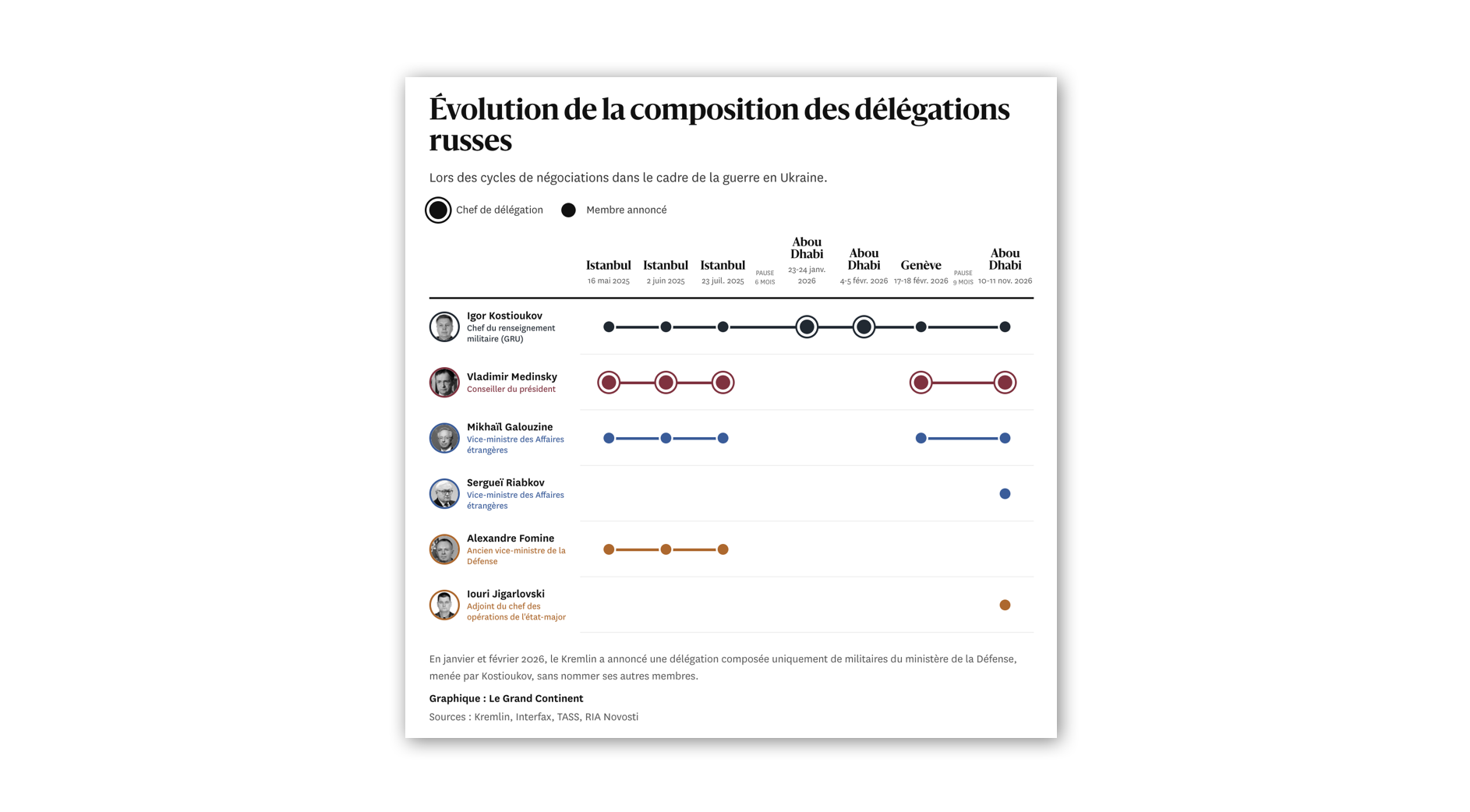
The delegation that will be present in Abu Dhabi from tomorrow, Tuesday the 10th, largely reprises the one from the last cycle, in Geneva in February.
- It will once again be led by Vladimir Medinsky, who has been taking part in the Russia-Ukraine negotiations since 2022.
- Medinsky, an adviser to Vladimir Putin, is an ideologue who had taken advantage of previous negotiations to deliver long lectures on the “root causes” of the conflict, according to Ukrainian and American sources.
He will be accompanied by Igor Kostioukov, the head of military intelligence (GRU) who had led the January and February cycles in Abu Dhabi, and by Deputy Foreign Minister Mikhail Galuzin.
- Deputy Foreign Minister Sergei Riabkov, in charge of relations with the Americas, arms control, and the Iranian nuclear dossier, is expected to officially be part of the delegation for the first time.
- Yuri Jigarlovski, deputy head of the General Staff’s Main Directorate of Operations, responsible for planning and conducting military operations, is expected to represent the General Staff alongside Kostioukov.
- During the Istanbul rounds in 2025, the Defense Ministry was represented by Alexander Fomin, then Deputy Defense Minister, who had already sat in on the 2022 negotiations. He left the ministry in October 2025 and was replaced in his post by Vasily Osmakov.
The composition of the Russian delegation, even if it shows a few changes, does not indicate a shift in Moscow’s position.
- Riabkov was indeed one of the main architects of the ultimatums addressed to the United States and to NATO members in 2021, which, according to the Institute for the Study of War, amounted to dismantling the Alliance under the guise of “security guarantees” for Russia.
- Medinsky, the head of the delegation, oversaw the new set of history textbooks, generalized in September 2026 to all Russian schools, which presents to students the “heroes” of the war in Ukraine that they must know to succeed in the history exam.