
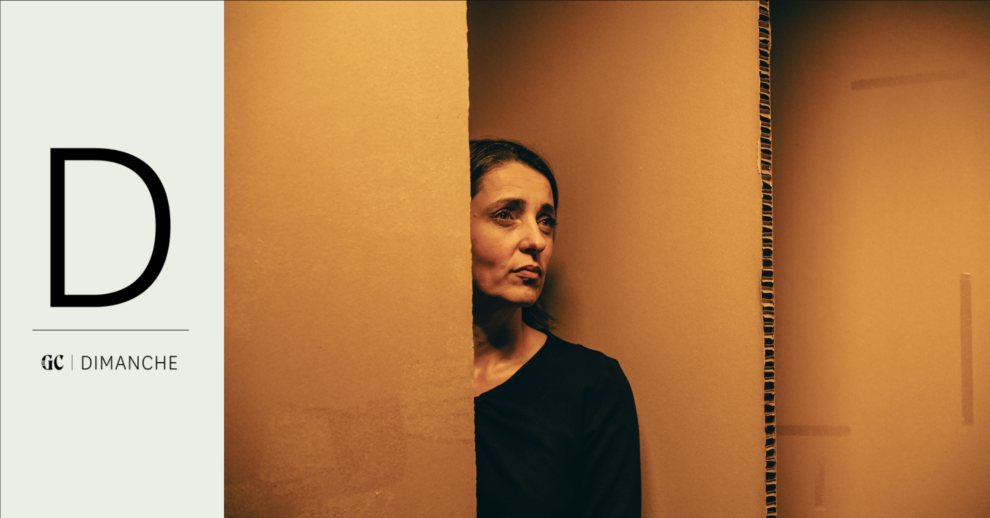
Things are busy right now. It’s always busy, but right now even more so — no need to ask why, we all know. So it’ll be a coffee with the head of the CGT, without even the moment for a coffee, just before an interview at France Télévisions. The very morning, she had gathered the CGT federations to take stock of sectoral wage negotiations. “We can’t even talk about a diesel engine,” she says, to describe the start of these negotiations, “since at this stage the engine hasn’t been invented yet. In most sectors, no meetings are planned.”
“The engine hasn’t been invented yet”
What a strange moment for a struggle, a few months before the presidential election? Not for Sophie Binet, who believes she can obtain “immediate gains for workers,” that is, wage increases. The government did grant a 0.6% boost to the minimum wage, which she places in the category of small operations “yellow coins.” “Now all wages must rise, and that will only happen under pressure from a balance of power. The CGT will therefore call for a new day of action on December 1 and will publish a barometer of sectoral negotiations, so that every employee knows where theirs stands, and to pressure the employers as well as the Ministry of Labor, which has levers to pull.”
Another diesel engine not yet invented: the youth. Were they heard? Not, according to her: “The announcements are piecemeal and above all neither funded nor implemented. The Education Minister promises to limit to twenty-eight the number of students per class in the Seconde year. Very well, but for that to happen you’d need eight thousand teacher recruitments that nothing counts on. He announces twenty thousand additional places in higher education, when more than sixty thousand high school students find themselves each year without placement; sixty to seventy thousand would be needed for the right to pursue studies, written into the education code, to become a reality. The same in the master’s program, where thirty to forty thousand bachelor’s degree holders remain each year at the door.”
Can this government, without a majority, do anything anymore? “It self-demotivates,” she says. “Restoring the taxation of the largest companies to its 2026 level is a political choice,” and she doubts that it would sink the economy, “with profit margins around 32% and dividends higher than ever. The same goes for the point of index for civil servants that the government could raise. It would cost about two billion euros, i.e., less than the three billion the government this year returns to large firms by easing their surcharge. As for the 2027 budget, it would finish weakening purchasing power already strained by the freezing of family allowances, housing aid, pensions and student grants,” and by what she calls “the taxation of the sick.”
Emmanuel Macron? “They damaged his entire second term,” she tells me. “He only understands the offer policy.” What will remain of Macronism? “Thanks to the mobilization against the pension reform, she explains, Emmanuel Macron was blocked on the essential: no reform of the civil service, two reforms of the unemployment insurance blocked, no reform of public broadcasting, and the list could go on. She had warned the president: “if he pushes the pensions reform by force, he will lose all credibility and the means to govern. The threat has been carried out.”

“There remains only one totem, the offer policy: lower taxation on the wealthiest and the largest corporations, multiply incentives for firms that capture the largest profits, compress wages and public spending.” This policy, pursued for more than ten years, is, in her eyes, “a catastrophe, whose economic results we can now see. It is to protect this, she says, that the president has always kept a trusted figure in the Treasury, no matter the cabinet reshuffles. The revenues, however, are not lacking: the CGT proposes tens of billions of euros. Abolish the Dutreil pact, abolish the tonnage tax enjoyed by a few shipowners, starting with CMA CGM, adopt the Zucman tax, overhaul and condition the 211 billion in aid to companies… If nothing moves, it’s because it contradicts a dogma.”
Henri Krasucki, a Heroic Life
We wanted to talk with Sophie Binet about one of her predecessors, Henri Krasucki, whose story has resurfaced in a book. Krasucki was a distant uncle – among Ashkenazi Jews, you are cousins because you come from the same village – and he came from the same village as my grandfather. My grandfather hosted him in the small house he owned there; Krasucki rode a bike with my mother, he was sixteen.
Henri Krasucki looked so much like my grandfather Yossele; he has always been very present in my family, where we were communists, and even a bit more than that. He resisted with cousin Hélène Igla, arrested by the Nazis in the Paris metro, then died in deportation. It moved me to see Sophie Binet taking up in her own words this tradition, she who does not come from that milieu and who trained with the Young Christian Workers.
She never met Krasucki: two generations separate them, and he left the head of the CGT in 1992, when she was ten. But she wanted to pay tribute to the testimony he gave in 1998 to the Foundation for the Memory of Deportation, published this autumn under the title We Wanted to Live but Not at Any Price. For her, “Krasucki is first and foremost the figure of the resistance.” She is proud to militate in “an organization led for fifty years by former resistants, Benoît Frachon, Georges Séguy, Henri Krasucki. The current leaders do not call themselves heirs, that would be presumptuous, but rather custodians: an inheritance that weighs on their shoulders, which they must live up to, to the clarity and courage of those who came before, and which also gives a lot of strength.”
This book, in her view, is “the best militant training manual there is. Not a history book: a book that gives a compass to today’s activists.” She draws from it principles. “Always work the base, first. We foster a grand romance of the armed struggle and clandestinity, she says, but Krasucki explains that even in clandestine action, his group conducted mass work and propaganda, without which the armed struggle would have been unpopular.” She was struck by what he recounts about resistance in the camps: at Jawiszowice, the work camp dependent on Auschwitz where he was deported, he managed to build a network of four hundred resisters among four thousand deportees. “Ten percent,” notes the unionist: “if the CGT counted ten percent of unionized workers in all companies, she would be satisfied.” She often cites this example to comrades who claim employer discrimination. “Krasucki, he achieved it at the risk of his life.”
This mass culture, he drew from his father, a unionist. At the time of the Munich Agreements, the majority of his father’s CGT comrades supported them as peace pacts; the Krasucki family saw, on the contrary, Western powers’ cowardice in the face of the Nazis. The father could have deserted his work collective and the militant framework. He chose to mute his disagreement to preserve the bond with his comrades, which later allowed him to organize resistance with them. Another lesson: dignity and solidarity as guiding principles, in every situation. “There is no small resistance; you can always do something.” Krasucki often said, she notes: “something had to be done, we didn’t know what, but something had to be done.”
“There is also internationalism, very strong in a man who became naturalized quite late, allied with a deep attachment to republican values. Krasucki tells of the Republic’s school, the tricolor flag brought out again in 1936, the motto that these young foreigners made their own. That’s what Aragon notes in L’Affiche rouge, she observes: these foreigners were also our brothers, engaged in the defense of the French Republic.” She finds it wonderful that “today’s mobilized high school students have pulled out the French flag and La Marseillaise to reclaim republican symbols. Krasucki recounts that his generation did the same in 1936, sowing seeds for the Resistance. Finally, the book contains things he never said about anti-Semitism.”

Why him rather than another? “Because he was, in her view, the most fiercely criticised, booed, and hammered general secretary of the CGT. Every CGT leader faces class contempt, because the CGT’s discourse disrupts capital,” she herself feels little about him, “the period being rather favorable to unions, and being the first woman in that post giving her some leverage. But Krasucki endured something of a different nature: beside the contempt for workers, there was xenophobia and anti-Semitism. He never highlighted or complained about it, perhaps to avoid entering that terrain.” She recalls, however, that “in the 1980s, when he was secretary-general, a journalist from Le Figaro dared tell him that as a recent Frenchman, he should criticize France less. This book rehabilitates a figure unfairly damaged.”
She also loves the complexity of the man. “Polish stranger, Jewish, worker, he could not be boxed into any category. He was a great music lover, a profoundly cultivated man who recalls reading Descartes’ Discourse on the Method in prison.” She admires Benoît Frachon and Georges Séguy just as much, “the latter having, in May ’68, understood that it was necessary to join the youth and the workers, which did not come naturally. But both were in their own ‘line of swimming’: workers, sons of workers, communists, sons of communists. Krasucki, a Jew, long a stranger, faced throughout his militant life xenophobia and anti-Semitism, something his predecessors did not have to confront.” That is what makes him, in her eyes, “so singular and complex.”
Never Back-to-Back
Here I come to La France insoumise. Some of public opinion wonders about Jean-Luc Mélenchon’s anti-Semitism, and polls suggest a second round between him and Marine Le Pen. “The CGT’s position is absolutely clear: we never back the far right against anyone; that is the confederation’s identity,” she replies. Even against a right-wing candidate? “Of course: the CGT called to block them with Jacques Chirac, then with Emmanuel Macron.” I push, to provoke, the name David Lisnard. “The question,” she answers, “is whether we are dealing with a true republican candidate.” What worries her is “hearing the theory of the great replacement from Bruno Retailleau, from Laurent Wauquiez or David Lisnard.” The country needs to reclaim a republican right, heir to Gaullism, one that builds a barrier against the far right and never allies with it. She senses that “all barriers are about to fall, that the prohibition that structured eighty years of political life is about to crumble. There is the potential glass ceiling to break, and the far right’s doors to power could open.”

“The CGT, it knows where it comes from. In 2024, during the second rounds between the right and the far right, its militants took responsibility, including in difficult constituencies: Elisabeth Borne’s own, in the wake of the pension reform, and Laurent Wauquiez’s as well. But that must apply to everyone, and not only in one direction.” She warns about seeing employers treat the far right as a force like any other, which she sees as a major change. “Laurence Parisot,” she recalls, “never had the slightest contact with the far right.” She calls on employers to remember their republican heritage and to honor it.
So I come to the delicate topic: anti-Semitism, and the accusations of anti-Semitism aimed at LFI. “The party of Jean-Luc Mélenchon is not an anti-Semitic party, she asserts, unlike the Rassemblement National, which is historically and structurally so, despite its façade.” She sees evidence every day. The day before, she was reading the story of a town where a survivor of the Vel d’Hiv roundup had been made an honorary citizen, and where the RN’s three elected officials had voted against. “That remains, however, that LFI, like all political forces, must do work on racism, anti-Semitism and stereotypes within it.”
“The CGT, she says, is doing this work. On October 5, 2023, the eve of October 7, it gathered five hundred militants in the confederation’s courtyard for a study day titled “Fighting the Far Right, Racism and Anti-Semitism.” Joining these three words is becoming increasingly difficult. Some had internally asked why specify anti-Semitism, since racism includes everything. In theory, yes, she admits, but it was necessary to undertake thorough and specific work on this particular form of racism. On that day, the confederation’s forecourt was named Henri-Krasucki Forecourt. We were right, she says. On October 7, the cards were shuffled. In November 2023, the CGT refused to participate in the anti-Semitism march because the far right was welcome there. One cannot be far right and claim to fight anti-Semitism, she explains; one cannot fight anti-Semitism through another racism; that is the whole ruse of the far right; and one cannot wage the anti-racist fight without naming this particular form of racism, anti-Semitism.”
She adds a detail that, in her view, blurs lines: “Israel is today led by a far-right Prime Minister. Benjamin Netanyahu, she says, invites leaders of the international far right to visit the Holocaust Memorial and even maintains contacts with the AfD,” which she calls a “neonazi party.” “This broad ideological confusion allows the European far right, heir to all the anti-Semitic parties on the continent, to present itself as at the forefront against anti-Semitism, and for Netanyahu to portray all those who reject” what she calls “his genocidal policy.” “We must not fall into the trap of portraying criticism of the State of Israel’s policy as anti-Semitism. But we must also, she adds, not justify, legitimize, or excuse anti-Semitism on account of the Palestine situation scandal, nor attribute Jewish identity to Israeli politics—these are two different questions.”
“The CGT was clear, she explains, thanks to this prior work and its history. Led for fifty years by former resistants, it had organized foreign workers through MOI, the Immigrant Workforce, before and during the war, with Yiddish-language groups. It therefore has a culture and history specific to fighting anti-Semitism. That did not stop it, during this famous day, from facing the residual anti-Semitism that has always existed in the workers’ movement. The same goes for sexism: the CGT is obviously not a sexist union; it is feminist, but that does not mean there is no sexism within the CGT, nor that it should not be fought.”
The Optimism of Will
And if Marine Le Pen were elected? “First, do everything to prevent it,” she answers, and she thinks she can achieve it. I point out that we read the same polls. “That’s the optimism of the will, as Gramsci would say”: I have pessimism of the intellect, she has optimism of the will. “In 2024, all polls predicted a far-right victory and none foresaw the left leading; the citizen and union-driven momentum made them lie. A poll is only a snapshot taken at a given moment, without social dynamics.” She cites Brazil, “where no poll predicted Lula would win and where mobilization, including union activity, beat the far right, then the United States, where the Democrats won by finally addressing workers rather than just saying racism and sexism are wrong. You do not defeat the far right with moralizing rhetoric or hollow values, she says, but with social perspectives and proposals for the world of work.”
Should we read this as a critique of identity politics, of what some call wokism? She denies it. “The CGT is feminist and believes that more than ever we must fight racism and anti-Semitism, of which there is a worrying banalization at work.” She receives testimonies “that we would never have heard a few years ago.” Just the day before, a mother told her that her son, an Amazon delivery driver, had been called a “filthy Arab” and slapped by a customer. She advised her to file a complaint, but not alone: accompanied by a CGT delegate who also supports her against the employer, so that the employer, responsible for their employee, takes responsibility and files the complaint with them. “These battles are essential,” she concludes, “but a left-wing policy cannot stop there. We must respond to social questions, put work at the center, ensure a monthly salary and lifetime rights—pensions, social security, unemployment—have a strategy to relocate and decarbonize industry, and bring true democracy into work.”
The Glass Ceilings
I raise a topic I had discussed before with Philippe Martinez: some CGT members vote for Marine Le Pen. How does she explain it? She begins with a methodological clarification. “We don’t know anything about individual union members’ votes, and the CGT doesn’t seek to find out, out of respect for freedom of conscience. The rule, however, is clear for militants: showing extreme-right opinions is incompatible with CGT responsibility, and even with membership. Those who do it lose their mandate. The cases are rare, about ten exclusions a year, and the rule has never changed. As for sympathizers, studies show they vote for the RN in a proportion ten to fifteen points below the average. Unions thus offer protection, relatively, but not completely. It would be necessary, she concludes, for the CGT to be much more present and much stronger; that would reduce the far right.”

This figure, above all, shows that “the far right is breaking through all its glass ceilings. It is advancing in all categories, including among public employees who had been kept away from it for a long time. For the first time in our political history, she notes, the far right could reach power through the ballot box; under Vichy, it was the war that carried it there.” She sees two main causes. “First, downward mobility: that of work that no longer pays, of public services that no longer protect, of industries that close one after another, of territories where there is nothing left, of the country in short. The fragmentation of collectives afterwards. The historical strength of the working class was solidarity, the principle that when you touch one worker, all workers come out. Competition, outsourcing, subcontracting, and offshoring broke up work collectives, which hurts unionism but also social bonds and democracy. Work used to be the last place where people mixed—managers and workers, people of all nationalities, skin colors, religions and beliefs. Unionism brings people together on the basis of common interests against the employer and leaves aside identity questions on which the far right preys to divide. By making it harder to form communities of interest, management strategies have complicated the task for unions, and that is also where the far right is advancing.”
She offers a rhetorical question: does she prefer Marine Le Pen’s pension reform to Emmanuel Macron’s? She says she likes our provocative questions, then deconstructs the National Rally’s project. “A complete con and a pro-employer reform since it introduces a capitalization stage, the number-one objective of an employer class that dreams of speculating with pension money. It would especially harden the requirements to validate a full career. Today, a quarter is validated with 150 paid hours at the minimum wage; with the RN reform, you would almost have had to work full-time, which would deprive part-time women and precarious workers of validation. Unemployment or sickness spells would stop counting toward validation. The display of a retirement at 62, or even 60, would then concern almost no one, due to the required annuities. Finally, the project eliminates all provisions on arduous work, another employer demand. Yet arduous work, she reminds us, those who have worked even one day know it, and it is reflected directly in life expectancy gaps. Denying it is an insult to workers.”
A Vocation
Where does her commitment come from? At fifteen, she discovers, in her high school, social reproduction: the children of workers do not have the same chances of success as the children of managers. That enrages her. She tells herself that either she becomes a worker herself, to reset the counters, or she dedicates herself to fighting this injustice, which would probably be more useful to others. Activism is for her a vocation, which gave meaning to her life. It wasn’t, at fifteen, a matter of joining the CGT, but of knowing how to live in an unjust society without investing all one’s energy in changing its rules. She found it intolerable “to have chances that others did not have, to seize them and leave things as they are; she needed to put these chances to the service of changing the game.” Hence JOC. She wasn’t baptized; she tried to believe in God a lot, but never succeeded. Her family, rather anti-clerical, never understood this choice. She now believes in something else: “in human action, in humanity.”
She studied philosophy, while doing a lot of practice, she says, “philosophy on the side.” Her first year of studies was Descartes’ year, which she liked, at least the few reference texts. Then militant activity took over; she completed her studies without being, she says, “a model student.” Marx? “Of course. Rereading the Communist Manifesto remains impressive: many things have changed, but it succinctly says potent, enduring things. A reference thinker, foundational.” Among contemporaries, she cites Naomi Klein, for her ability to think social and environmental together, and above all for the idea, developed several years ago, that “the environmental challenge is not a problem but a lever. The climate crisis is not the product of human activity in general, but of capitalist activity; it therefore requires transforming the economic system. The union movement has long been on the defensive on these questions; this reading allows us to go on the offensive.”
There is also Alain Supiot, who, she says, theorized the transformations of the world of work with decisive concepts. “Governance by numbers sums up what the CGT calls the Wall Street Management.” Taking responsibility seriously seems to her an essential title, “because globalized capitalism is a system of total irresponsibility, where no one is responsible for anything.” She notes this daily. “If HR managers find themselves sometimes held captive, it’s because there is no one responsible in front: the HR director is the agent of the CEO, the CEO is the agent of the shareholders, and the shareholders, in a financialized capitalism, are invisible and untouchable. This generalized irresponsibility, where everyone resigns, also nourishes the far right.” For the rest, she admits she lacks time to read.
Fanfares and Laughter
She played in a brass band. She can still play in theory, but she no longer brings out her instrument for lack of time. She finds the growing role of brass bands in protests wonderful: “a democratization of musical practice, rather elitist in France, and a way to make militant actions festive, attractive, joyful, so that demonstrations do not resemble first-class funerals.” I object that a demonstration is, first and foremost, anger. She answers with Krasucki. “When he enters resistance, in 1940, he is about sixteen. In an occupied France, under extremely violent repression, where every action is hyper dangerous, he does funny things to mock the occupier and win the crowd’s laughter. It’s a major lesson for him. You start from anger and indignation, but you don’t stop there: you rise above it, by laughing at those opposite, and that’s how you gather people. You must also enjoy militant life, and reject self-sacrificing commitment.” She laughs every day, as much as possible, even in the worst moments: “that’s what keeps you going, and what prevents you from taking yourself too seriously.” What makes her laugh? “Everything.” No favorite comedian, due to lack of time; she is surrounded by funny people who love to laugh and joke with each other.
Union, Not a Party
Why choose union work rather than politics? In France, former union leaders rarely go into politics; the two worlds remain separate, which is not the case everywhere. She notes: “we often caricature the CGT as the most politicized union in the world, when it is actually less so than others.” I point out that she has nonetheless crossed a kind of line. She contests: “the CGT’s stance on the Nouveau Front populaire is not new; there was, in Krasucki’s time, the Common Programme.” I specify that I’m thinking more about the fight against the far right, where she has shown more leadership. She can be very clear, she replies, “because the CGT has always been, and all its predecessors were, that way. It has never been a debate: it is a bedrock of the organization for 130 years. In 2002, under Bernard Thibault, the CGT called to beat Jean-Marie Le Pen; in 2017 and 2022, under Philippe Martinez, to beat Marine Le Pen.”
And Emmanuel Macron? She has only seen him once in a one-on-one meeting, in August 2023: the appointment accorded to every new secretary-general, like Philippe Martinez before her, or Marylise Léon at the CFDT. “After that, you don’t see him again.” She went straight to the point, listing all her disagreements, starting with pensions, and told him that “if he changed nothing, he would remain the president who had advanced the far right the most.” She didn’t know then that he would dissolve the Assembly in 2024. “Of all the very pleasant moments, she says with irony, he took away only one: we will need to talk again, I don’t agree with you on the far-right issue.” They did not go deeper; the interview ended. I note that he was elected against the far right. That is precisely what she told him: “elected against it, he will remain the president of the Fifth Republic who will have brought it up as much as ever, perhaps even to power.” So is she pessimistic too? “We will prevent it,” she answers, but even then the margin will be far narrower than in 2002, 2017 or 2022. He bears crushing responsibility on this point.

The turning point, in my view, is when the president decided that only demonstrations declared by unions would be allowed. How did she experience that? “As another strategy of division, and a way to make the CGT responsible for any excesses. Or the unions are to blame for dispersions if they refuse them; it’s a way to designate them to public condemnation. Granting unions a monopoly over demonstrations is sliding toward an authoritarian regime: any association, any citizen, has the right to organize a demonstration in public space. Ironically, it’s the president who has fought unions the most who ends up in this position.”
Three Dangers
In her book, she identifies three challenges: aging, artificial intelligence, and the climate. To her, aging is actually “more good news than not, a sign of social and health progress.” “Fewer children, for women, isn’t always bad,” she adds. She has a son; that is enough for her.
On AI, should we regulate, or even ban, or should we bet on redistributing productivity gains, perhaps into leisure time? “Both, she answers, but the latter requires the former. History shows that productivity gains never automatically or naturally benefit human progress: without regulation or a balance of power, they go to capital. The nineteenth century saw huge productivity gains and great industrial discoveries, which benefited humanity only in the twentieth century, after a hundred years of social struggles and two world wars, with labor law and reduced working hours. It will be the same with AI, which must be regulated economically and especially ethically, because it raises questions far beyond those of electricity or even the Internet. When the designers themselves warn that it could turn against humanity, or even destroy it, how can we carry on as if nothing happened? This is one of the fundamental questions posed by the mobilized youth. You’re crazy, they tell adults in effect: you’re burying your head in the sand about the environment, about technology, about inequalities, you’re offering us a crazy society.”
Why are these topics absent from the French political debate, when they occupy so much of the American debate? “First, she explains, because part of capital no longer wants to hear about the environment. We are living with the far right at the door of power, undergoing a shift from neoliberal capitalism to libertarian capitalism, for which even greenwashing is too much already. Trump cut all budgets, including those that funded somewhat meaningful actions. It was the GAFAM, the Big Tech, that helped elect him, and this new alliance with the far right makes environmental questions harder than before. Then, due to lack of courage and short-termism. AI and climate force us to ask what kind of society we want to live in five, ten, or fifteen years from now, when so many people don’t know how they’ll make ends meet on the fifteenth.”
Shostakovich and the Democratic Question
We must conclude, and we are used to asking our guests for a piece of music. She loves classical music, another point in common with Krasucki, even if their tastes diverge a bit: he leaned toward Beethoven, Schubert, opera; she toward Shostakovich. If you could pick only one work? “There are so many. There are pieces to see, like the Third Symphony, called the ‘First of May,’ for example, which she finds brilliant. “And those to listen to, perhaps chamber music, starting with Piano Trio No. 2.”
Shostakovich, I tell her, met a terrible fate: a man who believed in communism crushed by Stalin. I think of Krasucki’s generation, of Leopold Trepper, the leader of the Red Orchestra—the intelligence network that did wonders against the Nazis—whom Stalin had jailed after the war. The name means little to her; I strongly urge her to read his memoirs. “Shostakovich, crushed with all his ambiguities, is felt in his music,” she says. For those who had believed in communism and the Soviet Union, disillusionment was terrible.
“But the central question, the one that was too little thought through, is, in her view, the democratic question, and with it the independence of unions. It is perhaps the point that Marx did not develop enough, as if collective ownership of capital should naturally resolve everything. The real question is who leads. If the communist experiment failed, it was because we did not think about democracy, checks and balances, the proper role of unions, which is not that of the party.” She states her disagreement with Leninist conceptions of the party-union relationship: “the union must have an autonomous role; it is not there to be the transmission belt for a political strategy.”
As we part, she adds one last word. “All CGT general secretaries,” she says, “have shared this view. Even during the Cold War, the confederation remained independent, and Georges Séguy as well as Henri Krasucki asserted themselves as autonomous actors.” So there is nothing new in what she has just told me: it was already the practice of her predecessors.