
A Telescope and a Microscope
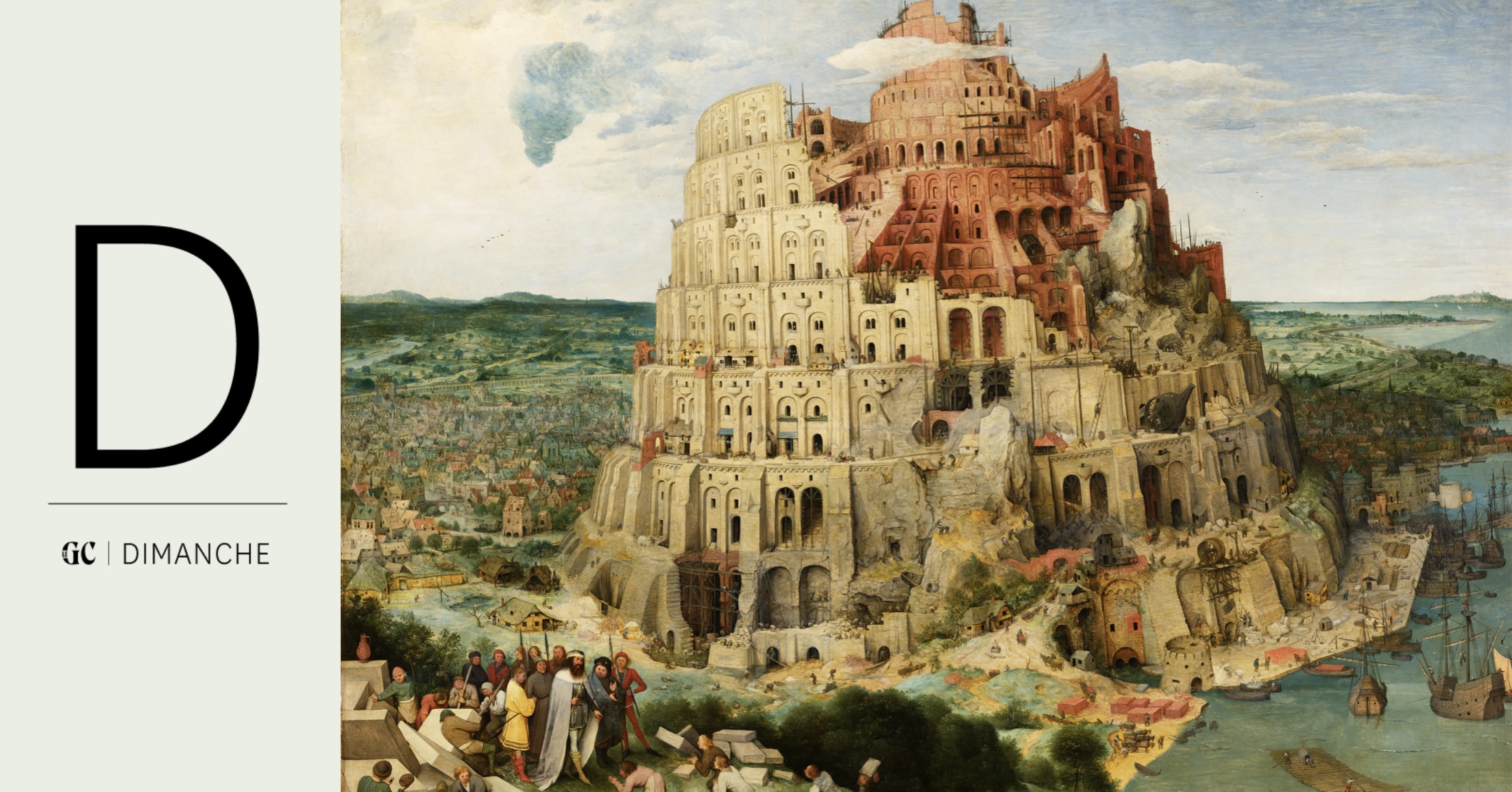
Pieter Bruegel’s The Tower of Babel (held at the Kunsthistorisches Museum in Vienna) depicts a world in its own right, occupying much of the composition. It seems to rise from a mountain, as if the architecture stretches the natural world while devouring it. The summit even appears to press beyond the frame, and everything surrounding it—the vast landscape and the walled port city—becomes utterly small and trifling. The men at work around the houses and the boats resemble ants. It is therefore a painting that one does not observe in the same way from a distance and from up close. The great art historian Erwin Panofsky once said that Flemish painters painted with both a telescope and a microscope. This formula fits especially well here.
In the foreground, a distinct scene unfolds: King Nimrod arrives to inspect the project he has set in motion. He is accompanied by soldiers and what seems to be the master planner. To his left, stonecutters continue their labor, while to his right, workers prostrate themselves before the king in a crawling gesture. This contrast between the act of prostration and the life continuing around it is remarkable, particularly in the precise handling of tools and the actions of the figures who keep working.
Thus Bruegel ties the king’s ambition—turned tyrant, who profits from his people and is worshiped as a god—to the human scale of ambition that seeks to reach the heavens.
The Biblical Narrative
The painting obviously illustrates the Babel story in the Book of Genesis, set after the Deluge. The descendants of Noah, all living in a single region and speaking one language, decide to build a city with a tower tall enough to reach the sky. They want to prevent being scattered across the earth. It is at this moment that God intervenes. He descends to earth, notices the construction, the know-how and the immense ambition of humankind, and decides to punish them by confounding their language. Instead of speaking one language, the people begin to speak distinct languages and cannot understand one another, which halts the work and leads to the abandonment of the Tower of Babel.
Bruegel highlights the essential elements without retelling the entire story. He focuses on the moment when people are united in this colossal enterprise to push beyond the limits imposed upon them.
The Babel narrative is also a tale of fall. In the Old Testament, two falls have already occurred. Bruegel painted the first: The Fall of the Rebels Angels (Royal Museums of Fine Arts of Belgium, Brussels), which, out of pride, refused to submit to God and were cast to earth. The second is that of man, who, by tasting the forbidden fruit of the tree of knowledge, provoked God’s anger. It is again a story of pride and ambition that leads to a third fall: the Tower of Babel. Yet the moment Bruegel chose to depict is intriguing. It is not the moment of confusion, dispersion, or collapse, but a construction site that seems to be functioning well. However, when one looks more closely, one discovers that this magnificent project is already threatened with ruin.
A Construction in the Form of a Paradox
The overall strange impression rests on the fact that the tower seems simultaneously under construction and in ruins. This is one of the paradoxes of the painting. From afar, it appears very solid, with its massive base, its repeating pillars and arcades, and the rocky footing that seems capable of supporting a colossal mass. It gives the sense of a perfectly organized project, with an extraordinary technical description. And then, when you approach—because this is a painting to be studied with a magnifying glass—you begin to see that everything begins to unravel.
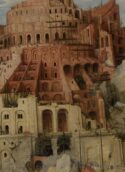
The base traces a spiral, and one can count seven levels, yet the very foundation that should allow workers, carts, horses, etc., to enter through the front entrance is problematic. Curiously, this great spiral ramp is interrupted by yawning abysses. What should guarantee the foundation and the circulation resembles more a labyrinth with passages that lead nowhere.
If one continues to explore the upper levels while the base remains unfinished, one notices that some parts have already begun to consolidate. There are even people who have settled there and already live among the structure. Small houses and everyday scenes appear. A mix of technically risky operations exists; taken separately, they are correct. But once all the parts are brought together, something does not work. Most notably, there is the striking anomaly: the tower tilts to the left. The builders have raised the walls in relation to the inclined ramp rather than to the ground. Each operation seems correct on its own. Yet when these operations are combined, the whole is false.
Everything is well built in isolation, but not the tower itself. And this is where Bruegel goes very far. Each craftsman knows his trade, every machine functions, and each gesture is precise. But no one seems yet able to see the whole. The tower thus becomes the image of a humanity that, with remarkable efficiency, pursues a project it no longer masters and which already carries within it its own fall.
Bruegel the Exegetical Painter
The Tower of Babel is a painting where several temporalities meet. Bruegel seeks to recover a biblical narrative of the past while translating it into the world of his own time. To do this, he draws on other visual traditions, but also on sources external to the Bible, notably Flavius Josephus’s Antiquities of the Jews. It is indeed Josephus, not the biblical account, who connects the tower’s construction with King Nimrod. Bruegel does not merely illustrate the biblical narrative; he offers a visual interpretation, a form of exegesis.
Exegetical reading of the Scriptures traditionally distinguishes four levels of comprehension. The first is the literal or historical sense, concerning events described by the text. It is on this level that the three spiritual senses—allegorical, tropological (moral), and anagogical—are grounded. In his painting, Bruegel emphasizes particularly the tropological sense, or moral reading, which invites us to consider the narrative here and now and to question our own conduct. In this way, the biblical past resonates with the contemporary world within the painting. The city around which the tower rises is encircled by walls on the left and opens to the right onto a port that recalls the city of Antwerp, where Bruegel lived.
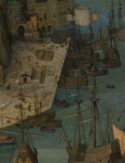
The tools of the workers, described with precision, the lifting devices, cranes and levers, as well as the four-masted ships that bring the bricks needed for the worksite, all belong to the sixteenth century. The maritime activity, commercial prosperity, and architectural expansion clearly evoke Antwerp. This work, intended to depict a distant past, stages the most modern techniques of his time. By situating Babel in his own world, Bruegel makes the biblical narrative immediate and seems to tell us that if the Babel enterprise were to happen today, people would probably redo it in the same way.
The Kakker
In his Book of Painters, published in 1604, Karel van Mander writes that Bruegel had been nicknamed “Pieter the Jester” and adds that it is often difficult to look at his works without laughing, even for the most dour spectator. As so often, it begins with a small scene or a tiny, incongruous detail, almost out of place, aimed at making us smile, but which also draws our gaze and invites us to reflect, even to reinterpret the whole painting. Here, Bruegel returns to a motif found in several of his works: a small figure crouched, defecating—a little kakker, which Van Mander also mentions elsewhere in his book. This detail is clearly comic. But it must also be taken seriously. The figure appears to the right of Nimrod, just above a stack of perfectly geometric stone blocks forming a pedestal, above which the little kakker seems to float.
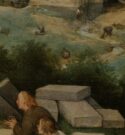
This detail perhaps also sheds light on the choice of the architectural model for the tower. Bruegel indeed draws on the Colosseum, which at the time stood as one of the great symbols of Antiquity. Yet under his brush, this ideal model becomes a strange hybrid monster, at once colossal project and already-begun ruin. It is precisely where construction seems to fail, where the tower looks dangerously tilted, that Bruegel places this little scatological figure. A trivial detail thus suffices to reveal the vanity of the entire undertaking. Bruegel may also have recalled an engraving of Roman ruins published by Jérôme Cock, in which a small defecating figure hides among the ruins. The pairing is striking: on one side, the monument, human ambition, the dream of grandeur, and already the fall; on the other, the fall of the trivial (to borrow Goethe’s phrase), which reminds man of his earthly condition.
Puzzles and Riddles
To the right, one finds a motif common in Bruegel, notably in works where Bosch’s influence is evident: a hybrid creature or anthropomorphic figure. Here, the small fortified structure crowned with a cannon that marks the entrance to the giant tower seems to possess a face. Its round windows, or oculi, resemble eyes, while its grand doorway evokes a mouth. The same anthropomorphic effect repeats across the entire surface of the tower, with its openings and arcades resembling eyes and mouths. It is as if Bruegel is telling us that this exaggerated architecture is ultimately a reflection of the one who built it: the monumental portrait of human ambition.
The Babel tower looks at us directly. But why is it looking at us? And why does it continue to speak to us today? Probably because it speaks not only of Babel. It speaks of all those collective undertakings that humanity undertakes and which, at a certain moment, end up exceeding them. At first, however, everything seems almost ideal. People speak the same language, pursue the same goal, and work under a remarkable organization. Materials arrive by boat, are unloaded, transported, cut, and assembled. Everyone knows his task and performs it with precision. And it is precisely there that the painting becomes unsettling. Everything works, but no one seems to see the whole. Each person performs his task perfectly without questioning the direction of the project. Everyone knows how to build, but no one appears to be asking why.
There is, of course, also the question of language. Bruegel chooses to portray the moment just before catastrophe and shows us all that a common language makes possible, while letting us sense how fragile that consensus is. The painting also speaks to power. Thousands of workers literally build the tower, while Nimrod, who stands apart from the labor, reaps all the credit.
And the tower itself keeps growing. It soaks up resources, dominates the city, and completely transforms the landscape. Its construction continues even as its faults already herald its collapse. That is why this image remains so pertinent. Bruegel keeps us in a state of awe and unease. We are amazed by what humans can achieve together, yet we also see the moment when their success begins to turn against them. The painter not only imitates nature with remarkable fidelity; he also offers us a mirror to human nature, to its ambitions and follies.
Each generation reinterprets these polysemous, enigmatic, and ambiguous images that confer the strength of Bruegel’s works. By painting an immense collective endeavor of vertiginous power, where everyone masters a part but no one seems able to grasp the whole functioning, the direction, or the consequences, Bruegel may have painted a prophetic image of artificial intelligence?