
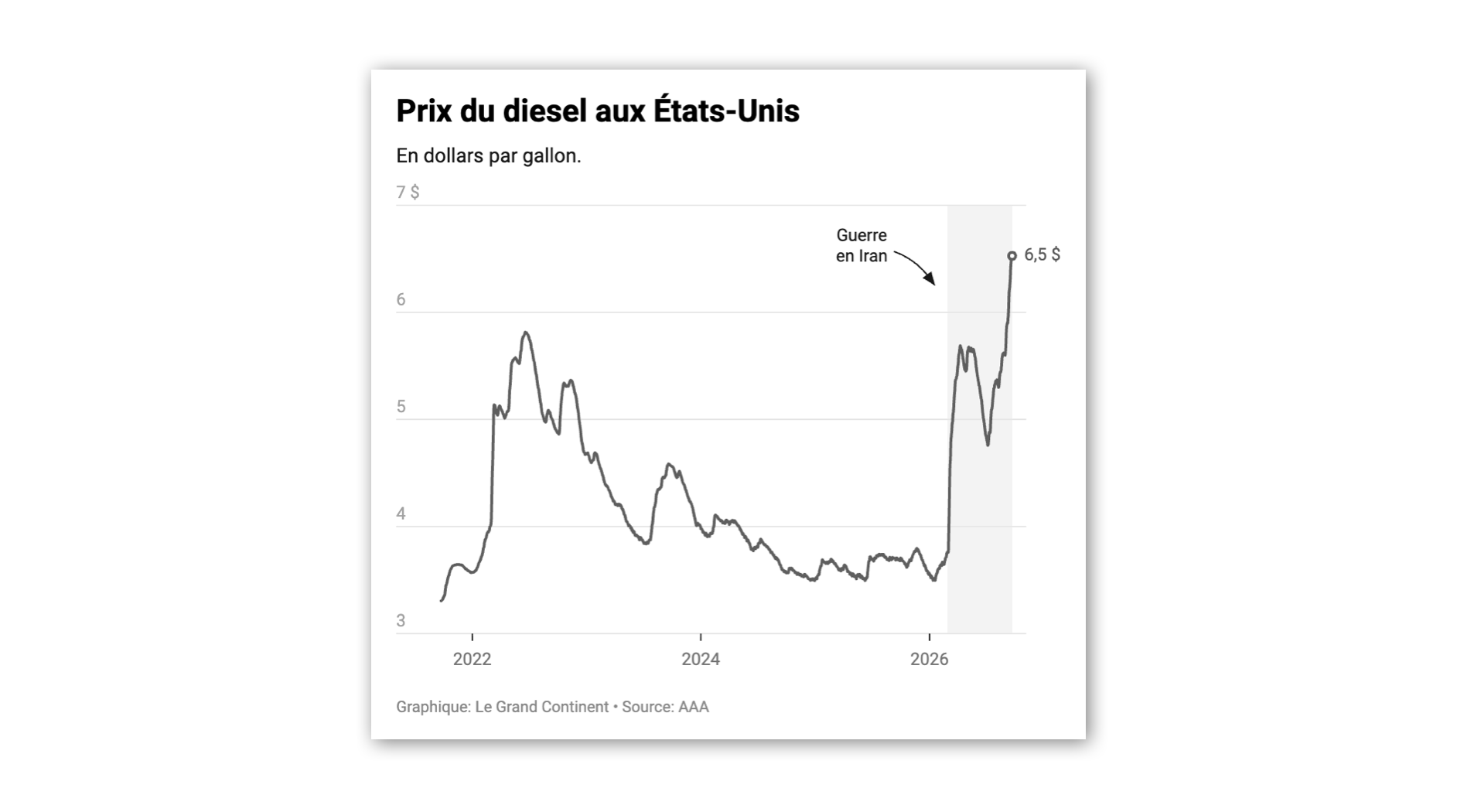
A growing number of Republican lawmakers are urging the White House to suspend fuel exports, notably diesel, in order to curb price rises in the United States. According to data from the American Automobile Association (AAA), the price per gallon of diesel exceeded $6.50 on Tuesday, September 22 — nearly double what it stood at the start of the year (about $3.50).
- The Louisiana Republican governor, Jeff Landry, named “special envoy for Greenland” by Trump in December 2025, called on Thursday, September 17, for a 90-day ban on diesel exports.
- His appeal was echoed in the Senate on Sunday, September 20, by Chuck Grassley, a Republican from Iowa, where the GOP could lose a seat in the November elections.
- In the House, Republican Representative Tim Burchett filed last week a bill to prohibit diesel exports until January 2027, and another to establish export controls if the national average price reaches $5 per gallon.
The Trump administration, which has up to now opposed an export ban, has recently signaled a certain openness.
- In early September, Energy Secretary Chris Wright did not rule out during an interview the possibility of implementing a diesel export ban. He did, however, state the need to “keep energy supply as fluid as possible.”
- Last week, Interior Secretary Doug Burgum stated that the Republican administration could “consider an export ban” if it believed that such a measure could actually lower prices — which is not currently the case.
An export ban, while it might lead to a relative short-term decrease in U.S. prices, would risk being counterproductive in the medium and long term. American refiners would be forced to cut their processed crude volumes, which would likely push up prices for all fuels — diesel, gasoline, and kerosene.
- U.S. exports of petroleum distillates (diesel for road use, diesel for agriculture, and home heating oil) have risen markedly since the early 2000s, increasing from 100 million barrels per year in 2007 to 450 million last year.
- Even if only a small portion of these exports go to European countries, which refine most of their fuels themselves (around 80% in 2022), a suspension of American exports would impact global energy markets.
Such a measure would reduce global supply, forcing buyers to turn to alternative sources. Meanwhile, production in Gulf countries is deeply affected by the war, the blockage of the Strait of Hormuz, and the Houthis’ attacks in Saudi Arabia, while Russia is preparing to extend its diesel export ban beyond the end of September.
- The price of gasoline paid at the pump by American consumers rose by 49% between February and September, more than double the increase seen in the European Union (24% on average across the 27 member states).
- Trump has accused Ukraine in recent weeks of being responsible for the price rise by striking Russian energy infrastructure. Yet the war in the Middle East has deprived the market of a larger volume of diesel than the war in Ukraine, according to Bloomberg.