
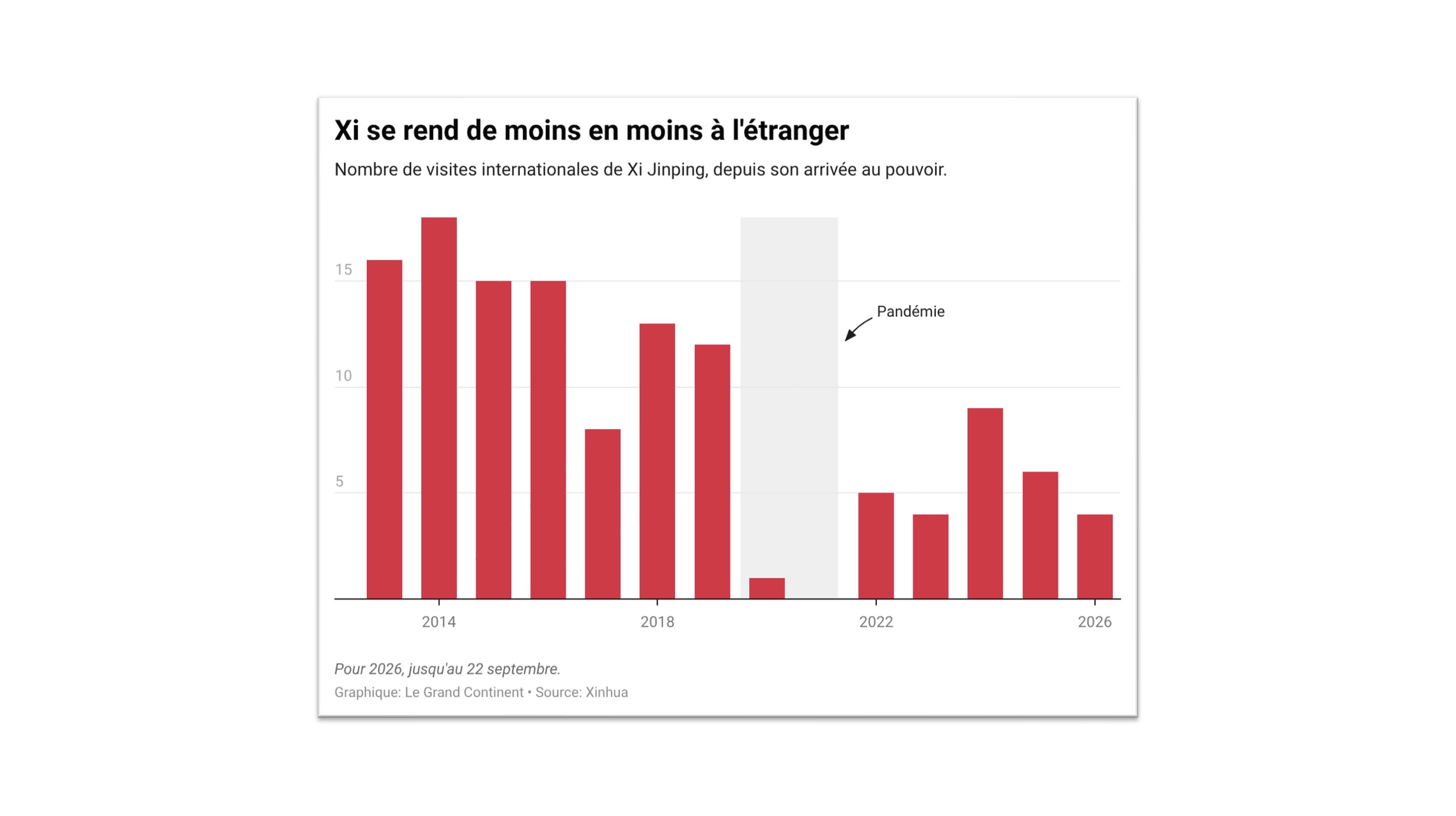
Xi Jinping is traveling today to the United States for the sixth time since taking office in 2013. For the first time, he will be greeted by the American president as he steps off the plane, breaking with the protocol, which, in the vast majority of state visits by foreign leaders, calls for a welcoming ceremony on the South Lawn of the White House.
Trump will thus become the first president since Kennedy to travel to Andrews Air Force Base to welcome a counterpart — apart from papal visits.
- The arrangement deployed by the White House to honor Xi Jinping and the first lady, Peng Liyuan, surpasses the measures put in place during Trump’s visit to Beijing in May.
- After a welcome at Andrews Air Force Base, Trump will receive Xi at the White House tomorrow, Thursday the 24th. On this occasion, 479 service members representing all branches of the U.S. armed forces will be on the South Lawn.
- The ceremony will include a presidential salute rendered by the United States Marine Corps Silent Drill Platoon and the United States Joint Forces Command, and will conclude with a military flyover featuring a B-2 Spirit stealth bomber and four F-22 Raptors.
Xi is accustomed to being greeted as soon as he steps off his plane by his hosts. In recent years, leaders who have made the trip for this occasion include former Hungarian Prime Minister Viktor Orbán, the King of Cambodia Norodom Sihamoni, Serbian President Aleksandar Vučić, and North Korean leader Kim Jong-un.
- These honors are, however, rarely given: Chinese diplomatic protocol indeed provides for a reception by ministers or senior officials.
- German Chancellor Friedrich Merz had thus been welcomed in Beijing during his visit in February 2026, while former British Prime Minister Keir Starmer was received at the airport by Chinese Finance Minister Lan Fo’an in January.
- Trump himself had been greeted by Vice President Han Zheng, and not by Xi Jinping.
The meeting is primarily aimed at consolidating the understanding begun in Busan in October 2025, then extended in Beijing in May.
- For Rush Doshi, a former senior official at the National Security Council under Biden, Busan mainly demonstrated that China now sees itself as the equal of the United States in many areas (AI, trade, security…).
- Beijing responded to American tariffs by weaponizing its dominance of the rare-earths sector, forcing Washington to back down.
- The lavish protocol reserved for Xi fits into this dynamic of self-interested courtesy – Washington is thus less about impressing Beijing than ensuring its cooperation.
The state visit is intended to maintain the momentum of the relationship and to confirm two additional meetings before the end of the year: one at the APEC summit in Shenzhen in November, and the other at the G20 in Miami in December.
- The principal objective is to preserve this framework of “constructive strategic stability.”
- The two sides have an interest in extending the trade truce, given internal political cycles: the United States’ midterm elections in November and the Chinese Communist Party Congress in the fall of 2027.