
Test the Grand Continent. The ideas and analyses you won’t find anywhere else. But you’ll see them soon everywhere. In your inbox from eight euros per month
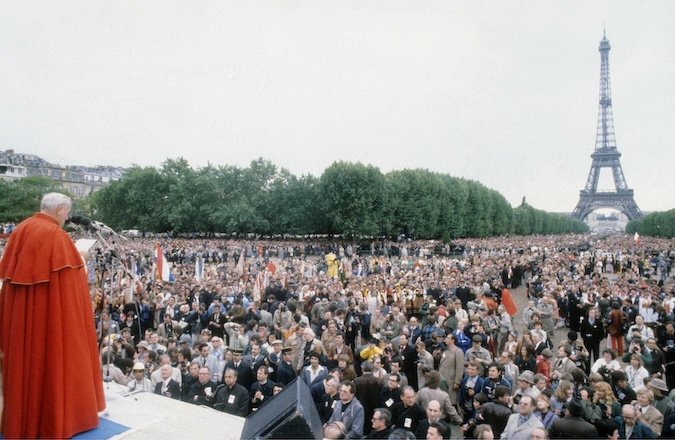
In 1980, during his first apostolic journey to France, John Paul II addressed the crowd gathered at Bourget with the question: “France, the eldest daughter of the Church, are you faithful to the promises of your baptism?” This famous prompt reveals something about the expectant and particular relationship between the papacy and France, which existed at least until the early 20th century, and at the same time signals a loss of influence, if not of prestige, of France within the Catholic world and especially with the Holy See, observable throughout the 20th century.
These lines of reflection, which do not claim to exhaust the subject, focus on this ambiguous relationship, concentrating on the period from the mid-19th century (the beginnings of what has been called the “Roman Question”) to the end of the 20th century: a century and a half sometimes overlooked, yet essential to untangle in order to better understand where we stand on the eve of Pope Leo XIV’s visit to France.
In this period, two main phases can be identified. First, between the springtime of the peoples in 1848 and the rupture of diplomatic relations with France in 1904, the papacy and France maintained a distinctive, fundamentally heritage-bound relationship with 1789 as a central reference point. Second, between the Separation of 1905 and World War II, the relations between the popes and France were marked by a gradual reconciliation and also by the consequences of France’s slow loss of influence within Catholicism. Finally, some concluding remarks address the second half of the 20th century, when, in the wake of the Second Vatican Council, the Church’s decentralization away from the old European powers accelerated.
It should be noted that these questions have spurred a substantial historiography, notably linked to the gradual opening of the Holy See archives (from 1884, when Leo XIII opened part of the Vatican archives, dating before 1814). Beginning with the pontificate of Pius XI, the habit developed of opening papal archives season by season, up to the latest opening under Pope Francis in 2020 of the archives of the pontificate of Pius XII. Work has also been conducted, in particular within the École Française de Rome in recent decades: numerous publications focus on the history of the papacy and its global implications, not limited to France.
1848-1904: a singular relationship, under the shadow of 1789
In the middle of the 19th century, the papal relationship to France inherits a decade of turmoil following the French Revolution. Beyond the persecutory climate that characterized the Revolution’s most violent phase, what occupied the popes was not primarily a change of regime. In the 19th century, the popes spoke little on this topic and rarely succumbed to the temptation of explaining the fall of the monarchy through a eschatological key, as imagined by Burke or de Maistre (the latter, however, giving a preeminent place to the pope within his counter-revolutionary system).
What primarily preoccupies the popes during the revolutionary period and the years that followed is safeguarding the primacy of the pope and his authority over the bishops. This was the core issue of the conflict sparked by the Civil Constitution of the Clergy, which can be read as much in terms of a rupture brought about by the Revolution as a continuation of a form of Gallicanism with deeper roots. The fiercely negotiated Concordat of 1801, despite the Organic Articles that limited papal prerogatives and despite a failed reform during the Restoration (1817), proves to be a compromise that endures through the entire century and across the various regimes, until 1905.
One should not think, however, that Rome had a juridical appreciation of the Revolution’s consequences. The early decades of the 19th century provided an opportunity for the papacy to begin developing a doctrinal corpus on the relationship between the Church and modernity, between the Church and liberalism—which, at least philosophically and politically, tended to be equated with the Enlightenment legacy and the French Revolution. Thus, one can understand, in particular, the first condemnation of “liberal Catholicism” by the encyclical Mirari vos of Gregory XVI in 1832.
French Catholicism in the 19th century is often depicted as a theater of conflict between liberal Catholicism and uncompromising Catholicism. Yet this is more a visual illusion. It concerns two periods of Catholicism that correspond to two different orientations. The July Monarchy and the brief Second Republic mark the high-water point of liberal Catholicism, with a strong intellectual bent (Lamennais, Montalembert, Lacordaire, Ozanam around the journal L’Avenir).
Liberal Catholicism is not a revolutionist project. It is staunchly ultramontane—which makes its condemnation all the more painful—and while it advocates a strict separation of political and religious spheres, and even the abandonment of the concordat, it does so primarily to secure the freedom of the Church. After Gregory XVI’s condemnation of liberalism in all its forms and of church-state separation, the leaders of liberal Catholicism continued to dominate Catholic intelligentsia in France; they oriented themselves toward defending several causes, the most well-known being the defense of Catholic schooling.

With the advent in 1846 of Pius IX, perceived as liberal because he was elected against the candidate supported by Austria, the great conservative Catholic power in Europe at the Vienna Congress, followed by the 1848 Revolution, which was free of anticlerical sentiment, Catholic liberals placed great hope in him. Early 1848, as the so-called “springtime of peoples” began in the Kingdom of Naples and spread to the Italian peninsula, Pius IX announced the drafting of a constitution for the Papal States. But his refusal to endorse the uprising against Austrian domination led by the King of Naples in the North of Italy pushed the pope to shift his position, drawing the king of Naples into a repressive course that soon engulfed the peninsula.
For more than twenty years, the France of Louis-Napoleon Bonaparte, elected president in 1848 and who became Napoleon III in 1852, became the guarantor of the survival of a Papal State increasingly endangered by Italian unification. The intensity of Second Empire military support for the papacy varied according to the crowds Napoleon III sought to win over in domestic politics, and the ambiguities of his Italian policy: for in reality, the Emperor was sensitive to the cause of Italian unification and saw it mainly as a way to challenge Austrian preeminence and the post-Vienna order. In 1849, the sending of an expeditionary corps to reestablish Pius IX in Rome after his expulsion by the Roman Republic led by Giuseppe Mazzini sealed the alliance between Louis-Napoleon Bonaparte and the conservatives. In 1859, while Napoleon III sought to evolve his power toward a “liberal empire,” he allied with Cavour and waged war in Northern Italy against Austria, which he halted abruptly, but which allowed Cavour, through a wave of uprisings in the peninsula, to secure numerous annexations to the Kingdom of Piedmont by plebiscite. A master strategist, Cavour knew how to evoke, before Napoleon III, the threat posed to the pope by Garibaldi’s Expedition of the Thousand in May 1860 to obtain the Emperor’s agreement for a preventive occupation of the Papal States by Piedmont and their annexation, with the exception of Latium.
The Second Empire nevertheless continued to defend this Papal State reduced to a mere shell against Garibaldi’s threat for ten more years, until the regime fell in the 1870 war: the repatriation of French troops from Rome then allowed the Piedmontese entry through the Porta Pia breach (a few steps from the current French embassy to the Holy See), and the installation in Rome of the capital of a unified Italy. Pius IX ordered Rome to be surrendered without battle and withdrew permanently into the Vatican Palace, refusing to make the pope dependent on the “guarantee laws” that the Italian government enacted in 1871. This marks the beginning of the “Roman Question” proper, which lasts for nearly sixty years.
The 1860s, during which Pius IX appeared particularly threatened, mark the beginning of an increasingly close relationship between French Catholics and the pope. This is evident in the engagement of the Papal Zouaves in the pope’s service. After the Battle of Castelfidardo, the great defeat of the Papal forces by the Piedmontese in 1860, the pope’s army, commanded by General de Lamoricière, from a Nantes monarchist family, benefits from an unprecedented international confessional mobilization that allows the organization of a battalion and then a regiment of Papal Zouaves. From 1860 to the disbandment of the regiment in 1870, 10,000 volunteers from twenty-five nationalities—mostly Dutch, French, and Belgian—took part. In France, every department contributed, but Brittany, especially the diocese of Nantes, was the major supplier of Zouaves (ahead of the North). The Battle of Mentana in 1867 was the major victory of the Zouaves against Garibaldi’s forces (and the rest of the time they spent waiting for an opportunity to fight…).
Behind the Papal Zouave commitment, we witness a multi-form engagement of French Catholics behind the pope and his temporal power: a spiritual commitment, but also financial, with the revival in 1859 of the Peter’s Pence. It is really around Pius IX’s figure (including very concretely, with the dissemination of his image and his messages, made possible by modern technologies) that the construction of a papacy revered and omnipresent in the Catholic world takes shape, what Philippe Boutry has termed the “movement toward Rome.”
In France, this marks the moment when a synthesis forms between a counter-revolutionary heritage, ultramontanism, opposition to liberalism and secularization, which comes to be known as “intransigence” or “intransigent Catholicism” (the term was defined by Émile Poulat), which gradually becomes dominant in French Catholicism in the second half of the 19th century. The pope’s image as a sovereign on a throne under threat is fundamental. Figures such as Louis Veuillot, editor of L’Univers, who lacked the intellectual heft of the leaders of “liberal Catholicism,” emerge from the shadows to become the spokesmen for defending the “pope-king.” In return, Pius IX frequently spoke about France and repeatedly approved the positions taken by Louis Veuillot.
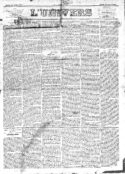
Under Leo XIII, one also finds this strong belief that the papacy is besieged by a liberal and anticlerical monarchy (the Piedmont of liberal and anticlerical modernity, which is how Cavour framed it in the 1850s to win northern Italian bourgeois support for unification around Piedmont). The confrontation between the Holy See and liberal Italy is a fundamental explanation for the papacy’s intransigence from the second half of the 19th century, and at least until the early 20th century. France’s third-position, involving both official power under Napoleon III who flattered and thwarted the Papal States, and the French Catholic church moving toward greater ultramontanism, also had a major influence on shaping the pope’s policy thinking.
Thus, the publication of the famous Syllabus as an appendix to the encyclical Quanta cura in December 1864 (which reiterates several dozen propositions condemning modernity, liberalism, and the Revolution’s legacy, already published in earlier papal documents) must partly be understood within the context of the “Roman Question.” Although prepared for about ten years, the Syllabus’ publication directly followed the Franco-Italian agreement three months earlier, which provided for a gradual withdrawal of French troops protecting what remained of the Papal States, without consulting Pius IX. Moreover, Napoleon III forbade public reading of the text, which was seen as an attack on his regime and policy. The Syllabus appears to ultraconservative Catholics as a confirmation of their commitments and, through the split its reception created within French Catholicism, is often described as the true birth act of Catholic intransigence, in opposition to the liberal positions condemned again.
The Syllabus, which becomes a true charter of Catholic intransigence in France by the late 19th century, does not merely function as a repellent that freezes the Catholic position in a unilateral rejection of modernity. It also, under the Third Republic, sparks a dynamic of intellectual, political and social innovations through which Catholicism seeks its own answer to “modern errors.” This is particularly evident in “Catholic social doctrine,” which emerges from intransigence (often legitimist) in response to social changes arising from the industrial revolution, but also to the fear of outright revolution prompted by the Paris Commune (1871). The experiences and reflections of the “Catholics social” from Belgium, Switzerland, Germany, and especially France, gave rise to the encyclical Rerum novarum (1891), a cornerstone of what is known today as the “social doctrine of the Church.”
The distinction commonly drawn for the period we are interested in between diplomatically minded or realist popes and intransigent popes must be nuanced. Intransigence thus becomes, in Rome as well, a doctrinal element in the relation to liberal modernity. The difference lies in whether it should be attacked directly (as Pius IX and, to some extent, Pius X in 1906-1907 did) or indirectly, through a bottom-up reconquest of society via charitable and re-Christianization works (favored by Leo XIII or Pius XI). Again, the relation to France serves as a fundamental indicator. Leo XIII does not resemble a liberal pope. He adopts the posture elaborated by Pius IX of the pope as a “prisoner in the Vatican.” The “movement toward Rome” is confirmed under his pontificate; the multiplication of pilgrimages, facilitated by the expansion of railways, is also a way for pilgrims to demonstrate their loyalty to the pope, to occupy the city of Rome still deprived of sovereignty by the Italian state and to remind oneself of the pope’s role as the Catholic Church’s capital.
Yet, while he stands firm against the kingdom of Italy, Leo XIII adopts a pragmatic stance toward France. He is highly informed, receiving many visitors from France, whether social Catholics marked by legitimism or Catholic intellectuals with liberal convictions (Étienne Lamy, Ferdinand Brunetière). Since 1879, Republicans had come to power in France after nearly a decade of monarchist rule that failed to restore the monarchy. The death of the main pretender, the Comte de Chambord, in 1883, followed by repeated electoral victories by the Republican camp, permanently sidelined the possibility of a restoration. For nearly forty years, the right was excluded from power. The Republicans undertook in the 1880s a substantial program including the secularization of society and especially education.
Throughout the Third Republic, anticlericalism—which in the 1880s primarily took the form of anti-congregationalism—formed the cement of a republican coalition whose other policies grew increasingly diverse. In the 1890s, the emergence of new political currents with more ambitious social aims—the Radicals and even the Socialists—fissured the Republican camp, some moderates being pushed toward the center.
Symmetrically, some Catholics, still very much a minority, considered unconditional opposition to the regime as sterile and argued that integrating into the political game through alliances with moderates was necessary in the face of social peril. This evolution is what Leo XIII sought to foster by encouraging the “reconciliation” of Catholics with the Republic, notably through the encyclical Au milieu des sollicitudes (1892), faithful to the thought of his predecessors who never showed a preference for a monarchic regime, but who sought to restore Catholics’ capacity to act politically. Yet the appeal to “reconciliation” was poorly received by most Catholics engaged in politics, who preferred to withdraw from parliament rather than disobey the pope, some taking up social action instead.
What to take from this second half of the 19th century? First, a strong link—positive or negative—between France and the popes, unmatched in the rest of the contemporary era. The pope played a significant role in French policy. He was increasingly present in French Catholicism as ultramontanism triumphed, nourished in part by the image of a martyr-like sovereign. In return, France appeared in papal audiences and in papal thought, and this became a major factor in understanding the papal stance toward modernity, which paradoxically contributed, in a way, to the emergence of the Church’s social doctrine.
1905-1945: from separation to reconciliation, an influence that wanes
The first half of the 20th century, opening with the separation of church and state, is marked by a withdrawal of France’s influence in the Catholic world. The Dreyfus Affair firmly closes the door on the era of “reconciliation” of the 1890s. It triggers a new sharp polarization between the left-wing republican side and the nationalist right. Consequently, among other effects, the loud anti-Dreyfus movement (and of course sometimes antisemitic) led some Catholic press organs (notably those of the Augustinians of the Assumption) to reintroduce anti-clerical sentiment into left-wing coalitions that governed France from 1899 onward.
A more virulent policy toward congregations reemerges, surpassing the 1880s, with the 1901 law which grants freedom to all associations except religious congregations, which must obtain government authorization—a request often denied. The Radical majority (the Bloc des gauches) came to power in 1902 under Émile Combes, and implements a strict interpretation of the law, closing many schools and forcing numerous congregations into exile.
Combes revived the theme of church-state separation, a banner tied to the Revolution and the Paris Commune. Initially, it served largely as a mobilizing theme and a means to pressure the pope. What Combes sought in 1902-1903, opposite to separation, was to use the Concordat as a more effective means of controlling the Church, especially episcopal appointments. He aimed to abolish, by force, the customary conciliation between government and Holy See that had characterized the 19th century—what was called the “preliminary understanding” for the appointment of bishops—and impose a more radical interpretation of the government’s right to appoint as recognized by the concordat through the “organic articles,” leaving the pope to provide only the canonical investiture under this reading.

Combes engaged in a head-on collision with Pius X from 1902, appointing or transferring bishops unilaterally; the pope refused to yield and confer investitures. Relations with the Holy See deteriorated until 1904. Combes deliberately triggered a diplomatic incident by allowing the visit to Rome of the French President Émile Loubet (as part of foreign policy orchestrated by Foreign Minister Théophile Delcassé to isolate Germany) to take place: for the first time since 1870, a Catholic head of state visited the King of Italy in Rome without a visit to the pope. In the same year, Pius X summoned to Rome two French bishops, one of whom was an openly republican figure, to defend themselves in cases of morals or administration: Combes demanded their recall, deeming them contrary to the concordat, the Holy See refused, the government announced the rupture of diplomatic relations, the French embassy to the Holy See was closed and the apostolic nuncio left Paris. Combes kept pushing, hoping to force Pius X to yield, even after his removal from office in January 1905. Thus, in a sense, the separation of Church and State became a reality by its own momentum.
The 1905 law is today regarded as a monument of the French legal system, which enshrines broad principles. First, in its Article 1, it guarantees freedom of worship. It is essential to recall that it begins by stating that it is on the basis of this principle that the government is compelled to do everything to allow the organization of Catholic worship even when, initially, the Church refuses the law. Then Article 2 asserts the absence of recognition or funding of religious cults by public authorities. The 1905 law did not create laicism (in fact, the word is absent from the text and only became common usage after the interwar period); it completed a process of progressive secularization begun twenty-five years earlier.
It is crucial not to forget that the 1905 law has always been the subject of interpretive disagreements, between the maximalist interpretation advanced by some on the left and far-left, who wish to use the law as a tool to weaken or even dissolve the Catholic Church, and a liberal interpretation emphasizing freedom of worship and aiming, as far as possible, to render the law acceptable to the Church. It is this second interpretation, driven by Aristide Briand, the rapporteur of the text, that prevails in the law’s wording. As for the spirit of the text, however, the two interpretations have continued to oppose one another in various ways, navigating sometimes unexpectedly between political sensibilities, up to the present day. This is why it is prudent not to claim to possess a single, unambiguous definition of what is now called “laïcité”: what a historian can offer is precisely a historicization of this complex concept, highlighting the diversity of its interpretations and its evolution through history.
The reason Pius X firmly rejects the text is not primarily the unilateral rupture of the Concordat it represents (which opponents call a “divorce”). It is the very essence of the text and the establishment of “cult associations” that lies at the heart of it, which the pope refuses. In addition to the abolition of the budget for worship, the main object of the 1905 law is to transfer the legal organization of worship from public law (under the regime of “public establishments of worship,” in force since the Concordat) to the law of associations, with the “cult associations” that would replace them. The question of maintaining episcopal authority over these associations, which must be composed of laypeople, lies at the heart of the 1905 debates.
In the encyclical Vehementer Nos, published in February 1906, Pius X condemns these associations, arguing that the rights of hierarchical authority are then not guaranteed. The year 1906 is filled with heated debates; most bishops and Catholic intelligentsia, taking note of Pius X’s principled condemnation, nevertheless favored a practical accommodation, given the risk of losing a large portion of the Church’s assets if no associations could receive them. In May 1906, at Pius X’s request, the first plenary assembly of the French episcopate was held (such meetings had been excluded under the Concordat) and it expressed support for the attempt at “canonically legal” associations, i.e., cult associations that would guarantee episcopal authority and conform to canon law. But Pius X preferred to condemn any such conciliatory path in a second encyclical, Gravissimo officii, in August 1906. The Catholic Church entered for nearly twenty years into a kind of legal vacuum, losing, on occasions, a significant portion of its assets.
Pius X was particularly influenced by the French intransigence, which had a strong influence on him. The pope was an avid reader of Mgr. Pie, the late Bishop of Poitiers, a strong defender of papal infallibility and a figure of intransigence; he would occasionally quote his writings verbatim in his sermons. The 1904-1907 period corresponds precisely to the knot of the modernist crisis: the encyclical Pascendi, which condemns the use of historical-critical methods for studying the Bible, dates from 1907. All of this is connected, in Pius X’s mind and among his intransigent interlocutors, to an assessment that France in 1900 was sinking again, even more radically than under Pius IX, into secularism, naturalism, and scientism, and it was essential to preserve the Church from it.
We enter at least a decade of intellectual hardening of magisterial authority, characterized by an anti-modernist struggle. The so-called “integrist” current that forms during this period (studied by Émile Poulat) traces its roots to radical intransigence and is not without political links to the Action française. It is worth recalling that the Action Française played a significant role in the demonstrations against the inventories of ecclesiastical property in early 1906 in Paris, which convinced the pope to publish Vehementer Nos. These networks intersect, notably in the French milieu surrounding Pius X. The intransigence displayed by magisterial teaching spawns, during this decade, divisions within the clergy and among Catholic intellectuals in France, between those who support it and those who deplore it.
World War I, even though Benedict XV’s calls for peace, seen as pro-German by some, were poorly received—including among Catholics—becomes a period of national reconciliation in the crucible of war, which seals the integration of Catholics into the Republic. The religious quarrel does not reclaim the central place it had in the preceding period (the anticlerical policy of the Cartel des Gauches in 1924, with attempts to apply separation to Alsace-Moon, and to again sever diplomatic relations with the Holy See, stands as an exception, but encounters strong opposition from conservative Catholics organized in the Fédération Nationale Catholique of General de Castelnau).
It is the 1919 election of a center-right majority (for the first time in forty years), the National Bloc, that enables a policy of religious pacification marked by the return of congregations and, above all, the reestablishment of diplomatic relations between France and the Holy See in 1920-1921. This renewal leads in 1924 to an agreement on the legal status of the Church in France, based on the creation of “diocesan associations” (work that could have been possible, and was envisaged, within the 1906 canonico-legal framework) and on the pope granting a so-called “prior notification” procedure that replaces the “preliminary understanding” in the context of bishop appointments.
Under Pius XI, the atmosphere seems to lean toward reconciling with the Republic, what historians have called the “second reconciliation,” notably marked by the condemnation of the Action française in 1926—an event experienced very painfully, but often in obedience, by the Catholics involved. Pius XI’s pontificate corresponds to a long period of concord with France, especially around the theme of peace, particularly when Aristide Briand serves as foreign minister (nearly a permanent figure in the 1920s). Briand pursued a determined policy of religious appeasement and Franco-German reconciliation, making him a highly valued interlocutor of apostolic nuncios, Bonaventura Cerretti and Luigi Maglione.
Yet Pius XI remains a pope marked by intransigence. His pontificate is structured around a broad political theology centered on the figure of Christ the King. The aim is to secure a Christian reconquest of society, but from the bottom up, through works, particularly through the development of Catholic Action, which becomes a major axis of his pontificate. Pius XI defends a strict autonomy of the religious sphere relative to the political sphere, in the context of an assertion of papal power and independence from the States more than ever. Under Pius XI, the Holy See knows how to leverage the loss of temporal power and the reconfiguration of the post-World War I international order and the emergence of multilateralism to affirm itself as a moral and diplomatic power of its own, capable of negotiating with states on equal terms. Cardinal Pietro Gasparri, secretary of state under Benedict XV and then Pius XI, makes extensive use of the new Code of Canon Law (1917) as a common law applicable to states and guaranteeing papal prerogatives, a framework that now informs the numerous concordats signed with states.
This evolution of the Holy See at the turn of the 20th century, which escaped French diplomacy’s grasp, lays the groundwork for a misunderstanding at the time relations were resumed. The Quai d’Orsay remains, in the 1920s, bound by a concordat mentality that hopes to regain, with the diplomatic relations, the possibility of having the Holy See ratify a number of decisions and thus gain a form of influence over Catholic hierarchy. These hopes are, for the most part, disappointed. Moreover, for these interwar diplomatic relations, many of the most important issues concerned colonial spaces and missions in general—and it is by considering these spaces that one can gauge France’s waning position.
Indeed, from the late 19th century onward, to speak of France is not only to refer to Paris and the metropolis; for the Holy See, it is fundamental: there is the colonial space proper, the development of which under the Third Republic favored missionary activity; beyond the colonial space proper, there are the cohorts of missionaries, men and women: one Catholic missionary in the world was French in 1900. Finally, there is the so-called “Catholic Protectorate” of France, with origins unclear and increasingly contested by other powers (notably Italy), under which France claimed to provide “consular protection” for Catholics of all rites in the Ottoman Empire and in the Far East. The Third Republic, despite secular legislation and even after the 1905 law, continued to rely on this powerful tool of influence: overseas missionary presence and the Catholic Protectorate.
But this ambiguous attitude ran into two obstacles in the first half of the 20th century: first, the rapid decline in the number of French missionaries, primarily due to schooling establishments being closed by the 1901 law, and also the carnage of World War I. Second obstacle: the Holy See’s own evolving attitude, which sought to centralize missionary organization under its authority (as indeed with the Church as a whole, on the basis of the 1917 Code of Canon Law). It became increasingly critical of the convergence between mission and colonization that had taken shape at the turn of the century (the historian Claude Prudhomme speaks of a “nationalization of missions”). This was already the object of the apostolic letter Maximum illud (1919) denouncing the nationalism of French missionaries.
The centralization in Rome of French missionary works (including the Oeuvre de la Propagation de la Foi, the main fundraising body for missions worldwide) within a new ad hoc structure, the Pontifical Missionary Works, in 1922, was received very poorly by the French government and stands as clear evidence of France’s waning influence in the missionary world and of the Holy See’s new freedom. But was such a decision indeed questionable? Since the war, France’s donations no longer dominate the Oeuvre’s funds, Americans having become the majority. More generally, from the interwar period to the present, American Catholic influence on the Holy See has gradually strengthened, notably through financial mobilization via powerful organizations like the Knights of Columbus.
In the final analysis, the first half of the 20th century marks a turning point in France’s relations with the papacy. While for Catholics the “movement toward Rome” reached its conclusion, from an institutional standpoint France’s position weakened, secular legislation preventing it from maintaining a place in the Catholic world that the Quai d’Orsay would have liked to retain.
Since 1945: a concern that has become a worry
A few brisk words, which will serve as a conclusion, about the period after World War II, which is probably the better known. Two ideas: since the war, France remains a preoccupation for the popes, but this preoccupation is also a concern.
The theme of a “Christian vocation” of France, already present with Leo XIII, becomes more and more present in papal discourse as secularization in France deepens and seems to render this “vocation” less obvious. Pius XII speaks of it readily, and even before his pontificate. If he did not visit France as pope, Cardinal Pacelli, then Secretary of State, was sent there twice on official visits as papal legate, in 1935 to Lourdes, and in 1937 to Lisieux and Paris, during which the cardinal delivered a memorable sermon at Notre-Dame on France’s vocation.
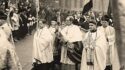
John Paul II, ascending to the papal throne as France found itself engulfed in the “Catholic crisis” (as Denis Pelletier notes), characterized by a long-term decline in practice (as the historian Guillaume Cuchet has recently shown) and accelerated secularization, repeatedly revisits the theme of France’s vocation during his seven apostolic journeys on French soil, including the famous term “the eldest daughter of the Church.” It is notable that this famous expression carries political resonance: the contemporary transposition of the title “the eldest son of the Church,” used in modern times to designate the King of France, the expression “the eldest daughter” circulated in Catholic discourse to refer to France during the early years of the Third Republic’s secular policies.
The relationship between French Catholicism and the popes is also intellectual, notably with John XXIII (who was deeply embedded in intellectual circles when he was nuncio in Paris after the war) and even more with Paul VI, personally linked to many figures of the “new theology” or the milieu of the Sources Chrétiennes (Congar, Bouyer, but also Guitton, Gilson, and Maritain, who served as ambassador to the Holy See in 1945, especially with the founding of the Centre Saint-Louis, embodying this intellectual and cultural dimension of France-Vatican relations).
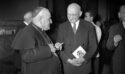
In 1964, between two sessions of the council, Paul VI, while visiting Saint-Louis-des-Français, declared that “France is the kiln in which the intellectual bread of Christendom is baked for the entire world.” In reality, all the popes discussed here have some form of cultural, intellectual, and even linguistic proximity to France, which Joseph Ratzinger (Benedict XVI) later embodied as a notable associate member of the Academy of Moral and Political Sciences in 1992. Yet it must be admitted that the situation is not the same today.

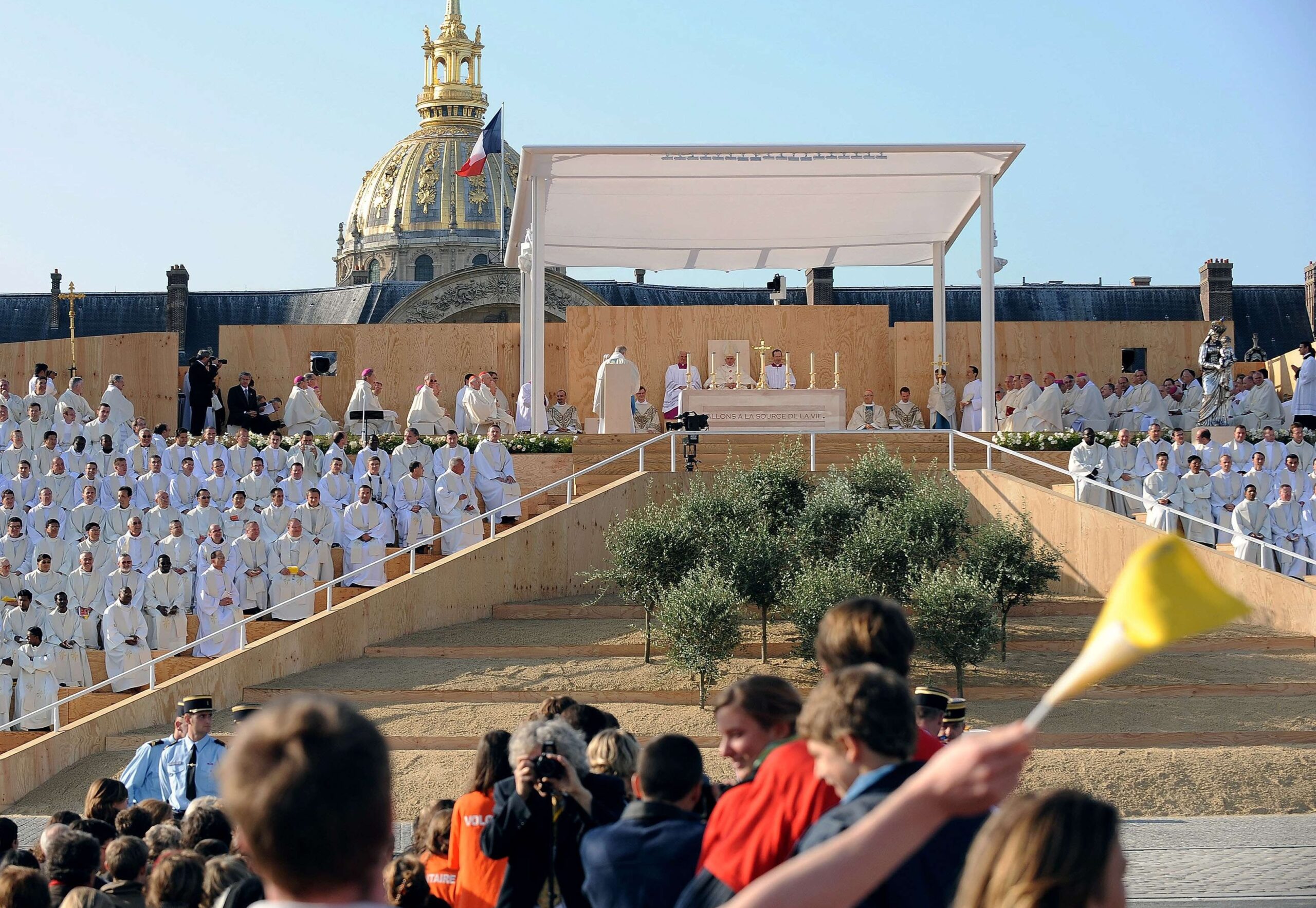
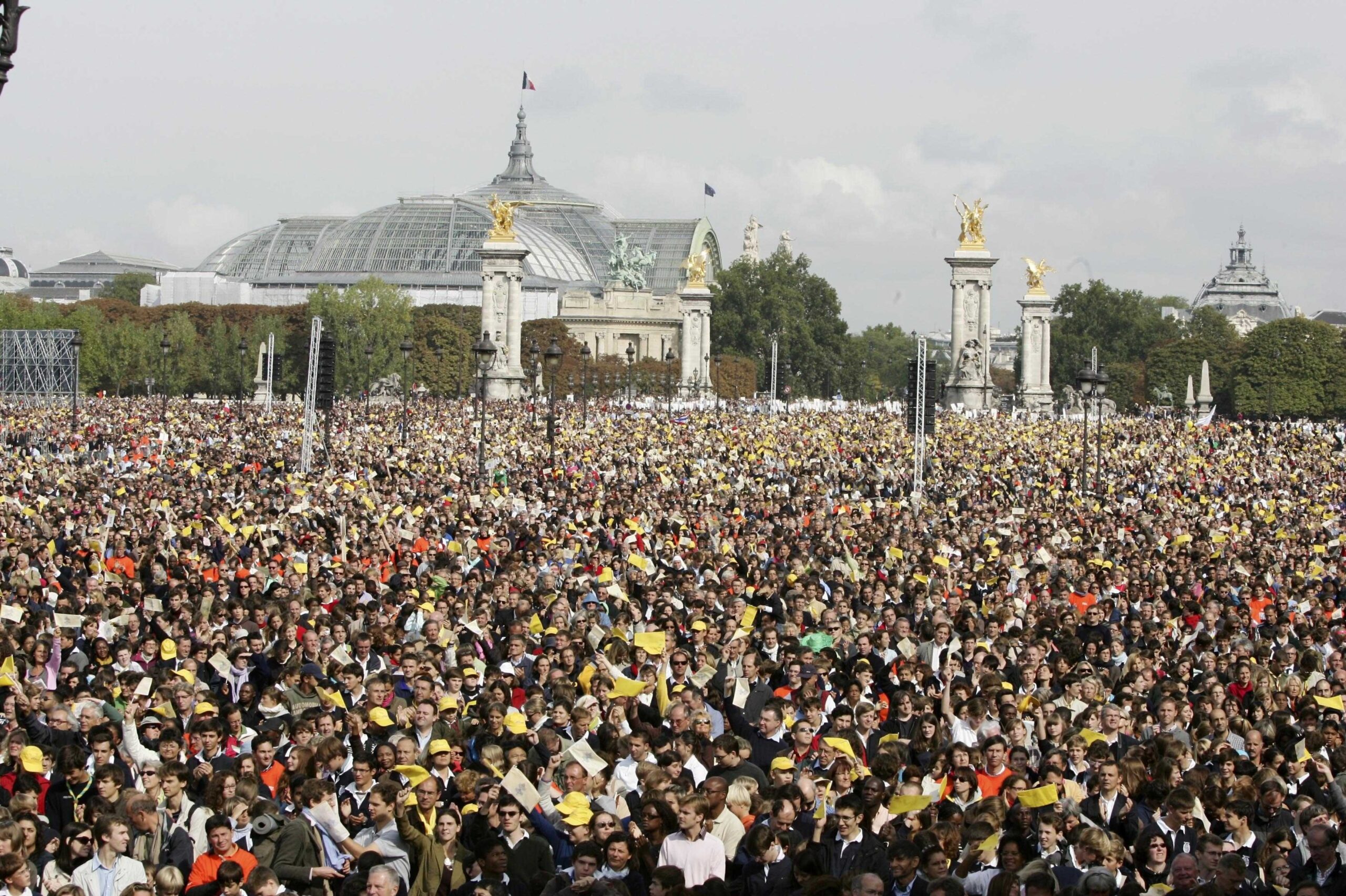
After the war, France is also a subject of concern for the pope, while secularization distances him from France, making him a figure viewed with more reserve—sometimes with hostility—even among certain Catholics. The 1950s, 1960s, and 1970s are years of polarization that French Catholicism embodies particularly, including in its relationship to the pope: from condemning the priests-workers (1954) to the emergence of a Catholic progressivism within trade unions and Catholic Action (notably during the Algerian War), and finally responses to Vatican II, including the foundation of the Society of Saint Pius X (1970). The figure of the pope is either venerated or rejected (or both, in a sense, as the Lefebvrists show).
But starting with the encyclical Humanae Vitae (1968), which condemns contraception and was poorly received by many Catholics, including clergy, the battleground shifts to “bioethics”: from civil unions to “marriage for all,” which created a minor diplomatic crisis during President Hollande’s term and Pope Francis’ pontificate; from abortion to “assisted suicide,” to which Leo XIII might allude.
The fracture represented by these issues is evident not only in the relationship between France and the Holy See, but, more generally, in the Church’s relation to French society, which, like many Western societies, becomes increasingly distant from the moral reference frame upheld by the papacy and the hierarchical Church for the majority. Yet in the small remainder of French Catholicism, where the sensitivity that Yann Raison du Cleuziou has termed the “observants” tends to be perceived as dominant, the figure of the pope and the ambition to remain faithful to his teaching, particularly on moral matters, are markers.
Since 2013, with popes coming from outside Europe and with a growing globalization of the Church that had already begun to germinate in the mid-20th century, the papacy seems to decenter its attention from older Catholic powers, including France. It would be difficult to imagine France-Seeje relation regaining the central place it once held in papal magisterium a hundred or a hundred and fifty years ago. Generally avoiding official disagreement points, the Holy See and France emphasize a number of geopolitical convergences on topics such as ecology, peace (notably in the Middle East, where France’s influence, though declining, continues to play a role), or the defense of a weakening international law in the face of American policy. In this context, it will be interesting to pay attention to the two faces of the France-Holy See relationship in Leo XIV’s speeches: perhaps France, but certainly not the most faithful, as Pope Francis once quipped.