
Edward Goldring, Purges ; How Dictators Fight to Survive, Cornell University Press
From the execution of his uncle by Kim Jong-un to the removal of more than a hundred Turkish generals by Recep Tayyip Erdoğan, purges have significant consequences for the survival and longevity of autocrats. Yet, many questions remain about the reasons dictators resort to purges and whether they achieve their intended effects.
Relying on an unprecedented global dataset dedicated to purges of civilian and military elites in dictatorships, and on case studies focusing on North Korea, South Korea, and Turkey, Edward Goldring examines the logic behind these purges and their consequences. He shows that dictators resort to purges to consolidate power, punish disloyalty, and turn elites into scapegoats in order to appease popular threats.
However, while purges help dictators consolidate power at the outset of their tenure, they actually undermine their position when they have been in power for a long time, sparking a backlash. In the face of a global trend toward authoritarian norms, Purges offers a critical lens on how autocrats preserve—and sometimes lose—power. »
Publication date: August 15
Read more
Justus Bender, Deutschland 2033. Ein Szenario, C.H. Beck

“A century after the Nazis seized power, Germany is about to elect its Bundestag—and the AfD emerges as the victor. The cordon sanitaire fails to hold: in the hope of discrediting the AfD once in government, the CDU gives in. But this calculation backfires. The right-wing populists dismantle, step by step, the liberal constitutional state. In the span of a single year, a regime that despises human rights and democracy comes to power.
The collapse occurs more quietly than many would have thought: without revolutionary violence, without frenzied crowds—only through administration, law, and a politicized judiciary. The Republic dies, but calm reigns in the country. People are tired and disoriented, protests fade into oblivion. They should have acted sooner. Now it is too late.
Justus Bender recounts a fall without spectacle—and that is precisely what makes his vision so realistic. The book takes place in the future, but it concerns a present in which hope still exists: it explains in detail which policies and what communication are needed today to avert tomorrow’s failure.”
Publication date: August 20
Read more
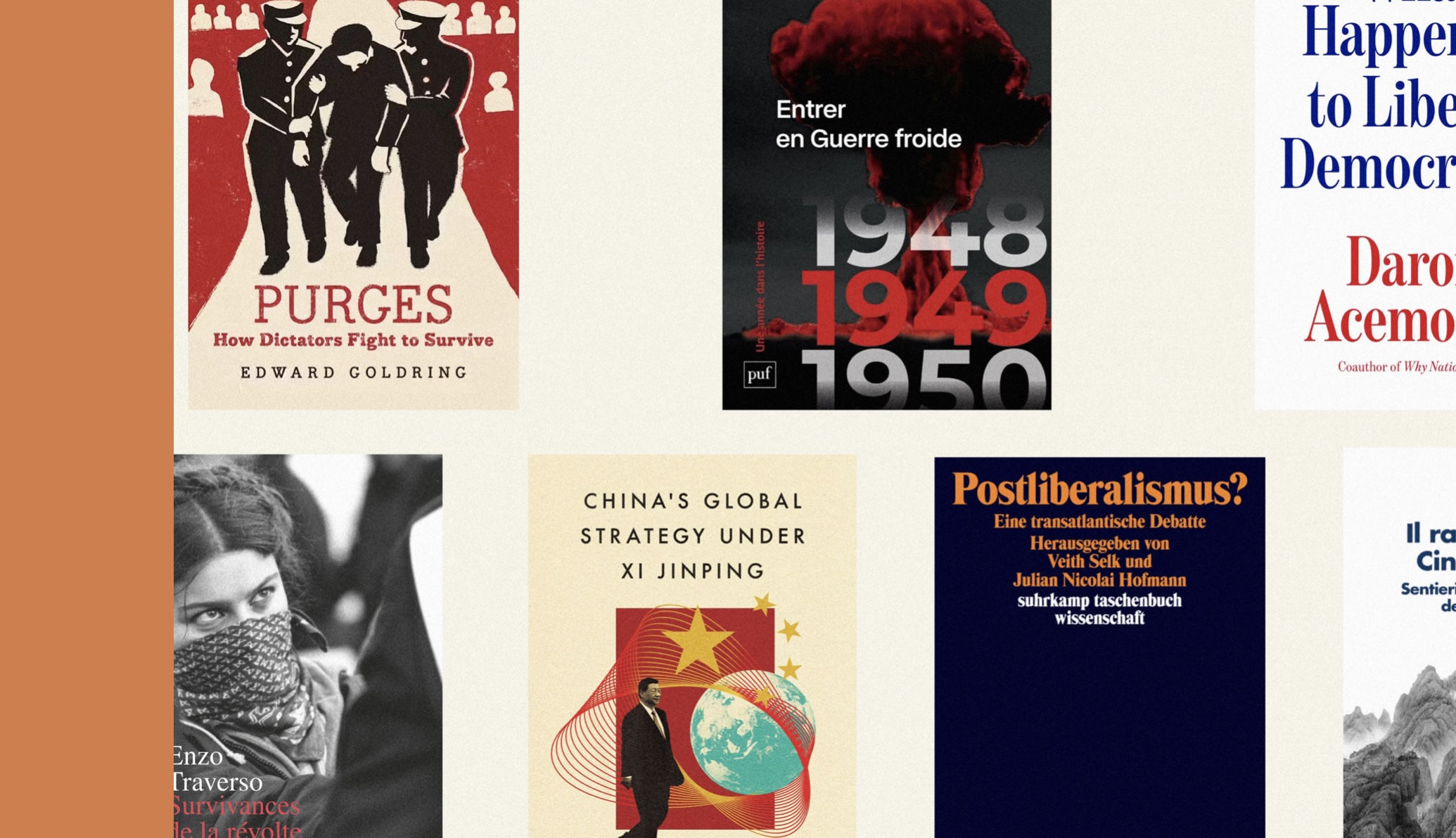
Daron Acemoglu, What Happened to Liberal Democracy ? Remaking a Politics of Shared Prosperity, Profile Books
“From its early days, liberalism promised a bright horizon of shared prosperity, equality, democratic values, and the free pursuit of knowledge. At first, it surged forward with dazzling momentum. Then it began to falter. Once a beacon from which hope flashed, it started to erode under the weight of elitism, intolerance, and the rise of autocracy.
In many respects, liberalism is in ruins. So what comes next? Daron Acemoglu traces the ascent and decline of liberal democracy, and offers a glimmer of hope for the future: a new theory that lays the groundwork for how we can—and must—rebuild liberalism before it is too late.”
Publication date: August 20
Read more
Veith Selk and Julian Nicolai Hofmann (eds.), Postliberalismus ? Eine transatlantische Debatte, Suhrkamp
“The supremacy of liberalism seems to be coming to an end. Faced with the intensification of geopolitical crises and the accelerated erosion of liberal democracies, a transatlantic debate on alternatives to liberalism—grouped under the broad and evocative term ‘post-liberalism’—is taking shape.
This volume collects contributions from internationally renowned scholars, such as Thomas Biebricher, Annelien de Dijn, Patrick J. Deneen, Anton Jäger, Philip Manow, Samuel Moyn, Jan-Werner Müller, Elif Özmen, Adrian Pabst, and Nadia Urbinati, among others, who examine this new phenomenon. As observers, critics, or proponents of these alternatives, they pose the following question: Can liberalism still be saved?”
Publication date: August 20
Read more
Justine Faure, 1949. Entrer en guerre froide, PUF

“Signing the North Atlantic Treaty, the creation of the FRG and the GDR, the Soviet atomic bomb, Mao’s victory: the year 1949 crystalizes the American-Soviet rivalry into a system.
Within a few months, the international balance shifts and the ideological confrontation turns into militarized and global conflict. This dynamic is not inevitable: in response to escalating conflict, hopes for peace emerge, internal opposition in the United States grows, and the trajectories of decolonized countries unfold.
1949 marks entry into a conflict without a declared war, which splits a continent, shapes societies, and structurally frames the bipolar order. Between closed borders, political rivalries, and containment strategies, a new world emerges, tense between nuclear fear, imperial ambitions, and local resistances.”
Publication date: August 20
Read more
Gregg Huff, The Economic Growth of Southeast Asia Trade ; Globalization and Development since 1870, Cambridge University Press
“This work offers the first comprehensive analysis of globalization and development in Southeast Asia since 1870. By interpreting more than 150 years of the region’s economic history, Gregg Huff traces the impact of an initial wave of globalization—from the 1870s to 1929—, the effects and consequences of Japanese occupation during World War II, and a second wave of globalization since the late 1960s.
Drawing on concepts of the “outlet for surplus,” the “dual economy,” and a “plural society,” the book argues that the response of Southeast Asian populations to revolutions in transport, innovations, and opportunities within the global economy manifested as export-led growth. The rapid growth in recent decades has allowed Southeast Asia to begin catching up with the major economies of the world for the first time in its history. Among the gains are industrialization, real social progress, and the emergence of many large urban regions. Yet the book argues that development in Southeast Asia, within its so-called “miracle economies,” remains incomplete.”
Publication date: August 20
Read more
Hans Woller, Thomas Mann. Biographie eines Politischen, C. H. Beck

“Everybody talks about Thomas Mann. His works, however, are not read as much as they once were. Will Thomas Mann himself fall victim to the same fate as other classics—a curiosity that quickly gathers dust, reserved for archivists? Historian Hans Woller uncovers a surprisingly different Mann and shows that his enduring significance lies precisely in his political engagement.
Despite the image he crafted of himself as a detached apostle devoted to pure art, Thomas Mann was throughout his life a “homo politicus” who for decades stood at the heart of his era’s debates. Accused of treason to the homeland, accused of being complicit with Jews, a “useful idiot” of Moscow, and a democrat at heart, he has been condemned, denounced, and elevated as a model. Hans Woller rediscovers the political Thomas Mann and, in doing so, dismantles many prejudices: the Nobel laureate was deemed Hitler’s most dangerous intellectual adversary, among the fiercest critics of his adoptive homeland, the “America of gangsters,” and did not hesitate to flirt with Stalin’s Soviet system.
Sometimes farsighted, but just as often a prophet of error, this patrician elitist was for Germans a disturbing contemporary, whose frankness made him hard to classify. Is this precisely why he still has much to tell us?”
Publication date: August 20
Read more
Gustavo Gozzi, Occidente e giustizia. Crisi di una civiltà e fragilità delle democrazie, Il Mulino
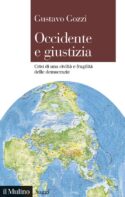
“The West is torn between a universalist vision of law and its negation, shaped by the dominance it once exerted over non-European peoples. This contradiction compels a reflection on justice—how to guarantee justice for those who suffered under this hegemony while seeking a better life in Western countries. This conception of justice is situated within the framework of a possible global constitutionalism, grounded in the necessary limitation of market powers that condition states and constrain democracies.
The volume develops the confrontation between this approach and a new world order centered on the multipolarity of former and new imperial powers. It offers a reading of the internationalist debate on globalization’s transformations, on Europe’s inability to be a global actor, on the double crisis—economic and cultural—of our democracies, on the loss of centrality of Western civilization in the face of the rise of the Global South, but with a view toward a gradual and necessary rapprochement to the ideal (inaccessible) of peace.”
Publication date: August 28
Read more
Adrian Daub, What Tech Calls Governing, Stanford University Press
“Tech companies are increasingly deciding who regulates and who governs. And the tech elite wields growing political power, seeking to reshape your workplace, your child’s school, and the federal government in its image. But what do they mean by ‘power’?
Taking readers from investor meetings to lecture halls, from science fiction to a neo-feudal vision of the world, Adrian Daub skewers how tech culture approaches hierarchy and domination, and the role a particularly masculine form plays in the ethics of this culture. From billboards to social networks, he questions how the Tech elite exerts its power within families and in offices, but also in sports arenas and YouTube channels, in courtrooms and on everyday commutes.
To ask “how do they seek to dominate?” is really to tell the story of Silicon Valley as a fragile masculinity—and precisely for this reason a dominant one—determined to exercise all possible influence without assuming any responsibility.”
Publication date: August 31
Read more
Steve Tsang and Olivia Cheung, China’s Global Strategy under Xi Jinping, Oxford University Press
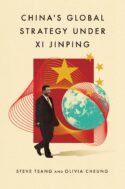
“Xi Jinping’s pledge to realize ‘the Chinese dream of national rejuvenation’ by 2050 succinctly captures the ambition driving China’s current global strategy. While the expression may seem vague, its implications are substantial: they determine how Chinese leaders interact with the world and envision China’s place within it.
In China’s Global Strategy under Xi Jinping, Steve Tsang and Olivia Cheung provide a clear analysis of how China seeks to reshape the international order on its own terms. Drawing on decades of political development, they offer a new, powerful conceptual framework—the ‘party-state-centric realism’—to explain the ideological, political, and strategic logic underlying China’s foreign policy under Xi Jinping.
The authors apply this framework to three key domains: global diplomacy, technology and the economy, and geopolitics. At the heart of Xi’s vision lies the restoration of the old “tianxia” model of world leadership, in which China becomes the preeminent power in the world—not by replacing the United States as the global hegemon, but by being broadly recognized as a force serving the common good. This model suggests a relatively passive form of leadership, yet one that seeks to fundamentally reshape global norms and institutions.
Steve Tsang and Olivia Cheung also examine the internal drivers of this strategy, showing how national political imperatives and party ideology shape China’s outward behavior. The result is a nuanced, current analysis of a rising power with global ambitions—and the risk of conflict among great powers.”
Publication date: September 1
Read more
Ilya Budraitskis and Ilya Matveev, Russia’s New Imperialism ; Capital and Ideology, Stanford University Press
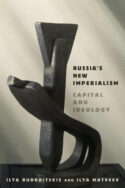
“Russia’s devastating invasion of Ukraine in 2022 embodies a broader phenomenon: the new Russian imperialism in the post‑Soviet era.
This book offers a critical, theoretically grounded analysis of Russian imperialism, focusing on the interplay between economy and ideology, coercion and hegemony, structure and action. While economic developments largely help explain the resurgence of imperialist impulses in Russia in the 21st century, a purely economic logic cannot account for the radical change in Russian imperialism since the annexation of Crimea and the fomenting of separatist unrest in Donbas. Nor can objective geopolitical developments, such as U.S. and NATO military deployments, fully explain this shift.
On the contrary, the book shows how the Kremlin’s response to Maidan’s revolution traced its roots to ideological consolidation in the years prior: the emergence of an ideology that marks the West as Russia’s eternal foe and Ukraine as the strategic pawn of the West. Ilya Budraitskis and Ilya Matveev examine Russia’s foreign policy and the Kremlin’s project to remodel the Russian people so that they serve its imperial program.”
Publication date: September 1
Read more
Jeremy Adelman, The Capitalist Era ; The Making–and Unmaking–of the Global Mind, Princeton University Press
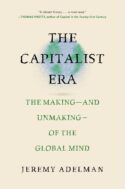
“Blending political, economic, intellectual, and environmental history, this book traces the epic story of the forces that, since the late eighteenth century, have transformed the world into a single yet fractured entity—united by exchange and flux, yet divided by suspicion and fear. It is the story of hopes for universal peace, of the panic over the destruction of the planet, and of the debates, policies, and media that have shaped how people see one another across distances and borders.
The Capitalist Era traces how global integration compelled populations from different regions to confront what it means to need one another for resources or recognition without fully knowing each other, and it describes the clashes and experiences that have shaped the world through periods of integration and disintegration over the past two centuries. As trade, migration, and new technologies drew peoples closer in their pursuit of wealth, security, and survival, enormous confrontations and frictions pitted writers and soldiers, biologists and economists, photographers and missionaries against one another.
Are strangers partners or rivals, liberators or oppressors? As this book argues, that may be the most important question weighing on our past, present, and future. To understand our world, one must grasp how strangers perceived one another when choosing to welcome or exclude, to respect or to dominate. Rejecting simplistic determinisms about an inevitable peace or an inexorable fate, this work highlights the fragility of the world’s unity.”
Publication date: September 1
Read more
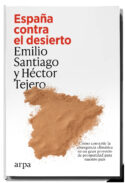
Emilio Santiago and Héctor Tejero, España contra el desierto, Arpa
“The Valencia storm has claimed 238 lives, the latest wildfires have burned record acres, and the heatwave has caused nearly 10,000 deaths in four years. The Iberian Peninsula is warming faster than the planet, and climate change is already reshaping its landscapes, its economic sectors, and people’s living conditions.
Emilio Santiago and Héctor Tejero analyze this threat in detail, but more importantly, they argue that a well-managed ecological transition could constitute a grand national project and the main driver of economic growth for our generation.
In the face of denial and catastrophism, two of the most influential voices in Spain’s ecological debate—a scientist and a politician—take a stand and propose a concrete, realistic strategy for Spain to lead its green revolution rather than becoming Europe’s desert.”
Publication date: September 2
Read more
Enzo Traverso, Survivances de la révolte. Essai sur la dialectique de la mémoire, La Découverte

“A work that tackles a fundamental phenomenon in the public, political, and media space, yet whose importance and consequences are underestimated: the conflicts of memory, their modalities, and their influence on social movements and ideological and political antagonisms.
Just as there is a dialectic of reason, there is a dialectic of memory that transforms the memory of revolt into a cult of order, turning the anniversaries of revolutions into military parades, transforming the legacy of the Holocaust into a justification for a genocidal state; national narratives and the tradition of the vanquished, the cult of heroes and the traces left by the nameless, monuments and dissident remembrances, all contend. In the face of fixed, passive, and reactionary memories that seem to dominate today, past uprisings remain living legacies to be reactivated to shape our present.”
Publication date: September 3
Read more
Olivier Dard, Histoire de l’extrême droite en France, Perrin

“This sweeping history of the far right in France in the contemporary era (1870–2026) is not, unlike its predecessors, a collective work but the result of a long, dedicated effort by a specialist in the field. It begins with the fall of the Second Empire and the possibilities opened by a monarchist restoration under the Comte de Chambord during the time of the Moral Order, finally concluding in 2026 at a moment when the Rassemblement National leads in the polls for the 2027 presidential election.
Based on numerous sources and a comprehensive reading of historiography, the book paints a broad fresco of the figures (Boulangism, Barrès, Maurras, La Rocque, Poujade, Tixier-Vignancour, Le Pen), movements (leagues, OAS, FN) and pivotal moments (anti-Semitism and the Dreyfus affair, February 6, 1934, Vichy, the Indochina and Algeria wars, Vatican II) that mark the history of a political family far more diverse than the label “extreme right” might imply.
This invites the reader into the heart of the world of these national and nationalist right-wing movements, tracing their workings across a vibrant history from the first world war to the Spanish Civil War, the 1930s through decolonization and the Cold War—moments that shaped this murky political cloud born out of anti-communism and the fight against “subversion” by enemies both domestic and foreign.
Thus, this history cannot be grasped through a purely national frame, and one of the book’s major achievements is its transnational lens, as its leaders radiate in Europe and the Americas at the same time that the latter feed into them.”
Publication date: September 3
Read more
Gaia Perini, Il racconto della Cina moderna. Sentieri letterari nella storia dell’ultimo secolo, Il Mulino
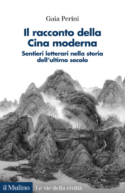
“China is a vast country, and its modern history is expansive and complex—a true labyrinth. The author charts a path, one among many possible routes through the dense forest of Chinese modernity, guiding the reader with a carefully chosen set of literary works, convinced that they illuminate their era in ways historical sources cannot always capture.
Rather than reflecting history, literature offers reflection on it, inviting readers to reconsider its crucial turning points: the end of empire and the creation of the nation-state, the revolution, socialism as China’s path to modernity, the contradictions of a socialist state, and finally the shift to a market economy. At the end of this journey, one discovers that many of the questions that concern Chinese writers also concern us, and that China is already part of our world.”
Publication date: September 4
Read more
Nicolas Werth, Adieu ma Russie. Mémoires orphelines, Les Belles Lettres
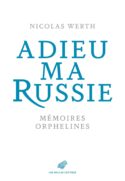
“Sometimes a state crosses a line—and so can a person. Then a date is born. Historians receive it with gravity and place it in the cemetery of centuries. Yet for the historian, it is rare for a date to do more: to enter one’s life like a knife. August 1968. With Soviet troops entering Prague, Brezhnev’s USSR crushes the Prague Spring.
March 1969. Desperate after the Soviet tanks arrive in Prague, Alexander Werth, the great Russian-born British journalist who had been engaged in anti-fascist work since the 1930s, a BBC war correspondent on the Russian front turned historian of the USSR, takes his own life.
February 2022. Vladimir Putin’s Russia invades Ukraine.
June 2023. Nicolas Werth, his son, falters in his turn. He has spent his life devoted to Russia. Twenty years spent in its language, its cities, its illusions and its ruins: a student in Leningrad, a teacher in Minsk and Moscow, a cultural attaché during Perestroika, a CNRS researcher, and from 1989 onward, scrutinizing a country and a political system at the end of its rope.
Dozens of books, thousands of pages, a life entirely given to understanding Russia, father and son have spent nearly a century cumulatively observing the same impossible country. And yet from that father, Nicolas Werth knew almost nothing.
Thus began his inquiry. He alone undertook to tell their century, weaving together his father’s work with his own and placing them along the long duration: this strange inheritance of historians.
Gradually emerges something rare—a testimony, perhaps even rarer than a testimony: the tale of a century of Russian history told by those who knew it best. Two generations, two historical consciences among the sharpest of their time; their experiences, even their wounds, are gathered here to compose not an official history of Russia, but its lived history, interiorized and then reflected upon.
This book, written with unusual honesty, recounts this: two lives bound to the same historical tragedy. It may also speak to a quieter truth: historians do not merely write History. They write the part of themselves that History has devoured.”
Publication date: September 4
Read more
Francis Fukuyama, In the Realm of the Last Man, Profile Books
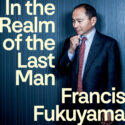
“In 1989, a year before the fall of the Berlin Wall, Francis Fukuyama—then a young scholar who had cut his teeth helping Ronald Reagan with research during his governorship of California—delivered a presentation that would become one of the most famous—and most controversial—works of political theory of our time: The End of History.
In 2009, he broke with his neocon mentors, from Allan Bloom to Paul Wolfowitz, after reconsidering his support for the “disastrous” invasion of Iraq in 2003 and the laissez-faire economic policies that contributed to the 2008 financial crisis.
But why did he change his mind? In these gripping political memoirs, which trace his father’s involvement in the civil rights movement and his own work under contract for the CIA in the 1980s, Fukuyama analyzes his life in light of the major political upheavals of the last thirty years—from Bush to Obama to Trump, from the war on terror to Russia’s invasion of Ukraine.”
Publication date: September 8
Read more
Victor Davis Hanson, The Counterrevolution. The Fall and Rise of Donald Trump and the MAGA Movement, Basic Books
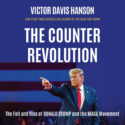
“When Donald Trump left office in January 2021, most observers thought his political career was over. Silent on social media, vilified by the press, and facing legal peril, the former president’s future looked bleak. Yet in the months and years that followed, Trump mounted a historic political comeback, moving from disgrace to victory and securing a second term that marked the beginning of a transformation of American society, culture, politics, and economics.
In this book, Victor Davis Hanson explains in detail how Trump reclaimed power and built a counterrevolution in the United States. The success and audacity of Trump’s program for his second term can only be fully understood as the fruit of four years spent in political and legal exile. Hanson details the tactical missteps and excesses of his opponents, as well as how Trump took note of those who persecuted him and shaped his new program around a counterstrike.”
Publication date: September 8
Read more
Johann Chapoutot, La bascule. Allemagne, 1933, Gallimard
“January 30, 1933—the turn. Germany slides into the unknown. No one knows how the Nazis—established in power when they had not expected to govern—will rule, and no one anticipated the institutional carnage they would unleash.
The right, fixated on the rise of the Communists, seeks to protect the economic, fiscal, and social interests of hereditary elites and to end democracy. It bets on Nazi violence to strike not only political opponents and unionists, but also immigrants, Jews, and all the ‘undesirables’ it abhors. Yet the Germans are reluctant, as shown by the spectacular failure of the Nazi union in professional elections and the antisemitic boycott of April 1, 1933.
The “seizure of power” lasted six months, until July 14, 1933, the date of the last cabinet meeting before the summer break. It was made possible by the turn of several elite groups that worked in favor of the Nazis: the army, the Catholic Church, the liberal media that tried to appease the monster, the judiciary and the high civil service, while industry, Protestant clergy, and large landowners had already chosen—the worst for the German people.”
Publication date: September 10
Read more
Mohamed Amer Meziane, Le Sacrifice du ciel. Une autre histoire de la raison, Le Seuil
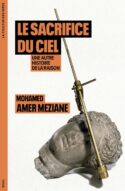
“Why do we instinctively think with “great Western authors”? Where does this tendency—so natural-looking—come from to name only them? Modern reason proclaimed itself as the sole path to enlighten the world after the Enlightenment and the “death of God.” But at what price did it achieve this “sacrifice of the heavens”?
Mohamed Amer Meziane answers these questions by cracking the statues of this pantheon of thought. He traverses the history of contemporary philosophy, expanding its usual geographic boundaries. Juxtaposing Kant or Hegel with the emir Abdelkader and al-Afghāni, he shows that the old European monopoly on Reason drives it to become irrational when isolated from other worlds. This work thus offers a new history of thought, opening the path to a different rationality: neither Western nor Eastern, but something other.”
Publication date: September 18
Read more
Gwendolyn Sasse, Russland – eine deutsche Erfindung. Warum so viele bei uns Putin falsch einschätzen, C. H. Beck

“Since 2022, Russia has waged an open aggression against Ukraine. Yet in Germany, many people continue to hold an unexpectedly positive view of that country, both in the East and the West. Why is that? Gwendolyn Sasse searches for explanations and shows how Germans have imagined their Russia.
For centuries, Russia has fascinated and occupied the European political and social scene. It is less about a true, historical or contemporary image of Russia than about the very idea of “Russia.” This idea has often more to do with German debates and sensitivities than with the Russian neighbor itself.
Before 2022, it fed illusions in political attitudes toward Russia, illusions that persist today and provide fertile ground for Russian disinformation campaigns. This book examines perceptions of Russia in East and West Germany using social science methods and tries to explain why, for so many Germans, perception and reality are so far apart.”
Publication date: September 24
Read more
Christian Ingrao, Le Temps des promesses, 1905-1990. Essai sur les migrations de l’espérance, La Découverte
“Since the early twentieth century, European, Maghreb, and Middle Eastern societies have shaped their relationship to time through a constant tension between mass violence and hopes placed in the future. This book questions what has become of the future—the promises of the twentieth century and their disappearance in the 1980s—and explores the conditions for reinvention of societies now deprived of horizons.
This book is part of a three-volume project seeking to understand how human societies occupying a space that includes Europe, the Maghreb, and the Middle East have, since the early twentieth century—a era marked by a dialectic of present mass violence and future hopes—constructed their relation to historical time. It will particularly seek to understand what happened to our future, to the promises of the twentieth century, and how societies without a future can be reinvented.”
Publication date: September 24
Read more
Olivier Roy, L’impossible révolution culturelle, Le Seuil
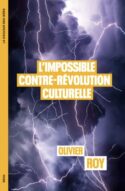
“The cultural counter-revolution is underway,” people say from all sides. From J. D. Vance to Éric Zemmour, and from Giorgia Meloni to Geert Wilders, populists have indeed begun reclaiming cultural space. But can they succeed?
Their conviction is that the people’s identity is endangered, and that defending it requires more than passing laws against immigration: one must restore culture against a liberalism that culminates in “woke” culture and multiculturalism.
But how can culture be restored when globalization and virtualization have eroded it? When it no longer constitutes a society? The cultural counter-revolution seeks to fill the void left by liberalism. Are the anthropological models it defends—hedonistic individualism of a bygone era or Christian neoconservatism—capable of doing so?
And if they are powerless to reweave social ties, how could they govern?
Publication date: September 25
Read more
Alexander F. Gazmararian and Helen V. Milner, Climate Fault Lines ; The New Political Economy of a Warming World, Princeton University Press
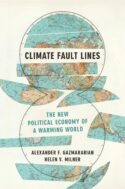
“As the world faces extreme heat waves, rising sea levels, and devastating wildfires, climate change is no longer an abstract concept. In Climate Fault Lines, Alexander Gazmararian and Helen Milner show that the impacts of climate change are far from evenly distributed, with the worst damage concentrated in the planet’s hottest regions. They argue that this fracture line—one that crosses existing social, economic, and political divides—will drive divergent political responses to climate action.
Populations, businesses, and governments on the most vulnerable side of the line are highly motivated to fight climate change because they bear its direct and increasingly severe impacts. Those on the other side are less motivated to address the problem, and when they do adopt climate policies it is mainly for other reasons: cleaner air, economic gains, or greater energy security.
Gazmararian and Milner support their argument—challenging the cliché that Northern European states lead on climate while developing countries profit—from a synthesis of economic, geoscience, and political science models. The data show that the voters and firms most exposed to losses are reshaping the incentives and policies of local and national governments situated below this fracture line. It is the unequal damages, not a shared global vulnerability, that increasingly shapes climate policy.”
Publication date: September 29
Read more
Sophia Mahroug, Les gardiens de la révolution de 1980 à nos jours, PUF
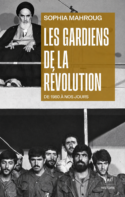
“‘Paramilitary’ forces, a praetorian guard, an ideological organization or a terror group… The body of the Islamic Revolutionary Guard Corps, formed in the early months of the Islamic Republic in 1979, is depicted in many contemporary analyses as a monolithic army, defined by its corruption and its almost dogmatic aversion to the West.
In this essay, Sophia Mahroug revisits the history of a plural legion—whose framework, men, and fractures had remained largely unknown—countering a fixed reading of a disciplined, disincarnate corps. She describes how, drawing on its culture of “sacred defense” (Defa’-e mogaddas), this body was elevated by propaganda into a divine army. Through an unprecedented historical Web-based investigation and a Persian-language translation of the scholarly literature on the Guards, she shows how those groups drew on this narrative to forge their own cultural institutions and their doctrine of soft war (jang-e narm) against the West. She also reveals a vivid sociology of petty bureaucrats who became archivists, technocrats obsessed with professional ascent, and military elites who are theorists of information warfare.
Publication date: September 29
Read more
Donatella Della Ratta, Violenza speculativa Come PIA ci sta abituando all’orrore, Einaudi
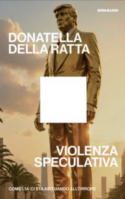
We live in a world flooded with artificial intelligence-generated images, now almost indistinguishable from reality. We consume them as entertainment, discard them as memes or satire. And yet there is nothing funny about them. These images have become one of the most effective propaganda tools of our era, accessible to everyone—from heads of state to anonymous users. They can transform obscene fantasies into political programs, such as a vision of Gaza transformed into a luxury tourist complex that, within months, moved from public debate to a plan for conquest and deportation.
These synthetic images are not neutral; they are the product of infrastructures controlled by a knot of financial, political, and industrial powers that speculate on the future’s imagination, or even its disappearance, if doing so yields new profits. They should not be treated as mere provocations or aesthetic curiosities, nor trivialized, reduced to a joke or bad taste: they have become integral to reactionary, racist, dictatorial, and genocidal projects. They are weapons in a cognitive war that concerns us all: they shape perception, steer desire, and prepare the collective sensibility to accept what once seemed unthinkable yesterday and which today takes the form of laws, public policies, institutional practices, or military operations.
Seeing horror in its anesthetized, smooth form, translated into seductive images, makes it acceptable—whether in war, deportation, or genocide. We must understand who is shaping the horizon of the possible, which dreams are summoned to be realized, and which worlds become desirable, precisely for that reason, real. The future is not a distant scenario; it is a struggle taking place today before our very eyes, where aesthetics, ideology, and power converge. Understanding this is to reclaim the right to intervene in tomorrow’s imaginary by producing images that do not yield to capitulation but open possibilities. For what is at stake is the world in which we will live.
Publication planned for Fall 2026.
Credits
Sauf indication contraire, tous les textes sont issus des quatrièmes de couverture des éditeurs.