
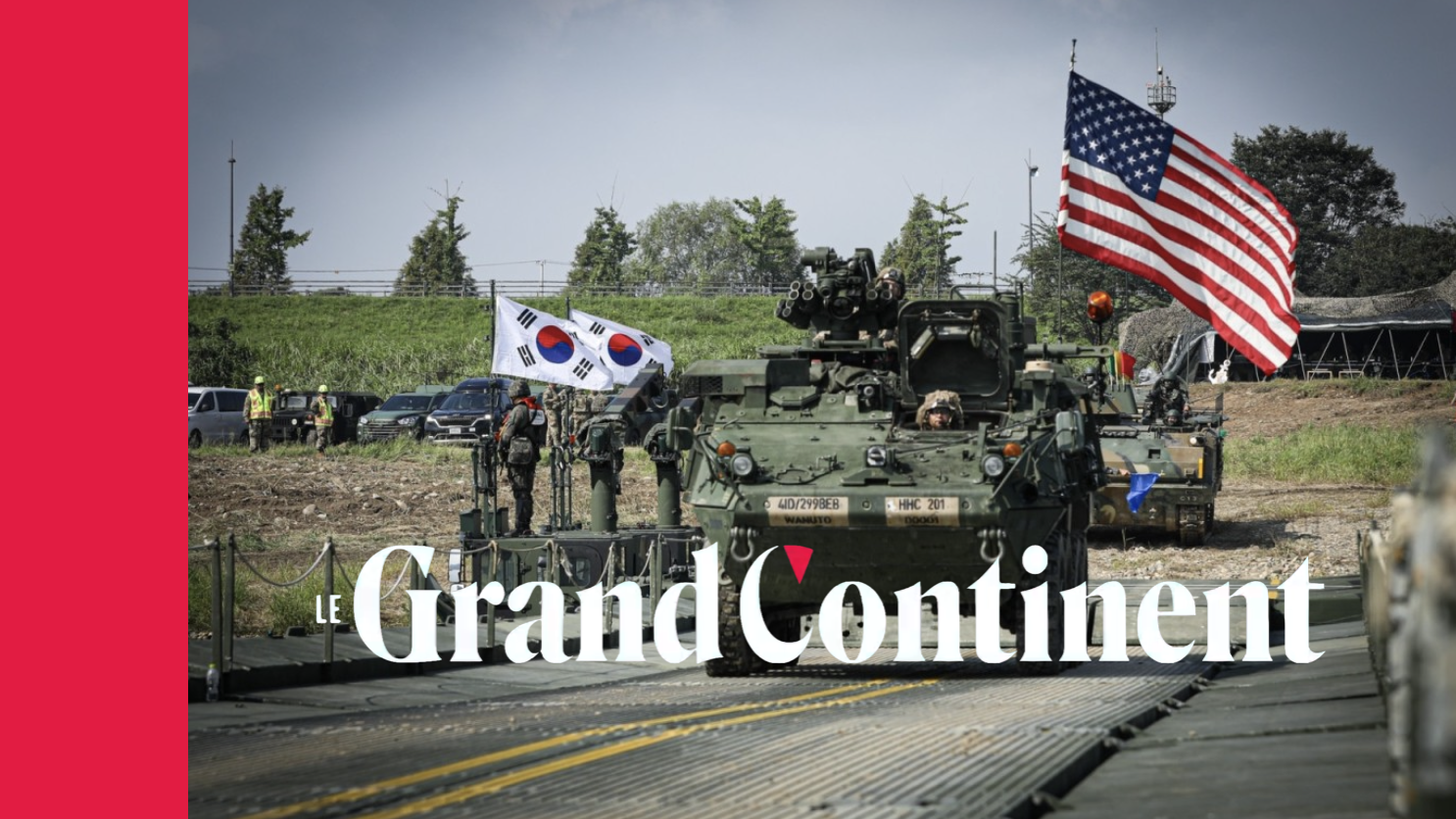
In the night of August 17, Donald Trump announced on Truth Social that he had ordered the Secretary of the War Department, Pete Hegseth, to “drastically cut back” joint military exercises with South Korea, arguing that they were too costly and sent to Pyongyang a signal that was “absolutely inappropriate and hostile.”
- The U.S. president regretted that it was “now too late to cancel them,” while mentioning his “excellent” relations with Kim Jong-un.
- He then indicated that he had recently invited the South Korean president to join the process of “denuclearization” of Iran, but received the reply: “No, thank you!” He added: “The reason I do not want military exercises with South Korea is to save hundreds of millions of dollars for the United States, which are not reimbursed to us.”
Initiated in 1976, the “Ulchi Freedom Shield” is an annual joint exercise designed to enhance the maneuvering capacity of interservice forces on the Korean peninsula, simulating a Pyongyang attack.
- This year it was set to run for 11 days, from August 17 to 27, cover the entire peninsula, involve about 18,000 South Korean troops, a figure similar to last year.
- The U.S. forces stationed in Korea did not disclose the number of soldiers participating in the exercise, their total strength currently standing at 28,500 men.
- Asked on Monday, August 17 about the consequences of the American president’s announcement, a Joint Chiefs of Staff official said the exercise “is proceeding as planned.” The Korean press expects an impact on the scope, the approach, and the timing of joint exercises “in the future.”
- Note that the two militaries had announced the exercise this year, highlighting a strategic shift in North Korea’s capabilities. A Joint Chiefs of Staff official explained that North Korean soldiers returning from Ukraine had gained real combat experience, which had altered Pyongyang’s operational capacities, and that this training would fully take that factor into account.
The decision by Donald Trump comes in an unprecedented strategic context, as the United States no longer has aircraft carriers in the Pacific.
- The USS George Washington left the Pacific in the past hours and is expected to replace the USS Abraham Lincoln in the Middle East.
- The carrier has been on station for more than 266 days without respite. Reports have repeatedly described sailors’ attempts at suicide by drowning, shortages of hygiene products and food, as well as failures in the piping network.
This announcement appears, in several respects, inconsistent with the policy pursued by the Trump administration.
- On Thursday, August 13, Donald Trump signed a memorandum aimed at revitalizing the American Navy, authorizing foreign shipbuilders investing in the United States to construct up to two ships in their home country. Hanwha Ocean, the sole South Korean shipbuilder with a shipyard in the United States (the Philly Shipyard in Philadelphia) was named the direct beneficiary of this measure.
- South Korea had been defined as a “model ally” on January 26 by the Under Secretary of War for Policy, Elbridge Colby, due to its new national defense doctrine. Seoul had also announced in 2025 a record surge in defense spending.
As Shashank Joshi of The Economist notes: “It is normal for US alliances to be stretched in periods of divergence in foreign policy. It is, however, absolutely not normal for the United States to subordinate its security guarantees—and the elements that undergird them, such as troop deployments and military exercises—to whether allies join the wars that Washington chooses to wage.”
- The U.S. National Defense Strategy, published on January 24, 2026, makes defending territories and American interests in the Western Hemisphere an absolute priority, while the Indo-Pacific region features only as a secondary concern.