
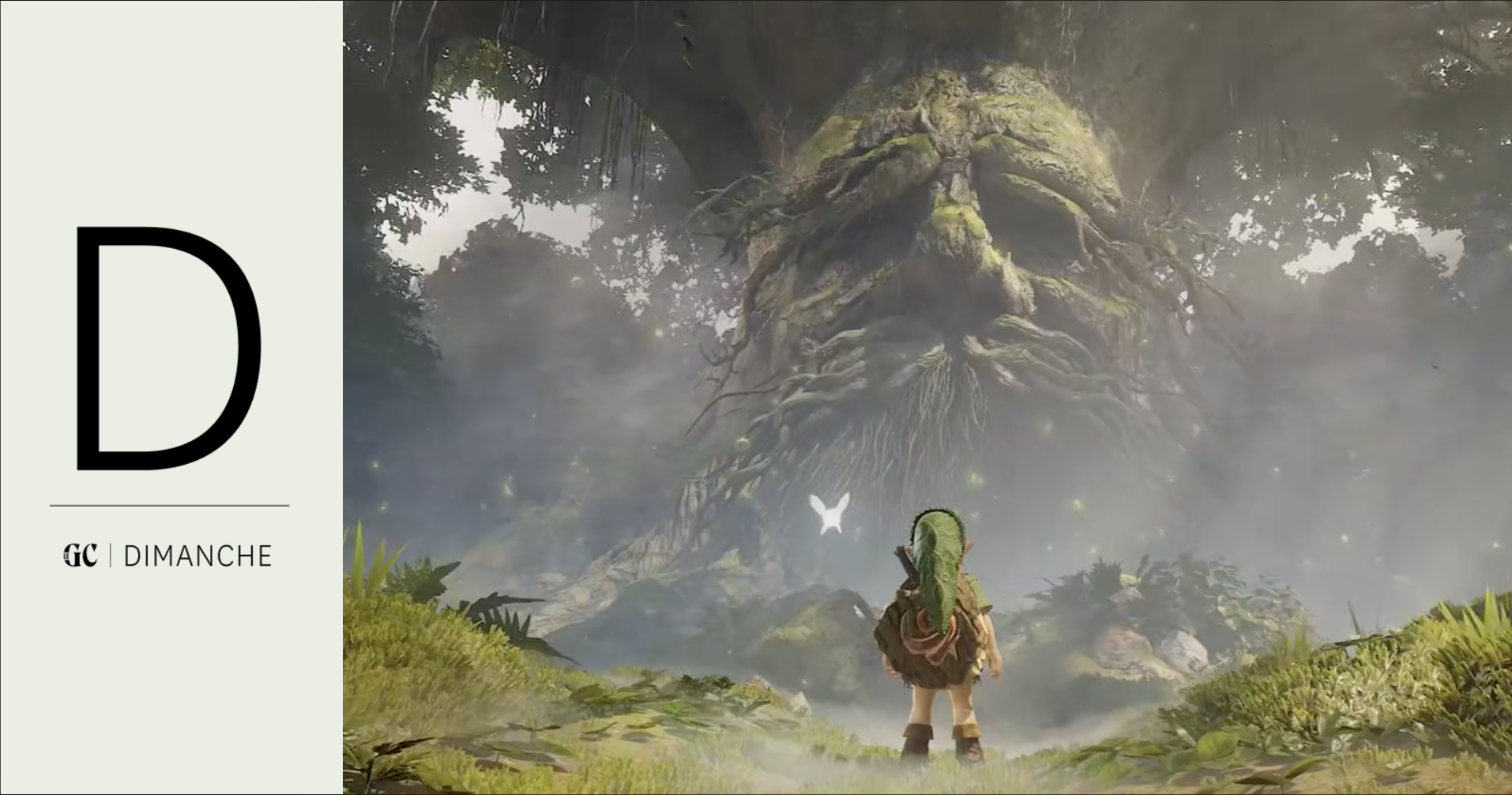
Nintendo marks this year the fortieth anniversary of one of its flagship video games, The Legend of Zelda, by releasing on this occasion a refreshed edition of its most celebrated installment, Ocarina of Time, whose original release appeared in 1998.
It is remarkable to consider that a video game series can reach forty years of age. The art of video games is beginning to display a considerable venerability. Let us venture a comparison with the evolution of cinema: if chronologically The Legend of Zelda (1986) corresponds to Griffith’s Intolerance (1916) — a masterpiece of grand scope yet bound by the technical means of its era — the year of Ocarina of Time, one of the first great three-dimensional games, would correspond exactly to the era of The Jazz Singer, the first talkie. Our own era would be that of the great Hitchcock works, that is, a full confidence in the tools of art… and the start of major remakes: The Man Who Knew Too Much (1934) was remade twenty-two years later, not unlike Nintendo’s game.
Where does the charm of The Legend of Zelda come from? Perhaps it lies in the fact that it presents a European medieval fantasy universe, as viewed by Japanese minds. It is far from the only series to inhabit this space, but the fusion (as one might say in cooking) here proves particularly fortunate. The hero is clearly inspired by Peter Pan: a little boy in a green cap accompanied by a fairy lives in a forest where children do not grow up. The tale is that of fairy stories in the Perrault mold: the girl is to be saved from her castle. Yet all of this unfolds within a universe where a Shinto-inspired mythos leaks through (the dungeons are built like Shinto shrines). And then, the whole is a curious mosaic of references that nonetheless stay in harmony. The hero’s horse bears the name of the Gaulish goddess of horses, Epona.
Oddly enough, the princess to be rescued is named Zelda after… Zelda Fitzgerald. Shigeru Miyamoto, its creator, explained: “Zelda was the wife of the famous novelist F. Scott Fitzgerald. She was a beautiful and renowned woman, and I loved the sound of her name. So I took the liberty of using it for the title.” He could not foresee that he would revive the name’s popularity to such a degree that the actor Robin Williams named his daughter Zelda in homage to the video game.
Perhaps it is also because the series, in the video game landscape of the 1980s–1990s, aimed at attaining the greatest refinement of its artistic qualities, without ever pretending to be anything other than what it is. Zelda does not pretend to be a film and wishes to remain essentially a video game adventure. But take the title screen of Ocarina of Time, the first thing you see when you switch on the console. It is a stark, nocturnal landscape, where a pixellated moon rises slowly while the notes of a piano melody—sampled in a manner reminiscent of Satie—resonate, and a rider approaches in the distance. It was light-years away from the exuberant and garish aesthetics of many video games.
The developer’s attention to detail in Zelda is consistently enchanting. When you plunge into the water in Ocarina of Time, not only does the water splash around you, but tiny bubbles appear beneath the surface and, if you look closely, they ascend slowly to the surface before bursting, and the moment of their burst itself creates little circles in the water. All of this was programmed manually on a 1998 console: a craftsman’s work in metalwork.
The latest productions have preserved this meticulous care. In Breath of the Wild, the sound of an object dropping into water differs with each object, whereas other developers would have settled for a single “plop.” It is only a glimpse of the degree of precision that Zelda’s developers bring to their craft. They are, in a sense, cathedrals of human ingenuity. One can hardly grasp the diversity of talents and know-how required to create a video game of this scale and to overcome its countless challenges. In the most recent Zelda to date, Tears of the Kingdom, the music that appears when the player dives from the sky is of extraordinary sophistication; instruments and melodic loops appear or disappear depending on the starting altitude, the player’s speed, and the manner in which they fall (see this thread that explains it better than I could).
Zelda is a video game that, contrary to what one might expect of “screen” experiences, invites concentration, attention, and even meditation. The opening sequence of Ocarina of Time has nothing to do with the dopamine traps of other video games and, worse, of modern social networks (some public debates lump these categories together as if protein bars and Alain Ducasse’s cooking had more in common than they do). One must read, get lost, explore, persevere, sometimes grow irritated at not finding the path or the clue that will unlock progress. It was a time before mass Internet; one could remain stuck for a week if a passage was too difficult or one did not know where to go. And it was not a problem, for it offered time to explore all corners of a universe that was neither too large to be rich in places and characters, nor too small to give the sense of a true world.
One should also pay tribute to the excellent French translation, which knew how to vary its registers and did not dumb down vocabulary or turns of phrase. The texts are thus far more sophisticated than the recent simplified versions of children’s books, for instance.
And then it is a generation-spanning experience. A large portion of children in developed countries born in the late 1980s and early 1990s wandered through the same virtual places, solved the same puzzles, followed the same storyline, uncovered the same secrets. This creates a kind of strange camaraderie and, today, a profoundly deep nostalgia. The nostalgia provoked by this kind of video game differs from others. It resembles more the sentiment one might have when thinking of a physical place from our childhood than the feeling invoked by readings or films from the same era. I have read a great deal of Tintin, and yet I am far from having the same attachment to Moulinsart Castle as to certain villages in The Legend of Zelda.
I imagine it is difficult, for those who did not grow up with this medium, to comprehend the emotions that these memories evoke. It is one of those experiences that cannot be transmitted. The height of irony is that Ocarina of Time itself is a game about nostalgia; the passage of time is central to the story and to the gameplay, and most of the game is devoted to recapturing the happiness of a lost past. By releasing today its remake, Nintendo is well aware of the effect it intends; the character designs are even inspired by Japanese puppet theater, as if players are invited to see not a modernized version of an ancient game but a deliberately transformed childhood toy. One might imagine Proust publishing, thirty years after In Search of Lost Time: the remake with even more madeleines.