
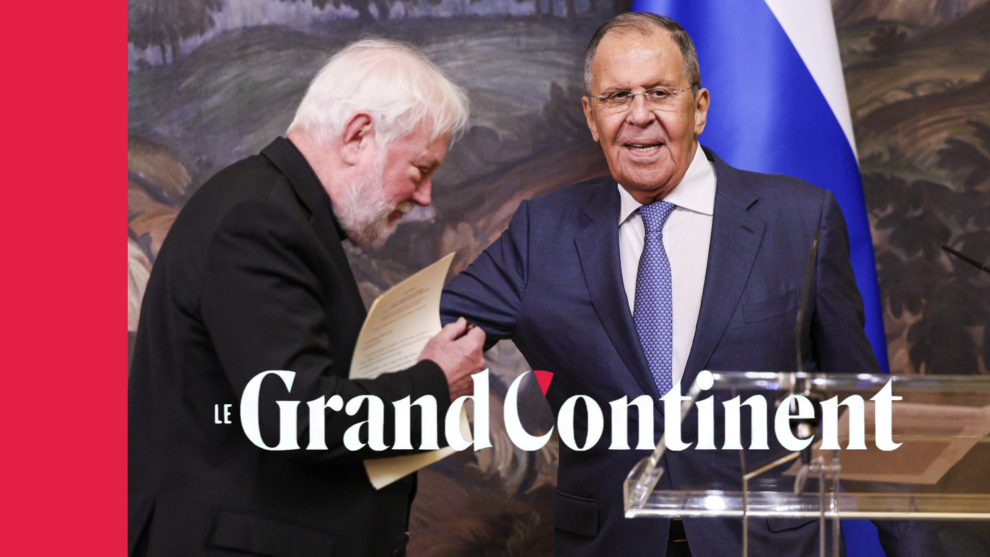
On August 24, Archbishop Paul Richard Gallagher, “Secretary for Relations with States” since 2014, i.e., the Holy See’s foreign minister, arrived in Moscow for a four-day trip, a notably long duration for someone at that level of the Vatican hierarchy.
- The significance of this trip is evident also in the Russian figures Gallagher met: although a personal audience with Vladimir Putin was not granted, the Vatican envoy had a one-hour meeting on August 25 with Sergey Lavrov, effectively his counterpart for the Russian Federation.
- He was accompanied on this occasion by Italian bishop Giovanni d’Aniello, Apostolic Nuncio to Russia since 2020. The following day, he had another meeting with Yuri Ushakov, Putin’s diplomatic adviser.
- Gallagher also met with Metropolitan Antony of Volokolamsk, this time his counterpart for the Russian Orthodox Church, as he heads the Moscow Patriarchate’s Department for External Church Relations and holds the rank of Metropolitan, i.e., archbishop in Orthodox tradition.
- While Gallagher’s trip was disclosed as early as August 6 by the TASS agency, the meeting with Sergey Lavrov was announced only four days earlier by Maria Zakharova, spokesperson for the Russian Foreign Ministry; one cannot escape the impression that the Kremlin sought to stage a diplomatic coup by revealing the visit ahead of time.
While the length of this journey may surprise, it is worth noting that Gallagher had previously travelled to Kyiv on July 20, where he was received by Volodymyr Zelensky and his foreign minister Andrii Sybiha.
- In Kyiv, Gallagher was preceded a few days earlier by Cardinal Matteo Zuppi, Archbishop of Bologna, president of the Italian Episcopal Conference, and Vatican special envoy for the war in Ukraine since 2023.
- Close to the Sant’Egidio community, with mediation experience at the end of Mozambique’s civil war (1990), Cardinal Zuppi would pursue a somewhat different line on Ukraine from that of the Secretariat of State led by Cardinal Parolin, more focused on his traditional role as a discreet facilitator of exchanges between the parties (the Holy See’s “good offices” diplomacy, less burdensome than formal mediation), whereas Matteo Zuppi would focus more on the humanitarian aspects of the war and the suffering of civilians: he even visited a camp for Russian prisoners in Ukraine.
- Anyway, these visions are less opposed than complementary, and they converge, for example, in the Vatican’s efforts to obtain the return of Ukrainian children abducted to Russia, or to facilitate prisoner exchanges, which constitute one of the few successes of the negotiations between the two warring sides.
- In September, Cardinal Zuppi is also expected to travel to Moscow.
- As Mikael Corre recently noted, one must also be mindful of the timing of this trip, which in a sense replaced the Russia-Ukraine visit of Steve Witkoff and Jared Kushner, which was postponed, and took place at the same time as CIA Director John Ratcliffe’s visit to Moscow. For Russian Foreign Ministry analysts, it is not insignificant that the pope is American and seen as an opponent of Donald Trump. In any case, Gallagher’s role as the pope’s trusted man is thus confirmed.
For the Holy See, which is accustomed to maintaining diplomatic contacts with the most recalcitrant states to the international order, the Kremlin nevertheless represents a particularly crafty and difficult negotiating partner to convince.
- Several times, the Holy See has offered to host negotiations between Russian and Ukrainian delegations: Pope Leo XIV reiterated this offer shortly after his election in May 2025.
- Following his meeting with Sergey Lavrov, Gallagher reiterated the Holy See’s general call to end the conflict, but without formulating conditions or proposals on more precise or technical points of cessation of hostilities, which is a sign that the Russian side is offering very little room for deeper negotiation.
- One of the few points of convergence between the Russian, Vatican, and American diplomats lies in the stated will to defend Christians facing persecution around the world. According to Lavrov himself, Gallagher expressed concern about restrictions on religious freedom in Ukraine, including a proposed ban on the Orthodox Church tied to the Moscow Patriarchate: a version that warrants scrutiny.
In Moscow’s refusal, there is also the old hostility toward the Catholic world by the Russian Orthodox Church, which itself constitutes part of its cultural hostility toward the “collective West,” instrumentalized by Kremlin propaganda; one of the Moscow Patriarchate’s grievances against the Ukrainian Orthodox Church, emancipated from its tutelage, is that it would seek closer ties to the Catholic Church in an ecumenical aim.
- In Ukraine, the position of Pope Francis, which had seemed to place the aggressor and the attacked back-to-back and had even denounced NATO’s “barking” at the Ukrainian border, had shocked even the ranks of the Ukrainian Greek Catholic Church.
Beyond the war in Ukraine, Archbishop Gallagher also came to reassure the small Russian Catholic community, facing harassment from authorities.
- He celebrated a Mass for peace in Moscow’s Cathedral of the Immaculate Conception, built in the early 20th century for the Polish community, and secularized for most of the Soviet era, from 1938 to 1991.
- The Catholic Church in Russia numbers fewer than 400,000 faithful (about 0.3% of the population), spread across four Latin-rite dioceses (Moscow, Saratov, Novosibirsk, and Irkutsk, all founded in the 1990s), an apostolic prefecture (on Sakhalin, legacy of missions to Japan), and an ordinariate for Byzantine-rite Greek Catholics.
- According to the latest figures in the Pontifical Yearbook, it counts 216 priests, 181 religious (men), and 228 nuns across about 200 parishes, several of which have merged in recent years following a period of expansion after the fall of the USSR.
The Russian Catholic Church currently finds itself in a delicate situation; since the start of high-intensity conflict in February 2022, Catholic charitable organizations must operate even more discreetly, under penalty of being accused of external destabilization.
- All parishes and religious communities must be registered with the authorities, and some face great difficulties. Furthermore, since May 2, the Moscow Archdiocese has been vacant, with the unexpected resignation, officially for health reasons, of Mgr. Paolo Pezzi, 65, Italian-born archbishop who has led this seat since 2007.
- Specialist in Siberian Catholicism, about which he wrote a thesis, allied with the lay movement Communion and Liberation which has the pope’s favor (seen recently during Pope Leo XIV’s trip to Rimini), Mgr. Pezzi is highly representative of the Catholic clergy in Russia, who are either missionary, with religious orders playing traditionally a very large role, or diasporic, often consisting of faithful of Polish, Ukrainian, German or Lithuanian origin.
- The bishop of Novosibirsk, the former Jesuit Joseph Werth, thus belongs to the Russian minority German-speaking; while his fellow bishop Clemens Pickel, bishop of Saratov, is originally from East Germany, and the bishop of Irkutsk has Polish origins.
- Mgr. Nikolai Doubinine, a Franciscan religious who serves as apostolic administrator heading the Moscow diocese after having been its auxiliary bishop, presents a peculiarity: he is the first Catholic bishop in Russia in more than a century to be native to the country.
- Because of this diaspora nature, for many Russians Catholicism is seen as fundamentally exogenous to their country’s culture; Latin-rite Catholics are paradoxically more tolerated than the Byzantine Greek Catholics, who were banned entirely during the Soviet era and are particularly ill viewed by the Moscow Patriarchate, which regards them as renegades, emblematic of the Uniate imperialist temptation of the Catholic Church aimed at the Orthodox world.
- If relations between the Catholic Church and the Moscow Patriarchate, icy under John Paul II, have warmed at the start of Francis’s pontificate, to the point of enabling the first meeting between the pope and Patriarch Kirill in Cuba in 2017 — a symbolic site of the pope’s “non-aligned” diplomacy — they have again faced major difficulties since the invasion of Ukraine, justified and blessed by Kirill.
- Mgr. Gallagher also noted that his meeting with Metropolitan Antony of Volokolamsk, who today maintains more cordial relations with the Catholic world than with the Patriarch Kirill, did not fall within the framework of ecumenical dialogue, which Rome’s Dicastery for the Promotion of Christian Unity handles, not the Secretariat of State.
The visit of Mgr. Gallagher would also aim to gauge the field for selecting a new Archbishop of Moscow. Officially, the Russian authorities do not intervene at any point in the episcopal appointment process, but unofficially, it is very likely that Gallagher consults them on the profile of the new archbishop.