
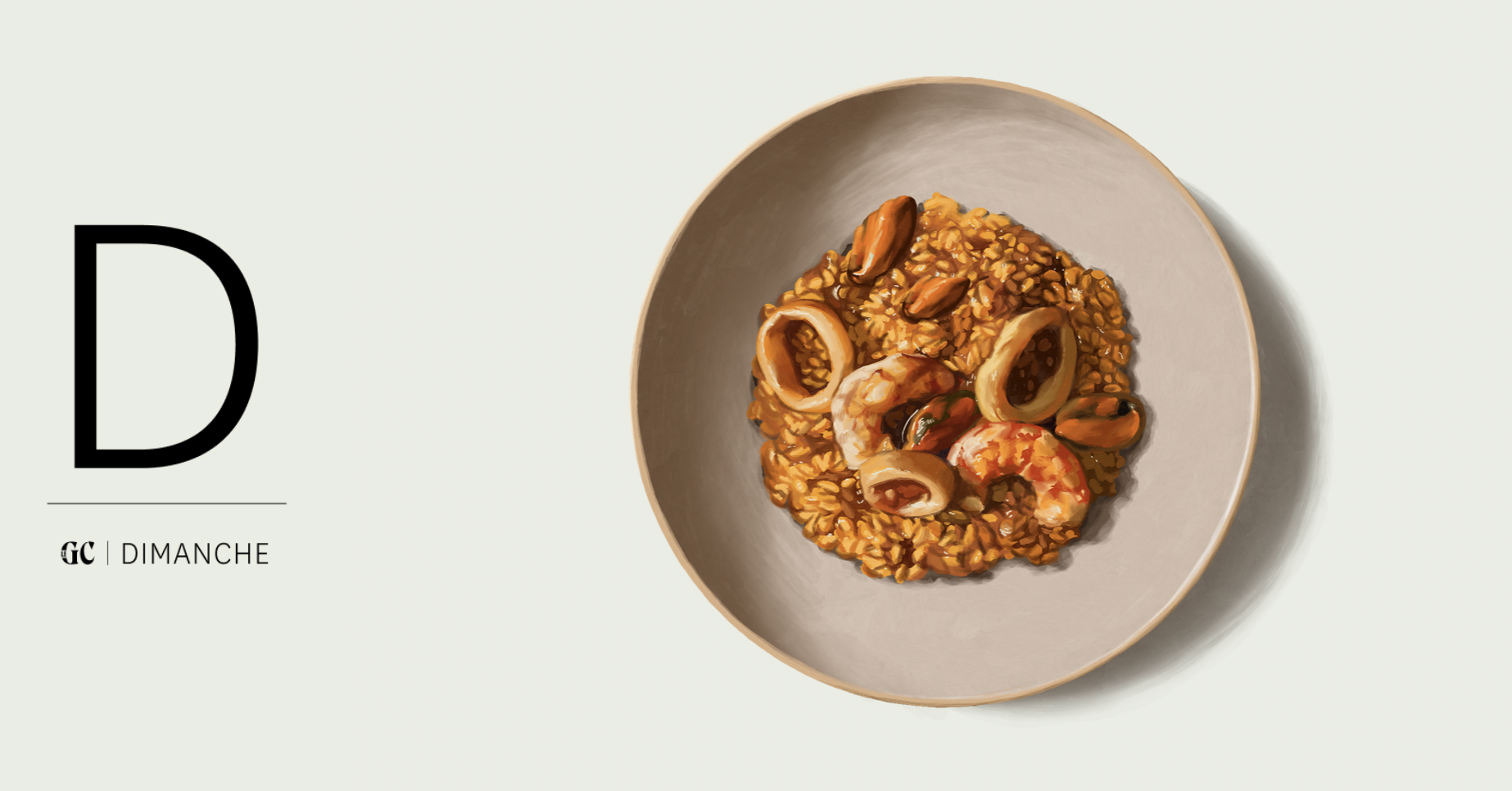
Ingredients for 4 servings
- 400 g Valencia rice
- 1 onion
- 2 garlic cloves
- 1 red bell pepper
- 1 green bell pepper
- 2 crushed tomatoes
- 1 bay leaf
- 100 g squid rings
- 100 g peeled shrimp tails
- 100 g peeled langoustines
- 200 g fresh monkfish
- 800 ml fish stock
- Saffron
- Olive oil
- Salt
The epigraph of my latest novel, Islandia, makes it clear from the outset that my parents never had the chance to visit Iceland. This country of extraordinary beauty holds a central position in the story of my two protagonists, as a land of symbol and emotion.
I, for my part, was fortunate enough to go there. They serve a traditional dish, a fish soup, whose name is easier to spell than to pronounce: fiskisúpa. A single tasting, no idea of the recipe, so I cannot say more. The best course is to go to Iceland, under happier circumstances than those of my characters, and taste this soup on the spot.
As a consolation, here is another seaside dish, prepared with different fish.
It is the “arroz del senyoret,” which could be translated as “rice of the young gentleman.” It is eaten a little all around Spain, but Valencia is where it is prepared. It resembles paella – in my view better than paella – with one detail that is not a detail: the fish and shellfish have already been peeled.
One thing that truly horrifies me: eating with the fingers. Getting one’s hands dirty at table to peel shrimp or open mussels in one’s plate may seem trivial, but it long kept me away from traditional paella. This version spares the fingers. Everything is already there, neatly presented, ready to be tasted. The pleasure isn’t the same, and the taste isn’t either.
On the other hand, if this paella version makes tasting easier, it complicates the preparation.
To begin, cut the onion, garlic and peppers (half of each pepper will suffice) into brunoise. In the pan (or paella pan), sear the monkfish, salted and cut into small cubes of about one centimeter, over high heat, in two tablespoons of oil, then set it aside.
Cut the langoustines into pieces, sear them with the prawns, then set aside. Do the same with the squid rings: cut into pieces, salt, sear, and set aside. Pour in two more tablespoons of oil into the pan, sauté the minced garlic and onion for about five minutes, then add the peppers and the bay leaf. Let them cook for about ten minutes, until they color.
Then add the tomato purée and cook for ten more minutes. Then fold in the rice, the stock, the squid, the prawns, the langoustines, the monkfish, and the saffron threads. Adjust the seasoning if needed before the rice begins to cook. All that remains is to let the whole dish simmer for eighteen minutes. Serve immediately, hot.
This passion for paella is an inheritance: my mother and father used to make an extraordinary one and the whole family loved it. An inheritance that evolves, since I have become a “senyoret” and this rice is now eaten mainly in restaurants. At home still, one must know how to prepare it. In Spain, arrocerías, the rice houses, take care of it very well, while contributing to a broader trend that particularly affects paella; starting from a traditional version, a popular dish, it is refined to reach heights of excellence.
The essential thing first lies in the quality of the ingredients: the fish, the squid, the prawns and the langoustines. Even if you can find very good paellas in Madrid, you should enjoy it preferably by the sea, in Valencia for example, from where I write. Paella is a child of the Mediterranean: the sea, good weather, the beach, the sun, the summer life, holidays. There is a very Spanish way to eat it, with your feet in the sand.
The other condition lies in the cook’s skill. The technique is judged in one place: the main difficulty of the dish is cooking the rice. It must be just right. Nothing obvious in such a long preparation, yet it requires serving it immediately after cooking.
But since it takes time to prepare, it takes time to eat.
You do not gulp down an arroz del senyoret in fifteen minutes, nor every day. Once every fortnight is enough. And preferably the Spanish way, facing the sea.