
All summer, Grand Continent will stay in motion. Each day, wherever you are, we will bring you ideas you won’t find anywhere else (but which will be everywhere again at the start of the season), texts you won’t find elsewhere or refreshing with our Sundays. To receive them directly in your inbox and support this momentum, consider subscribing to the magazine
The airplane door opens onto a carpeted corridor with a strong smell of mold. The air conditioning installed is no longer powered, humidity gnaws at the empty halls of Yangon International Airport. Passengers arriving from Bangkok struggle to unload their heavy luggage, the fabric and zippers ready to crack under the weight of everything now in shortage in Myanmar: toothpaste, tampons, shaving foam, chocolate, medicines, birth control pills.
At immigration, the counters for foreigners and locals are separated. In the line for foreigners, there are mainly Chinese from the southwestern provinces, import-export or textile entrepreneurs; a few Indians as well. The few Westerners are diplomats or humanitarian workers. The eight queues for the “nationals” move the slowest. A silence of fear settles in, the nervousness is palpable. Burmese citizens fear that the immigration officers’ computer will reveal that they are listed on the military regime’s “black lists,” aimed at repressing dissidents. On these lists can be found: democracy activists, family members of resistors, public servants who have resigned, anyone who has publicly criticized the junta, and young men called up for military conscription.
In April 2024, the regime in power reactivated a dormant law that imposed compulsory conscription for young men aged 18 to 35 and young women aged 18 to 27, but the measure has not yet been applied to the latter. The prospect of being used as cannon fodder by the generals who bomb villages, clinics and schools is the only option facing Burmese youth in their own country. To meet conscription quotas, officers do not hesitate to seize manu militari the youths they arrest at checkpoints, on roads or in airports, through the immigration services.
It is not uncommon for passengers, handing their passports to immigration officers, to slip in a few blue 10,000 kyat notes, to secure passage. Those who emerge feel fortunate. Yangon suffers from pollution and records 35 degrees Celsius in April. Yellow taxis, built in Japanese factories more than twenty years ago, welcome arrivals. Frustrated, drivers had to queue for hours before being able to purchase the rationed fuel that will bring travelers home, to Yangon, occupied by the Burmese junta.
In the country where China backs elections
Five years after the February 1, 2021 coup, General Min Aung Hlaing managed to organize elections between December 2025 and January 2026, and to be elected president. The ballot took place while Nobel Peace laureate Aung San Suu Kyi remained in detention, and her political party, the National League for Democracy, remained banned. The population was reluctant to go to the polls, and it was only the threat of repression in case of abstention that allowed the regime’s propaganda to display a turnout of 54%.
These elections mark a victory for the Burmese army, well beyond the ballot. While in 2024, the junta seemed on the verge of losing the ongoing civil war, the regime managed to organize the election without suffering major attacks from the revolutionary forces. These forces — divided into around a hundred groups, more or less under the authority of a government-in-exile of national unity — have since mid-2025 entrenched themselves in a defensive position, short on ammunition and outpaced by the firepower of the generals. A leader of the Mandalay People’s Defense Forces revolutionary group, Ko Phyo, stated in early 2026 that the resistance is now “unable to compete” with the arsenal and number of fighters deployed by the junta.
This turn of events was due to China’s direct involvement in the Burmese revolution since 2024. The elections themselves were supported, even sought, by Beijing. The Chinese special envoy for Asian affairs, Deng Xijun 邓锡军, likewise praised the holding of these elections in December 2025: “The successful conduct of these elections reflects the agreements and cooperation efforts between General Min Aung Hlaing and President Xi Jinping.” Beijing had already invited several Burmese political parties to China for study visits.
History of China-Burma relations
China initially remained wavering in the face of the February 2021 coup. A few days after the power grab, while protesters marched in front of the embassy in Yangon with banners accusing Beijing of having directly supported the coup, Ambassador Chen Hai 陈海 stated in Burmese press that such a forcible takeover “is absolutely not what China wishes to see.” Indeed, China had maintained close cooperation with the government of Aung San Suu Kyi between 2016 and 2020.
The Nobel Peace Prize laureate had visited China several times, for instance after her election in 2016, where she had met Xi Jinping. The Chinese president reciprocated the visit in January 2020, the first time a Chinese president had visited in nineteen years.
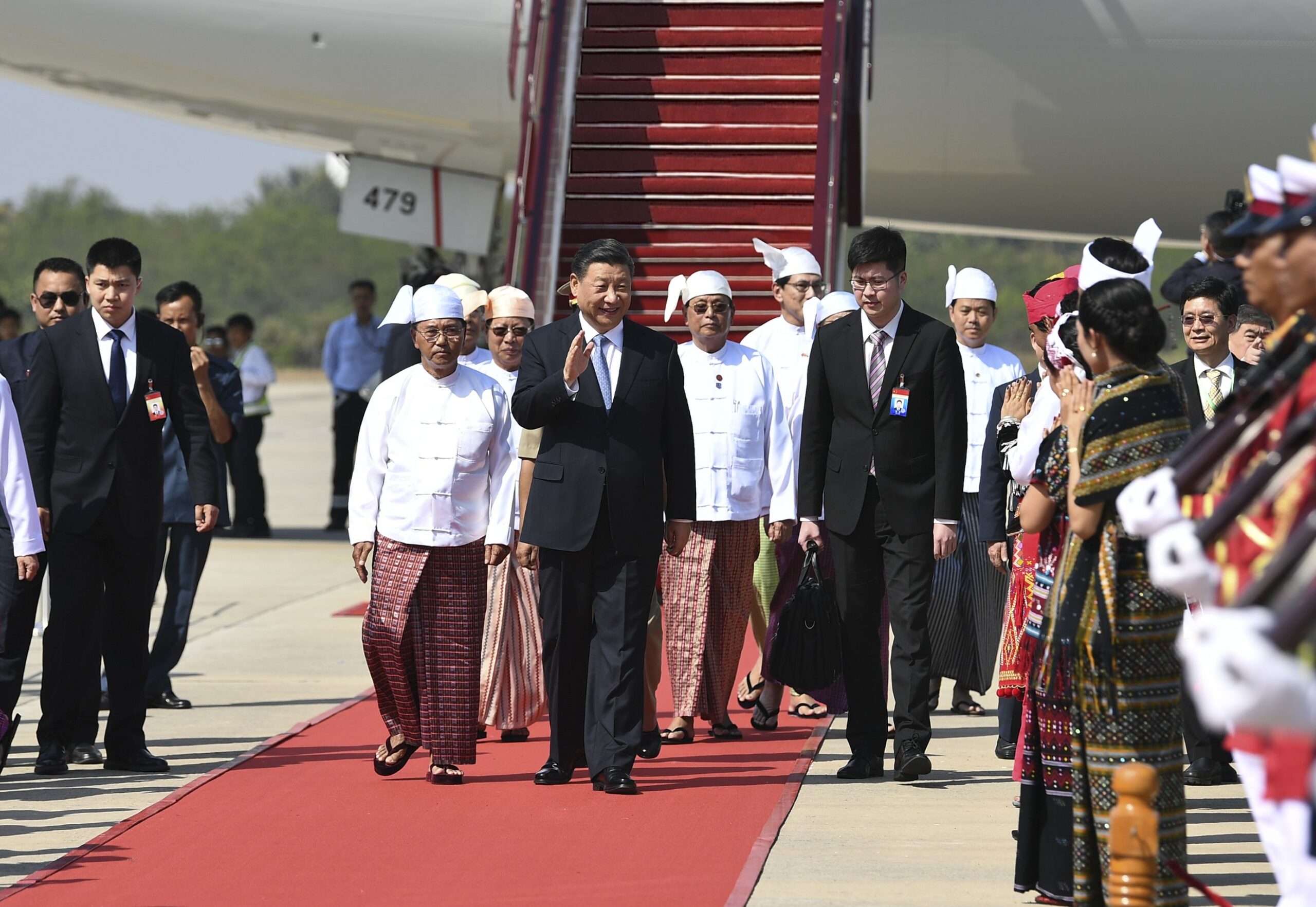
The government of the National League for Democracy nevertheless differed most from the previous government composed of former officers and led by President Thein Sein, a former general who had suspended the Myitsone hydroelectric dam megaproject on the Irrawaddy River in 2011. This gigantic project, signed in 2009 under Xi Jinping (then vice president) watched over, was meant to provide electricity to China, with less than 10% of the production left to Myanmar. Local Kachin populations opposed it, fearing disruptions tied to the dam, and demanding protection of rivers at the source of the Irrawaddy, a lifeline across the country from north to south and which helps fertilize the central rice plains. Rarely, the former generals listened to local populations and decided to suspend this project. This suspension was seen by Beijing as an affront. By contrast, once in government, Aung San Suu Kyi expressed a desire to relaunch Sino-Burmese cooperation. The State Counsellor had created a special commission for China-Burma projects which she personally chaired. Aung San Suu Kyi even went so far as to suggest the possibility of relaunching the Myitsone dam project. Myanmar’s economic opening benefited China and its companies able to produce at low costs the infrastructures and consumer goods needed for a developing economy. Between 2010 and 2020, bilateral trade rose from 4 to 19 billion dollars. China indeed had no interest in seeing Aung San Suu Kyi’s government overthrown.
From Watchfulness to Interventionism
In the wake of the coup, China adopted a wait-and-see stance and did not formally recognize the military regime of General Min Aung Hlaing, while systematically refusing any official contact with the exile revolutionary government. This dithering lasted until 2023, when Beijing became directly involved in the Burmese conflict on two occasions and along directions that were radically different.
On October 27, 2023, a coalition of armed ethnic groups led by the Ta’ang National Liberation Army, the Arakan Army and the Burma National Democratic Alliance Army launched an extensive offensive against the China-Burma border, targeting positions held by the army and allied militias. The operation dubbed “10/27” officially aimed to remove and arrest those responsible for online scam centers set up on the border. The fighting was marked by heavy use of drones by the rebels, and a high degree of cooperation among these groups whose equipment was Chinese and revolutionary young fighters seeking military experience. The operation was a resounding success: dozens of scam centers were dismantled and the Chinese employees involved were handed over to their national authorities. The Burmese army, which had narrowly managed to exfiltrate the militia leaders in charge of the zone, eventually extradited them to China, which sentenced them to death in 2025. Thus, frustrated by the junta’s inaction toward scam centers, Beijing showed that it was ready to use its influence over armed ethnic groups to directly intervene in a large-scale policing operation in Burma.
The operation “10/27” enabled a significant territorial gain for the rebels, illustrating the weakness of the Burmese army, triggering a series of offensives across the country: ethnic and revolutionary groups managed to seize several cities. A second operation was launched in the summer of 2024 by the same actors, with resounding success, the rebels having taken power in six cities and control of one of the 14 regional Burmese command centers, a first since the 1962 coup. However, this second operation, conducted without its consent, frightened China: the junta threatened to collapse. Anxious about the country’s stability and the security of its investments, Beijing intervened by pressuring the rebels to accept a ceasefire and helped to seal a land border blockade, suspending access to food and equipment. The Chinese regime also used its influence over the Was Army, a powerful autonomous ethnic group, forced to stop selling ammunition and to renounce passage through its territory. Under pressure, the rebels had to accept the ceasefire and symbolically relinquish control of the pivotal Lashio city, handed back to the army, even though it had been won at the cost of many casualties on both sides. The Chinese-supervised ceasefire, in effect since January 2025, was followed by visits by Foreign Minister Wang Yi and invitations to General Min Aung Hlaing to China, notably to visit weapons and drone manufacturing plants. This Chinese intervention and the introduction of conscription policy explain today the reversal of the military dynamics. The 2025/2026 elections mark the conclusion of this rescue cycle of the Burmese junta by Beijing.
Chinese Vulnerabilities
One might question the wisdom of this rescue. General Min Aung Hlaing has plunged Burma into the worst cycle of internal violence since independence. The conflict has already claimed more than 100,000 lives, notably from air raids conducted by the junta against civilian targets. The country, its people, and its economy remain ravaged by civil war. After an 18% drop in GDP in 2021, it has not yet returned to pre-Covid levels, making it the only ASEAN country in this situation.
Rampant Insecurity
ACLED’s platform ranks Burma as the second most conflict-ridden country in the world in 2025, after Palestine. Insecurity is endemic beyond the circle of direct army control exercised in Naypyidaw, Mandalay and Yangon. The army actually governs the largest cities in the central plains, but revolutionary or ethnic groups control the periphery and the borders. The roads linking these zones are dangerous: the road from Mandalay to Meikthila and Kyaukse is so perilous that residents prefer to fly. Across the territory, the number of checkpoints has increased, creating long queues at both formal and informal toll stations. Extortion can be carried out by the army, by militias backed by it, by ethnic groups or by revolutionary groups. Around Mandalay, between the army-controlled mid-sized towns of Meikthila and Kyaukse, various armed groups, with or without identifiable uniforms, can stop vehicles suddenly and extort money. The police are relegated to guarding administrative buildings and protecting the few officials’ convoys in transit. The junta partially legalized firearm possession in 2023, partly in response to concerns from pro-military and wealthy families about the explosion of violence. Young men do not dare to go out on the streets in Yangon for fear of being kidnapped for conscription. The army remains the primary driver of insecurity in a country that has entered into revolution. China’s support for the Burmese generals has indeed helped save them and their hold on power, but it does not translate into effective control of the country.
Malacca Dilemma
Myanmar holds strategic importance for Beijing as a direct access point to the Indian Ocean. The country indeed offers China the possibility to reduce its dependence on the Strait of Malacca, through which more than 75% of oil imports and a quarter of international maritime trade pass, and which, in case of open conflict with the United States, could be blocked. Since 2003, President Hu Jintao referred to this scenario under the name “Malacca Dilemma.” The launch of the “China-Myanmar Economic Corridor” in 2017 by Foreign Minister Wang Yi aims to provide a solution. The nature of the projects gathered under this entity clearly reflects this view of a country seen primarily as a “corridor”: oil pipelines, gas pipelines, a deep-water port, the Kunming-Kyaukphyu railway. China seeks to traverse Myanmar. The double pipeline, gas and oil, operational since 2013 for gas and 2017 for oil, has the capacity to serve 10% and 5% of respective Chinese energy imports. But its usefulness depends doubly on the ability to deploy the infrastructures needed to operate it and to guarantee their security.
Several attacks have already occurred along the Chinese pipeline, including one in May 2025, which consisted of a series of eight coordinated attacks by revolutionary troops, resulting in a temporary takeover of control stations. Early 2026, the Arakan Army was engaged in an offensive to seize the town of Kyaukphyu and its surroundings, starting points of the oleo-gas pipeline, which could give this junta’s sworn foe a significant bargaining lever. Other attacks on the pipeline are not to be ruled out by revolutionary groups currently threatened in their survival by the measures decreed by China. Through 2026, the attacks did not aim to damage the infrastructure, but rather to seize it to demonstrate a protective capability. Future operations, conducted by more desperate actors, could be far more destructive.
Heavy Rare Earths
The second vulnerability of China to shocks from Burma lies in the northeastern soils of the country, rich in heavy rare earths such as dysprosium and terbium. According to some estimates, Myanmar accounts for 60 to 80% of China’s imports of heavy rare earths since the late 2010s. Mines on the Burmese side of the border are now controlled by various armed ethnic groups. In 2024, the Kachin Independence Army seized a major mining area previously controlled by a local militia that had pledged allegiance to the Burmese army. Thanks to this seizure, the Kachin rebels were able to force China to reopen border posts that had been closed, illustrating this new vulnerability of Beijing.
Because of the scale of its investments, notably in infrastructure projects and extraction of raw materials, China is vulnerable to the repercussions of the 2021 coup. The decision to save the junta can be explained by these vulnerabilities. China sought to protect its interests, on which the regime’s potential fall could pose a threat. Ending its neutrality and engaging in conflict alongside the army creates new risks. The question remains whether the army that needed saving will actually be able to protect China’s interests, and whether the ceasefires imposed by Beijing will be sustainable.
The Burmese Generals Saved, But Neither Capable nor Subservient
The recent elections and military victories of the Burmese army seem to push away the possibility of a regime change in Burma. The fatigue from the war, evident in cities under army occupation, suggests a near future stabilization of military power, i.e., a return to a Burma before 2010. However, unlike 2010, when a civilian government began a process of political opening, there are currently no signs that could give hope.
Dupe Games: The Difficult “Cooperation” Between the Junta and China
For China, the early months of the new government were an occasion to celebrate Sino-Burmese friendship, notably by grateful Burmese generals. General Min Aung Hlaing initiated a process to relaunch the Myitsone dam project and public consultations have already taken place on site, to show how this project could constitute a real opportunity for local populations. These visits are largely staged in propaganda operations, and aim to promote the generals’ cooperation efforts.
The Burmese army has launched since winter 2025 a campaign against scam centers, now relocated to the Thai border. The junta staged itself dynamiting various complexes. But these centers were located on the territory of the Border Guard Forces militia, a powerful paramilitary group officially under junta control. The connivance between this militia and the Burmese generals is similar to what has been observed on the China-Burma border, where the leaders of local militias were appointed by the Burmese army. The campaign occurred within a broader regional effort under Chinese pressure, as elsewhere in Cambodia and Laos. The phenomenon is indeed widespread in Burma and Cambodia, where Chinese gangsters profit from deals with corrupt local authorities to host large online scam centers, employing thousands of youths from Southeast Asia but also from India and Africa, to target internet users in North and South America, Europe and East Asia. Behind the political show, the scam centers destroyed are already reemerging in other cities in Myanmar, including Yangon. In May 2026, Burmese press stated that General Pyae Son Linn, in charge of armed forces training and former military commander of the Rangoon region, had been arrested because it was revealed that he was directly receiving the proceeds of a scam center, in a hotel, in the city center. The financial windfall for the militia and local officers, as well as the need for Burmese generals to preserve their relations with the militia, without which the army cannot control the Thai border, explain the persistence of these criminal activities, despite Chinese pressure.
China, however, continues to raise the tone. Consequently, the Burmese junta dismissed Lieutenant-General Tun Tun Naung, Minister of Home Affairs and close ally of General Min Aung Hlaing in early 2026, after the discovery of evidence showing his involvement in managing scam centers. According to The Irrawaddy, this evidence was supplied by China. In early May 2026, the Chinese ambassador to Burma visited Naypyidaw to inquire about progress on a bill to anti-scam centers capable of imposing the death penalty in certain cases. But the cooperation resembles coercion by China more than collaboration.
In a similar scenario, in November 2025, the Burmese army dismantled a series of artisanal laboratories producing synthetic drugs. These laboratories were “discovered” following evidence disclosed by China, again. It is hard to believe the junta was unaware of the existence of this plant before this opportunistic Chinese help. Observers note that despite the seizures, no official was identified or arrested; the junta simply blamed local armed groups, without appearing credible. China seems determined to insert itself directly into Burmese affairs, including by investigating the highest officials, to be able to demand the execution of its requests, notably in the fight against narcotrafficking and against scam centers.
These examples of forced cooperation recall China’s frustration with the Burmese generals before Aung San Suu Kyi’s rise to power. The rescue of the Burmese army was carried out in the name of protecting Chinese interests. But the situation that led to the threat to these same interests is indeed the result of the Burmese generals’ actions. Betting on the generals who have lost control of the country’s land borders since 2023 to protect Chinese interests seems paradoxical.
Burmese Deadlock, Ceasefires Imposed, Peace Impossible
The cooperation of Burmese generals in service of Chinese interests remains ineffective, even counterproductive. As for infrastructure construction within the China-Burma Economic Corridor, the Ruili-Kyaukphyu railway project has seen no realization since its theoretical launch in 2011, as well as the deep-water port in the Rakhine region, which sits in the middle of the front line. The Transnational Institute identified, in 2020, 41 projects officially announced by China under the Belt and Road Initiative, of which only nine were accepted by Burma in 2020. During its visit to Burma in January 2020, Xi Jinping mentioned three “pillars” of the Sino-Burmese economic corridor: the Kyaukphyu Special Economic Zone, the border-special economic zones, and the New Rangoon project. The Rangoon project has completely faded from view following the coup; border special economic zones are now under rebel control, and the Kyaukphyu economic zone is partly occupied by the Arakan Army. The Burmese bridge between China and the Indian Ocean seems under pressure, especially since the conflict between the United States and Iran has underlined the strategic role of the Malacca Strait. Indonesia’s finance minister publicly spoke of the opportunity to tax navigation there, before retracting. The Burmese corridor, which was supposed to be a guarantee for China, looks very much like a dead end.
In 2026, China, and especially the Yunnan provincial authorities, eager to revive cross-border trade halted since 2023, found themselves obliged to cooperate with the armed ethnic group of the Army of the National Democratic Alliance to expel other armed ethnic groups from the main route. In reaction, Burmese authorities refused, in May 2026, access to any Chinese goods heading toward Mandalay from the border, the generals probably seeking to reclaim a share of the profits from this trade. While Chinese authorities organize perilous inter-ethnic military operations to foster the trade’s recovery, the junta begins a border-blockade campaign on the same route. This maneuver clearly shows the generals’ inability to accept compromise and their maximalist positions that delay the trade resumption desired by China.
Regarding scam centers, the tolerance, or even cooperation, of the Burmese army with criminal networks enabling fraud at an international scale, motivated in 2025 the United States to establish a special unit to combat scam centers in Thailand. This initiative, so close to Chinese borders and in a Beijing-influenced zone, is a consequence of Burmese misrule. China’s interests are directly hindered by it.
Finally, if the junta has managed to regain ground in the last six months, it has lost a portion of its control over the national territory compared to 2020, and it offers no credible peace process. The continuation of brutal repressive actions through airstrikes against schools and hospitals contributes to prolonging the conflict. The Burmese army has said it is open to peace negotiations in 2026 with certain groups, but its long history of betraying commitments since 1962 offers no encouraging precedent. In the words of the Arakan Army’s commander, a rebel ethnic group that managed to seize the entire western flank of the country on the Bangladesh border, “as long as the army continues to bomb civilians, it will be extremely difficult for us to envisage a political process.” The Arakan region is under total blockade, including food and medicines, and has been without Internet for more than three years. Mrauk-U General Hospital was bombed in December 2025, illustrating the brutality of the Burmese army, which treats the population as its enemy. In this context, the signing of a ceasefire, on the side of the armed ethnic groups that have suffered heavy military and civilian losses, seems hardly conceivable.
The National Democratic Alliance Army and the Ta’ang National Liberation Army have sacrificed hundreds, even thousands, of lives to seize the Northeast’s towns, including Lashio, now returned to the Burmese army. The durability of the agreements is questionable, from both the insurgents’ perspective and the junta’s, which now feels in a position of strength. Trusting the Burmese army to engage in a durable peace process would be historical blindness.
Did Beijing Make the Wrong Choice?
China’s collaboration with the army is a risk, which could have a ripple effect on projects and on Chinese citizens in Burma.
In October 2024, the Chinese consulate in Mandalay was targeted by a grenade attack. The Chinese embassy in Yangon is now encircled within a perimeter largely forbidden to traffic, for the safety of staff. Drawing an illustrative parallel, the exile newspaper The Irrawaddy published an analysis by Pakistani researcher Chandu Doddi, explaining that attacks on Chinese projects in Pakistan multiplied due to China’s unpopularity. Anti-Chinese sentiment in Burma is palpable, reinforced by working conditions in some Chinese companies, as well as by their cooperation with the army. Unable to trust the junta, China nevertheless pays the price of this cooperation.
During its visit to Naypyidaw in late April 2026, Foreign Minister Wang Yi, who came to celebrate the advent of the new government, would have met Aung San Suu Kyi, according to sources cited by The Irrawaddy. The meeting was not confirmed, the Chinese Foreign Ministry spokesperson merely stating that the “condition” of this “old friend” remains “in the minds” of Beijing. Directly after Wang Yi’s visit, the army released a rare photo of Aung San Suu Kyi and announced her transfer, from prison to a house arrest. According to the National League for Democracy party, the party’s international liaison office of the Chinese Communist Party would also have sent its best wishes to Aung San Suu Kyi for her 81st birthday, celebrated in detention on June 19, 2026. Irony of the Chinese Communist Party having helped organize elections in the context of a military coup, and which, the day after the vote, reaffirms its attention toward the country’s first political prisoner. The ambiguity of the saved Burmese generals, neither capable nor subservient, explains this particular diplomacy.
Faced with Chinese pressure, the Burmese generals play their balancing act by continuing to develop relations with Russia and India, the latter chosen as the first foreign destination of the newly elected President Min Aung Hlaing at the end of May 2026. Afterward, the Burmese general flew to an official visit in Beijing, in June 2026, where Xi Jinping expressed his support for Burma to “find a development model suited to its national characteristics and supported by its people.” The joint statement from the meeting again calls to “accelerate” cooperation efforts, the same message as during Xi Jinping’s 2020 visit to Burma, before the coup. China saved the generals, but are they truly capable of protecting Chinese interests? And for how long will they continue to obey Beijing’s orders?
The Chinese interventionism in Burma sharply contrasts with China’s overall stance of neutrality and non-interference in international affairs. The case recalls both China’s capacity to influence beyond its borders and its vulnerabilities in the face of local dynamics in a country in revolution.