
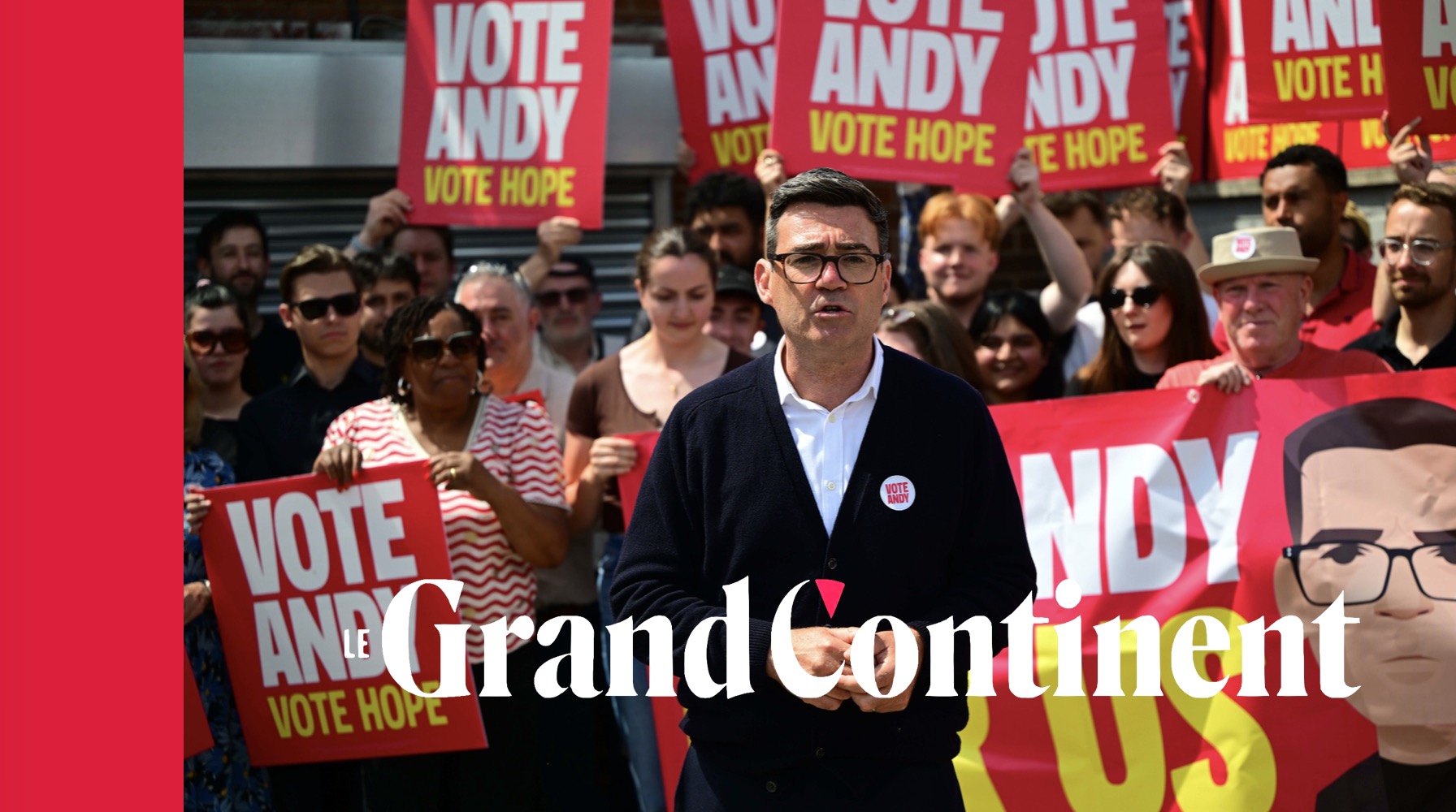
Andy Burnham was elected on Friday, June 19, in the Makerfield constituency, near Manchester.
As mayor of Greater Manchester since 2017, after having held several posts as secretary of state under Gordon Brown from 2007 to 2010, Burnham had failed to seize the Labour leadership following the 2010 election, which brought Ed Miliband to power.
- It was after the parliamentary rebellion against Jeremy Corbyn in 2016 and the internal struggles within Labour that Burnham swapped his Westminster seat for a local mandate.
- During this period he moved from the modernizing New Labour of the 1990s-2000s to the “soft left,” a more moderate wing of the Labour Party that sits between the left and the right.
- Burnham was elected to lead Greater Manchester, the second-largest metropolitan area in the country after London, for the first time in 2017. He has since been re-elected twice, in 2017 and 2021.
- His Friday election opens the possibility of challenging Starmer for the leadership of the Labour Party and becoming prime minister.
Burnham summarizes his political and economic philosophy as the Manchesterism, a response, according to him, to « the trap of high inequality and weak growth resulting from the aim, since the 1980s, to privatize economic power and to overly centralize political power within the Treasury. It is about creating a new politics to get us out of it and developing a new economy ».
- Burnham argues that deindustrialization, privatization, austerity policies and Brexit are the four main factors that have helped break the British growth model.
- The Manchesterism notably promises to return more direct control to local authorities over housing, public services, transport, and education, following the model of his policy implemented in Manchester.
- One of his most visible legacies as mayor has been the implementation of the “Bee Network”: a redesign of the metropolitan area’s public transport into an integrated network managed locally, modeled on London, with the introduction of a £2 ticket.
With Manchesterism, Burnham promises the end of neoliberalism and of trickle-down economics. However, it is not clear what form this policy would take at the national level.
- The Manchester metropolitan area, which shows one of the strongest growth rates in Europe, was already experiencing an economic boom before Burnham’s arrival.
- To finance its development, Burnham has sought to attract private capital, including some unconventional sources, which some see as running counter to the image he intends to project.
- In the New Statesman, Isaac Rose, who works for the Greater Manchester Tenants’ Union, goes further by accusing Burnham of having “adopted a neoliberal capitalist model that benefits foreign investors.”
If Burnham is currently the most popular politician in the United Kingdom, fewer than half of Labour voters see him as “different” from Keir Starmer, according to a YouGov poll. His popularity, partly built on an anti-establishment rhetoric, could be undermined if he were to take Keir Starmer’s place.
The next British general elections must be held by August 21, 2029. If Burnham reached 10 Downing Street, he would mainly have to address relations with the European Union, ten years after Brexit, but also with the United States. The United Kingdom will host the G20 summit next year.