
All summer long, Le Grand Continent will stay in motion. Each day, we will bring you ideas you won’t find anywhere else (but which will be everywhere come the fall), texts unavailable or refreshing with our Sundays. To receive them directly in your inbox and support this momentum, consider subscribing to the magazine
Maritime history, understood over the longue durée, can help us understand today’s China. For half a century, seas and oceans have ceased to be merely intervals between terrestrial civilizations, but rather structuring spaces for circulation, confrontation, mediation, and innovation. The historian Fernand Braudel was one of the first to show that the Mediterranean is neither a simple backdrop nor a homogeneous political unit, but a macro historical region made up of interdependencies, micro-ecologies, imperial rivalries, and long-term mercantile circulations.
This analysis has been extended by other authors who placed at the heart of the intelligibility of a maritime space its fragmentation and its combined connectivity. In this perspective, it is interesting to view maritime Asia as a “Mediterranean Asia,” not to apply an artificial Mediterranean model to Asia but, starting from this thought experiment, to propose a renewed reading grid of regional interdependencies. Thus, we do not transpose a model, but we strive to render legible three interconnected phenomena: mercantile circulations, the permeability between legitimate trade, smuggling and piracy, and the rivalries between central power and local powers.
We must extricate ourselves from the most immediate geopolitics and return to long history.
François Gipouloux
In a broad sense, maritime Asia stretches from north to south, from the Sea of Japan to the Malacca Strait, passing through the Taiwan Strait and the South China Sea. Historically, it has been characterized by an extraordinary density of trade routes, a deep intertwining of coastal areas with their inland riverine hinterlands, a plurality of political forms, and legal regimes that partially cover each other. In this regard, it shares several structural traits with Braudel’s Mediterranean: navigable proximity between micro-regions, the existence of intermediary ports between different cultural worlds, the coexistence of competing sovereignties, and the central importance of maritime exchanges in economic organization.
To understand current tensions in the South China Sea, the redefinitions of Taiwan’s place, the rivalry among Shanghai, Hong Kong, and Singapore, or the hardening of China–Japan relations, we must extract ourselves from the most immediate geopolitics and return to long history. Indeed, all of these regional relationships, more or less conflictual, can be explained by the different functions assigned to the sea for centuries: it is at once a resource, an axis of circulation, a contested space of sovereignty, and a milieu of interdependence. This framework helps to better understand the present.
The Sea Integrated with the Land: The Land-Sea Continuity in Maritime Asia
Between the sixteenth and eighteenth centuries, the idea took hold in Asia of a continuum linking land and maritime spaces: one cannot conceive of river basins without the continental production zones, themselves dependent on maritime circuits. These spaces are tightly interwoven. It is the Japanese historian Hamashita Takeshi who, by shifting the analytic frame from examining East Asia through a purely state-centric prism, uncovered a networked configuration, whether it be those that determine tributary trade, the circulation of metal currencies, or the operation of maritime customs, endowed with a relative autonomy. There is indeed a structural continuity that unites maritime and terrestrial spaces. The maritime space is not the exterior of the territory, but its functional extension: the seas of Asia are deeply embedded in continental systems. The great river basins, above all the Yangtze, connected interior production areas directly to maritime circuits. Proto-industry and Jiangnan’s craftsmanship (the Shanghai region) were connected to coastal ports and the overseas realm through a dense network of canals and tributaries. Silk, tea, porcelain, sugar, timber, metals, and rice were directed toward the ports of the southeastern coast, while Japanese metal money, and later Peruvian and Mexican silver, were channeled to China via Acapulco and Manila.
The maritime space is not the exterior of the territory, but its functional extension.
François Gipouloux
If one centers on the Chinese example, the southeast coastal zones of China did not constitute margins of the Empire, but interfaces between two regimes of accumulation and circulation: the agrarian-fiscal order of inner China and the commercial order of the coastal facade. The two coastal provinces of Fujian and Guangdong, though poor and cereals-deficient, learned to profit from the sea for their economy. They became the anchor of lineage institutions and merchant networks, the starting point of migratory flows toward Southeast Asia, and the link with Hokkien diasporas established in major foreign entrepôts, from Manila to Nagasaki, via Batavia.
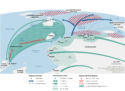
Unlike tributary or licensed trade, which were closely tied to imperial administration, Chinese maritime commerce differed in that it was less controlled by authorities. Its actors were more numerous and not limited to imperial officials or great merchants: brokers, captains, shipowners, and merchant-pirates formed a nebulous web, to which the Fujian, Guangdong, Chaozhou, and Hainan diasporas joined. Beyond private enrichment, the sea could also foster peripheral powers that tended to break away from imperial oversight. The warrior Zheng Chenggong Koxinga (1624–1662), a fervent Ming defender and organizer of the victory over the Dutch in Formosa in 1662, made this island a bastion of resistance to the new Qing dynasty.


It is also at this place that the struggle against Sino-Japanese, Sino-Vietnamese, and Sino-Siamese networks, as well as against the compradors, key figures of open ports in the nineteenth century, took shape. Finally, the sea and the maritime periphery of an empire are essential elements for linking to a broader region: Ryūkyū (today’s Okinawa), Nagasaki, Manila, Batavia, Malacca, Siam, and Vietnam were as many territories that extended beyond imperial centrality.
This land-sea continuum is matched by a fluidity of statuses: the same actors, the same networks, and even the same families shift, depending on the political conjuncture, from licit commerce to smuggling, then to piracy. The merchant Zheng Zhilong, for example, benefited from the tumultuous political transition between the Ming and Qing dynasties, evolving his status to accumulate roles that sometimes clashed with legal order: he became admiral, proto-sovereign, smuggler, or broker between the Empire and the sea.


The sea is therefore not the vast blank expanse sometimes depicted on maps; it is a space of competing governance, where the imperial state periodically attempts to project its authority (for example by banning maritime activities, then by partially lifting them), while private actors build a parallel order. The coastal zones can thus be considered an alternative fiscal space: while maritime prohibitions effectively abolish a stable and continuous imperial maritime taxation, private actors have built a competing system of levy and redistribution of maritime rents, such as intermediary commissions and rewards to smuggling networks, notably of silk, between the points of the Zhangzhou (Fujian), Nagasaki, and Manila triangle. It is within this space that a permanent arbitration between licit and illicit trade occurs, culminating in the formation of a para-institutional order, competing with that of the imperial state. The land-sea continuum invites us not to proceed through a dichotomy, between a closed continental Empire and a maritime world that would be more open. The two are in constant interaction, and the coastal zones are precisely the place where they are articulated. It is there that sailing and trading authorizations are negotiated, the moving boundary between licit and illicit activities is redefined, and the status of intermediary actors who operate between the imperial order and the private order is determined.
From these characteristics, it is tempting to draw a number of parallels with Deng Xiaoping’s reform and opening policy launched in the late 1970s. Once again, it is maritime relations that prove decisive in dismantling the straitjacket of a planned economy.
As under the Ming and Qing dynasties, in Deng Xiaoping’s China the fluidity of statuses and sea actors allows capital to circulate.
François Gipouloux
Economic and technological exchanges intensify between the coastal provinces, Japan, and the “four Asian dragons” of South Korea, Taiwan, Singapore, and Hong Kong. Between the 1980s and 2000s, these Chinese coastal provinces reconnect with their role as an interface between, on the one hand, a socialist hinterland and, on the other, a capitalist maritime space.
It is also at this time that, just as under the Ming and Qing dynasties, the fluidity of the sea actors and statuses enables capital to circulate. It moves from direct investment (licit) to money laundering and smuggling of manufactured goods (illicit flows), all supported by opaque legal structures. Special Economic Zones institutionalize these gray zones with the tacit consent of local authorities.
In this context, the “dragons,” but above all the Hokkien and Cantonese diasporas, play a role similar to that of merchants of the old imperial regime: they act as relays between foreign capital and internationally subcontracted zones distributed across the coastal provinces, managing to weave trust through kinship, a common linguistic community, or local compatriotism (tongxiang).
This idea of a land-sea continuum helps illuminate what purely economic analyses would struggle to grasp: the reconquest of the center by the periphery does not go through a political rupture, but through progressive infiltration. Maritime margins constitute the ideal base for this infiltration. The southern provinces do not openly challenge Beijing; they focus on creating economic situations that gradually compel the center to adapt its economic and political categories by legitimating private property, then triggering rural de-collectivization, and then accelerating the opening policy.
Rethinking Maritime Asia from the Mediterranean Paradigm
To deepen our understanding of the dialectic between continental empires and maritime spaces, the Mediterranean provides a particularly fertile interpretive framework.
The Mediterranean Asia is not merely a geographic metaphor. This rapprochement also shows how a maritime space constitutes a coherent historical unit, endowed with its own temporalities, forms of economic integration, independently of, or contrary to, the political divisions whose coastal states are the vectors.
The Mediterranean Asia is not merely a geographic metaphor. This rapprochement also shows how a maritime space constitutes a coherent historical unit.
François Gipouloux
Thus, from the sixteenth to the nineteenth centuries, the South China Sea and the Malacca Strait organized themselves outside territorial states — whether the Ming Empire, the Qing Empire, Tokugawa Japan, or the Southeast Asian kingdoms. The maritime space then appears as an autonomous order, a space of integrated exchange composed of diasporic merchant networks, common monetary forms (Japanese money, then Hispanic-American money), and shared legal and contractual practices. One also sees a culture of risk and trust built on community ties.
It is a radical reversal of the center-periphery dialectic: in the Mediterranean Asia, the starting point of economic momentum is maritime, not territorial. Zhangzhou, Malacca, Nagasaki, Batavia—these port cities are not the peripheries of terrestrial empires: it is the latter that become margins. In this configuration, Chinese coastal zones cease to be mere relays between interior and exterior — they become nodes in a macro-regional network with its own coherence.
Port Cities, Continental Empires, and Legal Pluralism
Asian maritime trade is governed by a commercial law that can be likened to the medieval European lex mercatoria. Limited partnerships, mutual insurance, and community arbitration fit into an alternative institutional order that develops over centuries and takes shape outside any state framework. It relies on merchant networks, diasporic dynamics, and informal regulatory forms that do not require the state to ensure their coherence or continuity. European domination (17th–19th centuries), followed by the carving up of the Asian littoral into sovereign states in the 20th century, appear less as the culmination of a natural trajectory than as a parenthesis — an enforced interruption of maritime integration dynamics that preexisted and survived them. Consequently, China’s open economy of the 1980s reactivates logics that colonial domination, then state assertion, had suppressed without eradicating them altogether.
Historically, maritime Asia was never ruled by a single political form. We see coexisting agrarian empires, thalassocratic formations, autonomous port cities, merchant diasporas, and, later, European companies that manifested sovereignty projections. This heterogeneity shows that maritime Asia does not fall under imperial domination but under negotiated governance. Malacca, Ayutthaya, Batavia, and Manila were, at the time, leading port cities that functioned as layered spaces legally, where princely law, community arbitration, merchant courts, customary practices, and, in some cases, European consular jurisdictions coexisted.
The European domination, followed by the carving up of the Asian littoral into sovereign states in the 20th century, appears less as the culmination of a natural trajectory than as a parenthesis.
François Gipouloux
Under the Ming, maritime prohibitions (haijin), often seen as a marker of continental retreat, must be contextualized. Recent work has shown that they were neither absolute nor continuous. The imperial state oscillated between suppression and adaptation: these regulations could take the form of formal prohibition, or licensed trade, but smuggling could also be tolerated. The movement of goods, especially in the southern coastal regions, remained dense enough to oblige the central power to repeatedly compromise. A paradoxical effect of the prohibitions was the militarization of the coast and the creation of an oligopoly, a confederation of smugglers and pirates, and then a monopoly on maritime trade with the rise of Zheng Chenggong, the “lord of the sea.”
This plurality of legal models helps nuance teleological narratives that pit the West, traditionally seen as the sole creator of modern maritime institutions, against Asia, seen as remaining in informal arrangements. Certainly, Europe developed earlier codified doctrines of international maritime law and centralized insurance markets. But Asia also houses partnership contracts, loss-sharing mechanisms, rotating credit systems, escorts and forms of merchant arbitration crafted within legal ecosystems that did not require the state to be coherent. The difference lies less in the absence of institutions than in their degree of formalization and the kind of legal ecosystem within which they operated.
Blurred Sovereignties
In such a context, one can speak of “blurred sovereignty,” a concept particularly useful for grasping the complexity of international relations in maritime Asia.
Within it, power is rarely absolute. It is exercised through devices of presence, escort, taxation, intermediation, and negotiation, more than through territorial closure. The figure of Zheng Chenggong mentioned above illustrates this hybrid logic: he is at once a merchant, a maritime warlord, and a resistant to the Manchu occupier. This singular figure blurs the boundaries between piracy, legitimate commerce, and political enterprise aimed at aiding the Ming dynasty. In this respect, he establishes in Taiwan an administration that reproduces, with remarkable fidelity, the structure of imperial power.
Xi Jinping’s China Imposes a Reconfiguration More Than a Retreat
Post-Mao China has gained substantial profit from globalization. Coastal regions—the Pearl River Delta (Guangdong), the Yangtze Delta (Shanghai-Jiangsu-Zhejiang), the Fujian-Zhejiang corridor—have operated as vectors enabling productions from the “world’s factory” to reach Western markets. This model rests on a classic combination: cheap labor, foreign direct investment, manufacturing subcontracting, and massive integration into global value chains after joining the World Trade Organization in 2001. The Special Economic Zones corresponded to the institutional framework of this opening, which was coastal and not expected to extend into inland China, still under a socialist economic system.
From 2012 onward, Xi Jinping’s policy marks a turning point. But can one say that it amounts to a move toward de-globalization? Indeed, we are witnessing less a retreat into autarky than a strategic reconfiguration—toward selective re-centering and the end of the economy’s systematic external orientation. The dual circulation (shuang xunhuan) makes domestic demand the primary engine of growth, while maintaining external circulation—exports, foreign direct investment, integration into global value chains—as a supporting role.
The New Silk Roads are a new form of globalization, now placed under Chinese hegemony.
François Gipouloux
The 15th Five-Year Plan (2026–2030) is part of the same movement: it strengthens state steering, the civil-military fusion, and the search for self-sufficiency in strategic sectors—semiconductors, AI, renewable energy—now explicitly tied to national security. This shift in the economic strategy testifies to a central project: China seeks to redefine the global economy in its favor.
The Belt and Road Initiative (BRI) is a new form of globalization, now placed under Chinese hegemony. With the BRI, the movement set in motion over the last two decades of the twentieth century reverses: it is now the continental Chinese power that projects outward, via ports (Gwadar in Pakistan, Hambantota in Sri Lanka, and Djibouti) functioning as maritime anchor points for a power that has again become primarily land-based.
However, this outward integration is not unilateral. Peripheral actors do not simply endure the center’s logic: they can reconfigure its terms, attempt to impose their own priorities, and in turn influence the hierarchies of the system. What precisely the BRI analysis reveals is that states and actors marginalized in the project’s initial architecture do not simply submit to Beijing’s priorities: they negotiate them—like Malaysia, which obtained a roughly 30% reduction in the cost of the East Coast Rail Link in 2019 after suspending it in 2018—, they push back—like Myanmar decreasing the Kyaukpyu port’s cost by more than 80% in 2018 to avoid over-indebtedness—, and they sometimes reverse them to their own advantage, introducing objectives of their own that alter the project’s hierarchy in return.
Margins are not only a source of resistance: they participate in the production of new hierarchies.
François Gipouloux
This center-periphery dialectic thus yields not the erasure of existing hierarchies but their recomposition. Margins incorporate the system by bringing in resources, constraints, and local logics that the center cannot ignore without risking project gridlock. The question remains open: is the periphery capable of exerting a structural pressure on the center, forcing it to recalibrate its financial, logistical, and diplomatic priorities in response to local resistance and opportunities? Far from a unilateral project projected from Beijing onto a passive space, the New Silk Roads (BRI) seem to reconfigure themselves under the influence of power relations, renegotiations of debts, route substitutions, and political redirections imposed by peripheral partners.
In doing so, margins are not merely a source of resistance: they contribute to the production of new hierarchies. The logistics nodes emerging along the BRI corridors—deep-water ports, multimodal platforms, special economic zones—tend to redefine centrality within the regional space, elevating previously secondary actors to pivotal roles. Gwadar becomes, after its concession to the China Overseas Port Holding Company in 2013, the maritime endpoint of the China-Pakistan corridor; Khorgos, a modest frontier post between China and Kazakhstan, becomes from 2015 the largest dry port in Central Asia; Piraeus, largely acquired by COSCO in 2016, asserts itself as the leading container port in the Eastern Mediterranean and as a new entry point for Asian goods to the Balkans and Central Europe.
This movement is precisely what the notion of the land-sea continuum enables us to grasp in all its complexity: it is not a unilateral domination of the continental hinterland over the maritime façades—nor the reverse—but a permanent recomposition of centrality relations in a space where hierarchies are structurally unstable.
The Chinese coast, traditionally oriented toward the rest of the world, faces a double tension: on one hand, it remains the primary vector of exports and global maritime connectivity; on the other, the dynamics of internal circulation push it to reorient toward the hinterland. More generally, this “sea appropriating” is a break with the idea that the international maritime domain is a free zone where one can move fluidly. China has progressively articulated a pursuit of access to global fluxes with a growing will to spatial and maritime control, without simply substituting one for the other. If some ASEAN countries (Vietnam, Malaysia, Indonesia) and South Asian countries (Bangladesh) capture a portion of the relocated manufacturing fluxes from China, these flows remain largely integrated into value chains whose core remains Chinese, either upstream (components, capital) or downstream (assembly, consumption).
The New Chinese Thalassocracy
A thalassocracy is not merely a naval power. It is a governance regime based on mastery of maritime routes and hubs, more than territorial sovereignty in the classic sense. If Athens, Venice, or Henry the Navigator’s Portugal stand as historical models, today’s China presents a hybrid and unprecedented configuration: it remains a major continental power (heritage of the Qing, and of a sovereignty concept of a socialist state), but it simultaneously develops a maritime projection of a thalassocracy type.
The “Maritime Silk Road” fits into this Mediterranean Asia geography: the same barriers posed by the Japanese archipelago, the same strategic nodes like the Taiwan and Malacca straits, the same imperative to dominate trade routes. But it extends this historical space westward, toward Sri Lanka and the Gulf of Aden. It also brings about a fundamental inversion: whereas the Mediterranean Asia was an area of bottom-up integration (driven by merchant networks, diasporas spreading through Asia, and implemented through informal practices), the BRI is top-down integration (state initiative, mobilization of public capital, diplomatic activism). The state seeks to apply to the sea the sovereign configuration that governs land. That is the paradox: by attempting to territorialize this space, China undermines precisely the flexible, informal integration that once gave it strength.
By attempting to territorialize this space, China undermines precisely the informal integration mechanism that gave it strength.
François Gipouloux
This re-conquest of the center by the periphery experiences a new turn in the twenty-first century. While, from the sixteenth to the nineteenth centuries, the maritime periphery organized itself independently of the center’s mistrust—sometimes against it, as evidenced by the smuggling networks and merchant communities of Fujian evading maritime prohibitions—in the last two decades of the twentieth century, the coastal periphery infiltrated and transformed the center: it were the coastal special economic zones, from Shenzhen to Xiamen, that imported merchant practices, capital, and diaspora networks into the Chinese system, turning them into the growth engine.
From the 2020s onward, the center, having absorbed the peripheral dynamics, tries to regain mastery of the maritime domain and turn it into a tool of its global power.
This reversal is illustrated by the Belt and Road Initiative, by the policies in the South China Sea—construction of artificial islands, deployment of coast guard and maritime militia in contested waters—but also by the absorption of Hong Kong, whose 2020 National Security Law marked the end of its semi-autonomous status as a platform (financial, logistical): the nodes that had historically served as mediators between the maritime system and the central territory are thus gradually reintegrated, through the center’s assertion of sovereignty.
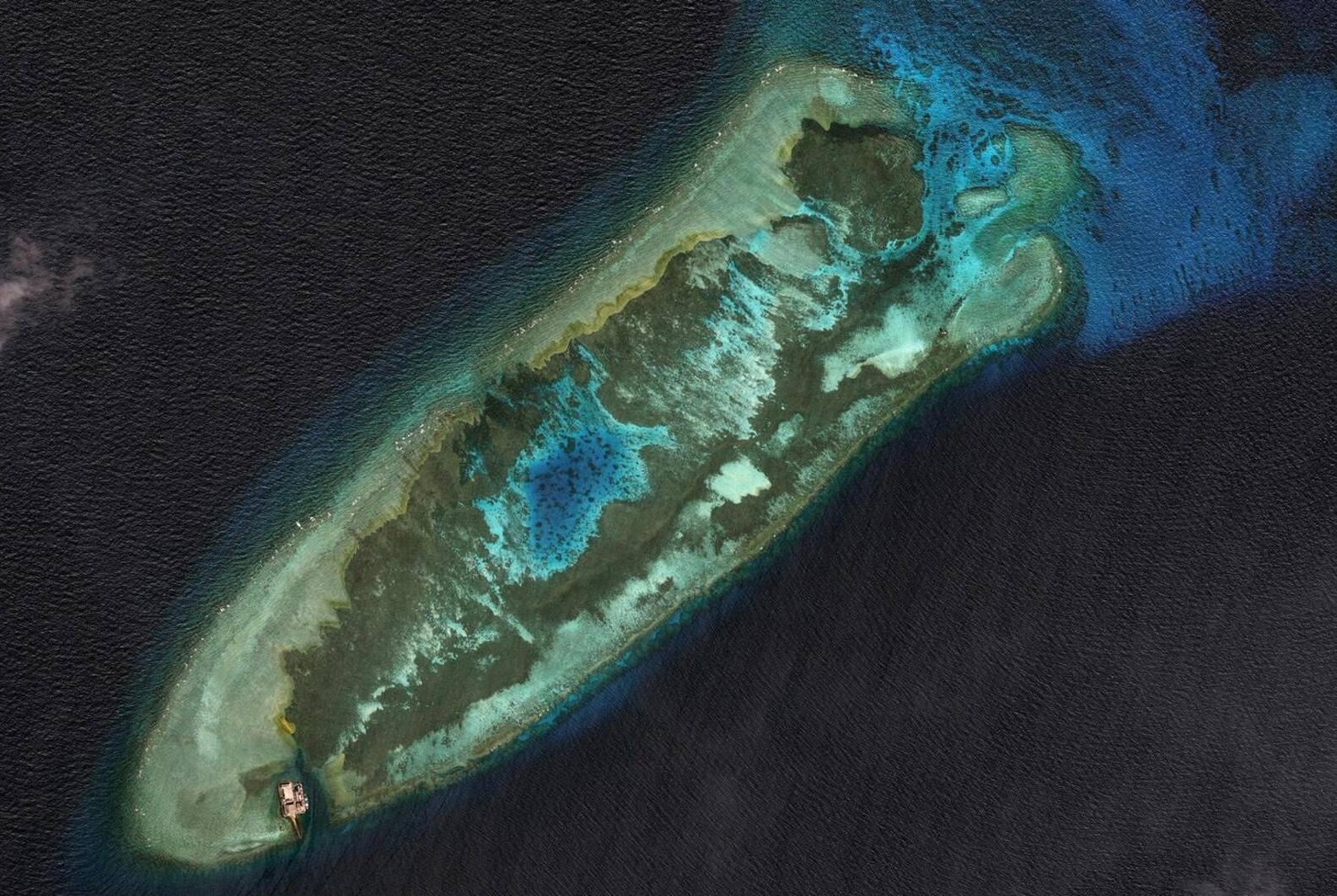
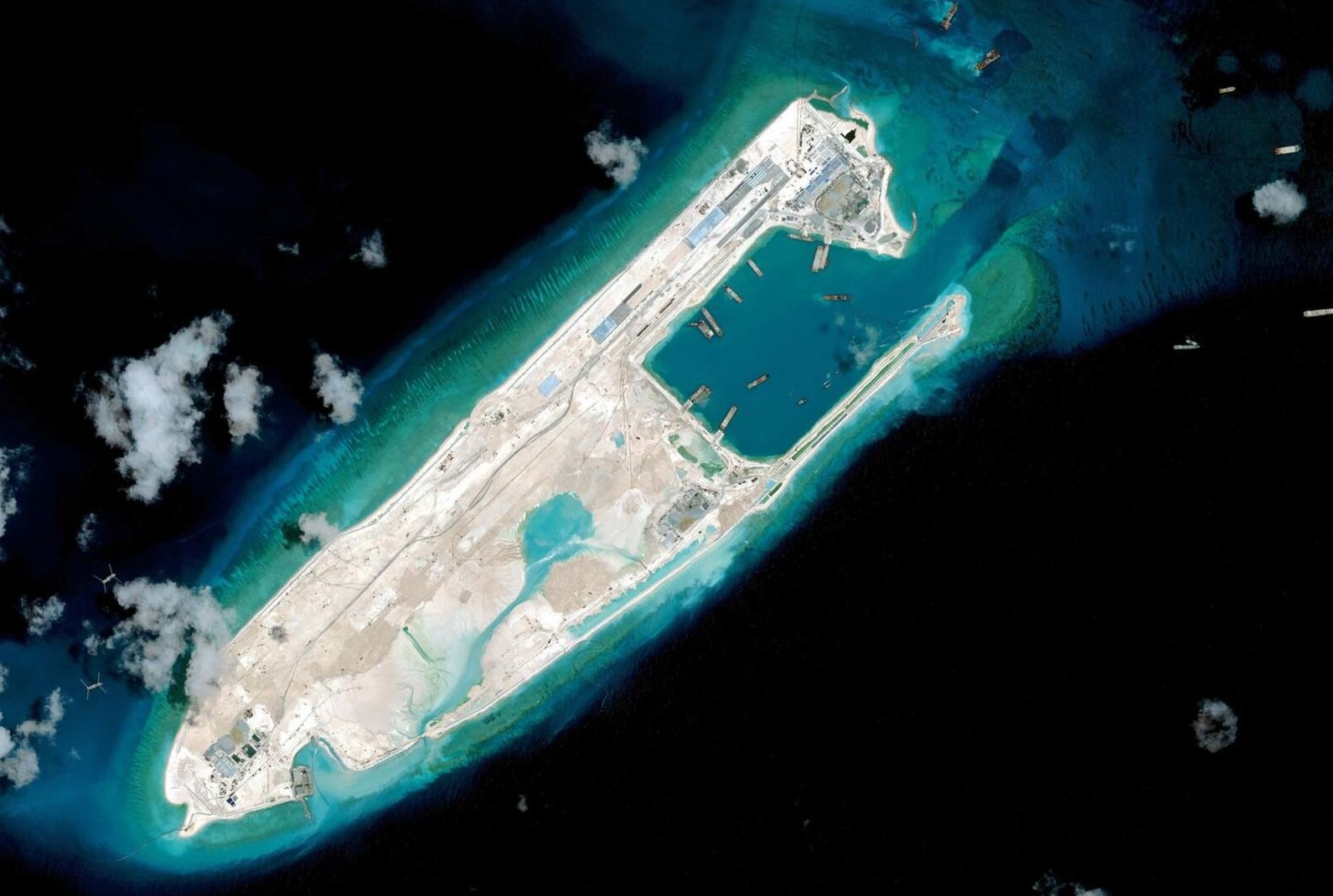
China’s contemporary thalassocracy remains relatively indifferent to questions of territorial sovereignty, at least as long as the security of its fluxes does not require it: Venice never sought to dominate the Adriatic hinterland to the Balkan region, nor did the Portuguese initially attempt to go beyond their African, Middle Eastern, or Indian outposts.
China, by contrast, seeks simultaneously to control maritime fluxes and to assert territorial sovereignty, including over maritime spaces—the nearly entire South China Sea claimed under the “nine-dash line.” Beijing currently pursues a maritime governance dynamic on a state-centric and hegemonic mode, whereas its historical form was decentralized, networked, and informal. In doing so, it captures the potential benefits—connectivity, influence, access to resources—while abolishing the conditions of its possibility: a maritime space governed from above, under an exclusive sovereignty logic, loses precisely the flexibility and permeability that had made the strength of the old land-sea continuum.
The Empire Goes to Sea
The land-sea continuum clarifies the relations between continental empires and maritime spaces. The coastal margins have never been mere peripheries. From the sixteenth century to today, they have often been sites of institutional innovation and vectors through which economic transformations penetrated continental political structures.
China captures the benefits of maritime integration while abolishing the conditions of its possibility.
François Gipouloux
Since 2012, China’s reorientation cannot be characterized as a simple retreat from globalization. The Belt and Road Initiative, the claims in the South China Sea, and the development of top-tier naval capabilities all testify to a desire to territorialize and hierarchize a domain historically founded on fluid circulations.
The principal paradox may lie here: today China seeks to exert control over a space whose historical strength lay precisely in its relative autonomy from territorial centers. Time will tell whether this attempt to synthesize continental power and thalassocratic ambition constitutes a new form of maritime integration or a fundamental rethinking of the very heritage of the “Mediterranean of Asia.”