
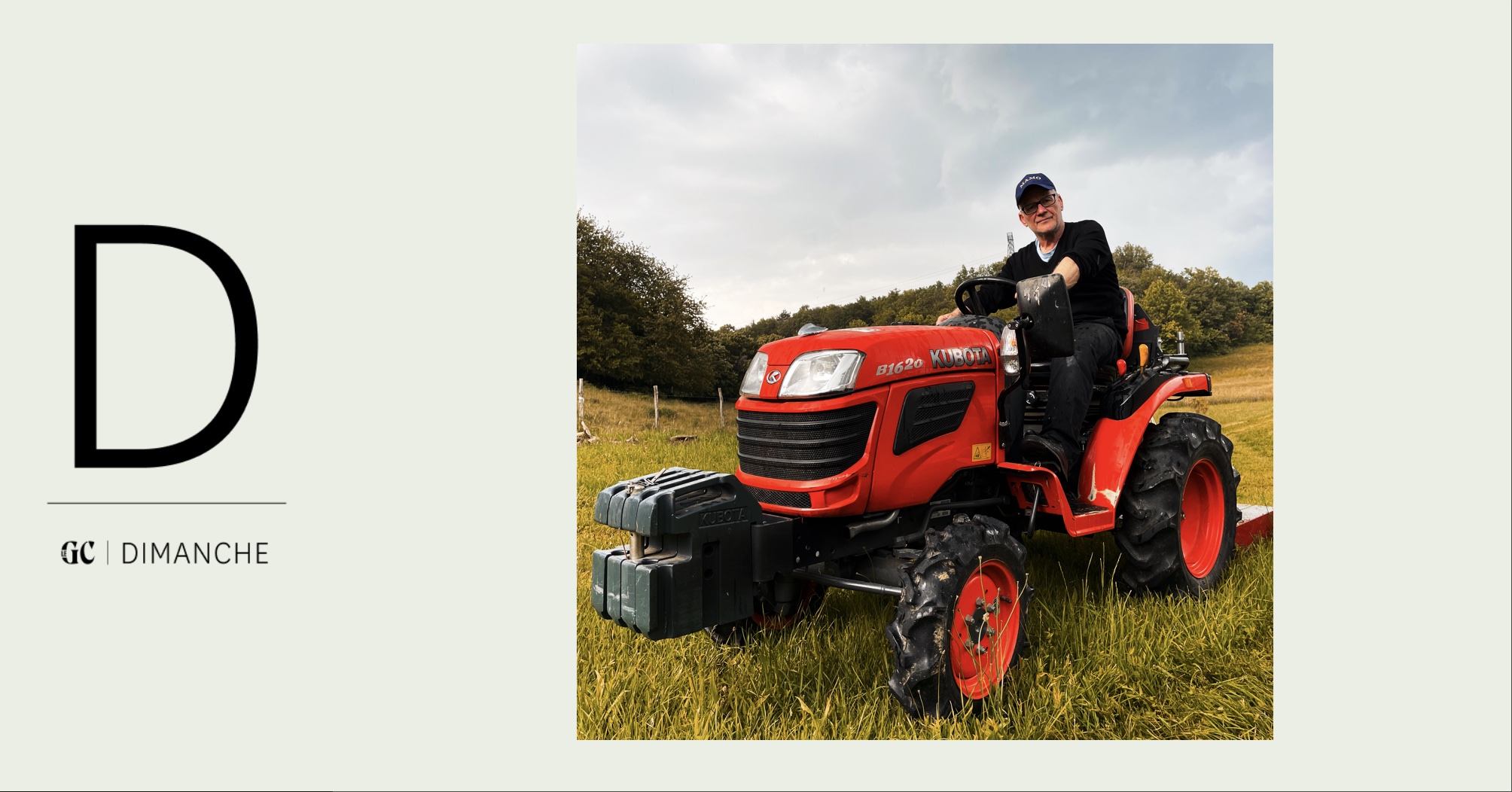
In Drôme, I have a neighbor. A neighbor, almost: you need a bicycle to reach his place, but these are human-scale distances, measured in climbs rather than kilometers. He’s a man who drives a tractor, who makes hay, who restores woods. His name? Thierry Frémaux: he is also, every May, the prince of the planet’s chicest estate, the general delegate of the Cannes Film Festival. It is this contradiction that has always captivated me: how does one go from the tractor to the limousine? More than a class defector, a code defector: Frémaux is an idiosyncrasy whose sociology has no key.
Passer à la ferme
Everything starts from the soil, and his is the soil of Tullins, in Isère, where, when young, he bought back the neighboring peasants’ farm, abandoned, fallen into ruin. He grew up elsewhere, Brunoy and May ’68, then Caluire, then Vénissieux, at the dawn of La Minguettes. The hill then was the dream: after the slums, they had built towers from which one overlooks all of Lyon, and people there would have everything. His father, an engineer, from Arts et Métiers, could have stayed in Caluire, bourgeois and fussy. No, he chose La Minguette, almost as a social act, and chose EDF when his peers headed into private industry. Those peers would be laid off twenty years later, through plant closures and early retirement, while he, earning less, took his retirement in a house that kept watch over his kin. This public service, he still carries, even in the way he runs Cannes.
As he explains it to me, “the farm is a way to seize the places of the grandparents, who made walnuts, milk, the timber cuts, and lived well, not far from the Vercors.” He does not exploit; he restores, and on this point he is inexhaustible. A poorly maintained wood pollutes, a carefully kept one wears down, otherwise drought makes the ash fall, he says. He has the tractors, the machines, he enjoys himself. Restoring, he adds, is to render the places as they were to him, including the neighbor’s who aren’t his: the patch of land where one stands, you pay attention there, and if everyone did so, we would all take greater care.
He knows his vegetation without being obsessive about it, just as he loves red wine without knowing much about it. And he notes, in a laconic way, that the south is advancing: soon wine will be made in Hauts-de-France.
Why not Paris
The bicycle holds a central place in his life, he says. It isn’t merely a question of sport. The bicycle is first and foremost about the mountains, the climbs, fifty, eighty, a hundred kilometers, and then the elevation. He climbs the Vercors, the Col de Rousset, La Chapelle. He often goes out alone, in the morning. He also skis the Chartreuse and he recalls that his maternal grandfather, a nurse, was among the few to enter the monastery, strictly forbidden to outsiders, having treated the monks. From his house he has before him the Chartreuse and the Vercors, that landscape to which Stendhal is said to have ascribed Italy’s value. He has always held that the Drôme is worth Tuscany. His farm is pisé, made of earth rather than stone, on the plateau. And one still finds, between Valence and Cannes, these first olive trees, these first cypress trees that say the South is rising.
He skis a lot, “very well,” he says with a touch of swagger. The other beloved place is La Grave in the Hautes-Alpes: the Galibier, the Lautaret, the Meije, the Écrins. He does not want to go far from it, which makes Paris out of the question. His two children, aged twenty-one and twenty-three, don’t care or adapt, knowing that after his death they won’t know how to run the house, because it’s a job: it takes him fifteen days to do the hay after returning from Cannes. He is the one who does it.
The Madman
The cinema, he explains to me, he didn’t discover in Lyon, but in Brunoy, at the MJC cinema club that his father co-led in the 1960s.

His earliest memories lie there, hazy: John Ford’s The Stagecoach, Bogart, that sense of stepping into darkness and instantly feeling at ease there. He loves cinema, he loves films. He makes sure to note this distinction: “There is loving cinema, and loving films.” “Cinephilia follows the classic path: friends, then daydreaming, and one becomes a creator.” Hence his maxim: “As soon as you talk about directors, not actors, you’re a cinephile; you care about the maker, not the performer.” Around sixteen or seventeen, one night, he teeters in front of Pierrot le Fou in a neighborhood theater. That film makes him understand that cinema can be like that too.
Hold on
The story remained. He outlines the progression. Master’s degree, DEA, a started dissertation he never finishes, some articles as well. He participates in the early days of Radio Canut in Lyon, one of France’s first free radios in 1977, broadcasting from the Croix-Rousse because the prefecture is lower and you gain a quarter-hour on the cops’ cars; the transmitters came from Italy, to avoid getting caught. Then 1981, Mitterrand, and everything changes, a grand moment, but brief, because the collective quickly passes him by. His parents were leftists, his father in the Unified Socialist Party, more Rocardian; his siblings more politicized than him. He is politicized through his work: running a judo club is a commitment, caring about society, where one is, matters as much as unionism or political engagement that never tempted him. Another link to his father, another tie to the public service, another to the common good.
The transition from apprentice historian to professional happened almost naturally. His mastery focused on Lyon’s years in the magazine Positif, before he ventured into a social history of cinema, not of art or industry, but of practice, at the scale of a city: Lyon, creator of cinema. He possesses a knack for a swift ascent: to work on the history of cinephilia, which had not existed as an object. People spoke of Cahiers du Cinéma and the New Wave, but in Lyon, another generation had not yet formed a group of filmmakers. There were the Cahiers in Paris, and Positif in Lyon, and the Institute is still its publisher today, the journal having returned to its homeland.
Chercheur le jour, et judoka le soir, he has plenty of time. He learns that Tavernier is launching the Lumière Institute. He pretends to be a journalist there, mainly to approach the man he admires, who is twenty years his senior. There remains a photo of their first meeting, and Tavernier’s line to him: “to praise Buñuel in Les Cahiers, and Fuller in Positif, to drive the two camps crazy, the right with left-leaning legs, and the left with right-leaning legs.”
Inventer
He starts as a volunteer, as his generation’s money-agnostic ethos prescribes, until he earns a meager salary. Bernard Chardère, the founder of Positif and the first director of the Institute, gives him tasks: that is where he learns the trade without pay, which explains why he now guards the volunteers. He finds himself, without truly seeking it, at the heart of history, he explains, in a space almost sacred. One day, he discovers La Sortie des usines Lumière in a poor copy and understands that the film was shot forty meters from there. No one knew: people were draining there, parking there. There was everything to do, and that’s why he harasses the officials, who never want to build for culture, so that they finish the place. People often do not know where literature, music, or painting were invented; cinema, he insists, is there, right there, he repeats.
He is offered then the Cinémathèque française. He refuses: he has better to do in Lyon, and above all, he does not want to leave the Vercors. Then Gilles Jacob calls him for Cannes. It’s 2000, and the contrast is there: the planet’s most snobbish place and him, a country-born man. In his generation, Frémaux thinks he is among the few who remain in public cultural action, while his peers became producers or distributors, for lack of having dared to pursue directing. Gilles Jacob belonged to that same world.
Changer de code
How does one hold up in such a milieu when one comes from where he does? First, he notes, he negotiates to keep Lyon, with the same patrons, quid pro quo, and Jacob accepts: that was his balance, not risking losing everything at once. Then Jacob knows him as a Cannes devotee, where Lyon had celebrated the festival’s fiftieth anniversary, which matters to him; he arrives with the opinions of a festival-goer, and Jacob accepts the sign. And Tavernier watches over them, not to protect him, but they are known to be linked. Legally, the Festival is an association kept at least half public.
One could finance it entirely by private funding, and it would be the Palme d’Or offered to a brand: we do not want that, we cannot. Pierre Viot, his predecessor as president of the Festival, told him this from the outset: Cannes must stay in public hands. And there he is, again aligned with the father, with EDF, for the common good. No unionism, no politics, but that, his commitment. In Lyon, the Institute welcomes six hundred thousand people a year: an act.
He signs the selections a hundred percent, yet lets himself be guided, surrounded by comrades: he imposes, and he lets himself be imposed. He embraces his marginality: the cinephile is always the marginal one, cinema not as noble culture but as common art, as Sartre used to say; one must always prove that people need old films, and we are used to fighting. Every year a controversy, but this year almost nothing; there was Bolloré and the petition, but it wasn’t them, Cannes, the object of the scandal. Bolloré is the man he cares least about: money, convictions, all in the service of his ideas; he is more bothered by those who, around, obey blindly. Bolloré has an ideological project that is not his own, but he has the right to have it, it’s the democratic game and the debate must take place with democratic convictions.
Rester
He has a theory of criticism, summarized in a phrase: “criticism has lost the public, just as the left has lost the people, the same phenomenon.” Critics have lost the public because they no longer speak to them, talking to themselves in the nineties and two thousands; today it sadly matters little. With the Nouvelle Vague he fully identifies with it, though his zealots are not entirely. He places Godard at the highest, up to the last film shot at the foot of his bed the night before a death he had decided upon; he regards him as a painter, not buying everything, but having received enough aesthetic and political emotions. Truffaut, brilliantly sharp, Saint Truffaut, whose films we love out of nostalgia for a certain France. His own schooling is French classicism; between Renoir and Duvivier he does not oppose them.
These feuds used to mobilize a broad circle; today everyone loves everything, each preferring within themselves this or that. At Cannes, chairs would rattle, and directors would rise in salute; now it plays out on networks, just as violently. The press critiques, not much cared for; his children have never read a review, just three sentences on Instagram. They say cinema is ending, rivaled by platforms; he does not believe it. A brilliant invention, they will accompany cinema, both are needed; Netflix thinking more than before about releasing in theaters since there is money to be made. Nothing replaces the big screen: cinema invented the halls, posters, the legend, the critique, all that platforms lack. He quotes Godard: “Television creates forgetfulness. Cinema creates memories” and he clarifies the director’s intuition: “we remember the films seen on television, not the act, that day, that place, that film, with a friend, with one’s children, or alone.”
Comme un mythe
This summer, Nolan releases his Odyssey, and Nolan is the rooms, nothing but the rooms. Ulysses, through Nolan, is an event. Frémaux turns over the famous Walter Benjamin text on the work of art in the age of its technical reproducibility. The work loses its aura because it is reproducible… Yet cinema recovers it as a mental and physical place, for “the act of going there, that day, that place, for each person, returns it.”

The book, too, is in crisis, as shown by the bookstores failing one after another. What he reproaches, and we return to criticism, is that all storefronts look alike and that the country is dying from it. Living twice in the provinces, he hears his farmer neighbor and his tastes. Does he not feel he is holding a world that is ending? He too belongs to the culture of books, and the further he goes the more he is: at his partner’s home, he has all his books, all his DVDs, and he tells himself that when he stops, he will have enough to redo everything, rewatch all of Ingmar Bergman’s films, reread all of Régis Debray, who begs him every year to place writers on the Cannes jury.
His children hardly ever buy books. One will be a bit of a painter, the other hesitates and would like to be a bookseller, but they tell him perhaps the moment isn’t right. “Yes, a world is ending,” he says, but he remains optimistic, and he rightly believes that one must fight to keep it alive, that it is everyone’s responsibility. He likes to remind that it fell upon him—the young Lyonnais who had the street of the first film. He was at the right age, the right moment, with cinema as a passion, and he met the right people.
Après l’Amérique
In summer, he works, because he explains: “vacations are meant to be spent working quietly.”
He writes an essay on Jack London, in the François Sureau and Sandrine Treiner collection, Ma vie avec. London was his writer, not from youth: not The Call of the Wild, but Martin Eden, Radiant Dawn, The Vagabond of the Stars. He rereads him and dedicates a large portion of his bibliography to paying homage to researchers, having known well Francis Lacassin, a great foreword writer for London, who had come to do a bit of cinema in Lyon in the fifties and who thus entered his corpus. According to him, in Martin Eden, London completely misjudged it. He claims to critique individualism in socialist terms, “or not at all,” we empathize with Martin, his dreams, his love of the street, his despair.
This year at Cannes, he was reproached for the absence of Americans. But the question isn’t that there aren’t any; there were, he notes: “James Gray made a brilliant film.” The real question is what happens to America. The answer is that there is less cinema in Hollywood, simply. “Hollywood has marvelized the audience. Even Spielberg didn’t come, for one reason: Hollywood doesn’t expose itself without being sure of its move.”
La bataille de Cannes
“Big films protect the little ones,” that has always been his stance. One could add: glamour must be mixed with “auteurism.” There is a Gaullist cinema, the kind Americans used to make and no longer do, a biopic that has the intelligence of the general public. It was necessary for the French to do it. “Out of competition, because that is its best place, and there is no point in measuring himself against the rest; but where he sits, he holds his own, and that deserves praise.”
He is already shaping the next edition, faithful to his tradition: on the last day of Cannes, he makes the list for the following Cannes. Especially since next year will mark the eightieth edition, in the midst of the presidential campaign.
I look at this friendly and vibrant man. Thierry Frémaux has spent his life between two domains that should not touch, the pisé farm of Tullins where the ash falls from drought, and the Croisette where world cinema comes to seek its light; the farmer and the prince. But on a bicycle, all that converges, and I, from the other side of the pass, continue to watch him, with the astonishment of a neighbor who still cannot believe it.