
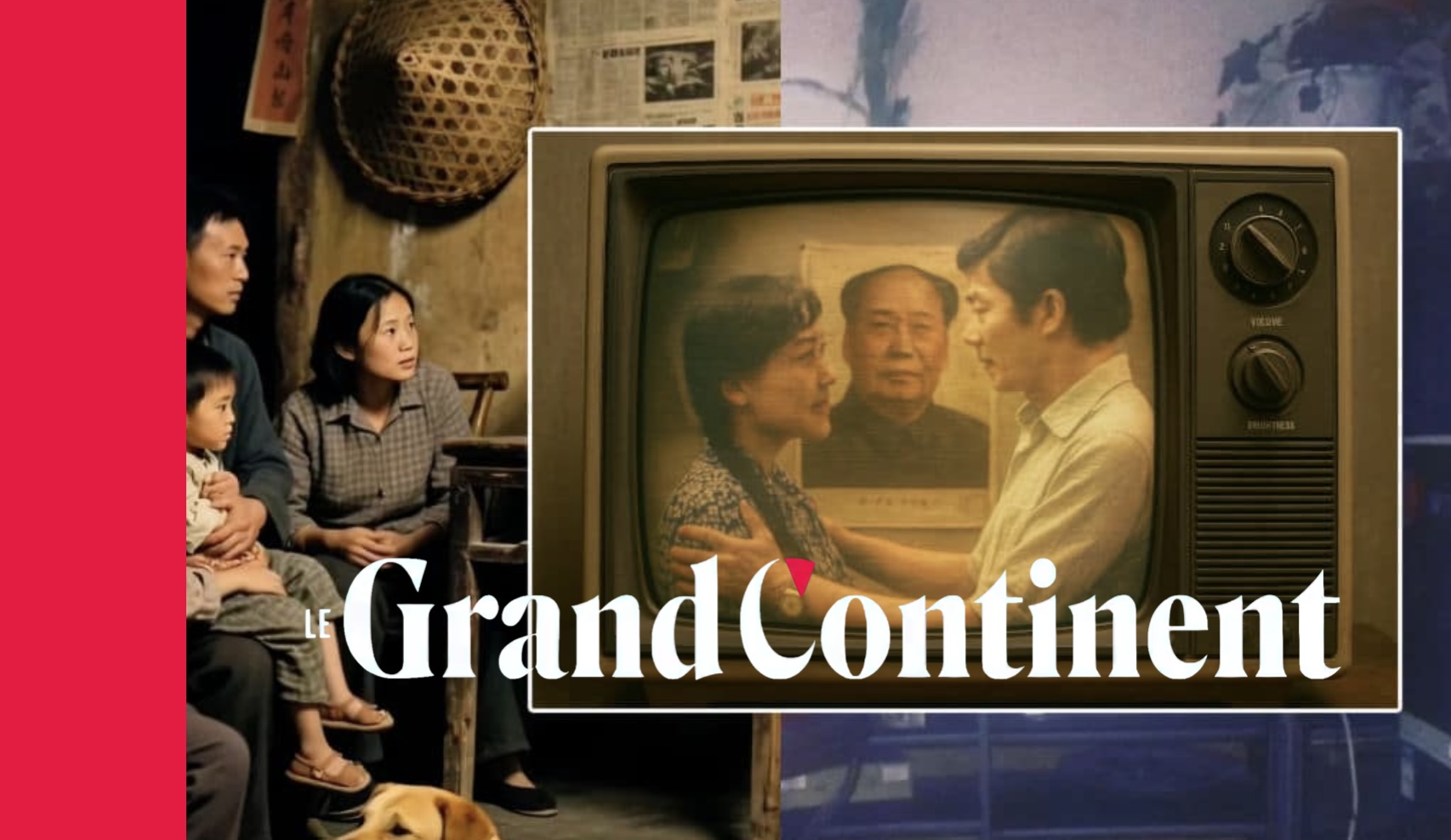
On Chinese social networks, a viral format has been circulating for several months. It showcases grainy images of China in the 2000s, accompanied by an opening line that has become almost ritual: “You just woke up. It’s an ordinary weekend in 2008.”
This phenomenon, named “the heart of the Chinese dream” (中式梦核), can be explained by the deteriorating material situation of the generation that produces it.
- The official unemployment rate for 16-24-year-olds stood at 15.6% in May 2026, its lowest in eleven months, after 16.3% in April. Most observers nevertheless believe that the real figures should be adjusted and could reach up to 30%, not counting young migrants who, holding temporary jobs, “thus escape the statistics.”
- The indicator had reached a record 21.3% by mid-2023, at which point the National Bureau of Statistics stopped publishing it before reintroducing it with a downward-adjusted methodology.
- The crisis hits particularly hard for new graduates. As the China specialist sociologist Jean-Louis Rocca shows, graduate starting salaries “continue to fall and approach those of the non-graduates.” Thus, between 20 and 25% of the 12 to 15 million electric scooter delivery workers are university graduates.
- Similarly, a housing crisis paradoxically swallows, in a country plagued by housing overcapacity, an average of 25% of young people’s income: real estate concentrates 70% of household savings, whose value fell by 17% between 2021 and 2025, “with peaks close to 40% in some large cities.” In 2024, household consumption accounted for 40% of GDP, compared with 68% in the United States and 53% in France.
In this landscape, young Chinese sum up in two viral words, “neijuan” (内卷, involution) and “jiaolü” (焦虑, anxiety), which must be understood to situate the rise of the “heart of the Chinese dream.”
- A typical post of this trend, analyzed by the New York Times, unfolds an ordinary day: the mother’s voice on waking, a weekend of 2008; the living room with dark wooden furniture; the buildings with “blue-tinted windows,” omnipresent in early 2000s Chinese apartments; lunch at KFC with detachable coupons tucked into the newspaper; the gathering of young people with extravagant hairstyles, the “Shamate” (杀马特), a subculture of migrant workers seeking to stand out in a conformist culture. The downbeat ending is always melancholic: “if only every day could be as happy.”
- The variants catalogued on the Xiaohongshu network (REDnote) unfold the same template: “You have finally returned. We are in the year 2000”; “You are awake, it’s the summer of 2008. You’re back, but there is no one”; “You’re back, it’s Beijing in 2008. The Olympics are about to begin.”
- The iconography mobilizes internet cafés, the ping of Tencent’s instant messaging launched in 1999, which had been the entry to the Chinese Internet for an entire generation, before WeChat and its granular mass surveillance capabilities, the outdoor gym equipment in bright colors, the song “Beijing Welcomes You” from the 2008 Olympics, all presented in low resolution.
The story of this viral phenomenon is not easy to retrace, but this retro aesthetics, straddling nostalgia and the unsettling strangeness produced by the acceleration of virtual space, seems to have emerged from Internet subcultures in the 2010s, and to have widened thanks to short-video platforms between 2018 and 2020, before the hashtag surpassed a billion views in 2021.
- “The Heart of the Chinese Dream” has been developed in various formats, from amusement parks to the dishes of hot pot restaurants, to video games like “Millennium Dream” which offers a first-person walking simulator through early 2000s China, blending the nostalgia of the prehistory of computing (Y2K) with “liminal spaces.”
- Generative AI has massified the production of this meme, giving it a new dimension that is more personal: every user can now create their own nostalgic images, aging real videos or fabricating scenes from the 1990s–2000s.
If it is difficult to offer a single key to reading this trend, a few explanatory lines can be proposed.
- According to the analysis of a designer who dedicated a dossier to this phenomenon, with “the heart of the Chinese dream” there would be “a very particular form of nostalgia. It is the visual remnant of a country that grew too fast, and the displaced nostalgia it left behind.” This reading of nostalgia as a by-product of acceleration sits at the heart of Chinese analyses of the phenomenon. As artist Huang Heshan recalls, the buildings in which most urban Chinese grew up were built without renowned architects and are “rapidly demolished and abandoned by the cities that had hosted them,” even as they are saturated with personal memory. Since 2008, “society has taken off,” but “a part of our soul stayed there.”
- According to Han Xiaoqiang, a professor at Southeast University, interviewed by the New York Times, this meme would be used by young people as a kind of “digital analgesic.” He sees it as a compensatory fantasy: “[the young Chinese] use nostalgia to return to a dream because they cannot change anything.”“The heart of the Chinese dream” would thus express involution (“neijuan”) and anxiety (“jiaolü”), two political affects which, according to Jean-Louis Rocca, mark both the nostalgia for a time “carrying hope” and the realization that “giving it your all” no longer suffices to secure a favorable social position, and the lucid gaze of youth at a model that offers neither success nor pleasure.
These contents do not seem censored and circulate relatively freely. What about their political dynamics? Is the Chinese Communist Party overwhelmed by youth nostalgia?
- Publications related to the “heart of the Chinese dream” experience a different fate from the 2021 slogan “lie down” (tangping). At the time the foundational essay had been removed, the hashtag banned from most social networks, the regime press widely propagated the editorial “lying down is shameful,” up to a warning by Xi Jinping himself in Qiushi magazine.
- Similarly, they do not suffer the crackdown that hit another meme, that of the “garbage time of history” (历史的垃圾时间) in 2024. Hu Wenhui’s essay defined the “garbage time [as] the moment when the dice are cast and defeat is inevitable … the general trend is fixed, the defeat irremediable, all effort is mere agitation,” and implicitly compared China to Brezhnev’s USSR, “which had been purged from the Chinese internet, references to this viral hashtag partially erased, and regime press fought back through Wang Wen denouncing a ‘pseudo-concept’ ‘more dangerous and more vicious than tangping,’ for denying ‘the current state of development of China’.”
- What conclusions can be drawn from this differentiated treatment? One can see both an overflow and a calculated tolerance in a moment of particular tension. Unlike tangping (which proposed mobilization in a paradoxical way, described as a “passive-aggressive resistance” by novelist Liao Zenghu) or the “garbage time” meme (which offered a sharply critical diagnosis), the “heart of the Chinese dream” tends to display a form of nostalgia that appears politically demobilized and that, paradoxically, supports part of the official discourse by emphasizing central elements of its narrative (the Beijing 2008 Olympics, the prior economic development before the Western crisis, etc.).