
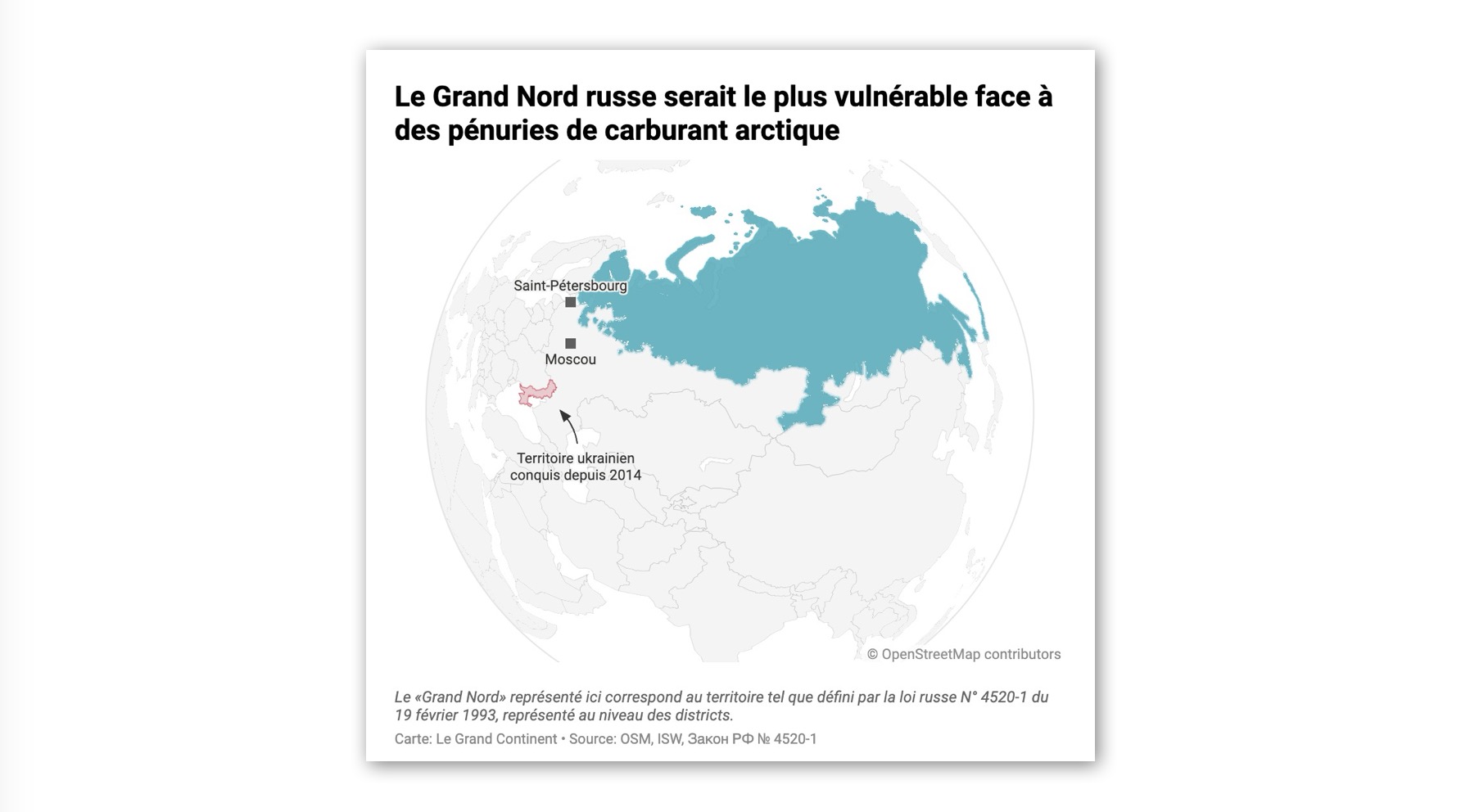
This is one of the most significant potential impacts of the air campaign targeting Russia’s oil production and refining sites: according to Ukrainian expert Ivan Marchenkov, if production does not resume in the coming months, Russia could face a shortage of gel‑proof fuels, essential for life and economic activity across most of the country’s regions, and especially in the Arctic and Siberian territories.
- To enable engines and generators to start when temperatures can drop to -30°C, or even -40°C, millions of Russians rely in winter on so‑called “arctic” fuel.
- This fuel is predominantly produced in autumn to supply the coldest and most isolated regions of the country. It is mainly obtained by blending diesel with aviation kerosene, but can also be produced through a deparaffinization process paired with aviation kerosene in about a dozen specialized refineries.
- Moreover, seven of these refineries equipped with deparaffinization units have already halted production following Ukrainian strikes, while aviation kerosene is facing a growing shortage.
Nearly 10 million people live in the Russian Far North. By disrupting fuel production, a prolonged strike campaign could thus threaten the supply for these regions, which would have the effect of making life virtually impossible there, especially in localities not connected to the electrical grid and where diesel power plants are used to generate electricity.
Such a scenario hints at a phenomenon of reverse conquest.
- Russia, waging an extremely costly military campaign, with an average pace of advance of less than 130 square kilometers per month since January, could thus experience a massive internal exodus.
- The potentially affected territory, defined here as Russia’s administrative Far North, would be far larger than the Ukrainian territory occupied since 2014, including Crimea: 12,000,000 km², versus 117,000 km² in Ukraine, i.e., a ratio of 1 to 100.
The Arctic fuel supply for the “northern regions” is a particular concern for the Kremlin.
- On July 9, Deputy Prime Minister Alexander Novak convened representatives from federal executive bodies, regional leaders, and sector companies, who presented him with a report on the availability and volume of petroleum product reserves.
- Logistics, delivery schedules, and the allocation of resources between isolated towns and villages were among the issues “addressed,” according to a statement released by the Russian government.
- Last week, on Wednesday the 8th, Moscow imposed a ban on diesel exports. Imports from Belarus, for their part, jumped by 50% in June, reaching 77,000 tonnes.
- Russia is also seeking to import more aviation kerosene, which plays a key logistical role due to the distances separating population centers.