
Throughout August, Le Grand Continent will publish freely accessible The Vocabulary of the Far Right, the result of the collective work of a group of researchers — sociologists, historians, political scientists, sociolinguists — from across Europe under the direction of Steven Forti. To receive each lemma in your email inbox and support the work of an independent editorial team, subscribe
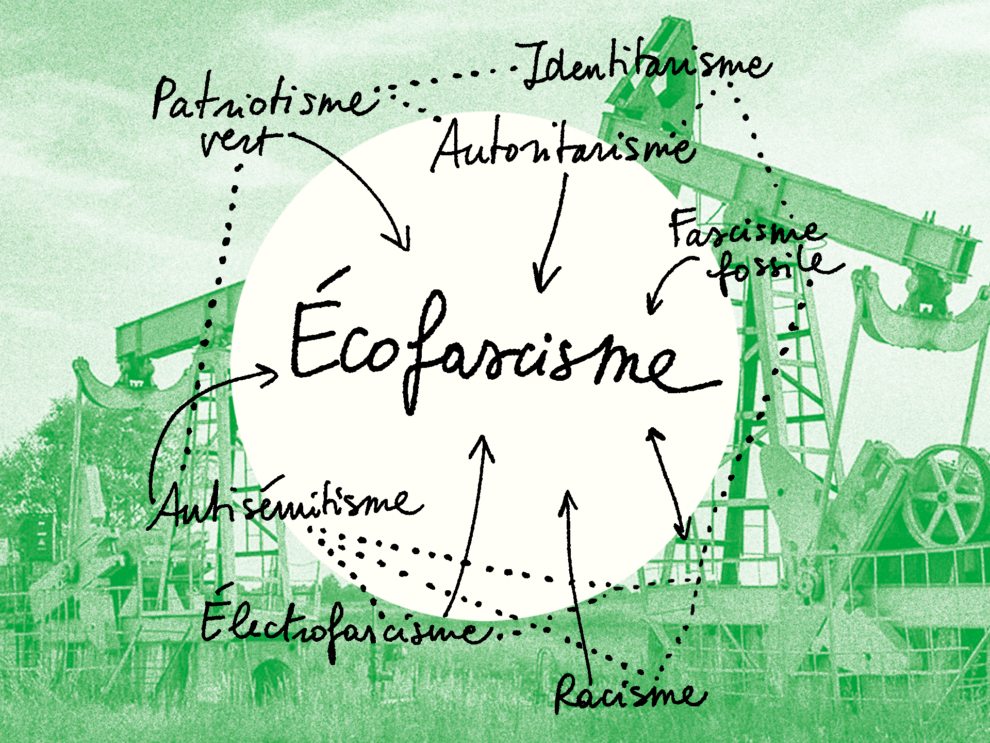
On March 15, 2019, before killing fifty-one people in two mosques in Christchurch, New Zealand, the Australian terrorist Brenton Tarrant uploaded a manifesto in which he defined himself as an “eco-fascist.” The history of this notion is, however, far more complex than this murderous usage suggests. Before becoming the self-designation of neo-Nazi killers and a floating signifier in public debate, “eco-fascism” was first used by a philosopher of the eco-left as a warning.
The trap of a word
A concept does not always map onto the reality it claims to describe. Whether it is a label actors apply to themselves or a designation from outside — both situations coexist here — its meaning can be obscured by its own wording. This is, at least, the argument of philosopher Fabrice Flipo in his analysis of the notion of ecofascism .
Discussing the epistemological validity of the term, Flipo points to its early use by the Franco-Austrian philosopher André Gorz, a pioneer of political ecology. In “Socialism or Ecofascism,” published in the journal Le Sauvage in 1973, Gorz used the word to denote the authoritarian management of the ecological crisis that capitalist actors could implement in response to environmental constraints. For Flipo, this logic echoes the theory of the Marxist thinker Nicos Poulantzas on the role of the state in times of crisis: when capitalism goes through a phase of overproduction, it seizes the state to impose tighter control over the economy. The inspiration, however, could only be partial: in Poulantzas, the authoritarian transformation of the state in a capitalist crisis took forms very different from fascism.
Flipo subjects to the same critical examination the notion of “electro-fascism,” another concept coined by Gorz to designate the authoritarian constraints that nuclear energy would impose on society due to the risks inherently associated with it. A similar judgment could today be applied to “fossil fascism” theorized by the Marxist geographer Andreas Malm and the Zetkin collective. Taken out of their original context, such usages tend to reduce fascism to a mere form of authoritarianism, a trait that is neither exclusive to fascism nor unique to the far right.
Historian Daniele Conversi questions even the use of the term. Examining its use in the context of the resurgence of the far right, he describes the phenomenon as “an afflicted and regimented environmentalism, diluted and emptied of its meaning, reduced to a strictly local-national and territorial dimension… in a limited and territorially framed perspective that can hardly be described as ‘ecologist’” . Flipo’s verdict is close. Ecologism designates, in his view, “well-identified and relatively stable political forms,” that is, “a social movement carried by cosmopolitan activism seeking to rebalance the social metabolism with nature… emphasizing democracy, civil disobedience and non-violence.” Therefore, calling it “far-right ecologism” is, in his eyes, a form of “confusionism” .
Other researchers embrace the category, by contrast. Balša Lubarda has made “far-right ecologism” (far-right ecologism) an analytical concept in its own right, and the works collected by Bernhard Forchtner document an environmental relationship characteristic of these movements. The dispute remains open, and it concerns less the facts than what the word “ecologism” can legitimately cover.
Adjacent concept, “green or ecological patriotism” is hardly less ambiguous. Whereas ecofascism seems to encompass a wide range of phenomena, from neo-Nazi groupings to government-right actors, the “green patriotism,” a much less common occurrence, is mobilized mainly by institutional political actors. It carries its own tension, since it advocates environmental preservation while confining it to the national or regional scale, without necessarily supporting substantial climate action. Reclaimed even by some left-wing forces, the label functions less as an oxymoron than as an available signifier, each actor bending the old ecologist slogan “think globally, act locally” in his or her own way.
Within the first group, Dubiau identifies a series of themes carried by actors who present themselves as progressive yet converge with more traditionalist conservative ideologies: the idea that human beings are inherently parasitic, incapable of maintaining any relationship with nature other than predatory; neo-Malthusian conceptions making population growth the main driver of the environmental crisis; deterministic and catastrophist visions of an inevitable collapse of industrial civilization; technocratic and authoritarian responses to ecological degradation; ascetic readings of degrowth, based on the moral restriction of consumption. The list is broad enough to feed the narratives of far-right polemicists, ready to unmask an “anti-humanism” even within moderate environmental organizations.
A green-brown genealogy
Right-wing and far-right actors who engage with ecological discourse draw on familiar elements of conservative and traditionalist ideology: rejection of the idea of progress, a holistic view of society, and the belief that individuals inherit values transmitted by previous generations to whom respect is owed. The most canonical conservatives idealize a “lost purity,” often embodied by the figure of the peasant. Within this frame, public discourses present the balance of campaigns as an extension of natural law, while cosmopolitanism is rejected in favor of a localist nostalgia for rural life. The city symbolizes the supposed failures of multiculturalism, of technology, and of modernity; the countryside, anchored in family, religion and nation, provides the setting where “to preserve a regulated way of life and maintain a familiar moral order” . These arcadian representations set rooted and cohesive communities against urban individualism — echoing, often, antisemitic tropes that depict Jews as nomads and uprooted.
Jean Jacob identified this integration of nature within a conservative framework in the work of Edward Goldsmith. Founder of The Ecologist and co-author, in 1972, of the influential Blueprint for Survival, this Anglo-French ecologist subscribed to a regressive view of femininity, immigration, the family and community, and more broadly to an authoritarian conception of social order; he also participated in GRECE conferences, the matrix of the Nouvelle Droite. Stéphane François likewise characterizes his environmental stance as anti-individualist, anti-modern, technophobic and anti-capitalist. Yet one should measure the scope of this proclaimed anti-capitalism. The alternative economic models that Goldsmith advocated remained based on private ownership of land and localized production modes, i.e., the restoration of a traditional agrarian order far more than a transcendence of capitalism.
Similar attitudes are observed within ideologies explicitly Nazi, fascist and neo-fascist — the latter drawing most directly on conservative intellectual traditions. While the Third Reich promoted an ideology profoundly marked by an ecocidal productivity, some currents of Nazism — notably around Richard Walther Darré, Reich Minister of Agriculture and proponent of the “blood and soil” (Blut und Boden) — simultaneously encouraged organic farming, vegetarianism and various forms of nature worship, as shown in a landmark essay by Janet Biehl and Peter Staudenmaier. Strasserism — the current organized around Otto Strasser, who wanted to give Nazism a more social profile — sought to reorganize German society around a new rural anthropology: “Like Jünger, Strasser dreamed of a new ‘Worker,’ but of a particular type: a Peasant, whether peasant-worker, peasant-intellectual or peasant-soldier,” Patrick Moreau notes. In France, former French members of the Waffen-SS, the military branch of the SS that recruited volunteers from across Europe, helped shape in the post-war period the earliest identity-based and supremacist conceptions of nature. At the forefront is the writer Saint-Loup, real name Marc Augier, a leader of these “green-browns” studied by Stéphane François. Explicitly racialist, these authors advocated a society organized around the strict separation of peoples.
Yet it is within the French Nouvelle Droite that the most developed synthesis between ecology and far-right thought has been elaborated. Born in 1968 around GRECE and led by Alain de Benoist — for whom true conservatism is revolutionary — this intellectual current aimed to revitalize the traditions of the radical right, notably through the thesis that Judeo-Christian heritage is at the origin of contemporary liberal egalitarianism, which could only be ended by a return to pagan and hierarchical spiritualities. Transposed to the ecological field, the Nouvelle Droite draws on German political Romanticism, the völkisch currents and the “conservative revolution” of the Spengler, Schmitt, Jünger orbit. Like these movements, it idealizes a return to the earth as an antidote to the supposed corruption of urban industrial life; attributing to Christianity, in rupture with ancient paganisms, the establishment of a dualism between man and nature — and the legitimization of exploiting it —, Benoist’s followers have added a neo-pagan defense of degrowth and a critique of productivity.
From the margins to the center
Figures from the identity movement have extended these arguments, notably writer Renaud Camus, the main proponent of the conspiracy theory of the “Great Replacement,” who asserts that “environmentalists defend biodiversity everywhere except human biodiversity”. Although the Chamalières-born writer proclaims non-violence, it is within this milieu that the El Paso (2019) and Buffalo (2022) attacks fit, whose perpetrators — like Tarrant in Christchurch — presented their violence as part of a “green nationalism”. An accelerationist group such as the Green Brigade, affiliated with the international neonazi organization The Base, presents itself as a gathering of “eco-extremists … determined to dismantle the system that exploits our land, our animals and our people”.
In more institutional settings, far-right formations structure their critique of ecologism through populist narratives. In Spain, Vox promotes a “common-sense” ecology, opposed to the “radical ecologism” that European bureaucrats would impose; but whenever one must choose between ecological policies and economic interests, the party of Santiago Abascal consistently opts for the latter, as shown by Camil Ungureanu and Lucia Alexandra Popartan. Balša Lubarda has documented a similar rhetoric among the leading illiberal parties in Poland and Hungary: in Poland, Law and Justice (PiS) speaks of “rational ecology” or claims a “realist ecology” to align its environmental rhetoric with defending the status quo; in Hungary, Viktor Orbán’s Fidesz clothes its reforestation and solar development policies in religious imagery — that of a “Christian-conservative green policy”.
In France, the National Rally has, in recent years, partly under the influence of the Nouvelle Droite, adopted an agenda of “patriotic ecology”. Hervé Juvin, an essayist and promoter of an organicist and civilizational ecology, elected as a European Parliament member on the party list in 2019, was its principal architect. As early as June 2018, during a debate on environmental policy, Emmanuelle Ménard, a non-affiliated deputy close to the National Rally, cited him from the Assembly podium: “More than any moral, social or political reason, it is the exhaustion of natural resources that will doom the liberal individualist model in the short term,” writes Hervé Juvin.
In Italy, Giorgia Meloni matches the same conservatism with environmental themes. In 2021, at the conference “Rural World: Fragile and Hidden Biodiversity” of the European Conservatives and Reformists group in the European Parliament, the leader of Fratelli d’Italia declared: “The conservation of natural heritage is a fundamental element of our political identity as conservatives […]. The right loves the environment because it loves the land, its identity, its homeland”.
The greening, however, is only one of the two possible paths. Since his return to the White House, Donald Trump has chosen to stake a hyper-fossil position. Reiterating in his January 20, 2025 inaugural address the slogan “drill, baby, drill” (“fore, baby, fore”), he proclaimed on the same day a “national energy emergency,” initiated a new withdrawal from the Paris Agreement, and suspended federal wind-power concessions. This overtly extractivist productivism, in which is embodied the “fossil fascism” described by the Zetkin collective, directly weighs on the European context. It offers the continent’s radical right a model and rhetorical cover, legitimizing at the highest level the battle against the Green Deal, which Vox seeks to repeal and which the National Rally denounces, and it lowers the political cost of climate denial.
The growing visibility of “eco-fascism” and, to a lesser extent, of “green patriotism,” can thus be read in two ways. On the one hand, their proliferation reflects the increasing effort by a portion of the far right to develop arguments — however fragile they may be — that allow addressing the ecological crisis beyond mere climate denial, thereby responding to a rising majority demand. For critical literature, these discourses often aim to provide an ecological veneer to identity-based and unequal agendas. Even when environmental concern is sincere, the proposed solutions, strictly national, hierarchical and identity-driven, seem incompatible with realistic strategies to prevent environmental collapse, as well as with the fundamental principles of historical ecologism.
Scholars who use the term, despite its ambiguities, typically regard it as a critical tool aimed at highlighting the greenwashing of the far right, deconstructing its narratives and revealing its underlying aims. However, the use of this concept comes at a cost: it legitimizes the idea that ecologism could unfold in multiple ideological variants, including the far right, even fascist. If words are “loaded pistols,” to borrow Brice Parain’s phrase Sartre made his own, one must ensure they do not turn against those who employ them.