
We are only halfway through summer, yet the data available so far point to a turning point. Climate change is now a tangible reality, manifesting through a string of records simultaneous in the atmospheric, oceanic, health, and economic realms.
We have compiled thirty data points to situate ourselves on this trajectory.
June 2026 was an exceptional month: it was the warmest on record in Western Europe and the second warmest globally, according to Copernicus .
- Never before had a June been so hot in Western Europe: an average of 20.74 °C, or 3.06 °C above the 1991-2020 normal. The previous record dated from June 2025.
- Globally, the average June temperature was 1.39 °C above pre-industrial levels.
The end-of-month heatwave pushed the thermometer 14 to 18 °C above normal in Central Europe, setting monthly and absolute records in several countries, including Germany and the Czech Republic.
Germany broke its national absolute temperature record for three consecutive days, with readings up to 41.7 °C on June 28 in Coschen.
- In Denmark, the national absolute record was recorded at 37 °C, while the United Kingdom erased its June record for three consecutive days, up to 37.3 °C recorded on June 26 at Santon Downham (Suffolk), far ahead of the old 35.6 °C mark held since 1976.
- On Wednesday, June 24, it was hotter in France than in nearly a third of the Sahara Desert. As hot in Paris (41°C) as in Abu Dhabi, United Arab Emirates, as hot in Strasbourg (37 °C) as in Niamey, Niger, as in Brest (36 °C) as in Timbuktu, Mali, and as in Bordeaux (42 °C) as in Riyadh, Saudi Arabia.
- With 40.7 °C, Barcelona recorded the highest temperature of its 112 years of records on July 8.
- Elsewhere in the world, according to NOAA data, the Japanese capital shows July-August temperatures and humidity levels akin to those of Bangkok and Singapore.
- In Beijing, the annual volume of rainfall has risen by 20% over ten years.
- On April 27, the planet’s 50 hottest cities were all in India, with an average daily maximum temperature of 44.7 °C.
- In Colombo, Sri Lanka, the gap between the heat index of 46 °C and the thermometer reading of 32 °C stems from a humidity level of 84%. Air close to saturation no longer absorbs perspiration, leaving the body with no means to shed heat.
In Europe, which is warming at twice the global average, heat has a clear impact on mortality.
- According to Santé publique France, 5,764 excess deaths were recorded, all causes combined, during the heatwave that hit France from June 17 to July 2 .
- Heat-related excess mortality, recorded in just a few weeks this summer, stands at nearly 10,000 deaths, according to the WHO — an incomplete tally, based on data from only five countries.
- Heat-related mortality in Europe has risen by 30% over twenty years, causing more than 200,000 deaths in the last four years.
Ocean temperatures are rising clearly.
- In June, the average surface temperature of ice-free oceans reached an unprecedented June level: 21.0 °C, surpassing the records of 2023 and 2024 .
- 82% of the world’s ocean was in marine heatwave conditions by the end of June, the second-largest expanse ever observed.
- The average anomaly recorded in June in the northwestern Mediterranean, hit by a record marine heatwave, stands at +5.2 °C.
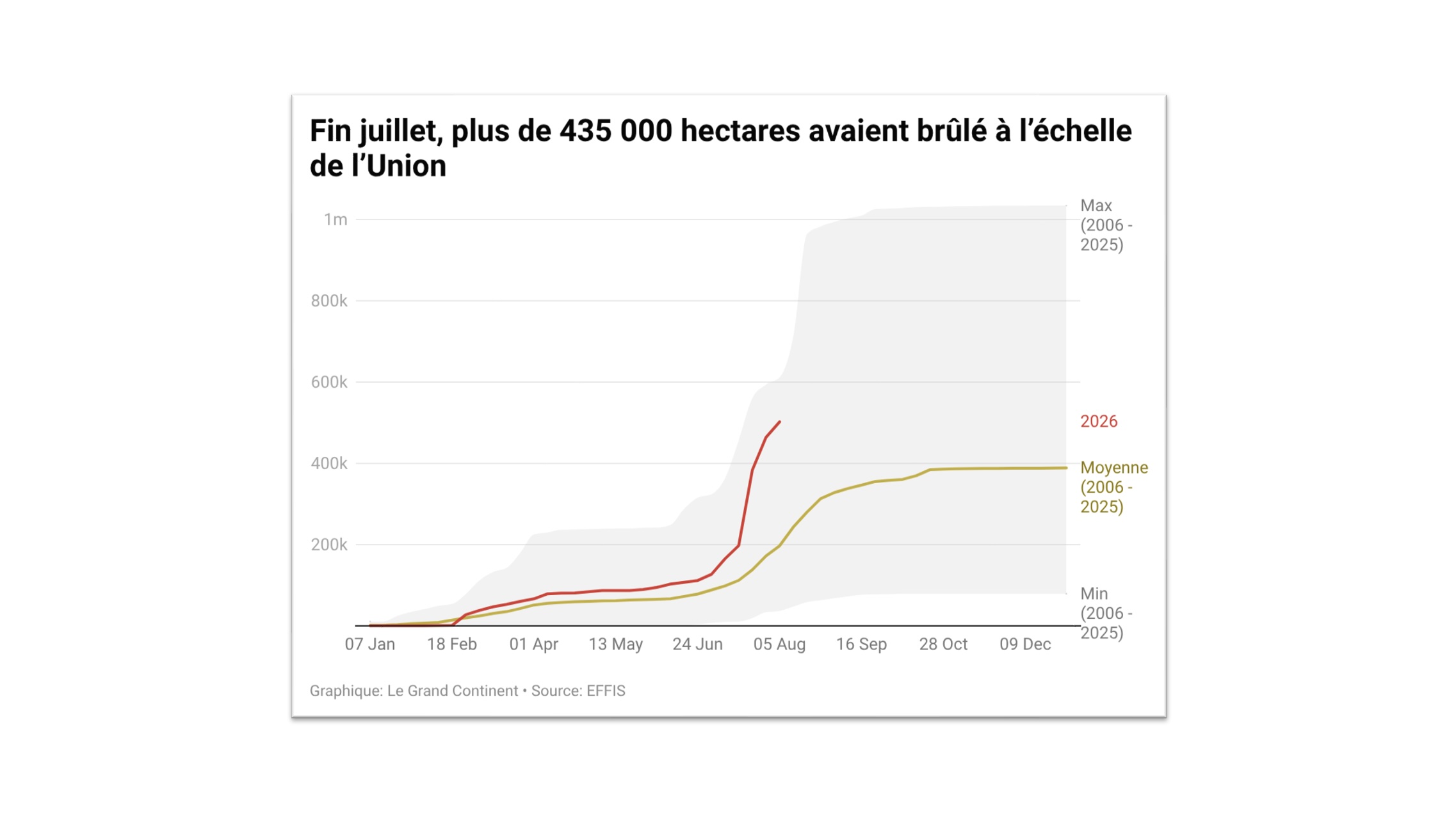
By the end of July, more than 435,000 hectares had burned across the Union scale, a figure that surpassed 500,000 by early August.
- Spain alone accounted for more than 200,000 hectares burned, or about 0.4% of its territory.
We are only at the start of August, but the gaze must already turn to 2027: for the first time, a month could exceed +2 °C above pre-industrial levels.
- According to the latest projections from the Rosenstiel School at the University of Miami, there is a 35 to 40% chance that the global mean temperature will exceed for the first time +2 °C above pre-industrial levels in a given month, by early 2027.
- That is what the El Niño event this year could provoke, which could be among the strongest ever recorded. Indeed, this phenomenon mechanically amplifies the warming caused by greenhouse gas concentrations.
- The regions most exposed to El Niño-driven warming are the Americas, Africa, and Australia — but, unlike previous episodes, Europe could also be affected, from this autumn through spring 2027.
- El Niño brings droughts to India, southern Africa, and Oceania, as well as wetter weather in the southern part of the Americas, the Gulf of Mexico basin, and the Horn of Africa.
According to Copernicus, the goal of the Paris Agreement to limit temperature rise to 1.5 °C is practically unattainable given current trajectories — a sustained crossing of the threshold is expected in about four years .
The tipping point already carries a measurable economic cost.
- According to PIIE, El Niño could cause losses of 700 to 3,100 billion dollars to the global economy over the next five years.
- The impact of a 2.2 °C warming by 2050 could result in a 10 to 20% decline in global GDP, according to Oxford Economics, which warns of an “economic annihilation” at +5 °C by 2100.
- Rising temperatures could cost the Indian economy up to 4.5% of its GDP by 2030.
The rise in temperatures is also triggering infrastructural disruptions.
- By the end of July, the Panama Canal Authority suspended part of its booking system because droughts lowered the reservoir levels that feed the waterway linking the Pacific Ocean to the Atlantic Ocean.
- The Rhine, a artery for Europe’s chemical industries, refineries, and steelworks that connects Germany, Switzerland, and France to Dutch ports, is nearing multi-decade lows. The Danube, Po, Rhône, and Saône also display flows well below averages.
- The historically low level of the Danube forced Romania and Hungary to operate their nuclear plants at reduced capacity, and to urge households and businesses to limit consumption to peak hours. Dacia and Ford halted production. Romania had to shut down one of the two reactors at Cernavodă, which provides 20% of its electricity; on August 3, its navy detonated 180 kg of explosives in the riverbed to redirect cooling water toward the plant.
The end of the banana?
- Under the tropics, Cavendish bananas face a real risk of disappearance due to extreme conditions, diseases, and pests fostered by climate change.