
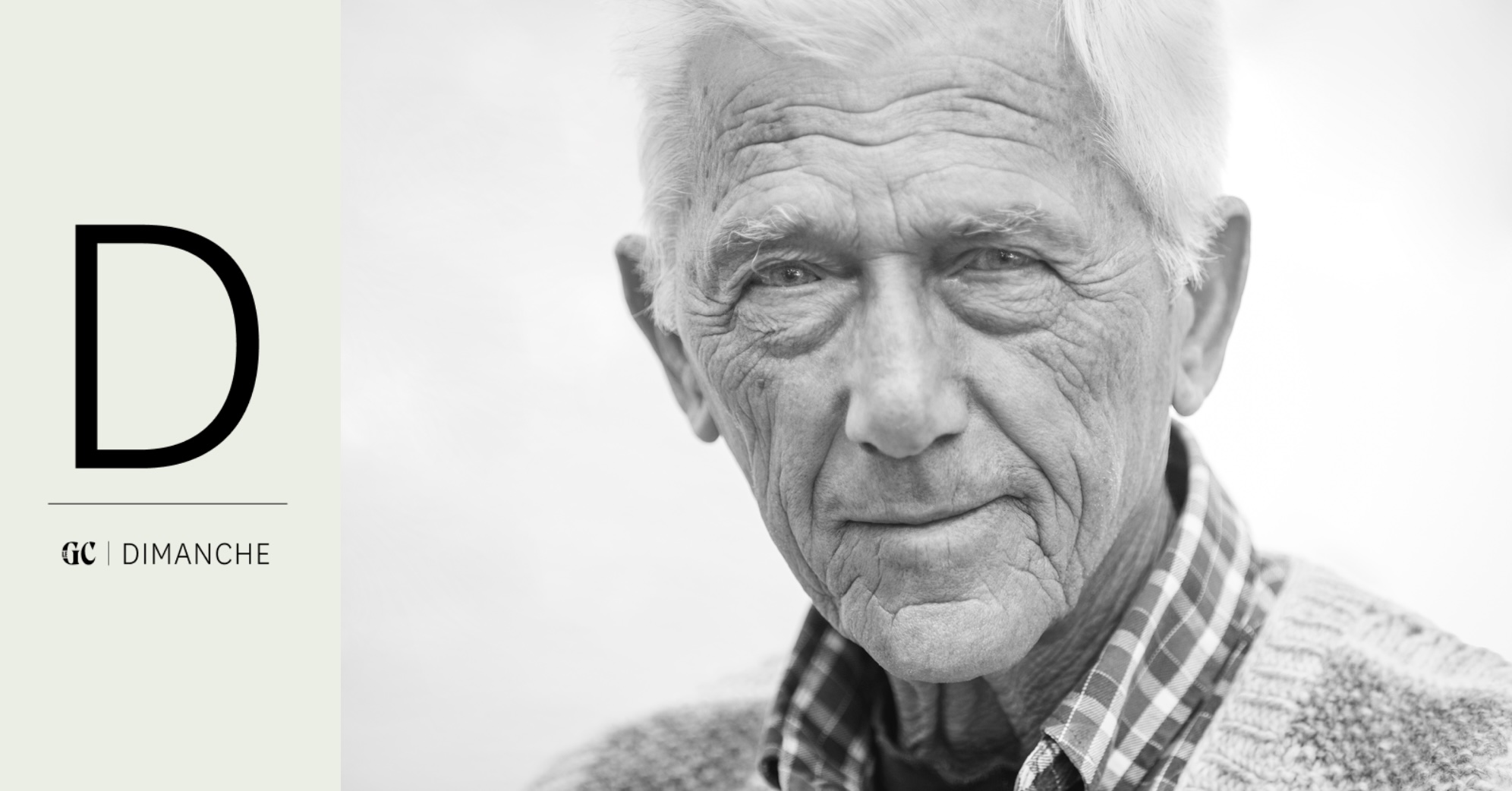
It was breezy that morning in Sweden. Theodor Kallifatides wore a light gray sweater. At eighty-eight, the writer still possessed a striking blue gaze—lively, curious, and deeply kind. Nothing in his bearing sought to impress. He listens at length before answering, with the calm, patient tempo of those who know that ideas gain nothing by rushing. For him, thought rarely moves through concepts: it starts from a memory, a face, a life.
For more than half a century, Theodor Kallifatides has built a singular body of work in which the experience of exile continually dialogues with Greek memory. Novel after novel, he composes the same inner geography, traversed by language, childhood, civil war, exile, and return. Reading him, one quickly understands that Greece is never merely a backdrop for him, but a way of questioning Europe.
The continent views Greece as its starting point. It is there that it locates the invention of democracy, philosophy, and tragedy. Yet, reading Kallifatides, an almost opposite intuition imposes itself. Greece is not only the place where Europe was born; it is also where it is discovered. As if the shocks it endures—the wars, the migrations, the economic crises, the fragilities of democracy—manifest there earlier than elsewhere, with a particular intensity. Not because Greece stands out as an exception, but because it reveals, before others, movements destined to become European.
They pose this hypothesis to him. Kallifatides smiles. He does not reject it. He prefers to shift it: “For a long time, Greeks did not really think of themselves as Europeans. If you wanted to be European, you had to leave: go to Germany, France, or Sweden. At that time, Europe seemed to begin elsewhere. To join it, you had to leave Greece.”
As the conversation progresses, an evident truth becomes clear. If his work frequently illuminates European questions, it is because Theodor Kallifatides himself has undergone the most decisive experiences: exile, war, language, uprooting are not objects of reflection for him. They are his biography.
When someone notes that his work seems to tell the story of Europe, he nods without ceremony. His personal history begins, too, long before the major contemporary debates on migration or European identity: “My father was a refugee. He came from Pontus, in Turkey. All his life he remained a rooted-out man.”
This family memory teaches him early that a country can be lost without vanishing, that a language can survive across a border, and that identity never rests on a passport. The rest of his life would only give a face to this first lesson.
When he left Greece for Sweden in 1964, he did not think he would become an exile writer. Like many others, he believed he would stay a few years: “I thought I would return. All migrants think this at first. Then life settles elsewhere. The years pass. And we discover that we belong to two countries now, without belonging wholly to either.”
This sentence recurs often, in various forms, in his work. Exile is never a dramatic rupture. It is a slow, almost imperceptible shift. A life is organized elsewhere, new habits appear, another language becomes familiar, while the country left behind continues to inhabit memory.
They then ask whether one ever stops being a foreigner. He takes a moment to reflect: “Integration exists. But it takes a long time. Often longer than a generation. Governments think that everything can be settled quickly. The pace of life follows another rhythm.”
Then he recounts a nearly banal scene. One day, on a Swedish train, he coughs because he has a cold. A woman looks at him and says: “There are hospitals in this country.” He smiles: “I had lived in Sweden for decades. I wrote in Swedish. I was a recognized writer. Yet, at that moment, I became an immigrant again.”
After the time of departure comes the time of language. Perhaps that is where everything hinges. After leaving Greece, Theodor Kallifatides learned Swedish, to the point of making it his writing language. Yet, when asked what Greece represents today for him, he speaks of neither landscapes nor monuments. He answers without hesitation: “Greece is my language.” Then he adds, almost in the same breath: “I manage in several European languages, but they are not my language. Greek is me. I have the sense that if I do not say something in Greek, I have not said it completely.”
Asked whether, in rightly celebrating multilingualism, Europe might be at risk of forgetting that languages are much more than simple means of communication: they are visions of the world, memories, and legacies. Kallifatides agrees at once: “The first word we know is the one we receive from our mother. It is our first world. I do not believe we can ever create another one.”
This sentence perhaps sums up his entire body of work. The mother tongue is not only what we learn first; it is what teaches us to inhabit the world. Other languages widen the horizon, enable other encounters, other readings, other lives. But none can fully replace the one in which things first received their name.
He then notes a development that worries him: “Young people today learn several languages. It is a blessing. But these languages are becoming more and more tools of communication. We risk losing something deeper: the sense of the world contained in the words.”
He then evokes an image drawn from Homer. In the past, he says, the smoke rising from a house announced that a home was alive. Today, that smoke has vanished. It is not merely a change in landscape; it is a way of inhabiting the world that is vanishing: “If we lose that language, we will be left with an informative language. But the language of emotions will disappear.”
For Kallifatides, language does not merely transmit words; it transmits memory, sensitivity, and a way of looking at reality. What Kallifatides defends through Greek goes far beyond the confines of a national language. He reminds us that a civilization always begins with words that teach less how to communicate than how to see, to name, and to love.
As the conversation progresses, Homer’s presence becomes more and more evident. Not as a cultural monument, but as a writer who continues to accompany our era. For Theodor Kallifatides, the classics survive not because they are part of heritage, but because they keep speaking about human beings. We are told that, for many, the Odyssey remains primarily the account of adventures of an ancient hero. He smiles and immediately shifts the perspective: “The Odyssey is not a book about journeys. It is a book about what it means to come home.”
All his work seems to prolong this intuition. Odysseus’s return is never that of a man who reclaims the world he left intact. Time has passed, places have changed, and the returnee is no longer entirely the same. Exile is therefore not just an episode of life; it becomes a human condition.
Kallifatides recognizes himself immediately: “When I return to Greece, I am happy. But I also know that I can no longer live there as before. The Greece I left no longer exists.”
They ask him why Homer continues to speak to us nearly three thousand years after composing his poem. His answer is simple: “Because he speaks of human beings. Not Greeks. Not Europeans. Human beings.”
In a few words, he offers a definition of the classics. They do not cross centuries because they would be untouchable; they cross centuries because they keep asking the same questions to every generation. What is a home? What does it mean to leave one’s kin? Can one ever return home? It is precisely because they keep challenging our present that Homer, the tragedians, and all ancient Greek literature remain our contemporaries.
The conversation gradually returns to Greece. Not the Greece of childhood, nor the Greece of myth, but today’s Greece. Every summer, millions of travelers go there in search of light, of the sea. They note that his country has become one of Europe’s most sought-after destinations. Is this fascination a blessing?
Kallifatides closes his eyes for a moment, as if to recover a place: “Athens is still there, but it is no longer the same city. The children I played with, my schoolmates, first loves, everyone who filled my world has disappeared.” Then he adds, almost in a whisper: “It isn’t only the changes of a city. It’s also me who has changed. You never return to a city with the eyes of your twenty-year-old self.”

They remark that Greece seems to live, with a few years’ lead, the continent’s major questions: tourist pressure, migrations, economic crises, democratic tensions. Does it continue to be this privileged observatory post for the continent?
Kallifatides does not believe in prophecies. He believes in history. “We have already lived through many things that other Europeans are only discovering today. History never repeats itself in the same way, but it always leaves signs. The hardest part is recognizing them in time.”
The conversation naturally slides toward democracy. After all, if Europe keeps looking toward Greece, it is also because it seeks there the origin of its political ideal.
For Kallifatides, however, democracy is never a legacy definitively won; it remains, every day, a work to restart, a daily responsibility: “We keep preparing wars. We spend more and more money on weapons, while the poor grow poorer.” He pauses. “The real conflict of our era is a war against the poor.”
To his eyes, this same responsibility also shapes how Europe views migration: “A society is never built by withdrawal. Those who arrive first seek a life: to work, to learn, to raise their children, to participate in the community that welcomes them. Immigration is not the problem.”
His worry concerns the resurgence of ideas he believed belonged to last century: “What scares me are the ideas we thought had disappeared and that we see resurfacing all over Europe.”
The conversation closes on a question that threads through all his work. The ancient Greeks distinguished nostos (νόστος), the return, from patris (πατρίς), the homeland. Two words that our languages often translate in the same way, but which do not entirely cover the same experience. Nostos is the path back home; patris, the place of belonging. In Homer, one does not guarantee the other. One can find the path to one’s island without finding the world one left behind.
They ask him, after more than six decades spent in Sweden, whether these two words still make sense to him. Kallifatides does not answer as a philologist. He answers as a son: “I have lost my Ithaca, but as long as I live, I will carry the benevolent smile of my mother within me.” His answer naturally leads to another question. Why do his books almost always return to the same place? Why, from novel to novel, does one keep returning to this village of Yalós, where peasants, fishermen, teachers, children, priests, the defeated of the civil war, and exiles cross paths?
Like Yoknapatawpha County in Faulkner or Macondo in García Márquez, Yalós has become the literary territory where Theodor Kallifatides unfolds his work. Book after book, he returns there to interrogate memory, time, and history.
Kallifatides smiles. Yalós exists and does not exist. It was born from Molaoi, the small town in southern Peloponnese where he grew up. But geography there gradually transformed into literature. Memories mingle with imagination, the living with the dead, until Yalós becomes a place more faithful to memory than to the map.
For the first time since the start of our conversation, Kallifatides goes back to his childhood: “I was five when I witnessed the execution of a man. I have never forgotten his gaze. I came home, my father, who was a teacher, had already taught me to write. It was the first time I traced words on a sheet. I believe that, in a sense, everything began that day.”
They finally ask what, even today, pushes him to write: “I will write as long as I continue to see the eyes of that man executed. The day I no longer see them, I will stop writing.”
A long silence falls.
The work of Theodor Kallifatides arises from this double fidelity: the smile of a mother and the gaze of a condemned man.
Between these two images, a world has been built.