
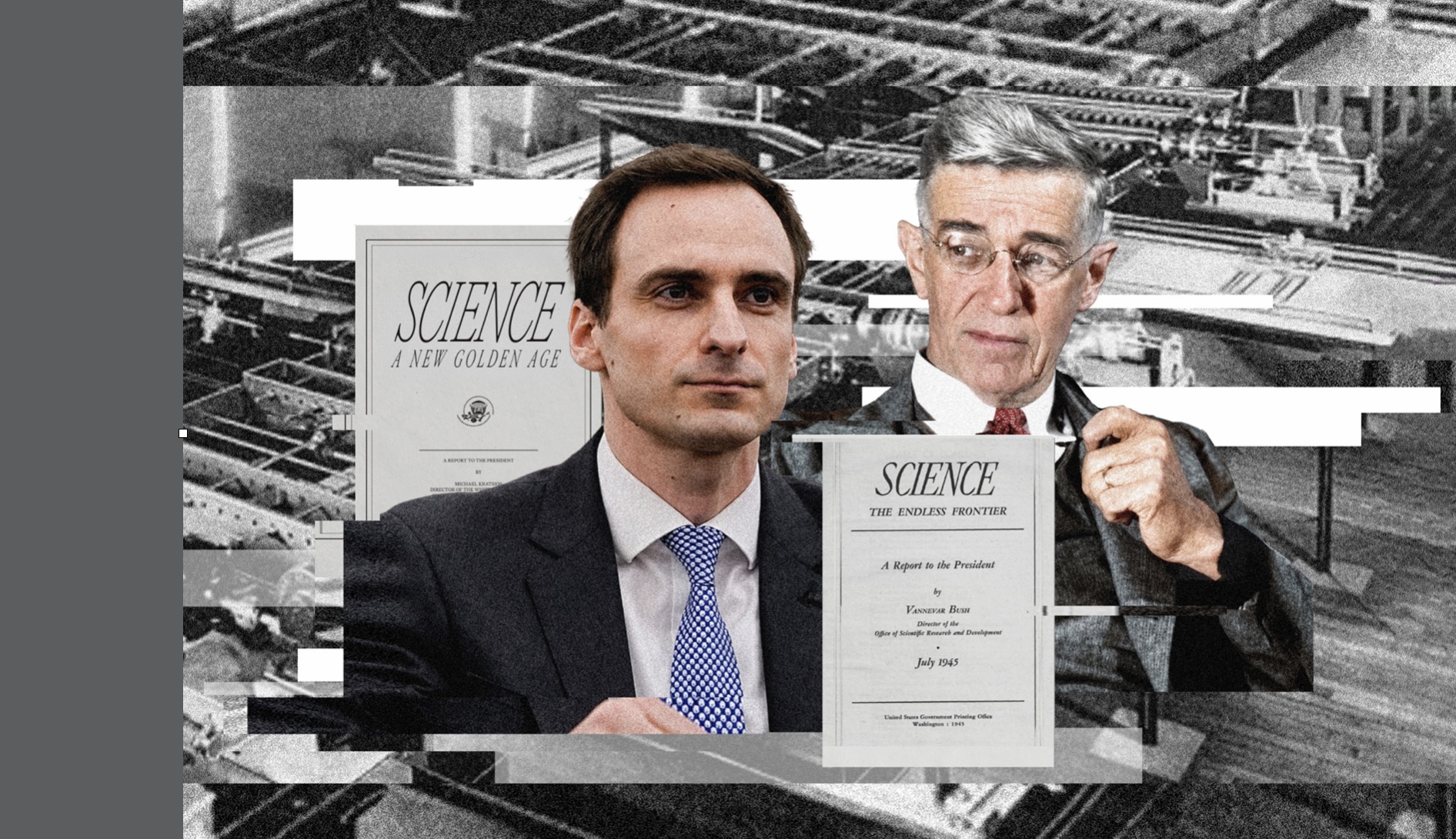
Eighty-one years after the historic report commissioned by Roosevelt and delivered to Truman by engineer Vannevar Bush, the White House is redefining America’s science policy.
Presented to the U.S. president on July 21, 2026, on the eve of the Genesis: Science, a new golden age summit, this 123-page report, signed by Michael Kratsios, director of the Office of Science and Technology Policy (OSTP) within the White House, presents itself as the successor to Science: The Endless Frontier, beginning with its blueprint.
In reality, this is the inversion of that. While Vannevar Bush founded a new universalism and a state-funded open science, Kratsios intends to reorganize science in the service of American sovereignty and its dominance.
In a world where American industry spends $700 billion on research and development each year, more than triple the public sector, and where half of researchers’ time is consumed by bureaucracy, the document does not call for more money, but for a change of scientific regime. Uninstall the 1945 software and propose a new paradigm.
Three decisions structure the report.
The first: to overhaul, in fundamental ways, the allocation of the roughly $200 billion in annual federal spend, funding people rather than institutions, and ending consensus-based reviews (golden tickets, fast grants, X-Labs, sectoral ARPAs).
The second: to embrace the technological choices through six national missions funded in the 2028 budget – AI, quantum, fusion energy demonstrated by the mid-2030s, a return to the Moon as early as 2028, robotics, semiconductors “EUV and beyond.”
The third: to make AI the very infrastructure of science with the Genesis mission, by linking the seventeen national laboratories, their 40,000 scientists and their twenty-billion-dollar annual budget to universities and private sector research – with a clearly stated numeric target worth noting: to double American scientific productivity in ten years.
From a European vantage point, one might argue that a scientific revolution could not be led by a president who is so clearly positioned beyond science. And Kratsios’s doctrine will need to be judged by its capacity to resolve a fundamental contradiction: an administration that demands “merit-based” selection is also one that, since 2025, cancels subsidies for ideological reasons, freezes funding for major universities, and regards foreign talent as a risk to national security. Yet this text must be taken seriously, because the signal is brutal: allies are absent, foreign talent is viewed as a security risk, and ASML—the rare European success in photolithography for semiconductors—features among the American “failures” to be corrected.
One paradox: this document, which implicitly designates the Middle Kingdom as the threat to be contained, largely adopts the approach of major industrial powers like Germany or China, even proposing to turn American federalism into a testing ground for regional experimentation and to advocate for a much closer collaboration between research, industry, and defense.
Yet, read in reverse, the same report sketches at least three levers for Europe. The first is human, and it is unprecedented: an American system that treats its foreign doctoral students as a security concern opens, for the first time since 1945, a massive recruitment window to our advantage — provided we answer with instruments commensurate to the challenge: long-term funding, genuine freedom, infrastructures worthy of the name, agility and speed as core values, because such a window will not stay open for long.
The second lever concerns our data: Genesis may aggregate the entire American federal apparatus, but it lacks the data commons we hold (the EMBL-EBI reference genomics, Copernicus Earth observations, CERN and ITER data sets), i.e., a tangible bargaining chip to negotiate access and interoperability rather than to beg for it.
The third lever is normative: the “Gold Standard Science” component (reproducibility, transparency, automated verification) is the only chapter of the report that naturally calls for multilateral action, and the interfaces of autonomous laboratories are not yet locked in. Europe can co-author these standards today, or suffer them in five years as it already endures its dependence on cloud services. The only proportionate response would thus be a functional equivalent: a European Genesis backed by EuroHPC and our instruments, led by an ARPA-style agency—one that Draghi’s report urged, freed from the hurdles of committees and bureaucratic processes.
The Americans took eight months to go from a decree to a platform. Nothing in Union law prohibits such speed—nothing, except us.
This text can therefore be read both as a manual, and as a case study to understand how the United States of Donald Trump envisions itself — and as an ultimatum. It is to this necessary reading that the comments accompanying, below, the full translation of the executive summary (pages x to xvii) invite readers.
CHAPTER I — INTRODUCTION
American scientific progress has been the beating heart of the 20th century. It delivered victory on the battlefields of World War II, ensured America’s triumph in the Cold War, and produced the most prosperous nation in human history. We developed the alchemy that taught sand to think, bringing forth the digital world of silicon chips. American science defeated polio, sent humans to the Moon, and gave humanity general-purpose artificial intelligence. This leadership improved lives and defined the very fabric of our modern world.
The bedrock of these profound advances was laid in the years following World War II, largely thanks to the vision laid out by Vannevar Bush, the principal scientific advisor to Presidents Roosevelt and Truman. In his canonical 1945 report, Science: The Endless Frontier, Bush argued with prescience for federal support of fundamental research, laying the groundwork for the modern scientific enterprise. This enterprise, however, was built largely around what would come to be called the “linear model” of technological progress—moving from fundamental research to applied research, then to technology development and industry. Even at the time, this model was a simplification; today, eighty-one years later, it has become increasingly inadequate to describe progress. Discovery now most often takes the form of an iterative loop between fundamental and applied work, with industry and engineering playing a vital role in catalyzing even fundamental research itself.
The public funding of research and development, especially fundamental science in universities and national laboratories, has rightly risen over the eight decades since Bush’s report. But private industry has become by far the leading source of R&D funding in the United States, its share having nearly doubled since the 1950s. American companies now deploy roughly $700 billion annually, more than three times the combined public and higher-education expenditures. This shift has expanded the overall pie and should be welcomed across the research ecosystem, but it also requires an appropriate adjustment in how the federal government contributes.
New challenges have emerged in recent decades. Despite massive increases in biomedical funding since the 1990s, the pace of significant breakthroughs seems to have slowed, and drug approvals have stagnated. Researchers today often spend half of their time on paperwork and administrative tasks, a burden exacerbated by the growth of federal and university bureaucracies, further squeezing the funds available for real science. A smaller share of American citizens now occupies advanced-degree roles in STEM fields. Competitors are channeling unprecedented resources into science and engineering, adopting an approach that mobilizes society at large to seize dominance in strategic technologies.
Meanwhile, the AI revolution is reshaping the conduct of science, and inherited scientific institutions and infrastructures are not fully ready to capitalize on this transformation.
America has led the world toward scientific progress because Americans refused to stand still. We have already adapted to changing conditions by boldly reinventing how we structure science, and we must innovate again. Never has scientific and technological development been more essential to our national security and economic vitality, and never has this progress been so deeply embedded in our global diplomatic relations.
The President’s priorities are clear, as he seeks to lay the foundations for a new American golden age of innovation. He has asked this administration to revitalize the national scientific enterprise, ensure U.S. leadership in emerging technologies in the face of foreign rivals, and ensure that all Americans benefit from new scientific breakthroughs and technological transformations. The President understands American history as a story of ambition, discovery, and invention, that of pioneers who continuously seek new frontiers to explore, particularly today in science and technology.
The following chapters offer recommendations, insights, and guidance for the entire American scientific enterprise—from government to universities, and from the private sector to philanthropy.
CHAPTER II — REVITALIZING AMERICA’S SCIENTIFIC AND TECHNOLOGICAL ENTERPRISE
To reverse stagnation and reinvigorate the pace of breakthroughs, the federal government must unleash American scientists to do their best work. Federal funding in the university world remains rooted in mid-20th-century assumptions, channeled through traditional disciplines and overly focused on short, project-based grants. Review committees filter proposals largely by consensus, which discourages transformational ideas. Agencies face little pressure to correct underperforming portfolios. We must remove unnecessary burdens, realign funding toward excellence and risk-taking, and embed continuous improvement, driven by data, into an annual R&D portfolio of roughly $200 billion.
- Centering on the individual scientist : Put the researcher back at the center of the American scientific enterprise. Free them from mounting administrative burdens that now consume nearly half of their working hours. Invest in people, not only in projects, by expanding portable doctoral fellowships such as the National Science Foundation’s (NSF) Graduate Research Fellowship Program (GRFP), supporting independence early in careers and scaling long-horizon funding for the best and brightest, modeled on the NIH Director’s Pioneer Award.
Open up alternative pathways beyond the traditional academic route, and ensure that selection rests purely on merit, not the political fashions of the moment.
- Diversifying funding mechanisms : Move beyond consensus-based peer review by embracing a wider array of selection mechanisms tailored to different kinds of science. Examples include “golden tickets” that empower individual evaluators to champion ambitious proposals, fast grants delivering timely funding decisions, prize challenges and ahead-of-market commitments that pay for outcomes, and re-granting models that delegate funding authority to scientists to mobilize distributed expertise.
- Creating new institutional models : Many of today’s most important problems are too large for a university laboratory, too transdisciplinary for a single department, and too hard to commercialize for a private company. Federal funding should underpin a broader ecosystem of actors. The recently launched X-Labs can assemble agile, time-bound teams of scientists and engineers to tackle specific bottlenecks. ARPA-style programs can empower program leaders to make bold bets and select researchers to execute them. Curiosity-driven institutes can provide our best minds with the stability to pursue fundamental questions over long horizons.
- Reducing bureaucratic burdens : The demands on federal grants have exploded over the past decades. Some grants now take almost two years from submission to award — nearly as long as it took to design and build the first Boeing 747.
- Compress evaluation cycles, eliminate redundant reporting, and manage indirect cost recovery that fuels administrative overhead, redirecting that money toward real scientific infrastructure. Advance reforms that reduce the burden of grant applications, with relief targeted specifically at early-career researchers.
- Institutionalizing continuous improvement : Funders should apply to themselves the same critical scrutiny they are meant to apply to grant proposals. Establish within federal science agencies a metascience unit with real authority, reporting directly to the director, empowered to conduct controlled experiments on evaluation and funding mechanisms and to drive organizational change. Elevate the prestige of program directors, broaden their latitude in setting scientific directions, and support them as architects of the fields they help shape.
CHAPTER III — ENSURING THE UNITED STATES’ LEADERSHIP IN CRITICAL AND EMERGING TECHNOLOGIES
The United States possesses the world’s most vibrant scientific scene and the private sector’s most dynamic engine for turning ideas into innovative industries. Yet scientific leadership alone does not guarantee national power or economic vitality. We must tightly couple our scientific and technological enterprises to ensure that American-originated revolutionary ideas are rapidly prototyped, tested, manufactured, and deployed at scale on U.S. soil.
- Restore permissionless innovation : Regulators have grown adept at weighing the risks of action but blind to the costs of inaction. Good rules require real-world data, and that data can only come from the freedom for innovators to prototype and experiment. Extend the President’s reforms in nuclear, pharmaceuticals, and drones to other sectors. Weigh benefits as well as risks, streamline approvals, and use regulatory sandboxes to test new technologies in controlled environments.
- Open federal infrastructures to American builders : The federal government holds facilities and testbeds that no startup can replicate alone. Expand industry access to U.S. lab infrastructure, including DOE laboratories, NASA centers, and War Department facilities. Factor innovative potential alongside scientific merit in access approvals, streamline CRADAs and licensing, leverage Other Transaction Authorities (OTA) to enable private-sector co-design of research directions, and broaden partnerships with the private sector to undertake joint investments in cutting-edge equipment.
- Strengthen public-private partnerships and talent flows: The university is no longer the sole crucible of America’s most innovative science. Scale agency-backed foundations, focus SBIR and STTR programs on building strategic capabilities, and support joint centers spanning industry, academia, and federal facilities. Roll out broad doctoral and postdoctoral fellowships in industry that move talent fluidly between sectors, leveraging the private sector’s resources to bring industrial-scale assets to university researchers.
- Organize precompetitive consortia and grand challenges : The Apollo program and the Human Genome Project succeeded because the federal government mobilized scientific effort at a scale no single institution could match. Use grand challenges to push breakthroughs forward and create large “moonshot” missions for national-interest issues. Support industrial consortia and use federal resources to lift shared engineering bottlenecks in fundamental domains, as the EUV venture did for semiconductor lithography.
- Use counties and states as laboratories : Federalism is one of America’s greatest strengths. States can experiment with regulation, permitting, and economic incentives in a manner the federal government cannot replicate. Support state-led experimentation, partner with jurisdictions moving the fastest, and let localities compete to attract regional innovation. Ensure strategies that work spread across the nation, advancing science and technology in every county and state.
CHAPTER IV — MAKING SURE SCIENCE AND TECHNOLOGY IMPROVE THE LIVES OF ALL AMERICANS
The American scientific creativity and entrepreneurial culture position us to translate breakthroughs into technologies that enrich the lives of every American. This enrichment should include the creation of manufacturing jobs, not only consumer products. By rebuilding the link between science and hands-on know-how, federal leadership can ensure that the economic benefits of discovery—including jobs, supplier networks, and know-how embedded in workers’ hands—reach Americans in every region and every sector of the economy, thereby sustaining our technological leadership for future generations.
- Integrate hands-on training : Technology is not only codified in papers and patents but also in tacit knowledge passed from mentor to mentee. Require universities and community colleges to embed practical technical training and immersive internships into STEM curricula. Recognize hands-on experience and professional certifications in degree attainment. Reform accreditation, admissions, and tenure to reward practical work done in real-world settings alongside scholarly publication.
- Open scientific careers beyond the academic track : Establish national fellowships for skilled trades, residency-practitioner programs that bring machinists and technicians alongside PhD researchers, and portable industry-recognized certifications in advanced manufacturing and laboratory techniques. Link hobbyists and tinkerers in rural communities to formal research opportunities, and open universities to local residents’ technical training.
- Modernize learning and career pathways : Extend apprenticeship models into science and technology fields. Adopt performance-based financing models, scale up Workforce Pell Grants, and support community colleges as regional hubs of scientific and technical talent. Connect these hubs to federally funded sites of industry, innovation, and manufacturing.
- Build dense local innovation clusters nationwide : Technological leadership emerges where research and production are close to each other. Expand regional innovation hubs, manufacturing institutes, and defense-base industrial centers to anchor regional ecosystems. Coordinate with local universities and national laboratories to build specializations and talent pools. Pair these efforts with relocating advanced manufacturing and restore feedback loops between researchers, engineers, and skilled technicians.
CHAPTER V — A NEW GOLDEN AGE
America stands at the dawn of a scientific revolution, in which AI accelerates discovery, enhances cognitive capabilities, and unlocks solutions to some of our greatest challenges. But “AI for science” will remain constrained by the frictions and inefficiencies of human institutions. We cannot fully harness AI and the productivity gains that accompany it unless we boldly reform our scientific institutions, build nation-wide infrastructure, and ensure rigorous verification of the knowledge base from which AI learns.
- Launch and scale the Genesis Mission : Fully fund and expand the Genesis Mission as America’s flagship AI-for-science initiative, integrating supercomputers, AI models, scientific instruments, and datasets across national laboratories to double the productivity and impact of American science within a decade. Focus it on cross-cutting challenges where breakthroughs unlock entire branches of downstream discoveries, and where AI can transform the practice of science itself.
- Institutionalize Gold Standard Science : An AI operating on a flawed knowledge base will merely entrench bad science.
- Apply reproducibility, transparency, data sharing, and falsifiability across federally funded research, via the presidential decree “Restoring Gold Standard Science,” thereby establishing a trustworthy foundation for AI-powered discovery.
- Build large-scale verification infrastructures : As the cost of data generation has fallen exponentially, verification costs have not kept pace. Invest in AI-assisted verification systems, open standards, and continuous replication mechanisms. Set standards to enable machine-auditable replication dossiers, and reward those who replicate or refute influential scientific results.
- Accelerate autonomous experimentation : Closed-loop autonomous laboratories can compress discovery timelines by orders of magnitude and enable science at truly industrial scales. Focus investments in robotics and automated laboratories, aligning with industrial demand and federal R&D to ensure our base of scientific equipment is built on world-leading hardware and software and leads the charge in the coming scientific revolution.
- Experiment with AI-native scientific institutions : Today’s funding structures, publication systems, and credit-allocation mechanisms were designed for a human-pace world of discovery. Begin the transition toward AI-native institutions, including faster and more open publication practices, more granular credit assignment, and new market mechanisms that direct resources to problems where breakthroughs count most.