
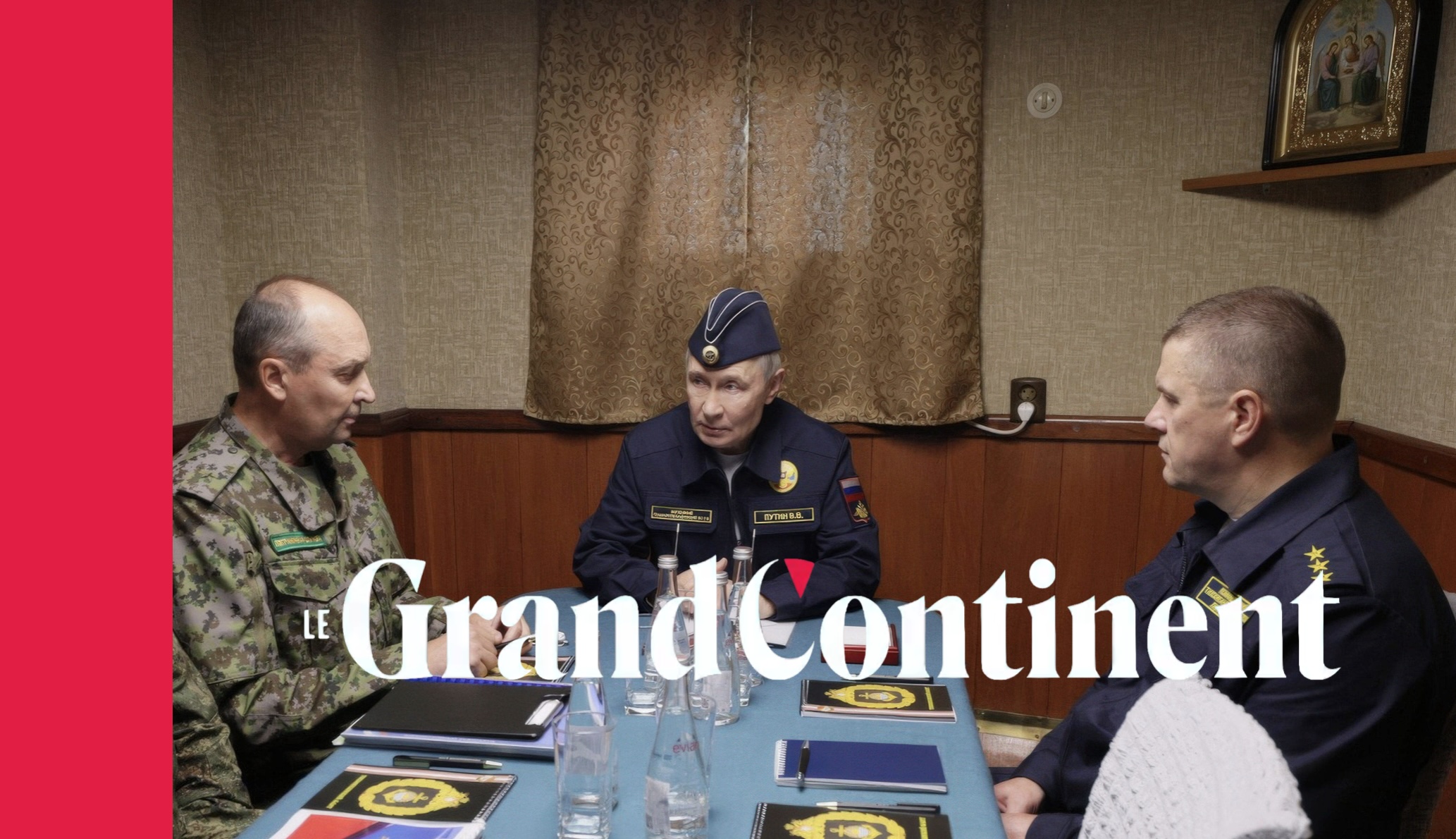
On Tuesday, August 11, Vladimir Putin traveled to Yuzhno-Sakhalinsk, the capital of Sakhalin Oblast, which also includes the Kuril Islands, a territory partly disputed by Japan. The following day, the Russian president took part in the final phase of the Pacific Fleet exercises aboard the guided-missile cruiser Varyag, before receiving a briefing from the commander of the Pacific Fleet, Viktor Liina, on the region’s geopolitical situation.
Putin then delivered a highly staged appearance, appearing before cameras in a naval uniform, flanked by senior military and intelligence officials. It should be recalled that the Commander-in-Chief of the Russian Armed Forces only recently adopted this habit of public statements in military dress. Between 2000 and 2022, these episodes were few; it was only since 2025 that the Russian president regularly dons full military attire, even in perplexing arrangements, such as a meeting with the Chief of the General Staff, held in December 2025 in a room with interior walls (not exterior) covered by camouflage net.
The true innovation of this summer of 2026, however, lies in Putin’s visit to the Kuril Islands, more precisely Iturup Island. In doing so, the Russian president abruptly broke with a strategy followed for decades by the highest Russian state officials: since Boris Yeltsin, the only visit by a Russian president to the Kurils has been a brief foray by Dmitry Medvedev to Kunashir in 2010.
Moreover, Putin’s decision came the day after a notably offensive speech towards Japan. Speaking aboard the Varyag, the Russian president asserted that Japan’s threatening policy and the rising sources of conflict in the Asia-Pacific region justified an expanding Russian military effort. This declaration was interpreted by many as a break with the long-standing policy of easing Russo-Japanese relations championed by Putin himself, or even as aligning Russia with the diplomatic pressure policy on Japan pursued by China for several months.
A different reading, however, can be put forward. For weeks Ukrainian drones have targeted the heart of Russian logistics with deep strikes on Wildberries’ sites, to the extent that Ukraine might be on the verge of “winning the war at the warehouses.” At the same time, the main headline in the Russian opposition media is not another verbal threat from Putin, but the decision to exclude the sole anti-war party, Yabloko, from the parliamentary ballot in September.
Thus, the Kremlin’s credibility is doubly called into question: unable to defend its territory, its economic assets and its population, the regime appears to have so little faith in its political mobilization capacity that it prefers to derail any opposition candidacy, even in a fully rigged electoral system. In light of this double failure, it remains difficult to interpret Putin’s go-to-war statements against Japan and the West as anything other than yet another distraction.
Dear Viktor Nikolaïévitch, dear comrades,
First of all, I would like to thank the commander for his detailed reports. The military exercises under discussion and other such events are necessary to ensure the fleet’s combat readiness, but also, more broadly, to protect our country’s interests and security across the Asia-Pacific region. They are also necessary for a third aim: strengthening Russia’s overall military capabilities in this region. All these initiatives must take into account the experience gained through the ongoing special military operation, as we discussed with the commander aboard the cruiser.
You mentioned the operational deployment of the Pacific Fleet’s Marine forces – namely the 155th Marine Brigade, now the 55th Marine Infantry Division – and I want to stress that there is, at present, no combat mission this division could not carry out. All potential missions are within reach. Our people show audacity, professionalism, even heroism. As for the fleet itself, it fully handles the tasks within its area of responsibility. Yet the tasks in question are becoming increasingly important, given the regional context just outlined by the commander.
We note that the potential for conflict unfortunately continues to rise. NATO is encroaching upon the region, new military-political blocs are forming, while new weapon systems are already deployed there or are to be deployed, even though they pose a tangible threat, notably to our country.
Observing this, tensions are also intensifying in a neighboring region, the Arctic, around the use of the Northern Sea Route. Yet Russia has always — I stress: always — stated its willingness to cooperate in the Arctic and to take advantage of the Northern Sea Route’s benefits. Our position has not changed. Of course, this requires strict adherence to international maritime law in force. We are already in talks with states willing to cooperate with us and showing interest, beginning with friendly states, including China and India. It goes without saying that we would welcome any prospect of cooperation, with both our friends and all countries eager to participate in this essential, promising venture, for the development of global logistics.
We have said more than once that the Asia-Pacific situation is among the most complex, shaped by a host of underlying issues. I would simply say today that we would like to understand our neighbor’s position, Japan, which has been mentioned in the various reports. Under the pretext of the events in Ukraine, this country imposed sanctions on us that we did not provoke, without even seeking to examine the real causes of the conflict. Unprecedented in its recent doctrinal documents, Japan has moreover classified Russia among the main sources of threats.
I would like to stress that we do not threaten Japan in any way. We have no grievance against it. On the contrary, it is Japan itself that pursues certain territorial claims against Russia: I am referring, of course, to the Kuril Islands issue. The current state of play is nonetheless recognized as one of the consequences of World War II in a series of international documents. Nevertheless, Russia has shown itself ready to seek a solution that would allow concluding a peace treaty with Japan.
I remind you that, as early as the mid-1950s, the USSR signed with Japan a declaration opening the way to a peace treaty. Initially, Japan had signed it as well, before withdrawing from the agreement, leading to the Soviet Union’s withdrawal as well. The new Russia has nonetheless responded to the Japanese government’s requests and agreed to resume — at Japan’s request — dialogue with a view to a peace treaty. It had also been agreed from the outset that this dialogue would continue on the basis of the declaration I just mentioned.
At that time, we had established constructive relations with several Japanese leaders, starting with former Prime Minister Shinzo Abe, who died tragically after having done much to advance Russo-Japanese rapprochement and harmonize our respective positions. Today, and to our great regret, we can only acknowledge a shift in position by our “neighbor,” without having provoked it ourselves.
In this context, we can only approve the commander’s proposal to develop the Pacific Fleet and enhance its military capabilities. We must now compile all the data necessary to implement this proposal. Instructions to this end will be issued to the Ministry of Defense as well as to the government of the Russian Federation. It will also be necessary to designate those responsible for their implementation and determine appropriate funding sources.
I nevertheless insist on this point: Russia remains ready to cooperate with all its neighbors, whether with Japan or with other regional states. I know the Pacific Fleet conducts joint military exercises from time to time, and I request that these operations continue.
I would finally like to draw your attention to one last issue. The commander just mentioned the question of escorting Russian ships within the Pacific Fleet’s designated territory. We must keep in mind the latest European Union decisions. Authorities in certain countries, in total violation of international maritime law, have for years sought to hinder the movements of ships belonging to our economic actors by peaceful means. More recently, they have even contemplated seizing these vessels and selling the goods they would have extorted from us.
We must take this decision for what it is: brigandage and piracy. If this plunder were actually carried out, we would be compelled to respond in kind, not limited to the territories where these raids against our vessels occur, but everywhere we deem necessary and appropriate. In any location, including within the Pacific Fleet’s area of responsibility.
I therefore ask you to give this matter your full attention. An instruction to this effect has already been issued to the Ministry of Defense before being sent to the Pacific Fleet commander. I ask you to present all your suggestions on this issue.
In conclusion, I would like to reiterate once again that Russia is strengthening its security on a global level and across its various regions. However, we remain ready to seek acceptable compromises for all our neighbors and partners, provided they truly take into account mutual interests.