
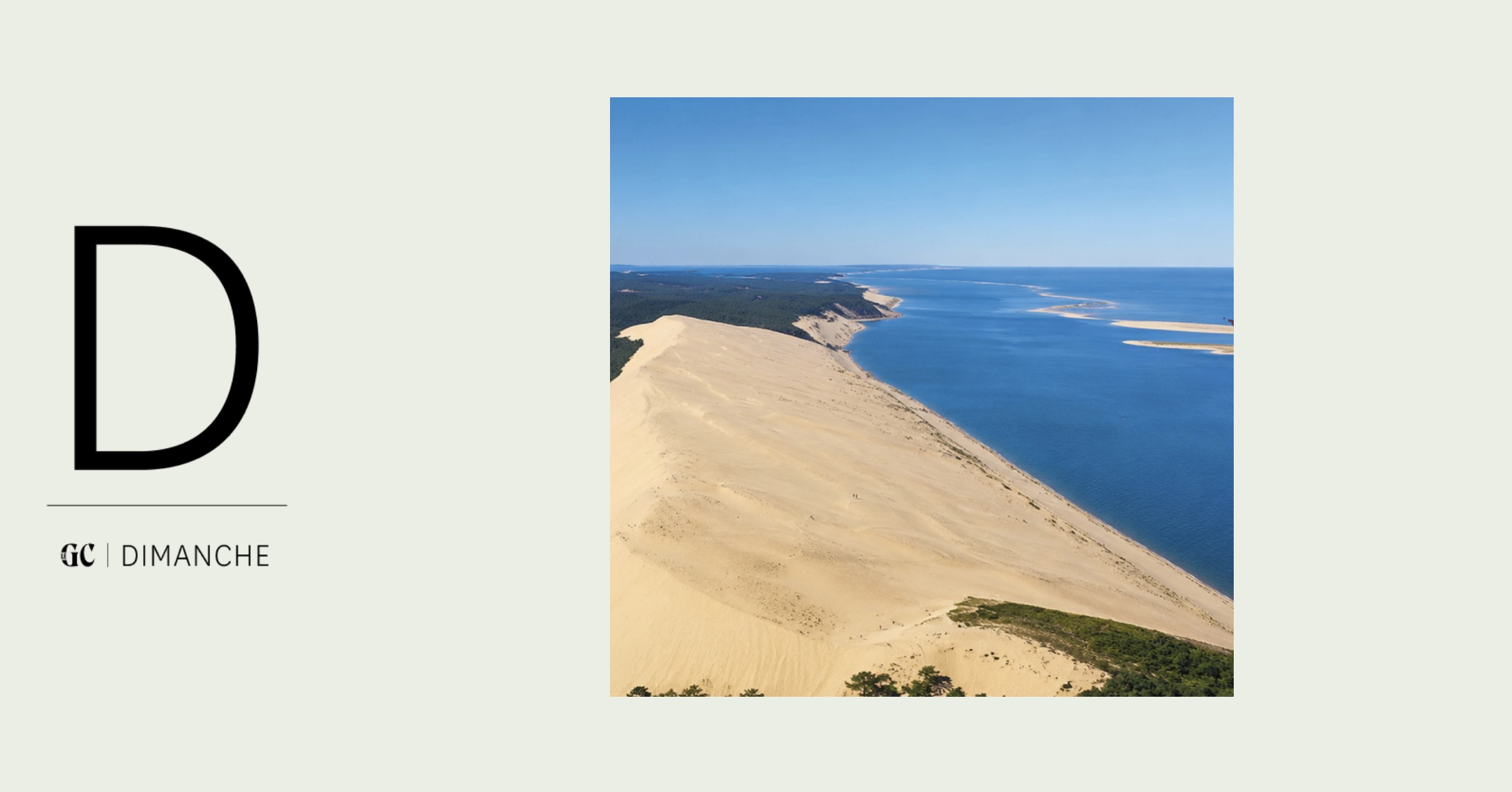
When did you first discover Pyla?
I discovered Pyla about twenty years ago, when I met my wife. I knew a bit about the Atlantic coast, but more from the Île de Ré side. My wife, on her side, is from the Arcachon basin. She spent every summer in Biganos. Little by little, I started spending all my summers there, and my attachment to this exceptional place was born.
Do you feel like a Pyla resident?
Contrary to what one might think, Pyla residents have a very strong sense of belonging. Despite the villas, vacation homes, hordes of tourists, jet-set stars who come to party, and the urban and landscape changes — fairly modest compared to other French coastal regions — there is a deep identification of Pyla residents with their land. Not everyone can claim Pyla-ness. Generations from the same family pass through beachfront houses, and many people I know there carry childhood memories. That isn’t the case for me. I was 40 when I discovered the region. Consequently, despite the 20 summers I’ve spent diligently on Pyla beaches, I still feel like a stranger or an intruder there.
But that doesn’t bother me. It’s probably tied to my personal history: I’m from nowhere. My grandparents and parents grew up in Morocco, in Casablanca, but I wasn’t born there myself. I grew up in the Paris suburbs, but I couldn’t honestly say that Bas-Montreuil, where I spent my childhood, gives me a particular sense of belonging. I’ve lived in Lille, in Paris, but I’ve never considered myself a Parisian. I spent several years in Guyana, where I loved life there. So I don’t truly have a “home,” let alone roots.
What does your ideal day look like when you’re at Pyla?
I love running on the beach, very early in the morning, when the tide permits. Stepping onto the wet sand just after the sea has withdrawn, with the sun in the distance, still near the water, is wonderfully pleasant. From Le Moulleau to Arcachon, before the sunbathers arrive, you can still have the place to yourself, with magnificent houses to gaze at. It’s magical. There are many joggers, but most prefer running on pavement, while I’m attached to the feel of the sand, even if it means running a little crosswise.
Then I very often go to the Teste market. After that, I ride my bike regularly. I do at least one circuit around the Arcachon basin every summer, on pleasantly laid-out bike paths. Depending on the route, I can also come back to my starting point by boat. In the past, we used to take the boat to the Arguin Bank, at the foot of the Dune du Pilat. But it has dramatically shrunk over the years, due to storms and gusts that push sand back toward the dune. And that little sandbank is what used to let you feel like you were in the Seychelles. The sand was incredibly fine and rivaled the finest beaches of the Indian Ocean.
What underpins your attachment to this place?
Unlike my wife, or those who spent all their summers there as children, I don’t have buried memories, nor that very singular attachment that makes you deeply long for the land and landscapes to maintain a sense of eternity. It’s more about affection. I watched, with a heavy heart, the major fires of 2022 and 2023, which ravaged 7,000 hectares of the La Teste-de-Buch forest. The damage is still visible. Every harm to the woodland, the pines, the houses, grieves me greatly. Especially since, as I mentioned above, unlike other places, the Pyla has been very well preserved. There hasn’t been concrete development. It has changed very little over the past 40 years.
If there is any change, would it be sociological in nature? Real estate has become unaffordable and the basin has turned into an enclave for the wealthy.
Absolutely. Although, Pyla in particular still preserves a very important core of families who, for several generations, have lived side by side and continue to lend thickness to the place’s memory.
That said, Pyla has become very expensive and that is one of my anxieties. I fear it will become an enclave of millionaires.
Fifteen years ago, you could still buy a house not far from the sea, but that is no longer possible today. At any rate, I could no longer do it. It has taken on enormous proportions. In any case, Cap Ferret across the water draws far more of the people.
Is there any rivalry with Cap Ferret?
No, none at all. Cap Ferret is a very beautiful place. It is a little less wooded than Pyla; the PLU is not the same, so the houses are closer together, but they are houses for millionaires.
We have another advantage: the beaches. Cap Ferret has beaches on the ocean side, but on the basin side the beaches are small, with many oysters and boats. Whereas we have a very beautiful beach on the Arcachon side. It’s different, but I don’t harbor hostility; there isn’t any particular rivalry. It’s a matter of taste.
If you had to sum up Pyla in one image, what would it be?
Pyla is a white house beneath the pines. I hope to find, with each new visit, the same forest richness and the same built landscape. This is indeed linked to the notion of childhood memory, which carries a bit of the hope of pausing time. There is a sting when today’s reality no longer matches that memory, like discovering that the small house where your grandparents lived has been demolished. That is what hurts. With climate change, I always hope Pyla will not be distorted.
What are your best reading memories at Pyla?
It’s a place where I read a lot, especially some rather substantial volumes, impossible to finish during the year. One of my best Pyla readings is certainly 22/11/63 by Stephen King, a dystopia about the assassination of American President J.F. Kennedy. I reread a few chapters from time to time. This summer, I’m starting Philippe Jaenada’s next book, The Stranger on the Quai de Javel.
Usually, I bring along a good stack of books that I struggle to finish in a single summer, so I end up with quite a well-stocked on-site library. It works a bit like an extension of my Paris desk: I deepen topics I discovered during the year.
What kinds of books do you like to read in the summer?
I read a lot of history, especially right now, after the release of the Gaulle diptych, the cinematic epic by Antonin Baudry. His work has made me want to reread the biography by Jean Lacouture, or Julian Jackson. I also want to delve into what historian Arnaud Teyssier wrote about de Gaulle. And not necessarily to read monumental works: I especially enjoy small anecdotes, such as rumors of a liaison between de Gaulle and Elisabeth de Miribel, de Gaulle’s stenographer when he drafted his 18 June speech, who later became a biographer and diplomat. That is what another historian, Jean-Luc Barré, recounts. When Xavier Giannoli’s film Les Rayons et les ombres came out in March, I wanted to learn more about the character Jean Luchaire. I therefore want to read a biography this summer.
I especially value those moments when there is time to wander, from book to book. It’s important to take advantage of these times to not always explore the same subjects, but I must admit I have a fondness for history. One summer, for example, I recall doing a series of readings about the memory of the Shoah in France, from Vichy to the Vel d’Hiv’ roundup. The book that Claude Lévy and Paul Tillard drew upon is truly remarkable. Pierre Laborie, Jacques Semelin are other major figures who contributed to this memory through their work. Semelin is a historian who lost his sight, and whose autobiography, J’arrive où je suis étranger, moved me greatly.
Is there a book that changed the way you experience the summer?
I am deeply attached to this repetition — returning to Pyla every summer — this cycle that lets me rediscover a place I love, where I know I can recharge and where I don’t waste my time, even if everything is more codified than when you set out to explore the Tatacoa Desert or venture to the summit of the Himalayas. I recently read a book by Jeanne Herry that left a strong impression on me, 80 étés. The title corresponds to the average number of summers we live. The reckoning is quite vertiginous, if not cruel: between summers we hardly notice during early childhood, summers when we must study to pass exams when we are young, and summers when we must pack a mountain of books for the literary season, when we are reviewers, there are only a handful of summers where we are truly free to do what we want — we must know how to enjoy them.