
In a letter to Friedrich Niethammer dated October 13, 1806, Hegel recounts having seen Napoleon on horseback riding through the town of Jena: “I have seen the emperor—this soul of the world—galloping through the town to conduct a reconnaissance; it is indeed a marvelous sensation to see such a person, concentrated here at a single point, seated on a horse, embracing the world with his gaze and dominating it.”
Can a single individual truly embody, at a given moment, the movement of universal history?
In this summer of 2026, we are almost sure: the spirit of the world may no longer see itself, but it can hear itself. And we have heard it in the drum solo of the Chinese group Splay.
Splay is a bit of a geeky pun: it comes from “splay tree” (in French, “arbre évasé”), a classic self-balancing data structure taught in algorithm courses. It is the name a group of students from Tsinghua University in Beijing chose for themselves when taking part in the university festival “One Thousand and One Nights” of the computer science department, in 2013.
In the concert video, which now has several hundred views on YouTube, as the singer introduces the group members, he lingers on the drummer, Kimi, who raises his arm to the sky and launches into a solo, after which the song “Wake Me Up When September Ends” begins. This is a well‑known ballad from the Green Day album American Idiot (2004), in which the frontman Billie Joe Armstrong expresses the anxiety and grief born of his father’s death, a sentiment quickly identified with American youth after 9/11 and the Iraq War.
Rock as a Foundational Narrative
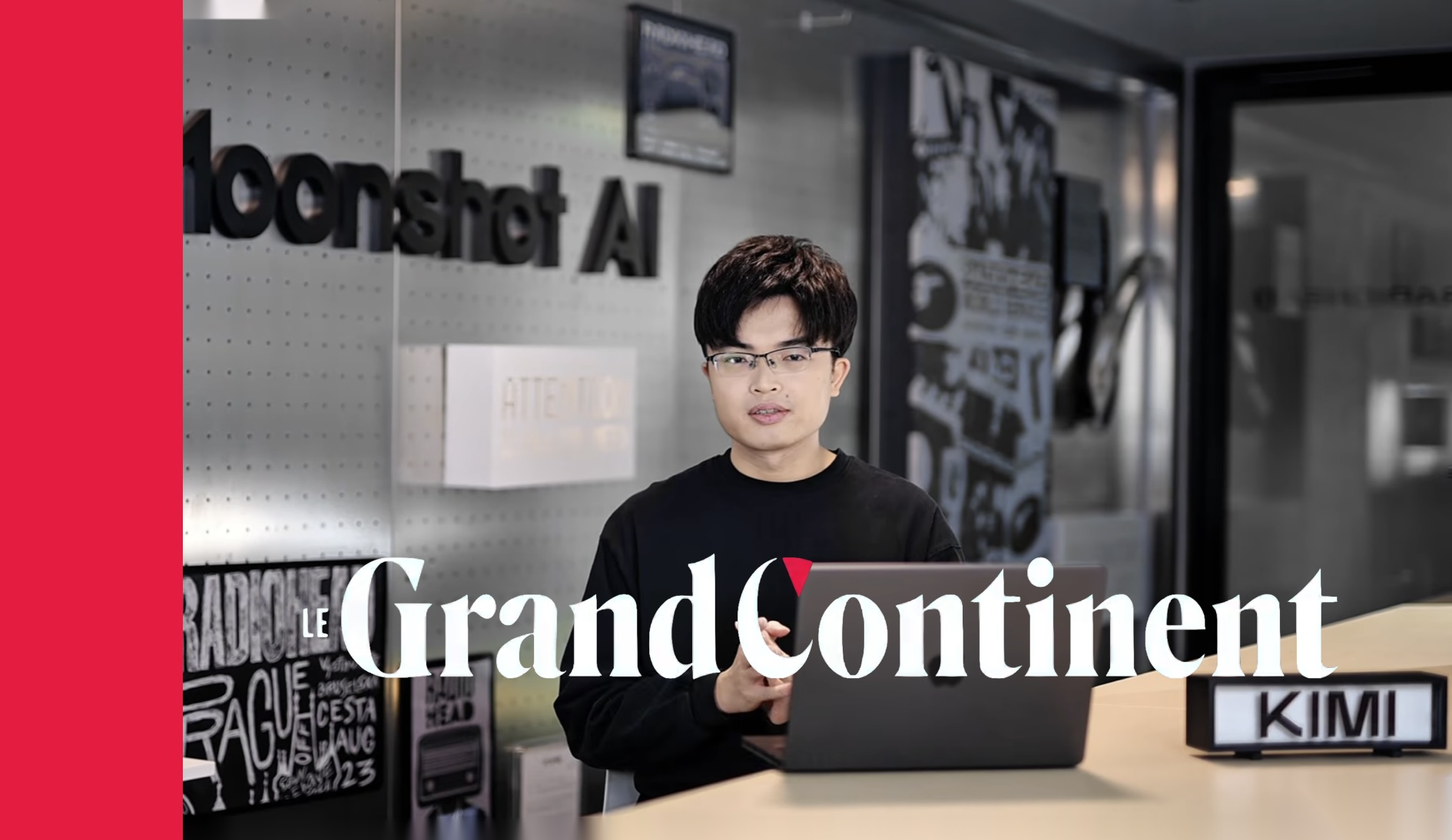
Kimi, the drummer of Splay, is none other than Zhilin Yang, the founder and CEO of the Moonshot AI company. His new Kimi K3 model propelled this open‑source enterprise to the front line of the AI race.
Born in 1992 in Shantou, a city of 5 million inhabitants in Guangdong, he was at the time of this concert a brilliant computer science student in Beijing. Admitted to Tsinghua in 2011 in thermal engineering, he shifted toward computer science, a choice he attributes to reading a Haruki Murakami novel, whose characters code late into the night to bring technology to life. He earned his degree in 2015. He would then pursue a PhD at Carnegie Mellon University, gain professional experience at Google Brain and Meta Platforms, and finally return to China. In 2023, he founded Moonshot AI, which positions itself as one of the six “little dragons” of Chinese AI and, over time, receives investments from Alibaba, as well as from Chinese venture‑capital whiz Neil Shen, Meituan, Tencent, and public‑sector vehicles such as CPE.
Moonshot AI develops the Kimi models—the nickname for Zhilin Yang—up to the launch of K‑3, which plunges a good chunk of the American AI players into a panic, in an atmosphere worthy of “Wake Me Up When September Ends.”
It would be hard to overstate the narrative and symbolic importance of rock in the Moonshot AI story. Yang Zhilin has often said that the moon figures in the company’s name as a tribute to Pink Floyd’s The Dark Side of the Moon, an album whose 2023 founding year marked the exact fiftieth anniversary.
In office videos, Yang presents the AI models with several albums displayed in the background: the 50th anniversary edition of The Dark Side of the Moon, followed by I Might Be Wrong and A Moon Shaped Pool by Radiohead.
The musical references at Moonshot AI do not stop at the décor. The meeting rooms and common spaces at the Beijing headquarters are all named after rock groups: Pink Floyd, Led Zeppelin, Deep Purple, Rolling Stones, Metallica, Queen, Radiohead. “We are a team of scientists who love rock — Radiohead, Pink Floyd — and cinema — Tarantino, Kubrick,” summarized an employee on X in the summer of 2025. “One of the main reasons I joined the company is that the taste felt right.”

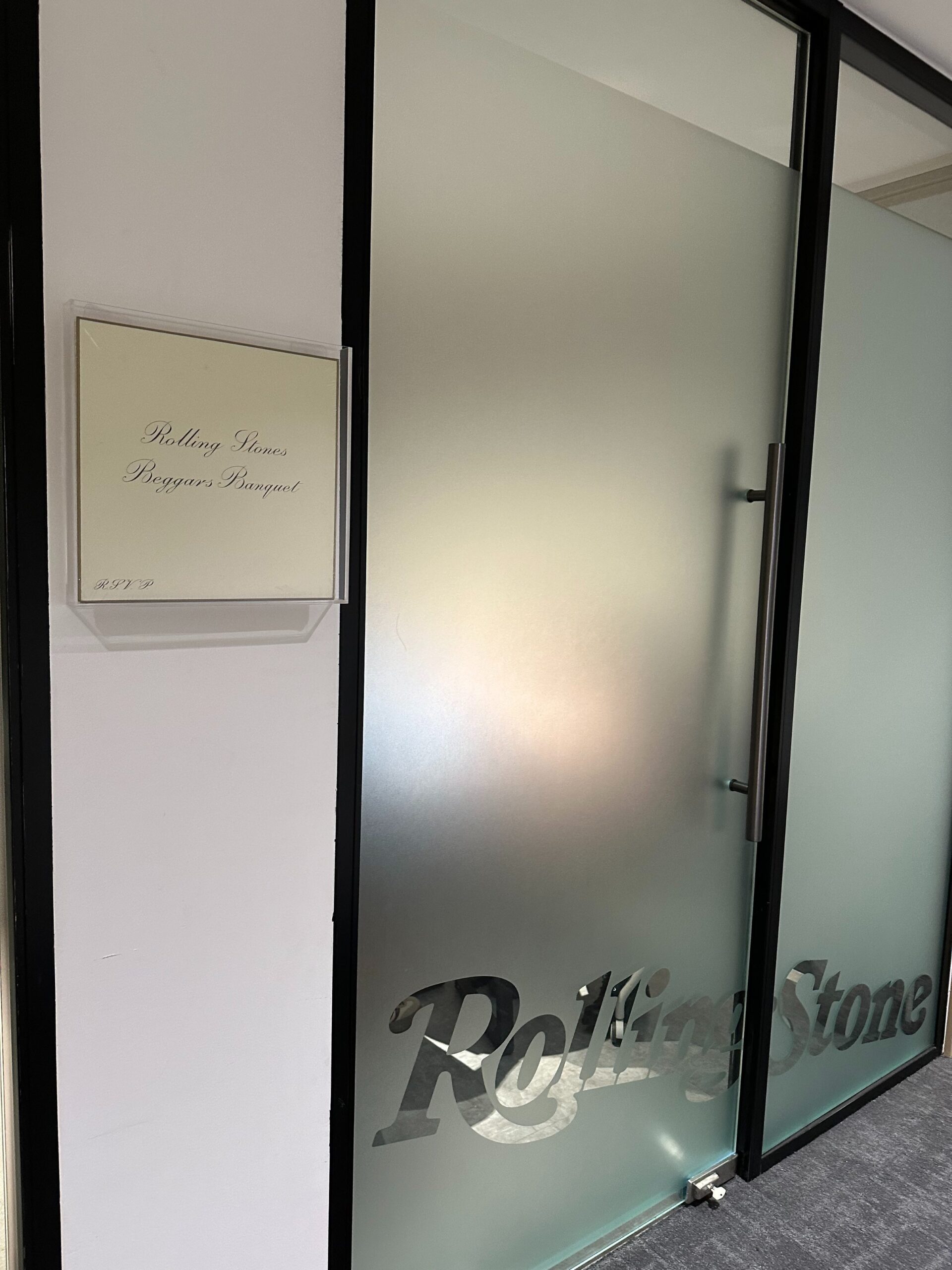

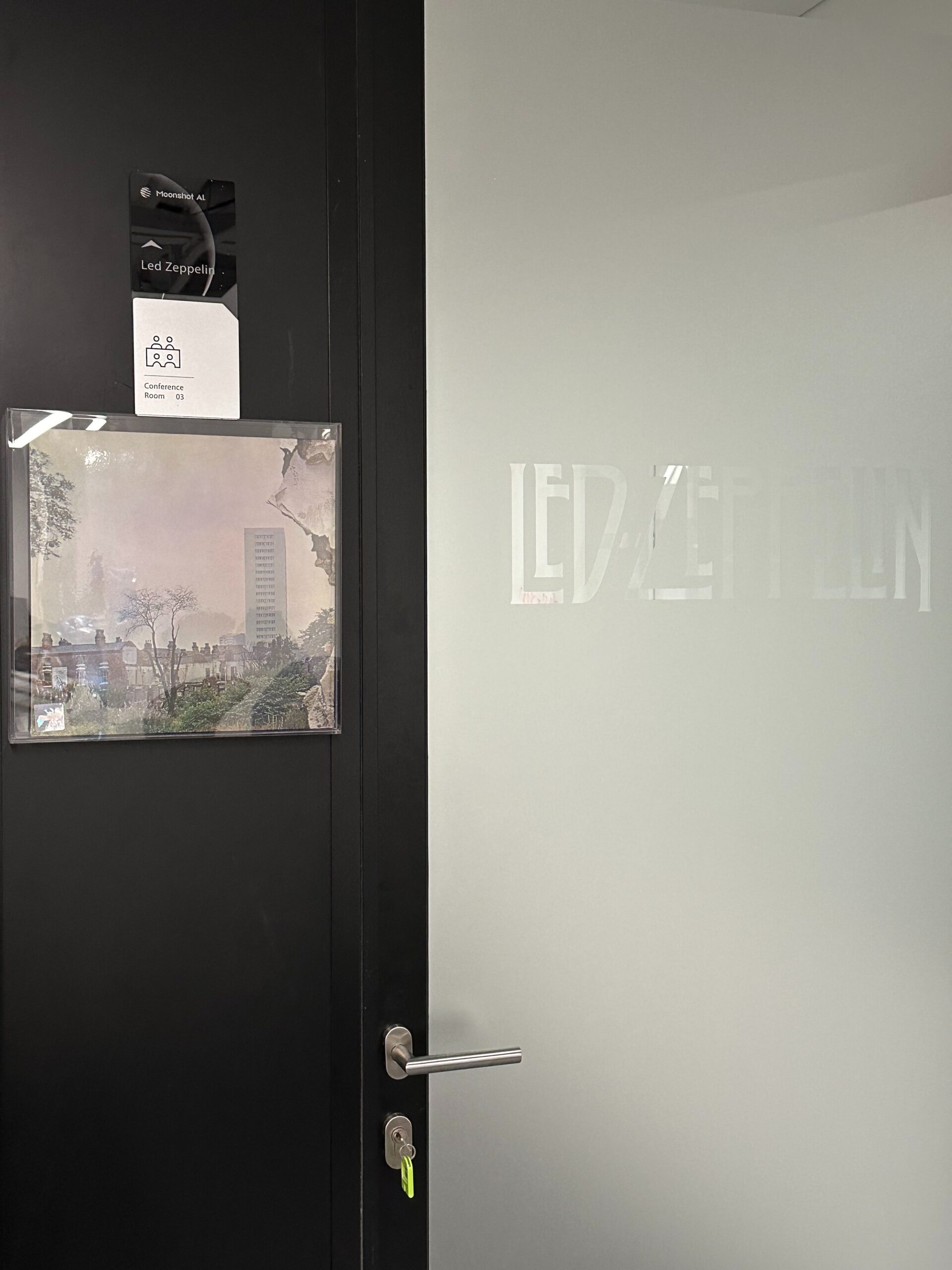
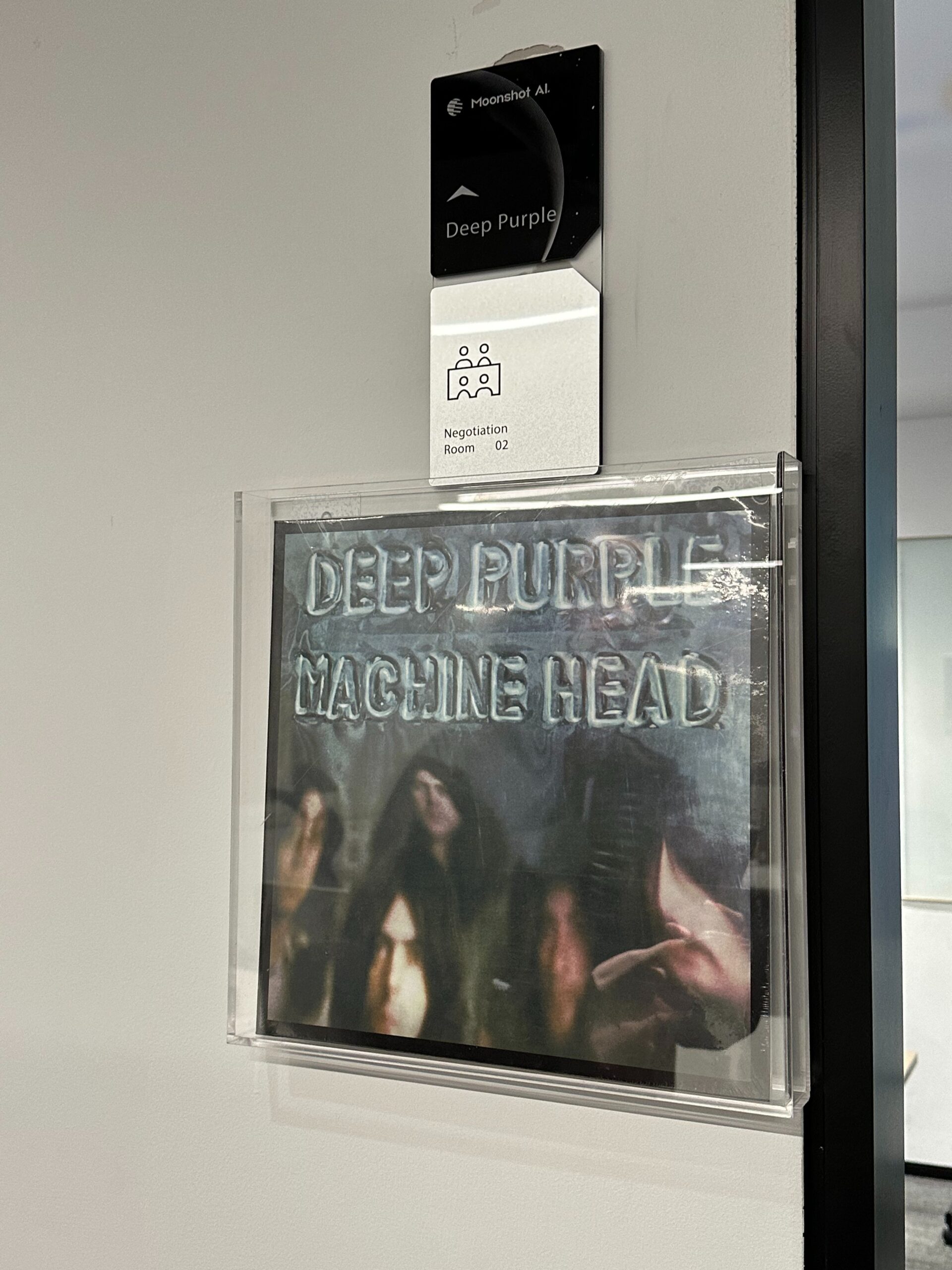
One of these rooms bears a name not found in any discography: Splay, which thus sits among rock and pop classics.

This is no accident: the X profile photo of Zhou Xinyu is a shot from a Splay concert in 2013 at the famed campus festival. Zhou Xinyu is not just another employee: a classmate of Yang Zhilin at Tsinghua’s computer science department, he helped organize campus music contests with him before becoming, ten years later, co‑founder of Moonshot AI, where he oversees system engineering.

These cultural aspects are not superficial details. They are clues that shed light on a fundamental question. If they shock us, it is because they reveal the human depth of young people who enjoy themselves, nurture strong passions, and do not fit the stereotype of little robots controlled by the Communist Party, thinking only of working until they drop.
Yet one should not conclude that Moonshot is simply a music club. Testimonies describe a culture of relentless schedules in a plainly utilitarian headquarters. But it is precisely the combination of computational excellence and a passion for music that makes Yang Zhilin’s myth at Tsinghua—where he was nicknamed “Yang Shen,” “Yang the genius”—not only because he finished at the top of his class, but because he did so while playing the Moonshot drummer of Splay and organizing campus music contests. Taste is treated as a competitive advantage in its own right. As investor Kevin Xu noted: “A culture that embraces not only hardcore technology but also music, art and the humanities gives Moonshot an edge. The frontier AI development belongs to the taste for research—the fusion of the humanities and technology that we had never seen before.”
The American Mirror
These cultural aspects produce another shock, perhaps even more profound.
If one compares Zhilin Yang’s profile with that of Sam Altman, it is hard to argue that the OpenAI CEO is a more interesting figure than the founder of Moonshot AI.
On one side, we have a researcher who has published with Turing Award laureates Yoshua Bengio and Yann LeCun, a programmer who helped invent two major deep‑learning architectures. A young student who chose to study computer science after discovering Murakami and who fully immersed himself in the atmosphere of American universities (surrounded, of course, by Chinese or other people of Asian origin) and who could have continued his journey in the United States, but who chose to return home to found a company (thus to prosper), surrounded by symbols of his musical culture that marked him and his peers throughout his education.
On the other side, a person who dropped out of Stanford to found a startup (thus to prosper), who presided over the most famous startup accelerator in Silicon Valley, and then built OpenAI. Sam Altman has extraordinary talent for raising funds, attracting users and turning attention into revenue. But the day he wanted to prove that he was human, that he had passions or simply taste, he filmed himself cooking pasta with an improbably large amount of garlic, making one wonder whether the man who taught machines to imitate humans can’t imitate humans himself.
Who would you want to be? Whom would you want to imitate?
These are important questions that touch on the story of Chinese talent in the United States and the impact of American migration policies—topics hotly debated in the tech ecosystem during the K‑3 shock.
There is no divine right that a Chinese, Indian, Vietnamese or Indonesian student should necessarily stay and build a career in the United States. Every Asian country rising in the industrial and technological value chain will implement policies to retain or bring back as many students and researchers as possible; and we will see, as is already the case in China, narrative and symbolic mechanisms developed to reinforce this demand, with the particularities of the Chinese system and the role of the Communist Party.
Meanwhile, as recent Pew Research Center surveys show, the soft power of the United States is waning on a global scale.
The American system retains elements of attraction, but significant signals are already emerging: reductions in student visas and career path choices diverging from the past, notably under Trump’s policies.
A MAGA response to this situation would be: “Very well, with fewer Chinese and Indians, there will finally be more jobs for real Americans,” but as Ng has reminded in these pages, that answer would be obviously inconsistent. By weakening its pull, the United States accelerates its own fragility and confirms the prophecy put forward by Wang Huning in the book published a year before Zhilin Yang’s birth: America Against America.
The AI Race and the Mimetic Desire
The power of the story of an AI rock star is thus decisive in a country like China, where the pool of talent, researchers and startup founders is far larger than in other nations, including the United States. For in this race, the scarce resource is not capital or computation, but young people capable of training a frontier model—and a gifted youngster does not choose a career by salary alone, but by imitating the desire of another: by asking whom they want to resemble.
That is why being Zhilin Yang — as being Liang Wenfeng — means something specific in this context, something deeper than the gaps between the Chinese and American systems, in the semiconductor ecosystem or, more broadly, in financial capabilities.
It is precisely in the deployment of this “mimetic desire” and in the competition for talent that the real plot of Kimi’s story unfolds—not merely, or even chiefly, in how it performs against American models, which is only part of the whole.
As several observers have noted, Yang’s case predates the recent shifts in American immigration policy, and this is precisely what makes it troubling for Washington. The Chinese lure that led the founder of Moonshot AI to return home was already at work when staying in America remained the path of least resistance: roughly 90% of Chinese STEM PhDs earned in the United States between 2000 and 2015 still resided in the United States by early 2017. Today that dynamic has reversed. New student visas fell by more than a third between the summer of 2024 and the summer of 2025. In July, Washington ended the “duration of status,” which had allowed foreign students to stay as long as their studies lasted since 1978. At the same time, Beijing opened its K visa for foreign scientific talents, without even requiring a job offer.
Thus a cultural shift is underway, and one can trace it in Moonshot’s most discussed strategic choice: open source. When Yang, after the DeepSeek shock, decides to open the company’s models, he is making a commercial and geopolitical bet, while also leveraging a recognition economy. As engineer Wang Tiezhen summed up: “Researchers want to be remembered for their breakthroughs. Open source gives them that.” While Alibaba and Baidu watched their star researchers depart, torn between frontier research and commercial imperatives, Moonshot AI weathered the fierce talent‑pursuit in Chinese AI by keeping intact one of the country’s best teams, largely composed of Tsinghua and CMU collaborators.
The scene of Kimi’s drum solo reached us thanks to Ruofan Zhou’s site and YouTube channel, a brilliant leader and guitarist of Splay, who lives today in Switzerland and who, on his site, summarizes his passions with a line where, after “I do research and I love…,” five possibilities alternate: code, photography, travel, music, games.
On his Instagram page, photos of mountain landscapes — the Tre Cime di Lavaredo, the Arolla Glacier, the Matterhorn — contemplate the disputes between humans and machines across the Pacific.