
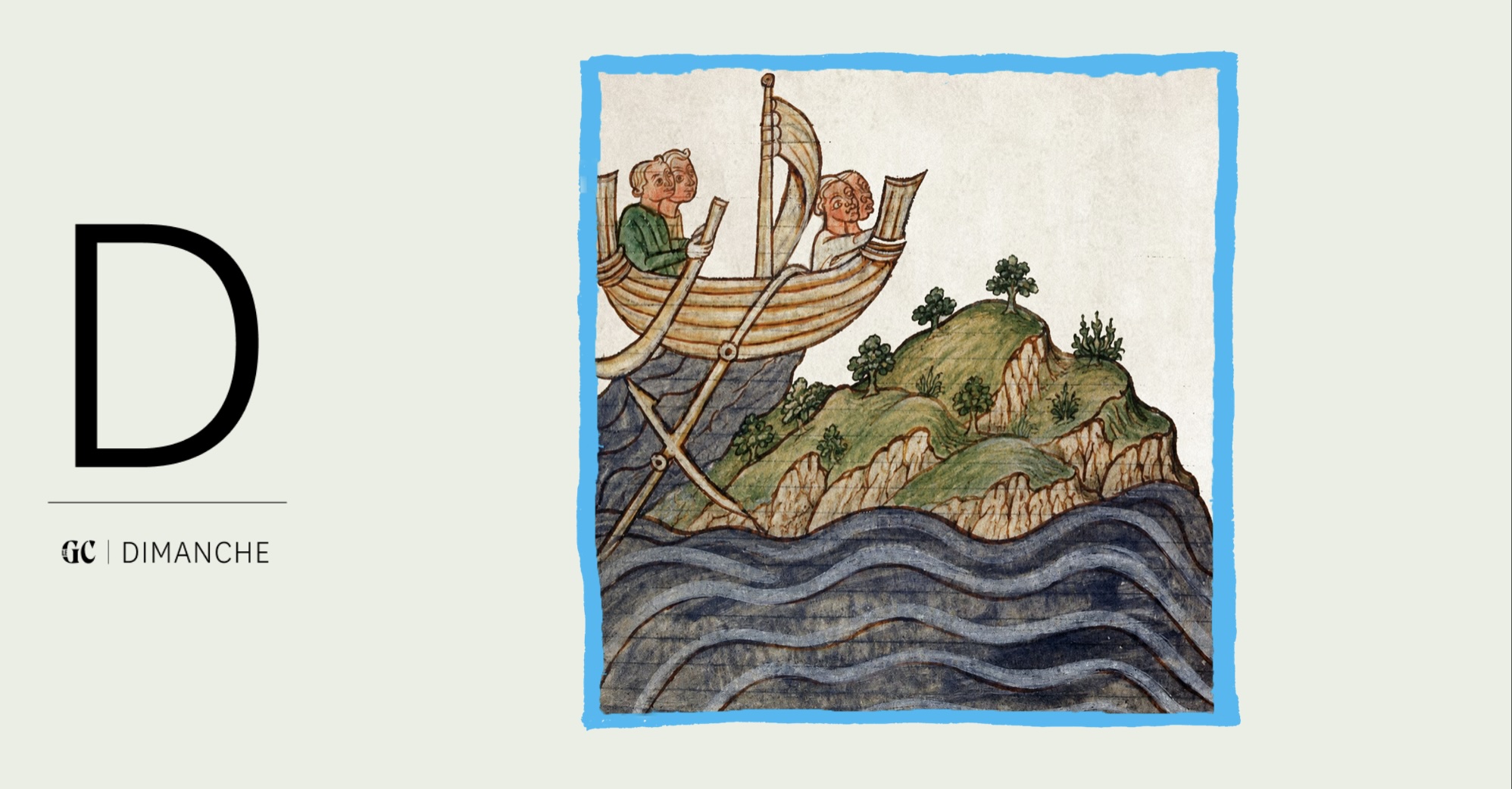
The worst vacation of my life was spent on a Greek island. A Cyclades island, hot, barren, windy, where you can neither run nor drive, where you search in vain for a bar on the horizon, and where the sea, when you want to reach it, must be earned at the foot of cliffs, which, for a man prone to vertigo, feels less like swimming than like a trial by ordeal. I was set there like a package, confined within a perimeter, deprived of any direction to flee. For that is the island’s first betrayal: it promises freedom and delivers confinement. The mainland can be left in a thousand ways; the island imposes itself within a fixed radius.
The sense of displacement remained, the islander’s last consolation. It did not come. This island, in summer, is populated by the majority of France’s audiovisual producers. I found there the same dinners as in Paris, the same faces, the same conversations, with the Aegean Sea as a backdrop. If I had stayed in early September, I imagine Delphine Ernotte’s speech, president of France Télévisions, would have been broadcast on the village square. I wondered whether this island deserved to be renamed “France Televisos.” It was so un-Greek that I bumped into a guy who had been in high school with me, someone I had left behind with relief—the high school and that man alike.
Two lines from poets returned to me among the stones. The first is famous, by John Donne: “No man is an island, entire of itself; every man is a piece of the continent, a part of the whole.” The second, I had just encountered while reading Paul Valéry: “I have sometimes thought, he explains, that if man could not live a quantity of other lives than his own, he would not be able to live his own.” One says that we depend on each other by the exterior; the other, that we depend on ourselves through the detour of the other. Together, they assert that no existence, no culture, closes in on itself like an island. Yet this is precisely what David Graeber demonstrates, in anthropology.
For the great anthropologist, who died in 2020, in his own way, speaks about islands. He criticizes an entire school of thought for trying to confine peoples within closed, airtight, incommensurable worlds, conceptual islands where everyone would inhabit their own reality, without bridges to others. And he answers, in sum, what Donne and Valéry already answered: no one is an island, neither a people nor a man.
After reading and rereading the reply he addressed to his colleague, Eduardo Viveiros de Castro, recently translated under the title The Dead End of the Ontological Turn, by Le Bord de l’Eau, I would have liked to ask him that. Since that is impossible, I decided to do, as Calvino did with Emperor Moctezuma II, interview him anyway. The interview you are about to read is thus purely imaginary, but, I hope, entirely true: it never happened, yet it could have happened. All this, and more, is under his pen and in this wonderful little book from which I have reorganized and drawn out a few excerpts marked by asterisks (*).
I begin with a confession, David Graeber. I hate islands. I feel placed there, assigned, imprisoned within a boundary. A simple vacation neurosis, or is there something more serious at stake?
Something serious, and that fascinates me, because it is exactly the problem I address in The Dead End of the Ontological Turn, but at the level of ideas. My theoretical adversaries spend their time building conceptual islands. They claim that each people inhabits a closed world, an “ontology” of its own, separated from ours by an impassable boundary. They want us to talk not about people who have beliefs or perceptions radically different from a shared world, but about people who literally inhabit different worlds. There, the island is raised as a method. Your vacation malaise and my disagreement as an anthropologist share the same object: confinement.
Summarize the dispute in a single sentence. What, at bottom, separates you from the anthropologist Viveiros de Castro?
A principled position, almost symmetric to his. I am an ontological realist and a theoretical relativist. I believe there exists a real world, a single one, that we will never fully know, and I place the highest value on the diversity of ways—often incompatible—of thinking it. He does the opposite: he multiplies worlds and freezes the ways of speaking about them. Where he sees separate ontologies, I see a single reality and a thousand theories. The difference is not minor, because it determines what an ethnographer is entitled to say.
You yourself went to Madagascar as one goes to a distant island, in search of an absolute outside. What did you find?
The opposite of what I expected. I went to Madagascar expecting to encounter something like a different ontology, a set of ideas fundamentally different about how the world works. Instead, I met people who doubted. Who admitted that they did not really understand the ins and outs of their own magic, spoke contradictory things, and mostly agreed to regard most sorcerers as liars, crooks, or impostors. The island of radical otherness I had been promised did not exist. In its place, interlocutors as skeptical as I am.
They sold me this Greek island as an elsewhere. I found Paris there. Geography said it was connected to nothing; in fact, it connected to everything I wanted to flee. Chance?
Rather, a law. An island is never a bubble. Take Malagasy medicine, the fanafody, which I had believed to be purely local: The fanafody has always been a form of dialogue with a larger world. It continually integrated objects and ideas from elsewhere, fragments of Arabic writing, trade beads, money melted from Austrian thalers. Madagascar had, since the initial settlement, been a center of commerce and migration: the most remote island in the Indian Ocean was a crossroads. Your island merely states it more bluntly: there is no outside separated. What you call the continent’s contamination of the island, I call the normal condition of all things.
Paul Valéry wrote that man could not live his own life if he could not live a quantity of other lives than his own. Is that what the anthropologist, and, in his modest way, the traveler, do?
That is the heart of my craft, and the heart of my disagreement. There are two ways to unsettle our categories before the foreigner. Are we unsettling our categories in order to (1) better understand the radical alterity of a specific group of people; or (2) to show that, in at least some respects, this alterity was not as radical as we thought, and that we can use these seemingly exotic concepts to reexamine our daily assumptions and to say something new about human beings in general? I am, of course, in favor of the second position. The greatest achievements of anthropology have arisen from this gesture: daring to ask but aren’t we all, in a sense, totemists?, isn’t war a form of ritual sacrifice? Living another’s life, in Valéry as in me, is not to lose oneself: it is to return with a clearer view of one’s own. The other is not an island to visit; it is a detour through which one returns home.
Your opponents would say, though, that by refusing separate worlds you disrespect the peoples, that you drag them back into your own world.
That’s the accusation, and I turn it around. It is they who lack respect, by locking people into categories that are often arbitrary. Do they really believe that most of the people we study would agree with the proposition that they live in a fundamentally different “nature” or “ontology” than that of other humans? Philosophically placing someone on an island is not an honor. The problem with cultural relativism is that it puts people into boxes not of their own making, and ontology merely deepens that. Some people like deep boxes. But we must respect the desires of those who want their boxes to be less deep, or who do not want to be boxed at all.
So you extend the image to the limit: even on an island, between two neighbors, there would still be distance?
Yes, to the ultimate, and that is my deepest conviction. If we define reality as what always escapes our descriptions, then radical otherness simply means reality. But beware: the real is not the same as nature. We will never fully understand cultural difference because cultural difference is real. Yet likewise, no Iatmul, Nambikwara, or Irish-American will ever fully understand another because individual difference is also real. Each person is, therefore, a bit of an island for their neighbor, not because they inhabit another world, but because they are real—i.e., unpredictable.
So what binds us if not a ready-made shared world? What do we share, a Malagasy and you, me and a Greek islander?
The recognition that we do not understand. That is where I differ most from my peers. What we share is not a common knowledge, but a shared ignorance. The expression I have almost certainly heard most often when people spoke of spirits was simply “I don’t know.” The spirits were by nature unknowable, and that was not a shameful confession but the common ground of the conversation. Because it makes more sense to define reality as precisely what we can never fully know… The only things we can have absolute and complete knowledge of are those we have invented. That is what links the islands: not a common land beneath the sea, but the same abyss underfoot, the same fog. We are all in the same boat. A pretty image for a man who hates islands: salvation is not in the island, it is in the boat that moves from one to another.
Since you refuse to treat magic as another world, let’s settle it: can Malagasy charms stop hail?
That is the dangerous question, and I will take it seriously, because my realism has a price. If we can say that some propositions are false, we can say that others are true. So: being able to say that certain forms of magic do not actually work allows us to say that other forms of magic do work. So, and if Ravololona could genuinely prevent hail from falling on crops? I lean toward no, I stand with the skeptics when a verdict must be rendered. But I do not turn it into a dogma. For magic is indeed a claim of power. It is a claim of power that plays with the limits of our knowledge. Treating every strange utterance as the window of a closed world disturbs no one: it protects us from the uncomfortable question, namely whether, perhaps, they might be a little right.
One last word. If I had to draw a moral from the holidays of your anthropology, what would it be?
That “an idea that is not dangerous does not deserve to be called an idea,” as Wilde puts at the head of my book. So hate the islands if they oppress you. But hate them for a good reason: not because they would be too other, but because they lie in claiming to be separate. No island is an island, and no person is entirely either. We are not held by a shared land nor by a separate world: we are held by the passage from one to the other, by the boat, by the detour. Perhaps that is, in essence, what it means to live other lives in order to live one’s own.
We did not part ways, Graeber and I, because I only leave the living; the dead never leave me, and I often think of that man who had appeared to me as a Mick Jagger of anthropology. But I digress; Jagger is not a man, for Jagger is immortal.
If I may offer a pointed conclusion, this dizzying fondness for stones surrounded by water has a political translation: to make people believe that there exist politically “islands” that are permanently separated from each other when, in reality, there is a continuum, a great continent, if you will. And I leave the final sentence to Graeber, even if it is not customary to end a piece with a quotation: “In my most cynical moments, I find that sociology (social theory) is a kind of game, where one of the aims is to see who can find the boldest, the most shocking, the most dangerous-looking idea, yet one that does not significantly undermine the existing structures of authority.”