
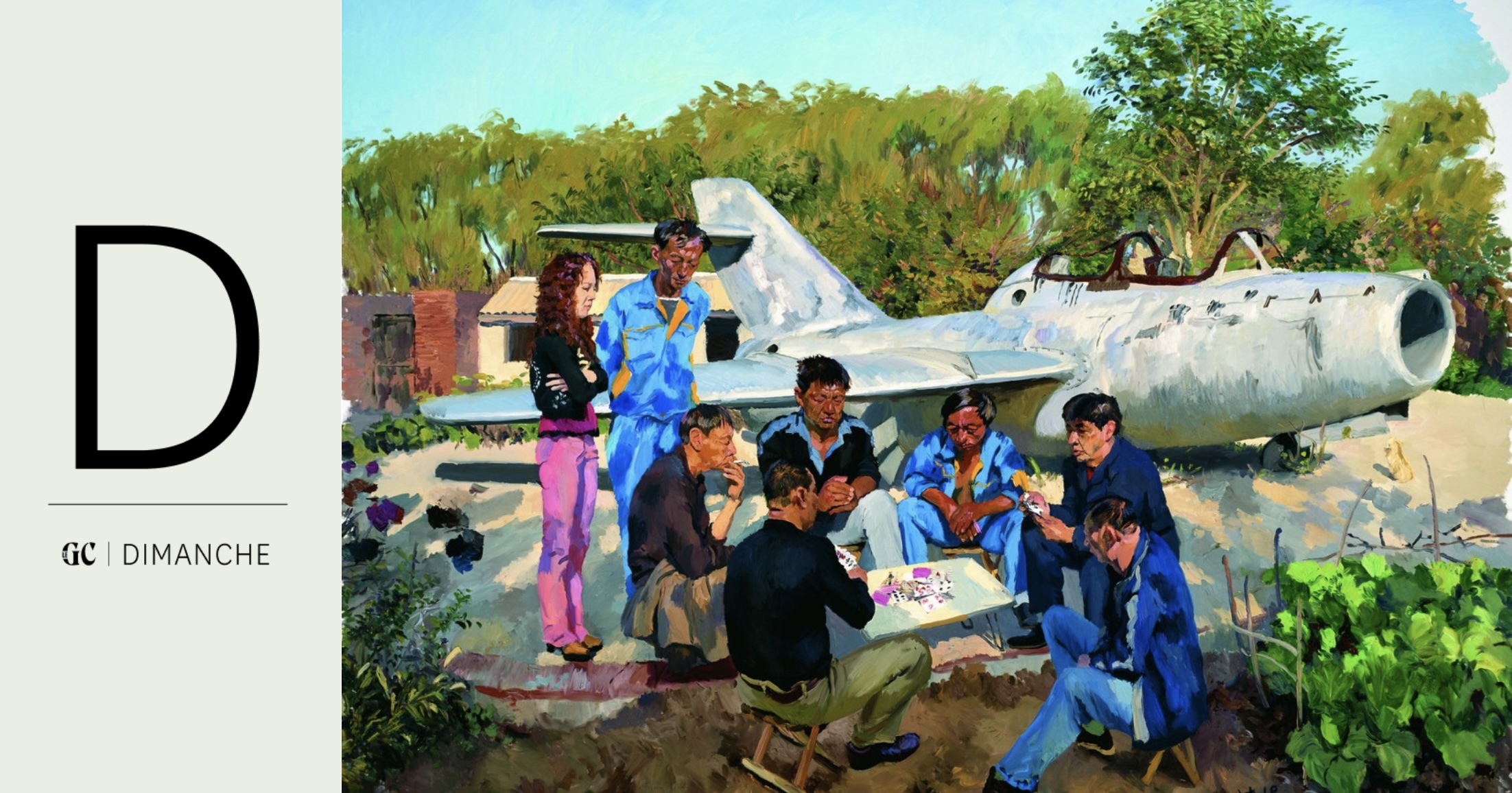
The painting rests on a contrast: in the background, the wreck of a Soviet airplane; in the foreground, a few people absorbed in their game, with no one making a move to connect the group to the lifeless machine.
The airplane is a dated, identifiable object steeped in history. It stands here for imported industrial modernization, the alliance with the USSR. It is now immobilized, but has not been removed; it blends into the landscape until it becomes an ordinary element. The title itself plays with this shift. “Airport” signals a place of transit, of movement, a sign of prosperity and economic development. Yet what we see is a wreck, an abandoned plot overgrown with vegetation (nature has reclaimed the space after a failed modernization) and people sitting.
One could read it with melancholy, but the green is precisely not the color of abandonment.
And that is where the attitude of the figures strikes. They do not look at the airplane, nor at the landscape, nor at the painter. Their attention is wholly absorbed by the game; there is something joyful and alive in their manners and in the quality of the light.
The clothes say the same thing: worn and mismatched garments, the casual leisure attire of the man seated next to the woman on the left. And yet, there is no awkwardness in their postures. They occupy their space with total ease, which speaks to the resilience of the Chinese people and their ability to say: “I will have my fun, no matter the stupidity that the world hands me.”
This painting was painted by Liu Xiaodong in 2010, at a moment when he was already wealthy and famous. We are in China’s Rust Belt; the images speak of a shortage — of work, of money, of things to do, of almost everything — but despite this, everything is bathed in a benevolence that is not nostalgia, but a willingness to understand and to see the other. It is the result of his stated theme, “how to see people,” which compels him to paint these individuals as they are at the moment he looks at them. It is the same discipline he applies elsewhere, in Israel-Palestine or at the Tex-Mex border.