
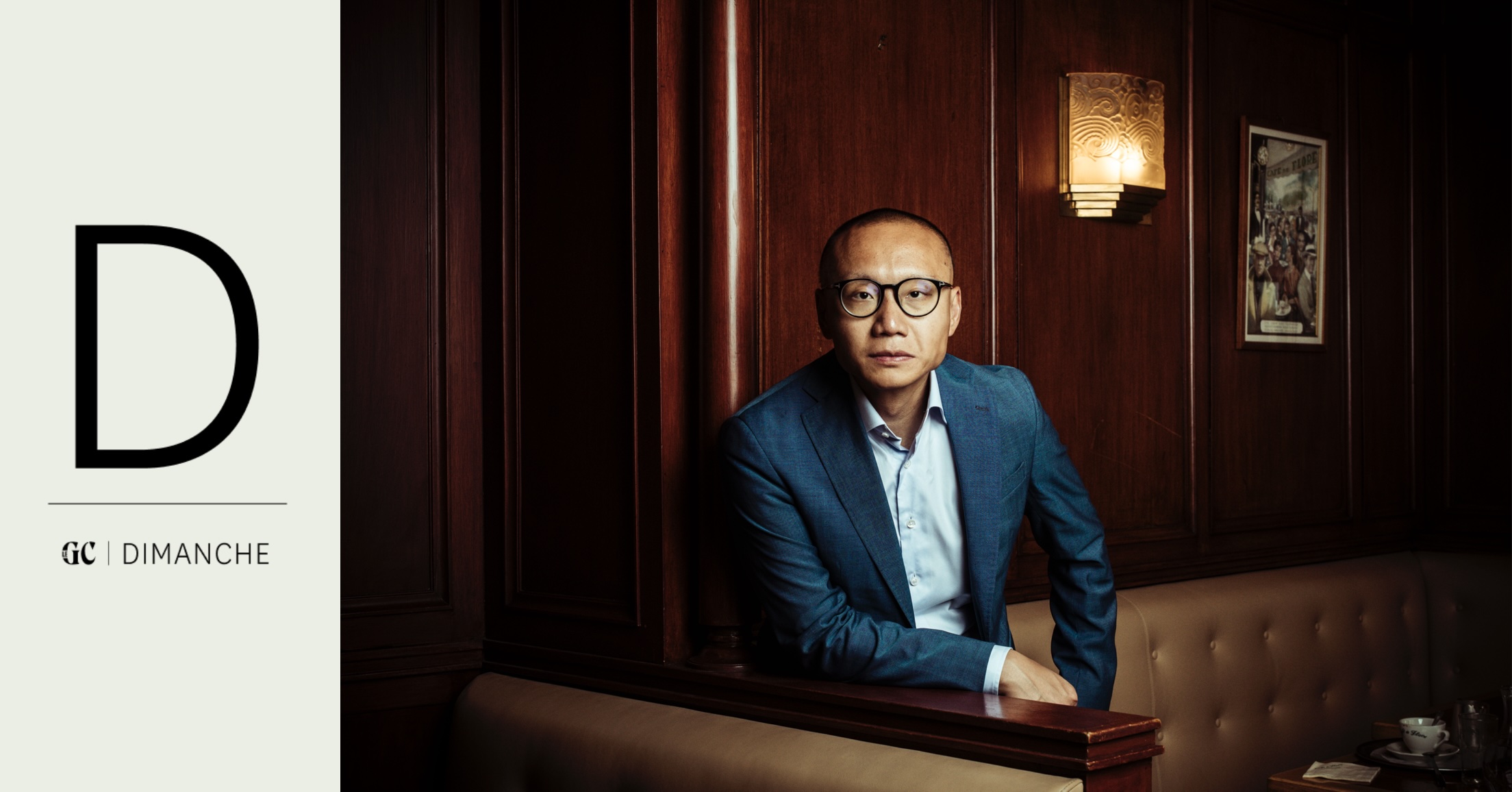
You can’t reserve at Café de Flore. But how could we have known? We only go to Flore reluctantly, when friends come to Paris from the United States or China. That is to say, almost never. Or precisely in the case we have today.
Between Dan Wang.
Born in Yunnan, raised in Canada, now based in Michigan, a fellow at the Hoover Institution, the Stanford-based conservative think tank, Dan Wang is the author of Breakneck, the book on China and the Sino‑American rivalry that has been the talk on both sides of the Pacific since 2025, and which has just appeared in French from Arpa under the title La Chine à toute vitesse.
Since we cannot reserve, we arrived a little earlier. We walked quickly past the terrace jam-packed with tourists dressed as Parisians, taking photos of their coffee, croissant, and berets, then retreated to the first floor.
A waiter kept us in line when we pretended to pull out a laptop. “We don’t work here.” He set on the table two orange juices, an espresso, a café crème and an Americano.
Disneyland in Paris
“I’m having a wonderful time in Paris. But I don’t understand how there can be so many fashion and luxury shops. Who buys all of that?”
The conversation starts exactly where we wanted to steer it.
It was almost the last time of the afternoon that our plan would work. It had been meticulously laid out. To lure him here, to Flore, just a few meters from the Deux Magots. To expose him to these two monuments of Parisian intellectual life that, in a few years, have become theme-park attractions, framed by Louis Vuitton shop windows.
But we didn’t really want to hear him talk about China rapidly refashioning its storefronts, nor about Americans occupying the terraces as if they were holding a bridgehead.
We wanted to know what the ghosts of this place whispered to him. And that is where this perfect plan began to derail.
Had he read Sartre, who wrote just a hundred meters from here?
— Not really.
Did structuralism, Lévi‑Strauss, serve him?
— No.
Derrida, Bourdieu?
— No, no.
We go all in. The famous French Theory that conquered American campuses?
— Meh…
— Foucault, after all?
“My wife will join us in an hour. Foucault is very important to her. I’ve read a bit of the History of Sexuality, because she made me. ” He smiles without apology. “For me, French is much more the France of my Canadian childhood. My mother’s favorite novel is Le Rouge et le Noir. It’s also my favorite… I grew up reading a lot of Le Petit Nicolas. ” Then, with a perfectly classroom‑like accent, he adds: “I speak a schoolboy’s French. I studied a lot, but didn’t really practice.”
Dan Wang studied philosophy, but he insists he chose logic and aesthetics, Russell and the Brits. “If I were to trace a genealogy, it would be Adam Smith, someone who described a world in transition. I was drawn to those who wrote clearly, and I cared less about the continental way of doing philosophy.”
That stuck with him: “When I open the opinion pages of French or German papers, I often find theory rather dull and leftism very predictable. It isn’t contemporary, it isn’t fresh. The Brits publish things I much more often want to read.”
He is criticized, he says, for not having written the grand integrated theory of Chinese history, politics, and technology. “I think that’s a strength. If I’d written that book, no one would read it, not even the experts.”
Yet, we object, a little puzzled, he cites Tocqueville. He looks at us. “That’s not the same thing.” What he shares with the author of De la Démocratie en Amérique is mainly a method, which for him can be distilled into one sentence. “Read, then travel, travel, travel. Go to the poor, mountainous countryside of China, then come to Paris and dine admirably.” He explains that he was recently in Salzburg to hear Messiaen’s Turangalîla-Symphonie and that he makes it a point to visit Europe at least six times a year.
“I don’t see enough intellectuals who travel. I don’t see enough people from the San Francisco Bay Area traveling. From this point of view, it’s the worst segment of American elites—they never leave the Bay.”
A Theory of Travel
Dan Wang is a man of two worlds, two rival worlds.
But above all he is a traveling intellectual. “The integration of people’s experience into theory. That’s my specialty. There needs to be enough knowledge, integrated with a wide world seen; that’s what we need most today.”
We ask him: if he does not like theory, does he have a theory of travel? A method? He doesn’t think about it long. He never travels without a history book that serves as a key, a chemical revelation.
Before this Paris stay, for example, he had read Eugen Weber’s La Fin des terroirs, Peasants into Frenchmen in English, the 1976 classic about deep France in the longue durée. “Do the French still read it? I found this story of a country with an ancient monarchy, sophisticated and highly centralized in Paris, that did not really control its own countryside until the end of the 19th century, remarkable. We meet a peasant woman who had never heard the name Napoleon in 1904. Soldiers in the trenches of 1914 who did not quite know that their grandfathers had lost against Prussia. The French state did not see its peasantry.”
Isaiah Berlin divided thinkers into two families, the foxes, who know many things, and the hedgehogs, who know one great thing. Dan Wang is evidently a hedgehog. Everything about him—the readings, the travels, the noodles of Yunnan, and the peasants of Eugen Weber—ends up serving the same obsession: to understand the Beijing–Washington rivalry through the people who make both countries, their elites and their engineers.
Thus he draws from Weber questions he would not have unearthed elsewhere during his short stay. “France helps me understand the Sino-American dynamic because France was an engineering state, like the United States. The French avoided some major Anglo-Saxon mistakes. They built housing, and today they have roughly fifteen million more of it than the United Kingdom, with the same population. France has the TGV, nuclear power plants.”
Then he adds: “But something broke. The last plant took twelve years to build. It’s in the global trend, but it’s bad. It’s very bad.”
“We don’t eat an electric car”
We will return later to the place France and Europe occupy in Dan Wang’s world. We first want to explore this intuition. Travel is his way of life, because, at heart, through his work he constantly tries to connect what everyone separates.
Yes, the Chinese technological and industrial leap is dazzling. He has documented it for years from Shanghai and Beijing, and his data lists have become almost proverbial. “China installs more solar in a year than the United States did in all their history. It builds twice as much solar and wind capacity as the rest of the world combined. The cement it poured in two years is almost equal to what the United States produced in the entire 20th century.”
The resulting industrial machine crushes everything in its path through exports. China’s manufacturing surplus last year reached about one trillion dollars, or one percentage point of global GDP, and it does not drop. “China tells everyone: we have German-like quality at Chinese prices, why not buy? And it counts on consumers to press themselves against protectionism. I’ve heard the protectionist song for a long time. So far nothing has happened.”
And yet, the writer who opened a crack of enthusiasm for the Chinese model in Silicon Valley is now less convinced. He sums up his turn with a line: “We cannot eat an electric car.”
The author who used to say that the United States is a country of lawyers and China a country of engineers now offers an almost symmetric thesis, just as persuasive. “In the coming years, China will excel in one thing: it will continue to develop advanced manufacturing, i.e., the whole range of cutting-edge technologies. But that will not be enough to decide the whole field; the United States has many other advantages. The Communist Party has not produced a vision of human flourishing that is attractive to the world, nor even to its own people. The United States, by contrast, keeps everything else.”
The two truths coexist. “The economy and the political system are in bad shape, and at the same time technology advances. Think of Stalin. He sent his best mathematicians to the gulag and still obtained technical advances and extraordinary weapons. The model, at heart, is simple. More money for science means more science. The Chinese are increasing their scientific budgets. The United States, meanwhile, cuts those of the National Institutes of Health. It starts to weigh.”
The Oyster and the Elite Theory
Then comes the core of his conviction, and the part of the conversation where it is he who asks us questions, notebook wide open.
He must measure how much this conviction goes against the grain. We are a few days from the triumph of the far right in Saxony-Anhalt. More and more people in the West are calling to close borders. Trump’s America sends away, Europe hardens its stance, and from London to Berlin the migration question dominates elections. It is precisely the moment Dan Wang chooses to defend the inverse thesis. According to him, civilizations that win are those that absorb outsiders, and the question is not how to stop migrants, but who will turn them into talents.
In the end, his elite theory resembles an oyster theory. A living elite absorbs the outside, incorporates it, transforms it into nacre, and allows itself to be transformed by it. “Take the British elites. When a family was ruined, they married American women from Ohio. The British aristocracy almost killed themselves during World War I; I think that’s where elite mortality was highest. But they renewed themselves. And look today. A Conservative Prime Minister of Indian origin, a Tory leader of Nigerian origin.” The very resentment itself serves as proof. “If you see such a backlash against Indo-Americans, it’s because they have done so well in business and in Silicon Valley. It’s a bit like Jews in the 20th century.”
Then, turning to us, he asks the provocative question. “Among the French, people of color succeed only in football, sports, and entertainment. Where are the Arabs, where are the Blacks, elsewhere? And where are the Chinese in French society?”
We mention Hong Wang, that mathematician who studied at Polytechnique before going to claim her Fields Medal in the United States. He wants to know exactly when in her career she left. He looks at us like a doctor who would discover the symptoms of a deadly disease: “This is actually a big problem for France.”
We press on. His wager seems historically grounded but can it survive the political pressure of late globalization? We object that in any democracy immigration is now one of the central political issues, and the model he describes, that of elites fed by foreign talent while peoples vote against or retreat, looks like a machine for creating backlash.
He does not deny the cycle, but he downplays its reach. “The faucet has opened and closed. The United States has completely halted immigration several times in its history. But there is a history—the Anglosphere—that renews itself through immigration for centuries, and American elites themselves believe in this model.” He adds that polls show Americans are “more favorable to immigration than ever, precisely because of the administration’s policies.” He notes a detail that amuses him. “Look at the composition of Reform UK and the MAGA movement, the share of people of color you find there. It’s interesting in its own right.”
His conclusion rests more on a physical law than a political program. The migratory tide is so powerful that right-wing parties can press the brakes, but they will not stop it, and for countries that attract talented immigrants, that is probably a good thing.
And that is where China again loses.
China, for its part, is the quintessential closed shell. “Ireland, with six million inhabitants, hosts one million immigrants. China, with its 1.4 billion people, hosts only one million.” The country that claims to organize the century attracts, in absolute terms, as many foreigners as a peripheral Atlantic island. For him, the verdict is unequivocal. “People don’t want to live in China.”
There is no Chinese dream
China offers a logically untenable model. No mercantile empire survived the disappearance of exchange. A mercantile empire that makes everything and does not need to import anything ends up destroying trade.
Does the same hold for ideas? From here, his contemporay culture retains something strange, an empire turned inward, which America, even in crisis, never is.
Dan Wang does not contest this diagnosis; he even intensifies it by citing a recent intuition from Branko Milanovic. Where are the Chinese who write about the rest of the world? “There are a lot of Chinese and Sino‑Americans who write about the United States, a few Americans who write about China. But Europe, Nigeria or Brazil seen from China? That would be an interesting perspective. It does not exist.”
“The Chinese look inward only. They don’t have a real worldview. What they want is to subdue the adversary, to ensure the South China Sea belongs to them, to keep the barbarians at a distance on all their borders. Realize the Celestial Empire. And the only thing they really sell to the world is to join the Empire to get cheap cars.”
A provincial empire, then? “Yes, that’s a good definition.”
But will material power someday produce cultural power? China’s soft power, TikTok, and cultural productions that are beginning to export themselves, will they ever match the allure of the American model? His answer comes quickly: “Of course not. It will never rival them. The Americans have known and continue to have extraordinary success. Hollywood remains sexy. Almost every city you can name in the United States has sex appeal. It’s not only Los Angeles, New York or San Francisco. It’s also Detroit. America has managed to make even its dead cities desirable.”
The Energy of Donald Trump
The Churchillian chief of staff once explained victory this way: “We won because our German scientists were better than their German scientists.” One could almost transpose that sentence today. America has dominated this century as long as its Chinese engineers were better than Beijing’s Chinese engineers.
Nothing is guaranteed now. Just open Kimi, the Moonshot Beijing lab’s AI model, which competes with the leading American systems at a fraction of their cost. The Chinese engineers who returned home are no longer second‑class players.
Are their Chinese engineers better than our Chinese engineers?
Wang hesitates. He offers a conclusion that does not please him. “The Americans tried very hard to curb Chinese AI. Those efforts failed. It’s not something I am particularly happy about. The Chinese train models at the level of Anthropic for a fraction of the cost. Some tell me that using them costs 3% of the price of American models. And with lower‑quality semiconductors. It’s neither cheating nor stealing. It’s the infrastructure, cheaper energy, a massive pool of engineers, utterly ruthless competition in every sector. China practices capitalism more effectively than the Americans.”
If nothing is less guaranteed, isn’t it also because Donald Trump sabotages the mechanism from the other end? Wang does not deny it. “It’s obvious that Trump harms the United States in all sorts of ways. He expelled Korean engineers who were building factories…” He lengthens the list. The Indian immigrant turned public enemy number one, “perhaps the Chinese in number two,” an elite turned into a dynastic court where the Russian oligarchy’s felons could be spotted at Don Jr’s weddings.
Why is he so confident then? Isn’t it paradoxical, coming from the man who wrote the harshest book about America’s inability to build, to be now so confident for the United States?
We test a hypothesis on the spur of the moment. Breakneck described an America that ends not with a bang but with a whimper, in a procedural groan rather than a spectacular crash. It was the America of Joe Biden, of a hidden senility, hesitant, ashamed. Trump is the opposite. He may have accelerated the decline, but he has mainly turned it into a bang. And the noise, in Wang, is a sign of life.
Perhaps that is the deepest key to his American optimism, and the most foreign to European ears. Where we see only alarming chaos, he sees evidence that anything is still possible. American democracy screams, tears itself apart, insults itself, violates what it voted for in the morning, and this spectacular racket, which exhausts observers, is, to him, the sound of a society still fighting for its future. “As long as it isn’t a civil war, it’s a living dynamic. There is energy.”
Even the resistance of institutions makes noise, and he tells us this with a sly pleasure. The Supreme Court rendered “major decisions against the president’s campaign promises. It’s unprecedented.” A country where power is loudly contested is a country where power is still alive and contestable. The absolute contrast is the Chinese silence. His advanced hypothermia.
The American Dream under Trump
“This may not be very popular to say in these pages, but I’m actually quite optimistic about the United States.”
He tells us another anecdote, another travel tale.
At the start of the year, he spent about ten days in Phoenix. It is there that TSMC, the Taiwanese semiconductor giant, the manufacturer of the world’s most advanced chips, the ones without which there would be no AI, no missiles, no phones, installed the largest industrial project in recent American history. A total investment of $165 billion, factories rising from the sands, and an expansion still announced in July. Wang went there to do what he always does—open his eyes and spend his days with the engineers.
“The Taiwanese send thousands of engineers to teach Americans how to make chips.” One must grasp the strangeness of the scene. The most threatened island in the world has decided to relocate its most precious know-how to its protector. Its best engineers cross the Pacific to train American workers in a country that was supposed to stop knowing how to build. “And these engineers live there. They shop at Costco. Women have a lot more freedom. Their children go to Stanford. They are well.”
He pauses on this image: Taiwanese families in the aisles of an Arizona hypermarket. “There is still a vision of the American dream that lives. And I found myself asking: what other country could do this?”
The Century of European Humiliation
The question is not rhetorical. It obviously applies to us. And we are going to pay the price.
The Chinese have a name for what happened to them between the Opium War and 1949. The Century of Humiliation, a hundred years of enduring others’ technology, watching distant powers redraw their economy, forcefully opening their ports, installing their trading posts.
All of modern Chinese politics is built on a pledge: never again. And the irony of the conversation taking place in this café, between Louis Vuitton shop windows and American tourists, is that the situation is being repeated, with Europe cast in the wrong role.
Dan Wang states it without cruelty, enumerating the fronts. “I see Europeans waging this battle against Chinese industry and against the Americans at the same time, and losing on all fronts.”
To the east, there remains the industry. “China is now at 95% of German quality but a third cheaper. In a few years, it will be at 120% of German quality, still cheaper. What will European industry do then?” In his view, the question of its survival is no longer a taboo but merely a matter of degree. “Can Germany survive the destruction of 30% of its manufacturing sector?”
To the west, everything else. “Americans outclass European firms in AI, software, and financial services.” The trading posts of the new century are not port concessions but language models, data centers, platforms, and battery factories, and Europe has almost none of them.
And so?
Europe slides toward the only model left when you have lost the factory and the software. Nothing happens except the place. While traveling in Vienna, his wife’s city, he found the word that resonated: “the mausoleum economy… I saw all these Mozart‑clad people in ridiculous suits taking you for a ride in a carriage.”
During his stay in Paris, he observed something he explicitly asks us to weave into the interview, though it is harsh, as often the exact things we don’t want to see are. “What strikes me—and you must write this down—is Paris’s restaurants. These are prices that only Americans can truly afford.”
When the prices of a capital align with the purchasing power of its visitors rather than with the locals, can we say the city has already changed its function?
He continues, even colder: “Europeans have optimism only for the past. The Second Empire, the Trente Glorieuses, the Habsburgs. The Chinese and the Americans, they still think about the future. They are the two only great powers that do. They have these visions, they try to implement them, imperfectly, but they retain a sense of optimism about the future.”
The Gentle Enemy
Is it time?
We look at this forty-year-old man on the first floor of Flore, between a finished orange juice and the ghosts of all the masters he has not read, and we understand why it was necessary to have this particular café.
Dan Wang is interesting not because he embodies China, or America, but because he embodies what lies between them. Their rivalry and therefore also their shared culture, imperial, totalizing, ambiguous, limited, provincial, irresistible.
Born in one, citizen of the other, left the first twice (the first time against his will, with his parents; the second very willingly, he demands pluralism, he demands debate).
Does he agree with that? Does he feel he is the child of their clash, as others are the children of a marriage?
He thinks for a moment. He searches for a phrase to serve as a moral to the story. “China and America fight so much not because they are different, but because they resemble each other. You must choose your enemies with the greatest care, because you always end up becoming them.”
And there, at last, we think we’ve got him.
There is, therefore, a French thinker he has read, René Girard.
He admits it. Mimetic rivalry, the desire that copies itself, the doubles that clash because they want the same thing, his work is shaped by this problem. But the admission comes with a refusal, for his Girard has little to do with the Flore. The theorist of mimetic desire, who died in 2015, reached him via Stanford and Silicon Valley, which made him their obscure prophet, and Peter Thiel their apostle.
“We must choose an enemy,” he insists.
“Perhaps that is the real problem of France and Europe. They have no enemy left, hence no future to challenge.” So, who? China? The United States?
He laughs, a laugh that dismisses the question. It would help if they noticed France, too.
Russia? He offers another track, a touch more ironic: “The Germans are too boring to fight. They’re simply not funny enough. Why not the British, again?”
“Robert Tombs, the great English historian, wrote a book titled That Sweet Enemy. The Gentle Enemy is you and them—seven centuries of fruitful hatred.”
He finishes his glass of water at Café de Flore. In the reflection of his Apple Watch, directly opposite, the sans-serif Louis Vuitton logo.
What remains is to know whether one can find something else.