
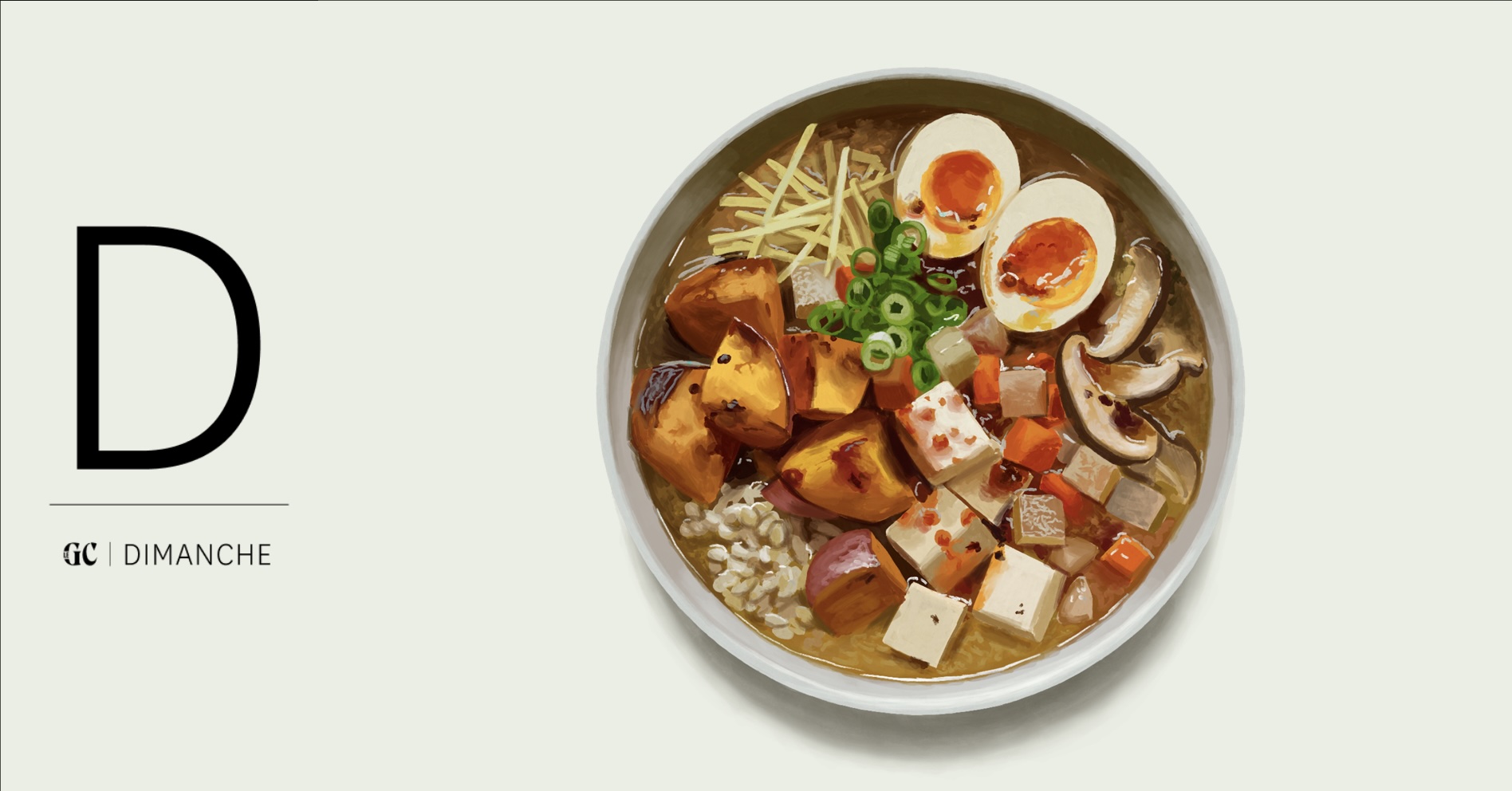
Ingredients (per person)
- brown rice
- 1.5 cups of dashi
- 1 tablespoon of ginger
- one carrot
- a daikon radish
- a handful of shiitake mushrooms
- one sweet potato
- 1/3 of a block of firm tofu
- a soft-boiled egg
- miso, to taste
- green onions
- chili oil or chili crisp
The Story
When I first started working at Google, in 2006–2007, it was the era when the company fed us constantly.
There were stands everywhere. We could choose from eight varieties of kombucha. If you wanted breakfast, you could pick from five kinds of pancakes, three kinds of crepes and sixteen kinds of jams.
For a while, I enjoyed all of it, even if it was absurd. Then, at some point, I felt, with a pang of fear, that my workplace was taking over my life, that my pleasures and joys—each tied to my role as an employee and paid by Google—were slowly being stripped away.
It wasn’t unfounded at the time, because the company tried to keep us on site, where social and personal life was simulated. There were volleyball courts, numerous outdoor activities, a laundry and a dry-cleaning service. Since there was food everywhere, you were always a bit too full and never needed to leave. And then, suddenly, it was 9 PM and we were still at work. We no longer saw friends, we didn’t cultivate relationships outside of work, and we didn’t devote time to what makes a life a life.
I didn’t want to rely on my employer for everything. So I stopped eating on site to restore balance and remind myself that I am not only an employee, but also a person. I wanted to manage my life on my own terms, without the intervention of a large tech company.
So I began to cook, almost as a dare. I wanted to return to cooking with the most fundamental ingredients, to master them perfectly.
That’s why, and because I grew up eating Japanese food, I started with the most elemental: brown rice. I learned how to soak it, drain it, and cook it in a clay pot. I also learned the timing, the different varieties of rice, and the right amount of salt to add depending on the temperature.
I wanted to gain room to maneuver at the most fundamental level and I learned this as a skill for my own body, to regain the use of my senses through my hands, my nose and my palate.
Food was something I entrusted to the company; it became a reminder of physical existence.
I still cook this way. It’s something I keep outside of my public life, as a way to be present for myself. I think business dinners, five-course meals, and the constantly pursued extravagance that accompanies them undermine the ability to fully enjoy food.
That’s what led me to brown rice.
The Brown Rice Bowl
Brown rice is one of the staples of macrobiotic cooking, a practice centered on eating food as unprocessed as possible. When I was a child, I regarded brown rice as a kind of remedy, not a source of pleasure. I wanted to reverse that view and learn to cook it so that it is as tasty as possible.

There should be about a 1 to 1 and three-quarters ratio of brown rice to water. Then add a little baking soda or salt. Chemically, this is to remove phytic acid, which is responsible for the bitterness of the rice. Soak the rice for six to twelve hours to begin a germination process that makes it more digestible, more flavorful, and more nutrient-dense. The soaking time depends on the outside temperature: in winter, a bit longer; in summer, a bit shorter.
Then cook the rice in a clay pot that radiates heat.
Don’t rely on the clock—rely on the aroma. Bring the water to a boil, then slowly increase the heat until steam escapes from the lid.
As soon as you detect a slight roasted aroma—not burnt, but a pleasantly toasted scent—turn off the heat and let it rest for 20 minutes.
This resting time allows the clay’s heat to diffuse slowly, yielding rice with a deeply toasted, hazelnut-like flavor, and a crust at the bottom that adds a delicious note, almost like Iranian tahdig.
In Paris, I have an induction stove, so I can’t use a clay pot. I use a very heavy cast-iron rice cooker, specifically a Kama-Asa 3GO, which I recommend. I use it several times a week, and it works like a clay pot.
Sweet Potato Miso
Meanwhile, bring the dashi to a simmer.

Add the ginger, the mushrooms, the carrot and the daikon, and simmer until the vegetables are tender. In the meantime, scoop out the flesh from the cooked sweet potato and mix it with the miso in a bowl until you obtain a smooth preparation. Once the vegetables are cooked, add the tofu. Turn off the heat, then fold in the sweet potato–miso mixture, whisking it well into the broth. Garnish with green onions, soft-boiled eggs and the chili crisp or hot oil.
I work from home most of the time. Between two meetings, I like to slice a few vegetables and start preparing sauces. In the evening, all that remains is to assemble everything, and a good meal is ready.
I have been cooking this dish for years and it holds a special place in my heart, because at first it was an act of active defiance, a gesture of self-protection and a way to reclaim something that seemed threatened: my ability to steer my personal life, the time I spend in front of screens, but also my tastes. I didn’t want them to be shaped by a company that has proven, both to its employees and to the world, its willingness to seize our lives, our institutions, and our social relationships.