
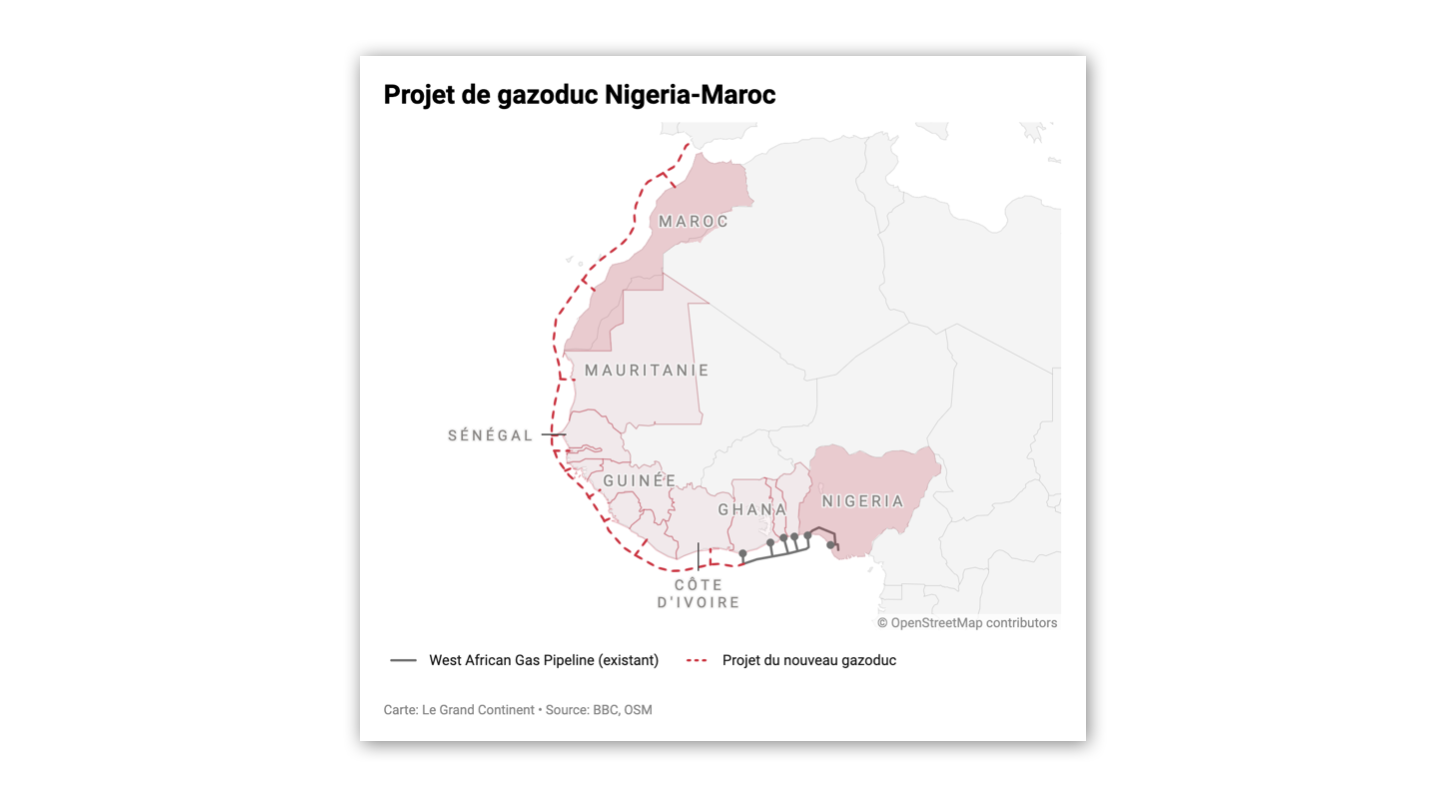
The 69th summit of the Economic Community of West African States (ECOWAS) took place on Sunday, July 19, in Freetown, Sierra Leone. The gathering provided the heads of state and government of the 12 member countries with a window of opportunity to launch a pivotal project: the construction of a 6,000-kilometer gas pipeline linking Nigeria to Morocco and crossing 13 African nations along the continent’s Atlantic coastline.
The idea had been floated about ten years earlier by King Mohammed VI of Morocco, but no final decision had been reached.
- The war in Iran and the tensions it has unleashed on the global gas market prompted ECOWAS to accelerate the project, with construction expected to begin in 2028 and first deliveries planned for 2031.
- A specialized company is to be established in Morocco to oversee the construction, while the governance bodies for the pipeline will be headquartered in Abuja, Nigeria.
- The announced capacity is 30 billion cubic meters of gas per year, which is a little more than half the capacity of Nord Stream (55 billion), which supplied Europe with Russian gas until 2022.
Nigeria and Morocco are the two key actors in this project.
- Nigeria, the 15th largest gas producer in the world and the second in Africa after Algeria, seeks to reduce its dependence on Western export markets, which are reducing their consumption of hydrocarbons, and to expand its influence in Francophone West Africa.
- Morocco, for its part, largely lacking fossil resources, aims to secure gas supplies and strengthen geopolitical ties with sub-Saharan Africa, notably within the context of its rivalry with Algeria.
Algeria indeed holds a dominant energy position across the Sahelian region. It would be the main loser if the project were to be completed.
- Connected to the Maghreb-Europe gas pipeline, which links Spain and Morocco, it would bolster Rabat’s role as a connecting state between Europe and Africa.
- Since the early 2000s, Algeria has been pursuing a competing gas pipeline project, linking Nigeria to the town of Hassi R’Mel from which the Maghreb-Europe pipeline originates.
- While its route is simpler and traverses only three countries (Nigeria, Niger and Algeria), it would pass through the Sahel’s most unstable regions, where several terrorist groups operate.
Issues related to financing and implementation of the project remain far from settled, and the institutional and security context remains highly unstable.
- Among the main threats are the presence of Islamist armed groups, piracy in the Gulf of Guinea and recurring coups d’État in the countries whose territory the pipeline would cross.
- Estimated at 23 billion euros, making it one of the continent’s most ambitious infrastructure projects, the cost could be further increased by inflation, which partly depends on developments in the Middle East.