
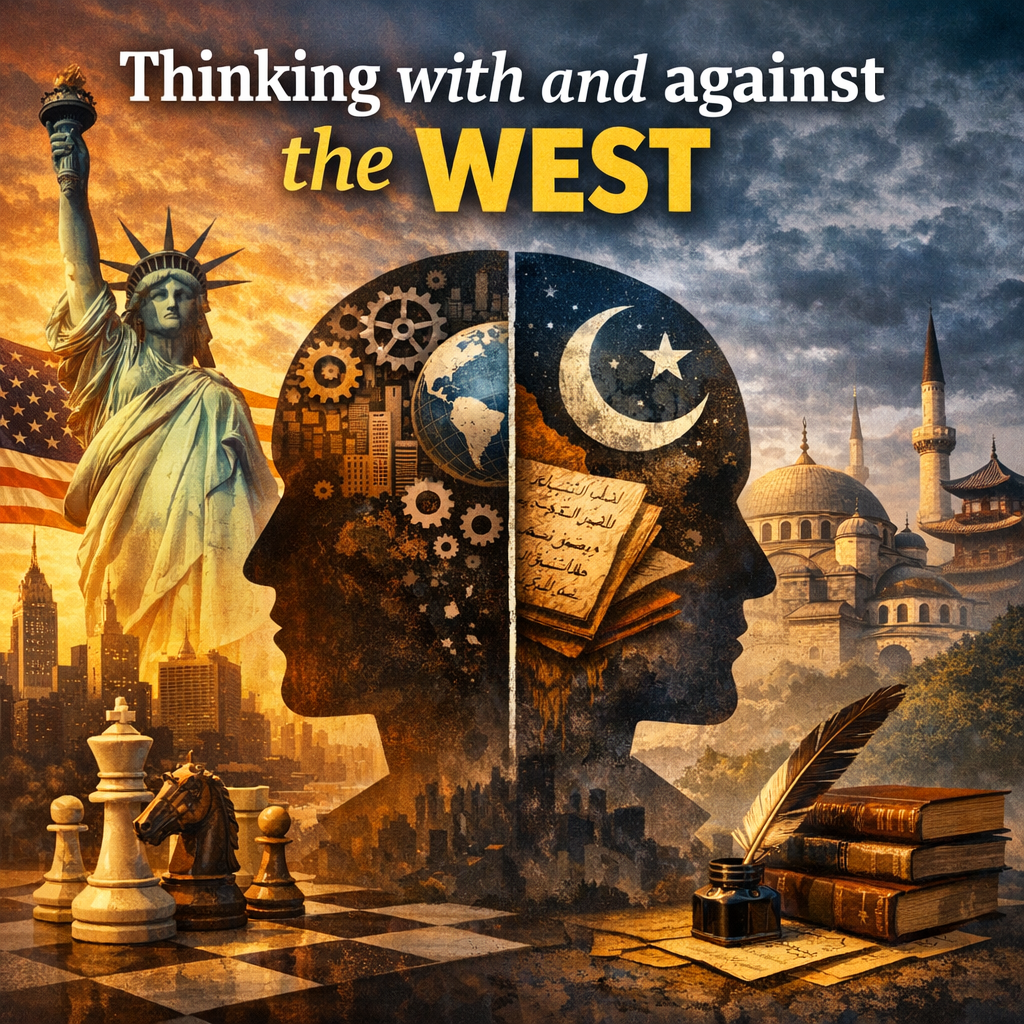
How has Western knowledge been absorbed and reinterpreted by non-Western societies? ? T. Brisson’s erudite work calls into question the image of hegemonism without nuance.
For more than ten years now, historians have highlighted the widespread project among non-European spaces of “ modernize without westernizing », contesting the West’s monopoly on scientific modernity. Thomas Brisson, professor of political science at the University of Paris 8, is part of this heritage with an energetic and stimulating synthesis which focuses on the methods of dissemination of Western knowledge, its reception but also its reinterpretation in Japan, China, India, or the Arab world. All these spaces are considered in the unity of their concern: within them, “ Western sciences made it possible both to form an image of an unequal world and to challenge this inequality » (p. 88). The work, drawing on numerous syntheses and some original studies, clearly shows the universality of certain intellectual trends in countries formerly subject to informal imperialism or colonial domination, such as the translations of new Western concepts into local languages or “ neo-traditionalization » ancient knowledge brought up to date (p. 148).
Dissemination of knowledge and alternative modernities
The book immediately takes a position against certain post-colonial readings which took the habit of citing the work of Edward Saïd on the creation of knowledge about the Orient, but without retaining all its nuances. Thomas Brisson recalls that if the social sciences have indeed imposed themselves in non-Western contexts in an unbalanced relationship, this does not eliminate the capacity of local actors to think and act for themselves, and the circulation of so-called “ hegemonic knowledge » of the West cannot be reduced to a univocal power relationship.
The book thus insists on the multiplication of trips and curiosity enterprises of scholars, ambassadors or soldiers who visit the West to understand it, within reformist projects which characterize both the Japan of the Meiji era and the Egypt of the century of the Nahḍa of XIXe century. These military or technical enterprises incidentally introduce the social sciences into the thinking of these scholars, which is not without creating internal disturbances or disputes that the work recalls very well. From the same interactionist perspective, Thomas Brisson returns to the importation of the model of Western universities and social sciences into a colonial context, then their hybridization with ancient scholarly traditions, showing the flexibility of both. Sociology, born in the context of the Industrial Revolution, is for example used in China or elsewhere to think about predominantly rural societies.
Some of the most interesting pages concern the journey of words or the appearance, under old terms, of new meanings. Considerations on the invention of “ Company » (the term then appears in a new sense in these languages) demonstrate in particular synchronous movements between European political modernity and the rest of the world ; society, formerly a community of believers, ethnic marquetry or relationships between sub-groups such as tribes, becomes an objectifiable whole, the subject of science and therefore of interventions to change it. Japan is particularly pioneering but the book recalls the universal success of philosophies of history or models of society, through the dissemination of the work of Spencer or Darwin.
This broadcast is in no way an imitation. It can provoke a defensive reinvention of its own traditions, the construction of fortresses impenetrable to Western influence where intellectuals arm themselves with a “ strategic essentialism » (p. 131) to protect oneself from alienation by the knowledge of others. Another movement, Western sciences are assimilated to formulate a critique of the West, as well as of Marxism, whose character “ Eurocentric » which the author underlines (p. 139) is not contradictory with its appropriation, in Iran or China, to rethink the history of these countries, renew their own tradition or criticize the West. Appropriating and refuting Marx could therefore be accomplished in the same gesture.
The book, by contrasting synchronic movements, underlines intellectual trends common to these societies which prevail over a wide variety of political, economic or social contexts. He thus gives a judicious example in the tendency to think of “ alternative precursors » to Western knowledge, a contradictory consequence of the desire to find authenticity while fighting on the same ground as the West. The Buddha becomes the inventor of psychology, Ibn Khaldūn, a North African historian who died in 1406, that of sociology: each time, it is a question of “ situate oneself in relation to a reference corpus while claiming to decenter oneself from it » (p. 176). The book demonstrates the ambivalent nature of responses to the diffusion of Western knowledge, also revealing fundamental, shared trends.
Non-Western chronologies and bibliographies
The reader, impressed by the comparative erudition of the work, can sometimes be dizzy by the handling of large groups (where the “ Arabs » rub shoulders with the “ Japanese ”, always located in relation to “ the West “), even if the author multiplies the nuances and fine approaches. He clearly explains that he cannot deliver here a “ world history of human and social sciences » (p. 201) but rather suggests recalling that circulations never occur without criticism, which themselves have favored other circulations. The distance the work places with the context and consequences of colonial domination is, however, striking. The author demonstrates indisputably that it does not summarize the intellectual relationships between these major cultural areas, but the degrees of colonial presence and the dose of violence that it introduced into the circulation of knowledge distinguished the spaces in a sometimes very clear manner. Japan’s alternative modernization is interesting in this regard ; not only was European imperialism less prevalent there, but Japan itself engaged in imperialist projects. A different situation in the Arab world faced with XIXe century to a much more brutal relationship with the colonial enterprise, in the Middle East and even more so in the Maghreb.
Scholars trained in universities after independence also inherited from Orientalism its reinvention of local intellectual traditions, and its selective conservation of manuscripts or authors. These intellectual projects also depend on the material conditions of their production, the weakness of the resources granted to the human sciences or the limits imposed on academic freedoms by the authoritarian regimes resulting from independence, at least in a certain number of countries cited. The translation (or not) of new intellectual concepts is understood through the corset of bilingualism imposed by colonial domination, which implies unequal ease in the handling of linguistic registers and a symbolic hierarchy established between them, including after independence.
The chronology has also been the subject of renewals in the history of science in these regions. Regarding the Arab world, research has shown the unrepresentative character of reformist thinkers of the Nahḍawhose early interest in the West in turn aroused the curiosity of the first specialists on the Middle East in Western universities. By establishing a fixed pantheon of reformist authors, the latter exaggerated their importance compared to other intellectual currents. If the XIXe century is indeed that of increased contacts with the West, the previous century also offers other forms of renewal, through the sciences, neo-Sufism, Muslim enlightenment » or legal reformism, which were precisely “ without Europe “. The scientific renewal of XIXe century is thus heir to longer transformations which cannot be reduced to the reflection, even critical, sent back by the West. It would therefore be useful, at least from the point of view of historians, to extend the chronologies for these spaces, outside of the usual divisions between modern and contemporary histories modeled on Europe.
Further downstream, the book also lends itself to other extensions. It clearly illuminates complex thoughts, those of alternative theories of modernization, the “ third ways » and counter-models… but these are mainly formulated in Western universities, by intellectuals from the regions concerned. The work thus examines the circulation of concepts, such as that of ʿaṣabiyya (the esprit de corps, a central idea in Ibn Khaldūn) not among Arabic-speaking thinkers, but among Western scientific congresses. However, the Westernization of knowledge is also being formulated within local universities which have developed, for decades, their own schools and paradigms, through work in social sciences published in Japanese, Arabic, or Chinese. The work concludes in a very relevant manner on the permanence of epistemic diversity, after having demonstrated the room for maneuver of thinkers who do not lock themselves into Western references, while having assimilated them through critical readings. This diversity calls for further investigations, in line with this rich work, on the contexts of production of epistemologies in the regions studied here or even in South America or Africa.