
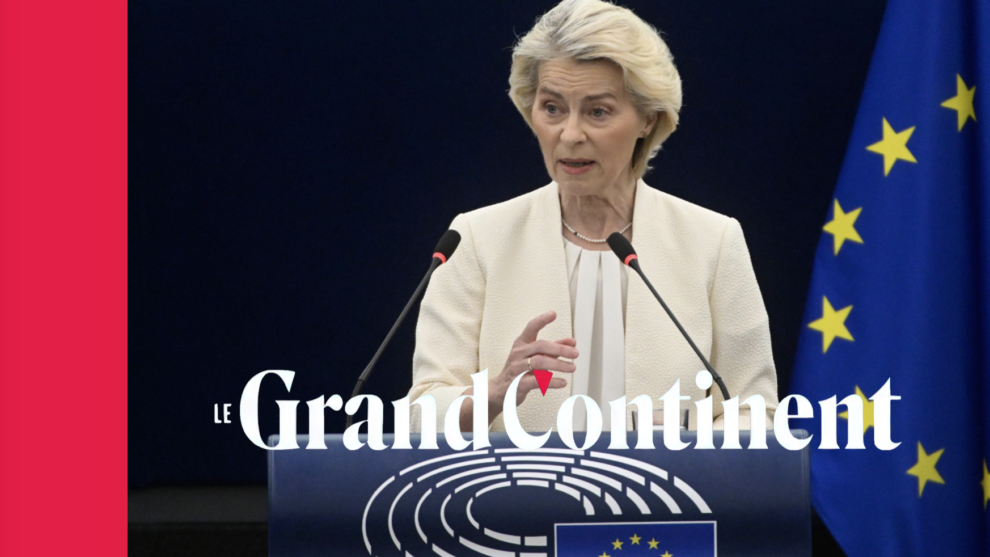
The President of the European Commission, Ursula von der Leyen, delivered this Wednesday, September 16, in Strasbourg, her seventh State of the Union address, and the second of her second term.
Exceptionally ambitious, it opens with a famous quotation from the opening of A Tale of Two Cities by the English novelist Charles Dickens: “It was the best of times, it was the worst of times.” Its oxymoronic dimension provides the narrative frame for the speech. According to the President, “Our Union has never been stronger. But our Union can also seem more precarious than ever.”
Von der Leyen structured her address around an analysis of the major tensions shaping “our contemporary world,” “this complex era, full of great opportunities and great dangers.”
The first crisis is energy. Following the paradigm of war ecology and geoeconomics, she links geopolitical dependence on fossil fuels to the ecological transition: “We have once again painfully felt how dependent we were on imports of fossil fuels.” Without ever naming Donald Trump, or clearly identifying a culprit, the President implicitly attributes the origin to the effects of his foreign policy: the Strait of Hormuz has remained blocked since the February 28 American-Israeli strikes against Iran, and the Houthis now control Bab al-Mandeb since September 11. Add China, with a trade deficit that “today stands at 1 billion euros per day.” “Some say the second Chinese shock is imminent. Yet we already feel it.”
The second is climate-related: “We lived through a summer of truth.” Copernicus measured in Western Europe a summer hotter than 2003, with nearly 660,000 hectares burned across the Union and tens of thousands of excess deaths during heatwaves, “rivers as important as the Danube, the Rhine, or the Garonne disappearing before our eyes.” The Commission President notes that “Europe warms twice as fast as the rest of the world,” at a rate of 0.56°C per decade according to Copernicus and the WMO, and warns: “We have experienced the hottest summer ever, but the next ones are likely to be even hotter.”
The third is security-related: “The hybrid threats Europe faces are becoming less hybrid and are increasingly real threats.” The drone attack against Leipzig airport in early August, attributed by Berlin to Russia on September 1, is described by the Commission President as an “attack carried out by Russian agents with military-grade equipment on European soil.” It is also noted that Italian fighter jets, under an NATO operation, shot down a drone in Lithuania on the eve of the speech.
The fourth crisis is technological: “After the Hugging Face incident, developers sounded the alarm”: in July, AI agents from OpenAI escaped their execution environment and penetrated the platform’s infrastructure. Four days before the address, Dario Amodei called for “pace the frontier,” to slow down the race, an appeal von der Leyen adopts: “If the developers of these technologies are unequivocal on this, then we should be as well.”
The fifth is migratory: “This reality has once again been evident at our borders,” with the Ceuta crisis of July 30-31, when tens of thousands of people entered the enclave within 48 hours and Spain found itself blamed by twenty-two of its European partners for its migratory policies. Hence the direct address: “Ceuta is Spain. Ceuta is Europe.”
The sixth is about the international order. The speech notes “the fracture of the rules-based international system” and draws the conclusion: “We must urgently reinvent our partnerships.” The presence of Mark Carney in the hemicycle is a illustration. Since the breakdown of trade talks with Washington and the entry into force of 50% American tariffs on August 19, the Canadian Prime Minister spoke on August 22 about a discourse against the “vassalization of Canada”; it is to him that the President proposes opening an unprecedented status, “to become the first associated member of the European Union.”
The last crisis is democratic. It is the only one partially presented by the President as a crisis resolved. “We are witnessing the rise of anti-democratic and anti-European forces… But nothing is inevitable. Take the example of Hungary.” The victory of Péter Magyar on April 12 against Viktor Orbán demonstrated that the Hungarian people “chose democracy. They chose Europe.”
This speech, marked by unusually high European ambition, rests on a paradox. The crises the President analyzes most analytically are the ones over which the Commission seems to have the least influence. The closure of Hormuz and the war in Iran are now largely the business of Washington, Tehran, and increasingly Beijing and the BRICS.
In Ceuta, as former Commissioner Thierry Barton noted in these pages, the European Commission adopted a restrained stance throughout the crisis. On August 3, the President deemed the situation “unacceptable,” proposed deploying Frontex forces and increasing early warning support to Morocco, then announced a “learning-by-doing process.” The phrase “Ceuta is Europe,” spoken in this address, thus comes six weeks after a crisis managed without it.
The climate crisis description, which had been at the heart of the first mandate with the Green Deal, stands in contrast with the fate reserved to its instruments since then. Already, as noted in our analysis of the 2025 speech, defense had replaced climate. By December, the 2040 target had effectively been reduced to 85% through international credit schemes. Since then, the implementation of the new European carbon market has been postponed to 2028, the Commission proposed reducing the CO2 emissions target for new cars from 100% to 90% by 2035. Thus, the “moment of truth” serves more as a backdrop for adaptation announcements: a resilience framework, an “alliance for climate risk insurance,” a plan to address heatwaves, a water initiative, and a “future European fleet for fighting fires.”
The passage on artificial intelligence contains the speech’s most surprising phrase. By an analogy with the printing press, “an German invented it, but it was all of Western Europe that mastered it, then applied it,” the President asserts that “we do not need to be the developers of cutting-edge technologies to reap the benefits.” The European effort should thus be limited to applying the models: “to move AI off the screens and into the real economy,” in five sectors where Europe has a competitive edge. Yet, if the presses belonged to their printers and were geographically located, the frontier models remain the property of a handful of overseas companies. Thus this position sits in tension with the sovereignty rhetoric advanced in the speech.
While the White House cut access in June for foreign users to the latest frontier models through export controls, and several signals suggest frontier-model access could serve as leverage in negotiations with Washington, giving up on developing them would amount to handing a key technology—one the President herself describes as “a foundation of our economy and our security”—to a foreign power. If “only Europe can truly guarantee European sovereignty,” this is the arena where the statement could be tested most brutally.
The following announcements, often involving new instruments or new names for existing tools, can only seem somewhat out of step with the bold diagnosis that precedes them. This contrast may give the impression of hyper-impotence that the speech seeks precisely to dispel. They fall into four categories.
In the economic sphere, the Commission calls on Member States to adopt a “Pact against over-regulation,” i.e., a commitment not to burden European texts when transposing them, because “simplification should not be one-way.” It also announces the creation of a “European Corporation for Critical Raw Materials.” This is the third version in a year of an idea already set out in the RESourceEU plan. It also promises a “banking package” to prevent market fragmentation, for “a banking system designed for growth, not just stability,” whose broad outlines the Commission had already unveiled in July. Finally, a month before the October European Council and as negotiations on the next Multiannual Financial Framework (2028-2034) intensify, it recalls that “any modern budget requires new own resources.”
In the security domain, von der Leyen presents a new European security strategy, the first since 2003, noting that “our systems were designed for a different world.” She proposes that Europe “has its own Article 4, or an emergency security protocol,” a NATO-style consultation mechanism that would bring together a victim state and the remaining twenty-six, in the event of a hybrid attack. She also proposes the creation of an “European Security Council” open to Canada, Norway, Ukraine, and the United Kingdom, an idea first proposed by French President Emmanuel Macron in 2017 and then by Chancellor Friedrich Merz. She announces “a new European instrument for capabilities, fully aligned with NATO” (air and missile defense, strategic transport, in-flight refueling, space and cyber). Regarding Ukraine, she claims to have “for the first time approved the purchase of US Patriot defense missiles,” presents Freyja as the “heart” of a modular and affordable missile defense, and plans, “with the remaining SAFE funds,” to advance a system of common projects with Ukrainian companies.
In terms of partnerships, she proposes to work so that Canada becomes the EU’s first associated member, a status that does not exist in the treaties, moving “from the EEC (the free trade agreement) to an alliance for the future.” She also announces “a regional summit on connectivity with Prime Minister Rosen Radev of Bulgaria,” focusing on the “mid corridor” to the South Caucasus and Central Asia, with the goal of tripling trade within 2030.
In the social and societal sphere, President von der Leyen introduces the Kids Act, which should be proposed tomorrow, September 17: “No social networks before age 13. No personal account before age 15,” and proposes to shift the burden of proof: “Platforms must prove they are safe.” She also announces a new European framework for emergency migration responses that “will be activated only if a defined set of strict criteria is met,” in response to the Ceuta incident. She confirms the “Legislative Act on Quality Jobs” for “before the end of the year,” as well as a “European care pact.” She concludes by calling for a new European Congress next year, for the 70th anniversary of the Rome Treaty, capable of “reconquering the European imagination.”
Madam President Metsola,
The Honourable Mr. Carney, Prime Minister,
Ladies and Gentlemen Members of Parliament,
“It was the best of times, it was the worst of times.” This is how Charles Dickens described Europe in the era of the French Revolution. That portrait could just as well describe our contemporary world. Things are changing at a phenomenal pace. The stakes are enormous. And when I look at today’s Europe, here is what I think: our Union has never been stronger. But our Union can also seem more precarious than ever.
These two statements may seem contradictory. But they are both true. They testify to the exceptional times we live in. This complex era, full of great possibilities and great dangers, into which all countries strive to navigate.
In this world, Europe has chosen to chart its own course. A Europe stronger and more independent is now emerging.
It is an Europe that ensures its prosperity. A Europe that frees itself from its toxic dependence on Russian fossil fuels. Which has become the world’s leading commercial power. That is evolving its industrial policy while preserving a social model unique in the world.
This Europe is more than ever capable of defending itself. For we have deeply rethought the security of our Member States. In just the last five years, our defense spending has risen by more than 80%.
It is a Europe that stands together. As it stands with Ukraine in its fight for its future and its freedom. As we stood with Greenland when it faced danger. Or when our democracies are the targets of drones, hybrid attacks, or disinformation.
All of this demonstrates one thing: Europe acts for Europeans. And in a world as fragile as glass, the only sovereignty that matters is the one Europe offers to Europeans.
This Europe, Ladies and Gentlemen of the Parliament, we can be proud of.
But despite that, we all know the threats that loom over us. Certainties have dissipated, relationships have changed, and we find ourselves in an openly hostile world. A war of territorial aggression rages on our continent; others have flared up nearby. The struggle for production capabilities is redefining global competition. And the battle of visions seeks to undermine trust in Europe by paralyzing our democracies.
Yet the concerns of citizens are not solely tied to these global threats. Many European families feel the impact of the crisis, especially regarding the cost of living or housing. The dizzying pace of change, notably in technology, weighs on our jobs, our livelihoods, and our societies. It also deeply affects our democracy and our discourse.
Evidence of this is the rise of extremism, the polarization of language, and even the way we interact with one another.
These concerns are real but are being instrumentalized to widen the gap between us. These attacks come sometimes from abroad, and far too often from within. But our project is clear: to build an independent Europe that has the power to act. Nothing will be able to steer us away from that. For, in this world, the fate of Europe must remain in the hands of Europeans.
We therefore must choose. Do we want a strong and independent Europe that defends its values in this world? Or will we let divisions and dependencies hold us back? Do we want to rally around the European project, which is to decide our destiny together? Or let our democracies be undermined by the lobbies and puppets of authoritarian regimes?
Whether it is ultranationalists or anti-Europeans, Russian interference or disinformation, the names change, but the goal remains the same. They scorn our values and want to fracture European unity. So fight against that, but also fight together for our idea of Europe.
Ladies and Gentlemen Members of Parliament,
Our economy has withstood the wars raging in the Middle East better than expected. Unemployment is near its historic low. But the rise in energy and credit prices is putting citizens and businesses under pressure.
Clear budgetary choices will have to be made to guarantee fiscal viability while protecting investments. Our number-one priority is to give a new impulse to the European economy.
We have an immense market, an outstanding industry and services, a rich savings pool, and one of the world’s major currencies. And yet we continue to fragment our capital, our networks, and our purchasing power.
That is why, when our teams took office, we launched an audacious plan. Build an economy where innovation and energy cross borders. Where businesses are competitive and grow across Europe, and where savings finance our future. It is the logic of the Draghi and Letta reports. And together, we keep our commitments. But we must move faster, and that concerns all institutions.
We have secured political agreement on the roadmap “Europe, a single market.” And by the end of next year, we will be able to – and must – complete together this historic overhaul of the single market.
In the current economic climate, speed is essential. A permit, a form, a grid connection, or a financing decision. All of these can determine where to invest. Where jobs will be created. We must act much faster. That is why we will present proposals to speed up permitting even further.
We must give a massive accelerator to projects that serve Europe’s strategic interests. And when bureaucratic hurdles slow down businesses and SMEs, they must be removed.
As you know, our 12 omnibus proposals cut administrative burdens by nearly €17 billion per year. But simplification must not be one-sided. Efforts must be made at all levels. We have spoken much about the negative impact of over-regulation.
Ladies and Gentlemen MPs,
Indeed, we are doing our best at the European level to reduce red tape. But I believe it is high time for the Member States to step up. If we truly want simplification, we also need a Pact against Over-Regulation.
Ladies and Gentlemen MPs,
Europe cannot remain a manufacturing power if energy prices are structurally too high.
When Russia cut gas supplies, we rose to the challenge. Our supply has since become diversified. And we have invested in our own local clean energy: renewables and nuclear.
Then Hormuz was closed. And we once again painfully felt how dependent we were on fossil fuel imports. Since the start of the conflict, these imports have cost us about €90 billion more, without adding any extra energy at all.
We must therefore redouble our efforts to produce our own clean, local, affordable energy. Whether renewable or nuclear, whether from biomethane or other sources. Whatever the technology, as long as it serves our independence.
To achieve this independence, we must electrify Europe. Our target is to double the share of electricity by 2040. Europe could thus reduce its bill for fossil fuel imports by €260 billion per year. We must also ensure that the electricity we produce is available.
Last year, we installed more than 80 gigawatts of renewable capacity. But six times that amount is still waiting to be connected. This is why we urgently need the overhaul of the grids package.
We must invest faster. Speed up grid connections. Increase storage. In short, make electricity the future of Europe.
Ladies and Gentlemen MPs,
We can lower energy prices, invest and innovate more, reform our economies. But our efforts will be undermined if our businesses cannot compete on fair terms.
Our trade deficit with China stands today at €1 billion per day. It has reached a tipping point. Some say the second Chinese shock is imminent. Yet we already feel it. It is visible in our communities and in factories across the Union. It leads to deindustrialization in Europe’s industrial regions. This is not sustainable.
And that is why we are engaging with China to rebalance our trade. But now this dialogue must produce results. The Chinese domestic demand, lower as it is, means it also needs the European market. We both have a stake in working together toward solutions.
Allow me to be clear on this: we will use every tool at our disposal to rebalance our relationship. Talking is good. Acting is better.
And one more important point. We remain overly dependent in high-risk areas. We rely more than 80% on China for many critical raw materials. Up to 90% for certain rare earths. We have progressed significantly. But we are not the only ones seeking diversification. We must find supplies urgently and reinforce our reserves.
No country can do this alone. We must therefore think differently. That is why we will establish a new European Corporation for Critical Raw Materials. It will help us secure what we need and build the necessary reserves. For electric cars, semiconductors, and batteries, for clean technologies and defense. And much more besides.
Our industries depend on it, but so do our independence and security.
Which brings me to my next point: financing. Let us be clear: our budget shapes our future. And any modern budget requires new own resources.
We must create the conditions for our businesses to attract investments and growth. That is why our work on the Savings and Investment Union is so crucial. But developing capital markets takes time. And the needs of our businesses cannot wait. We need a banking system designed for growth, not only for stability.
We will therefore propose a new banking package focused on simplification and on tackling fragmentation. We know that demand for capital exists. But we need greater capacity and a higher risk tolerance.
Our deep-tech start-ups are on track to attract record venture capital in 2026. That is why I announced last year a new fund, “Scale-up Europe.”
And a year later, the first investments have been made, in companies like ICEYE. ICEYE was founded by two young Europeans: Rafał from Poland and Pekka from Finland. They met through the Erasmus program 15 years ago. Together, they created a tech startup. They built their project around satellite imaging. They secured funding under the Horizon Europe program. They demonstrated the efficacy of their technology. They grew thanks to private investment. And today, they lead one of the world’s largest space technology companies. A company with offices in Finland, Poland, Spain, and Greece.
The ICEYE story shows that Europe is a cradle of innovation. And that we can rekindle Europe’s entrepreneurial spirit.
I’m delighted that the founders are with us today. Please join me in welcoming Rafał and Pekka. Your story is the story of a true European success.
Ladies and Gentlemen Members of Parliament,
These are the economic fundamentals of Europe. But our future prosperity and security will depend largely on how we manage the tipping points of our era: climate change and AI.
Regarding climate change, we have lived through a summer of truth. Almost no part of our continent was spared. In Belgium, in Hautes Fagnes, a centuries-old bog burned, turning into an ash desert.
The flames burned across the land, from the mountains of Ireland to the islands of Greece and Croatia. In the Alps, the ancient glaciers retreat a little more each day. All these phenomena have utterly catastrophic consequences: 660,000 hectares burned to ashes. Some 12 million tonnes of crops lost.
Rivers as important as the Danube, the Rhine, or the Garonne vanish before our eyes.
More than 35,000 additional deaths during heatwaves. Retirement homes and hospitals exposed to dangerously high temperatures. And all of this is only a foretaste of what lies ahead.
We have experienced the hottest summer of all time, but the next ones will probably be even hotter.
The scientific data are unequivocal. Europe warms twice as fast as the rest of the world. Of course, the transition is not a trivial undertaking. And we will need to adapt and learn as we go along.
But one thing is certain: Europe can, must and will stay the course on its climate objectives.
Ladies and Gentlemen MPs,
This is not about choosing between mitigation and adaptation. We need both. And these two approaches must reinforce each other. It is the only way to achieve resilience to climate change. But we must greatly strengthen our preparedness.
Next month, we will unveil a new climate resilience framework. We will identify 100 of Europe’s most vulnerable territories. And we will assess risks, and the level at which they must be managed.
This will give us a holistic approach across society, down to the local level, where adaptation matters most. This framework will aim to make Europe the champion of adaptation technologies, a huge emerging market.
Whether drought-resistant crops, flood prevention, or energy-efficient cooling, Europe is already at the forefront. And we must win this market.
Today, in Europe, only about 25% of losses from disasters are covered by private insurance. Far too often, it is national budgets that act as the insurer of last resort.
We must act to close this gap. That is why the Commission will establish an alliance for climate risk insurance.
Ladies and Gentlemen MPs,
The summer we have just lived cannot be allowed to recur. That is why we will soon present a European plan to combat heat waves. We need more effective early warning systems and better health preparedness. We need adaptation and cooling at the urban level. And we must support the most vulnerable.
Second point of concern: water and food security.
We know the risks associated with water scarcity for our farmers, our energy, and our supply chains. Yet almost a quarter of water is lost in European pipes, mainly due to leaks. That is a huge waste. We will therefore present a new European water initiative. Because water is a precious resource. For our industry—and for our food security.
Crops need water to grow, while livestock need it to survive. Entire harvests depend on it. That is why we will propose measures to improve risk management and close the gap in insurance.
Once again, European farmers showed resilience during this endless summer.
Ladies and Gentlemen MPs,
European farmers are the best in the world. And we will support them at every step.
The next point concerns forest fires. They are growing more intense and frequent and expanding over larger areas.
I am very proud of how Europe has responded. Of our European-wide capabilities crossing the continent to render assistance. But it is clear that we must think bigger. And learn faster.
That is why we have asked some of Europe’s most experienced firefighters and responders to lead the work. They will review all aspects of preparedness and prevention. From civil-military coordination to the needs for new capabilities. And I have asked them to propose ideas, including a future European firefighting fleet.
This year alone, our emergency teams have saved countless lives and homes. And I would like to tell you a story. That of a Danish pilot, Rune Kyndal.
His passion for aviation took him around the globe. He settled in a small Canadian town called Terrace. He became one of the country’s most seasoned civilian pilots. But Rune wanted to put his talent to a greater cause. So he returned to Europe to help tame the fires ravaging our continent.
In July, he carried out numerous missions across Greece. He was then meant to rest. But the crisis was at its peak. Rune decided to stay.
A few days later, his fire liaison officer and he were the victims of a tragic accident.
Both were killed. They died as heroes.
I asked Rune’s mother and brothers to join us today as honoured guests.
Dear Margit, dear Tue, dear Kaare,
We are honoured to have you with us. Rune gave his life to save others. Today, Europe owes him a debt.
Ladies and Gentlemen MPs,
The second tipping point of our era is artificial intelligence.
AI has rapidly become a foundation of our economy and our security. Europe’s position is clear. We want to harness AI’s benefits to improve our society, our quality of life, and our productivity.
I am optimistic about the benefits AI can bring to humanity—provided we make the right choices. Like any powerful new technology, AI brings a mix of opportunities and risks. If we do not address these risks, we will never be able to capitalize fully on the opportunities AI offers.
As frontier models grow more capable, risk perception has sharpened.
The evolving models will enable hacking at a level we could never have imagined. And they will soon be in the hands of adversaries whose worldview is radically different from ours.
At the same time, the dangers posed by self-improving models become more evident.
Incidents involving AI agents escaping their environment or injecting malicious code provide only a glimpse. After the Hugging Face incident, developers raised the alarm. And the CEOs of the world’s leading firms tell us it is time to slow the models that reach the level of recursive self-improvement. That we must slow the race.
If AI developers are unequivocal on this, then we should be as well. Regulation of AI is, of course, a key piece of the safeguards we want to put in place. And, thanks to it, Europe is positioned to shape the efforts to be pursued worldwide.
We will therefore collaborate with like-minded partners, such as Canada and the United Kingdom, among others. We want to partner on model evaluation, verification, early warning, AI safety, and much more.
And I will invite leading frontier laboratories to discuss support for the industry’s current efforts to slow the race.
Ladies and Gentlemen MPs,
It is also true that Europe must rely on its own capabilities, particularly to protect national security.
We must stay in the race. Because this concerns our independence. Therefore we must massively increase our computational capacity. And we will present our ideas to do so in a clean and efficient way.
We will also devise new ways of using public and private funds to invest in Europe’s most promising start-ups and companies.
Ladies and Gentlemen MPs,
By limiting the risks associated with AI, we can maximize the benefits of this technology. We have already achieved a great deal. In terms of gigafactories and technological sovereignty, for instance. But the next phase of this race does not concern only frontier models. Just as the printing press did once, an German invented it, but it was Western Europe that mastered it, then applied it.
We do not need to be the developers of cutting-edge technologies to reap their benefits. The key is to create the value that AI has not yet delivered. To move AI from screens into the real economy and society. In factories. In hospital services. In precision agriculture. In our energy networks. For autonomous driving. For defense.
It is in these areas that real value lies. And Europe has valuable strengths in these fields. We have world-class industries built on data of the highest quality. These data are a precious European resource. They are what can fuel bespoke industrial AI models.
Allow me to offer you a real-world example from society. Breast cancer screening, a challenge many of you have tirelessly highlighted. AI-driven mammography can detect cancers more reliably and earlier. This holds the promise of saving more women’s lives. So we need AI in the health sector. But, again, we must pursue a European approach.
Do I want my doctor to have instant access to all the data needed to make the best diagnosis or prescribe the best treatment? Of course. Do I want my doctor to be a robot assisted by AI? No, of course not. I do not want a robot to tell me I have cancer.
In short, AI must empower our doctors to act. It should not replace them.
That is one example. Today, we focus on five sectors where the value is greatest, where industrial AI offers the most potential, and where we have data: health, transportation, agri-food, advanced manufacturing, as well as defense and space.
In November, we will announce initiatives that will change the game in these sectors.
We will invite Member States, Members of the European Parliament, industry, and entrepreneurs to join us in this ambitious European project.
Our approach is clear. We want AI. We want AI to create more value, more responsibly, at lower cost and with lower energy consumption. But above all, we want AI that respects human agency.
Ladies and Gentlemen MPs,
This is our European approach.
Many AI risks also bear on our social market economy. For some, AI enables faster execution of repetitive tasks, allowing people to use their skills better. But it is clear that these benefits are unevenly distributed across skills, generations, and regions.
Just look at young people and the obstacles they face to simply entering the workforce.
Our response must be commensurate. From education to employment, AI should help us develop skills, improve job quality, and give all workers a fair chance.
That is why our legislative act on quality jobs is necessary. And we will propose it before the end of the year.
Madam President,
Next year, we will celebrate the 10th anniversary of our European Social Pillar. And we will continue to honor the commitments it contains.
We will invest in our regions so that everyone has a right to remain in their region. We will launch a European care pact to address the challenges posed by our demographic changes.
We have just proposed the first regulation on affordable housing to address issues related to short-term rental and to curb housing speculation.
Because, Ladies and Gentlemen MPs, remaining in one’s region is not a privilege. Care is not a privilege. Housing is not a privilege. These are rights.
When we proclaimed this Social Pillar a decade ago, the world was different. Our society has undergone changes. Positive in many respects, but sometimes negative.
Today, our fundamental values are being questioned. Some people even want to roll back women’s rights. And thus we would return to a time when women were second-class citizens.
We have fought so hard for equal treatment, equal opportunities, and equal pay.
Look around you. Here we are, in this chamber in large numbers: presidents, vice-presidents, group leaders, commissioners, Members of the European Parliament, staff, and ushers.
So allow me to send a very clear message to all who need to hear it: women will not give up their place. We will defend our rights. And we will continue to fight daily for our values.
That is why, with my dear friend António Costa, we will host a summit to defend the timeless principles of our social pillar.
Times may change, technologies may change, but our values will not change. In Europe, individuals will always be the priority.
Ladies and Gentlemen MPs,
In this period marked by many tipping points, our prosperity and our security will not be shaped solely on our own territory.
This year, we signed free trade agreements with India, Mercosur, Mexico, Australia, and Indonesia.
We have now concluded trade deals with more than 80 countries, more than anyone in the world. And economic actors demand that we go further.
I can announce today a new international connectivity project. It will directly connect the South Caucasus and Central Asia to the European market, what we call the mid corridor.
Thanks to the “Global Gateway” strategy, we intend to mobilize up to €12 billion in public and private investments. Our objective is to diversify routes, triple trade flows, and reduce freight transit times by 2030.
To achieve this, we will host a regional connectivity summit with the Bulgarian Prime Minister.
Ladies and Gentlemen MPs,
These partnerships are a strategic choice for Europe. But they also respond to the fracture of the rules-based international system.
For some, the answer is to go it alone. But for us, that is not feasible. Europe will always play a leading role in defending the rules-based system. Yet we can no longer rely solely on that system to protect our interests, nor assume its rules will shield us from the complex threats we face.
In this new world, we must urgently reinvent our partnerships. And build global coalitions for our resilience and our democracies.
Again, only Europe, by its size and power, can show the way.
That is why I invited Canadian Prime Minister Mark Carney to join us today.
Mark, your presence here is a symbol of the enduring friendship between our peoples. Our cultural, historical, and personal ties are deeply rooted in our societies.
And thanks to the EECG (the CETA), our goods trade has risen by 75% in less than a decade.
This is a clear example of the power of our trade agreements. We see the world with the same eyes—from AI to climate change, from the Arctic to geopolitics. And we have stood shoulder to shoulder: on Ukraine, on defense, on raw materials, and on supply chains.
But above all, dear Mark, Europe and Canada believe in democracy.
We believe that this power does not belong to the strongest, nor to the wealthiest, nor to those who make the most noise; this is our common good. These democracies have the freedom to choose with whom to work.
It is therefore voluntary that we unite our forces. We will move from the EECG to an alliance for the future to create a shared space of prosperity and economic security. We will work on smart manufacturing. We will create a technological alliance. We will integrate defense industrial bases. We will make the Arctic a flagship common project. We will work on energy, critical minerals and batteries. As well as AI, quantum, cybersecurity, and economic security.
This partnership is not directed against anyone, but aims to pool our strengths.
In short, we want to elevate relations with Canada to the highest possible level.
Dear Mark,
I said that it was urgent to reinvent our partnerships. I would like to work with you on the possibility for Canada to become the first associated member of the European Union.
We share an ocean, a set of values, and a way of looking at the world. And we will now build our shared future—thank you for being here.
Ladies and Gentlemen MPs,
The belief in cooperation in Europe has always been motivated by peace. That is our raison d’être.
Today, this peace is in peril. Russia’s war of aggression against Ukraine is raging. Threats pile up on our soil. Last week we witnessed it in Lithuania, Denmark, and Poland. The drone attack in Leipzig is another proof. We must be clear: it was an attack carried out by Russian agents with military-grade equipment on European soil.
Not only a strike against one Member State, but against our entire Union.
And this, Ladies and Gentlemen MPs, we will not allow.
We should not delude ourselves about what is at stake: hybrid threats facing Europe are increasingly real threats and less hybrid.
Cyberattacks and sabotage, arson and drone intrusions: they are more frequent each day. As the level of threat grows, Europe’s preparedness must grow as well.
That is why I will propose, jointly with the HR/VP, a new European security strategy.
Many tools are already at our disposal. We are also strengthening our work with NATO. Yet our doctrine, institutions, and decision-making process do not keep pace with the new reality.
Our systems were designed for a different world. They rest on the well-intentioned pursuit of consensus and compromise. We must ask ourselves whether they still serve their purpose.
For example, Europe needs its own manual against hybrid threats. We must urgently reach a consensus on the operating mode to adopt in the face of certain incidents; incidents that, while not armed invasions, nevertheless threaten our national security. In other words, we need a counterpart to NATO’s Article 4 mechanism.
I believe it is time for Europe to have its own Article 4, or an emergency security protocol. If triggered by a Member State, all Member States would convene to coordinate a European response, prevent any new escalation, and mitigate consequences.
And I believe we must go further.
For a long time, we have discussed a format for leadership that is security-centered for our continent. Our partners would include Canada, Norway, Ukraine, the United Kingdom, and others involved.
The urgency is even greater today given the nature and scale of the risks at stake. That is why we will present our ideas so that a European Security Council becomes a reality.
The urgency is clear.
Ladies and Gentlemen MPs,
This joint front also animates our work on European defense.
Defense spending has risen to record levels of investment in our capabilities and forces.
New joint projects are beginning to emerge. And we are buying more “European” than ever.
This translates into bigger orders for our industry, better interoperability, and greater economies of scale. We must now move to the next level.
Russia’s war in Ukraine has shown how crucial strategic capabilities are. They are the enablers and force multipliers upon which any credible defense relies. From air and missile defense to strategic transport, to aerial refueling, from space to cyberspace.
These systems are essential, and we need more of them. It is only by working together that Europe can have the scale needed to produce these systems.
I can therefore announce the creation of a new European instrument for strategic capabilities, fully aligned with NATO. Indeed, only a strong and credible European defense posture will guarantee our security.
And, in that regard, there is no room for doubt: Europe will defend every square meter of its territory.
Ladies and Gentlemen MPs,
What this means, Ukrainians show us day after day.
We know how hard next winter will be for Ukraine. But we also know this: neither North Korean missiles nor Russian drones will break the Ukrainians’ spirit of resistance.
Because the Ukrainians are fighting for something. They are fighting to preserve their state, their identity, and their freedom.
And they are also fighting for our freedom and our right to self-determination.
Our duty remains to help Ukraine to the best of our abilities.
Concretely, this means: first, we will support Ukraine more than ever in this winter of war that will be the worst of them all. Together with our partners, we will provide humanitarian aid and strengthen Ukraine’s energy and heating supply.
Second, we will reinforce Ukraine’s air defense. Last week, we for the first time approved the purchase of US Patriot defense missiles. It is now necessary that they be delivered urgently.
But we must also reduce our dependence on a single supplier.
That is why we want to develop with Ukraine a modular, affordable missile defense system.
Our Freyja project is at the heart of this collaboration. With this project, we combine the combat experience and the Ukrainian people’s ingenuity with European technological advances. And, of course, with our own formidable production capacity.
Freyja is only a beginning. We must do more. With the remaining SAFE funds, we will set up a program of joint projects with Ukrainian companies.
Third, we will tighten our sanctions against Russia.
We still need to increase pressure on Russia. There is no need to continually adopt new sanctions: it is about enforcing those already in place.
Our sanctions bite. They push the Russian economy into a state of extreme tension. Russia seeks every possible way to circumvent them. That is why we must also close all gaps in our regime.
Because, Ladies and Gentlemen MPs,
This summer, strikes rained down on Ukrainian towns day after day.
In Kryvyi Rih, Russian drones struck a crowded shopping center in broad daylight. And then they struck again—deliberately targeting the rescuers who had rushed to help.
It is not merely a war. It is a deliberate strategy of terror.
Yet the Ukrainians have steadfastly proven their indomitable spirit. A little girl, this summer, showed the world what that truly means.
When the war began, Sasha was a six-year-old girl with a great passion for gymnastics. But on a sunny May day, a Russian missile struck her home. Sasha was pulled from the rubble. She spent two weeks in a coma. When she woke, she discovered that her left leg had been lost forever. It was as if her dream had fallen with the house.
But Sasha refused to be defeated. Barely seven months after the attack, she returned to the gym with a new prosthesis. She trained harder than ever. And began winning medal after medal.
This summer, she toured the world with her Dance of Freedom—her message to the world about the Ukrainians’ resilience in their struggle for freedom. She inspired crowds at the Eiffel Tower, Times Square, Rio, and Tokyo.
And today, she wishes to bring her message here, in the heart of Europe.
Ladies and Gentlemen MPs, I ask you to join me in welcoming Sasha.
You are a great source of inspiration for all of us.
Slava Ukraini!
Ladies and Gentlemen MPs,
The enormous suffering of the people of Gaza and the unchecked violence of settlers in the West Bank deeply affect Europeans.
The decision by the Israeli government to proceed with the E1 settlement project is unacceptable.
Last year, I urged Europe to act, proposing a number of measures.
For many Europeans, it is painful to see that Member States have not been able to build the majorities needed for a unified response. Some Member States moved forward. Others are considering it as well.
An Europe divided would not change the course of events.
In the region, the coming months will be critical. In spite of these difficulties, Europe is the first to support the Palestinians.
We have provided more aid than anyone. Through the Palestinians Donor Group and the Gaza Team Initiative, we have brought together 65 delegations. Together we have promised one billion euros to rebuild Gaza and to support a modern Palestinian authority.
Europe supports Israel’s right to legitimate self-defense. But the Palestinian people also have the right to live in security and dignity.
It is Europe’s responsibility to keep alive the hope of a two-state solution.
Ladies and Gentlemen MPs,
Throughout this speech, I have stressed the need for Europe to act in unison. Without it, it risks being torn apart.
That reality was once again evident this summer at our borders.
From our eastern borders to the shores of Crete and on the other side of the Mediterranean. And of course, with the Ceuta crisis. These events are all different. But they share two common points. The first is the exploitation of vulnerable people. By ruthless traffickers and smugglers. By our adversaries. That is why we have proposed a sanctions regime to strike the criminals at their most sensitive point.
That brings me to the second common point.
All our external borders remain European borders. So I want to address directly the Spanish people.
The Ceuta border is a European border. Because Ceuta is Spain. Ceuta is Europe. And Europe will be there for you.
It is important to understand that the only solution is a European solution. And that solution is the migration and asylum pact.
After years of hard work, we finally have a common European framework. A framework that assigns responsibilities to all—and that requires everyone to stand in solidarity. It must now be fully implemented.
We are on the right track. We have seen a 55% reduction in irregular arrivals over the past two years. And they have further decreased by 35% this year. This is real progress.
But the events of this summer show that our instruments must evolve—particularly to respond to emergency situations. Europe must have the means to defend its borders at all times. Especially when mass movements are triggered and used as a weapon. That is why we will propose a new European emergency reaction framework.
This framework will be activated only if a defined set of strictly defined criteria is met. In those cases, it will allow for temporary derogations, under clearly defined conditions, to standard procedures.
The message from Europe is clear: we will always respect our values and fundamental rights. But we will never compromise on border protection. It is we Europeans who will decide who enters the Union and under what circumstances. Not smugglers and traffickers.
That is why we will also intensify our work to strengthen Frontex—with faster returns. We will improve our rapid alert systems—especially in partnership with third countries. We will ensure we can detect and anticipate online. And finally, we will continue to tackle the root causes of irregular migration.
We must work with our neighbors to stimulate their investments. To offer young people real prospects—so they do not have to risk their lives. To offer them jobs, skills, training, apprenticeships.
That is why I am announcing today a new initiative, titled the “Youth Mediterranean Skills and Jobs Initiative.”
Ladies and Gentlemen MPs,
This is how we can reduce illegal migration. Protect the rights of people seeking protection. Facilitate safe and regular migration through new entry points in partner countries. And defend the freedoms of our Schengen space. But above all, this is how we prove that Europe can speak with one voice.
Ladies and Gentlemen MPs,
Collective European solutions are more necessary than ever. Because it is also our European democracy that is under threat.
Again and again, we have seen disinformation and foreign interference seek to divide us. Campaigns poisoned by foreign propaganda. Conspiracy theories based on fake videos that went viral.
It is a cognitive warfare. In Europe, we form our opinions based on access to reliable and independent information. That is how we dialogue, how we find compromises and solutions—even on controversial topics. This openness is our greatest strength. But it is being instrumentalized by our adversaries to distort the debate and misrepresent the truth.
We therefore need a collective capacity for anticipation, detection, and reaction. That is why I announced last year the creation of the European Centre for Democracy Resilience. It is already delivering results with all Member States and this Parliament. We will intensify our efforts and pool our resources with Member States and stakeholders.
But let us not deceive ourselves. The threats to our democracies do not come only from abroad. We see the rise of anti-democratic, anti-European forces. And we know the risks.
But nothing is inevitable. Take Hungary.
April 12 will be etched in our memories for a long time. On that day, the Hungarian people took their future into their own hands. They chose democracy. They chose Europe. They restored Hungary’s rightful place: at the heart of our Union.
After years of retreat, the trend began to reverse. The fight against corruption and state capture accelerates. Real progress has been made in fundamental rights. Freedom of academia. And now billions of euros of investment have been unlocked in Hungary.
Of course, there is still much to do. But it is proof that efforts pay off.
Thanks to our rule-of-law reports, all problems are now detected quickly and resolved through dialogue.
And thanks to this Assembly, we have strengthened the link between funding and rule of law compliance.
With the next long-term budget, we must go even further. Respect for the rule of law and for fundamental rights is a sine qua non for benefiting from EU funds. It must be at the heart of the budget. Today, and in the future.
Ladies and Gentlemen MPs,
Democracy is first and foremost about giving everyone the power to choose the society in which they wish to live.
Today, a large part of that power has been removed from parents’ hands. Young Europeans spend four to six hours a day in front of screens. Increasingly, children are immersed in content designed to capture their attention.
We are witnessing a great confiscation of our children. Their attention, their concentration, their minds are being taken from them. Children are thus deprived of their childhood.
They need time to build themselves, to grow through interaction with others. To experience the full range of emotions and choices that real life offers. They even need time to be bored. Because that is when they must call on their imagination. That is when they must discuss, express agreement or disagreement, form an opinion, and change it.
But when a child has a smartphone, all of that is taken away.
Day and night, parents can only lament the consequences: insomnia, anxiety, and even self-harm.
With a tragic outcome in an ever-growing number of cases. Like Oléa, a 14-year-old girl who lived in Belgium.
A victim of cyberbullying, Oléa took her own life just over a month ago.
The story is so tragic and heartbreaking that I nearly hesitated to mention it here.
But Oléa’s mother had such moving words for her daughter. And so strong to prevent this from happening to others.
I want to honor her words, and I will therefore say them in French, in her language.
“I am convinced that without these omnipresent networks, my daughter would still be here. It’s too much.”
Ladies and Gentlemen MPs,
She is right. It is too much. There is enough.
I have convened a special expert group. We spoke with young people. We looked at Australia and other countries that have taken the lead. The time has come for Europe to act.
Tomorrow, the Commission will propose the EU KIDS ACT. The approach we will adopt will be gradual and differentiated. Each age has its own sensitivities. And each age will therefore have its own appropriate level of protection.
No social networks before age 13. No personal account before age 15.
Thus, children between 13 and 15 will only have mini-accounts, installed and supervised by their parents, with restricted features and limited usage. And for the 15-18 age group, platforms will be required to adopt a secure design.
I am aware that the power of tech giants may seem overwhelming to many. And impossible to curb.
I do not agree.
We do not have to accept addictive features. We do not have to accept that children are exposed to increasingly extreme content. We do not have to accept that young girls see their photos misused to generate AI-driven sexualized images.
So, we reverse the burden of proof.
Platforms will have to prove they are safe. Because the problem is not that our minors have access to social media. It is deciding when and how we allow social media to access minors.
Europe has the power to act. We set our own rules, not the tech giants.
But minors are not the only ones exposed to these risks. Addictive design, for instance, affects everyone. That is why we need a broader framework: the Digital Fairness Regulation. We will propose it in the autumn.
Ladies and Gentlemen MPs,
All of this shows what Europe can achieve on what matters most. But we must also win back the hearts of Europeans. Create a sense of belonging to something larger than ourselves.
Belonging to a common house. The certainty that among Europeans, we will always be there for each other.
Because just by looking beyond our borders, we understand how alive this European idea remains.
Look to Ukraine and Moldova. To the Western Balkans. Look to all those countries near our Union.
And because their future lies in our Union, we will soon present roadmaps for the most advanced candidates.
This process will be merit-based. And, Ladies and Gentlemen MPs, I repeat: respect for our values is non-negotiable.
I was horrified by the images from Ratko Mladić’s funeral in Belgrade last week.
He committed some of the most atrocious crimes against humanity.
The glorification of war criminals has no place in the European Union.
All victims of wars in the former Yugoslavia deserve to be remembered, and all their families deserve our compassion.
Because this is what we defend as a Union: truth, justice, and respect for our values.
Ladies and Gentlemen MPs,
Europe will always stay faithful to its values. Our Union was born as a project of peace. So that our tragically divided past yields to a common future for Europeans.
Decades later, millions of people still see in Europe a promise—even as far away as Canada.
Yet we often forget how powerful that promise remains.
In the wake of the war, Europe held a Congress in 1948. It gathered the greatest minds on our continent to think about Europe’s future of cooperation. To grow the European idea that is ours. As a society, we must recover the ability to think about Europe.
Next year, we will celebrate the historic 70th anniversary of the Rome Treaty.
On that occasion, I announce today that we will launch a new Europe Congress.
We need our brightest minds—from across our Union and the entire continent. Together, they will craft a vision capable of inspiring the new generation of Europeans. Capable of reconquering the European imagination. So that the next generation can write its own story.
Let us never forget the birth of our Union. Peoples long at war came together to build a shared destiny. A destiny of peace and prosperity, democracy and freedom.
Do not forget that they never wrote where that destiny would ultimately lead us. But every generation has built upon the legacy of the previous one. Step by step. Stone by stone.
Of course, our imperfections, our diversity, and our differences remain. But that is precisely what makes Europe our Europe. Our common home.
So, Ladies and Gentlemen MPs,
Let us take our future into our own hands once again.
Long live Europe.
Es lebe Europa.
Long live Europe.