
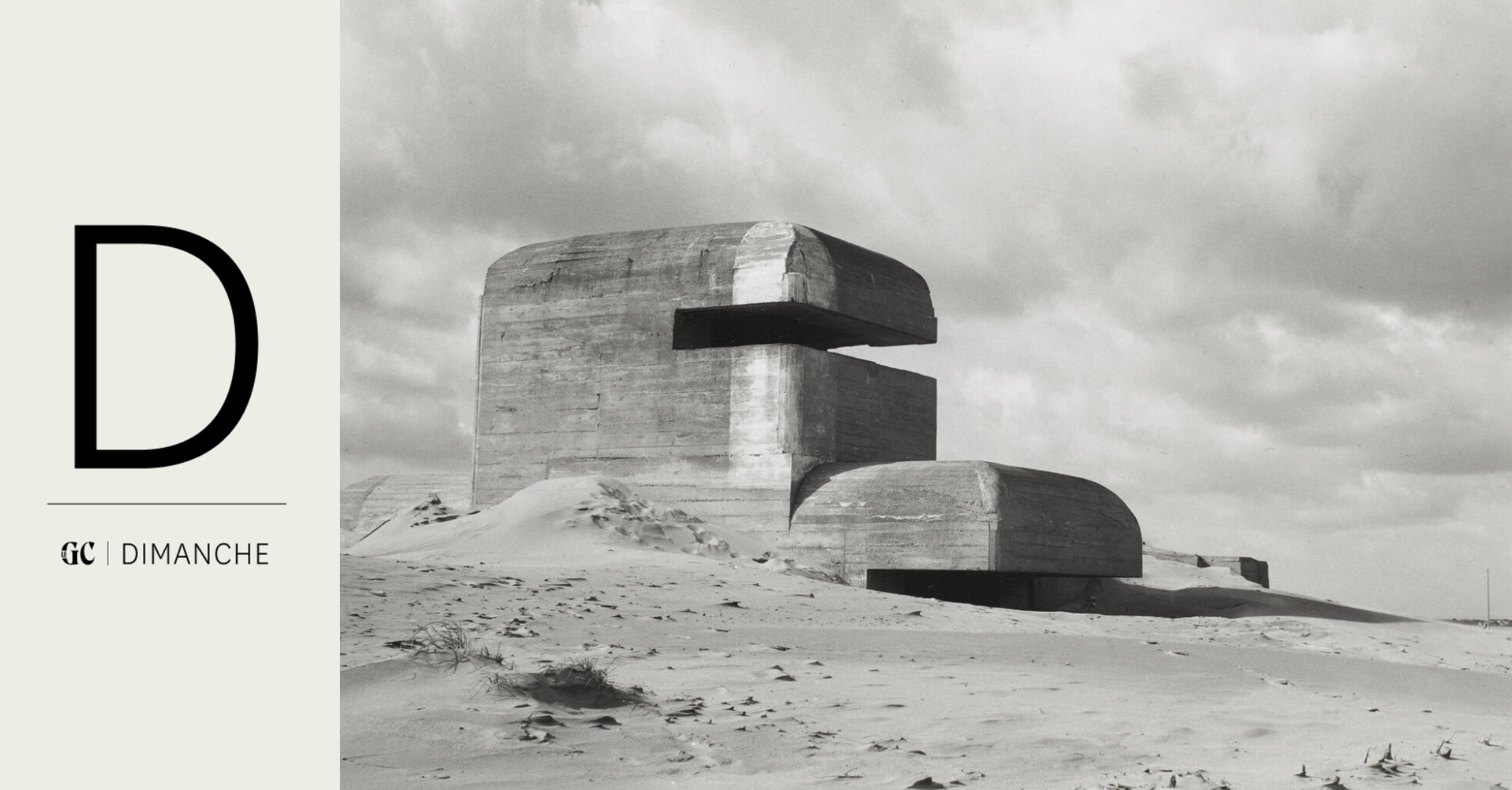
What could this ruined structure, stranded on a sandy beach facing the sea, be used for? It might serve as a lifeguards’ surveillance post, yet then why adopt such a stark, even unsettling shape? Could it be a set piece for a disaster movie? The ruin of a fortress? The forward outpost of extraterrestrials?
It is obviously a bunker. As a child, I saw several along the Normandy coast where my parents rented a house for the summer. I even dared to explore one, not without trepidation, but we were a small band of fearless adventurers. In my memory, these casemates served as wild toilets or trash dumps; they no longer housed cannons or weapons, the floor was sand, the reinforced doors had been removed or rotted in place. From a distance, the bunker looked like the helm of a giant knight clad in armor, or at least that is how I pictured it. If I dug all around it I could de-sand it, then it would rise and walk along the beach. But no, this concrete block possessed no agility; it remained there, immobile, useless.
My father, who had fought in the war, used to tell his children and their summer friends that the Germans had undertaken the construction of a wall along the entire Atlantic coast to shield against any invasion from the ocean. These bunkers were equipped with cannons, they dotted the entire maritime façade, facing the United Kingdom, which boasted a formidable fleet. He explained that this colossal project, with its scale and the mobilization of hundreds of earthmovers and masons, ultimately did not prevent the D-Day landings of June 6, 1944, as evidenced by the countless crosses planted in the cemeteries we visited in hushed silence.
The bunker is, above all, a war machine. If Hitler’s name was known to me then, I only knew of Fritz Todt as a high school student. This engineer, close to the Führer, first distinguished himself by building 3,000 kilometers of highways in Germany before launching the Atlantic Wall. He died in the explosion of his plane, suspected to be an assassination, though the mystery remains. It was Xaver Dorsch who succeeded him, with Hitler’s support. This other zealous Nazi engineer would not be troubled at the end of the war and would run a construction consulting company until his death in 1986.
But all that, this photograph does not tell us. Nor does it reveal the batteries of artillery, radar stations, submarine shelters (Brest, Lorient, Saint-Nazaire…), or the mere halts for soldiers, these concrete pillboxes plated with steel. These military works numbered around 12,000 from Norway to Spain; thousands of workers were requisitioned—about 200,000, including Spaniards and Indochinese complementing STO victims as of February 1943—to build them. Hundreds of French companies were drawn into this grim epic, demanding tons and tons of concrete.
What does this photo tell us? That this monolith does not seem out of place on this beach, or that we have become so accustomed to its presence that it no longer shocks us. It may have been parachuted (or buried), which would explain the absence of a foundation. Or perhaps it emerged from the earth like a flower without sap, with no other purpose than its own futility? Is it a horizontal mouth that it bears? Yet it seems mute; its mineral lips remain pressed. I could interrogate it all day and it would remain silent. And if that firing slit were its gaze? Looking at it closely, its face remains impassive, expressionless. Should we humanize it? Anthropomorphism has its limits, does it not?
A bunker is a bunker. Even in summer. This is what this photograph shows, and all the ones Paul Virilio takes that are collected in his book Bunker Archaeology.
Paul Virilio liked to say that he was a child of war. He was born in 1932. At eleven, he witnessed the bombing of Nantes and its partial destruction, and he thus became aware of the fragility of built structures and the speed of aerial combat. It was in the summer of 1945 that the ocean appeared to him for the first time since the Loire estuary, but he had to wait until the summer of 1958, in Saint-Guénolé, to become interested in this oblique structure, half-buried in the sand.
Other images then crowd his mind: mastabas, Etruscan tombs, Aztec assemblages, more or less linked to funerary rites. He begins to photograph the bunkers built along the coastline, and each casemate with its clean lines appears to him as “an empty arch or even a small temple without religion.” Every summer, with his family, he snaps the coastal landscapes with his Leica M2 to produce nearly 1,500 photographs, some of which would be shown at the 1975 exhibition at the Centre Pompidou.
“Linked to the ground,” he explains, “to the earth surrounding it, the bunker, in order to camouflage itself, tends to become indifferent to the geological forms whose geometry results from forces and external conditions that, for millennia, have shaped them. The bunker’s shape anticipates this erosion by removing any superfluous protrusion; the bunker wears down and polishes itself prematurely to avoid any impact, it folds into the continuum of the landscape and thus disappears from our perception, used as we are to landmarks and punctuations.”
This is the paradox of the bunker: it is at once autonomous from its environment and at the same time participates in it. Paul Virilio was not only concerned with landscapes and with what could oppose or alter them. He was also a war theorist who knew the main treaties of strategists just as well as the history of armaments and defensive systems. It is there that he understands the Nazi military failure. They remained on land without realizing that warfare would eventually be won in the air and at sea. The Germans delineated a terrestrial territory with pillboxes that did not shield them from aerial bombardment and from the landing of troops. “In Nazi doctrine,” he notes, “there is curiously only one element: the lithosphere, the ground, the blood. Despite aerial and submarine warfare, the drive of the early space weapons, the atmosphere and the hydrosphere remain foreign to Hitler’s ideology. The sense of limitation on the ground translates directly into that of the living space, the Lebensraum.”
That is where the sting hits and leads to capitulation. The bunker, remarkably solid, cannot do much against a conflict that employs weapons off the ground. And this photograph? The building stands alone. No human nearby, it has been abandoned by its soldiers. It mutters that it has become obsolete, that it has served its time, that it is overtaken by new wartime technologies. It seems tired, ungainly, isolated. What does it signify in itself? Only an entomologist specializing in these large stone-polished insects could pin it down and thus label it: bunker, a species on the brink of extinction.