
All summer, the Grand Continent will stay in motion. Each day, we will bring you ideas wherever you are that you won’t find anywhere else (but that will be everywhere again come fall), texts that are hard to find or refreshingly new with our Sundays. To receive them directly in your inbox and to support this momentum, consider subscribing to the journal
Tarred, tarmacked, and dusty… In 2026, the road isn’t exactly the place you’d dream of letting your writer’s pen loose. Yet many authors have celebrated their journeys: for Proust, it’s “the old road to Balbec,” “lined with ancient elms”; for Kerouac, it’s along the American highways, traveled at “full tilt,” where one must burn life at both ends. More tragically, the Italian poet Antonia Pozzi, who died by suicide, made her poems the mile markers of a long path toward death, gathered in The Road to Dying. The road, or how overheated asphalt makes life meet death. Charles Dantzig, what is the road of your Grand Tour?
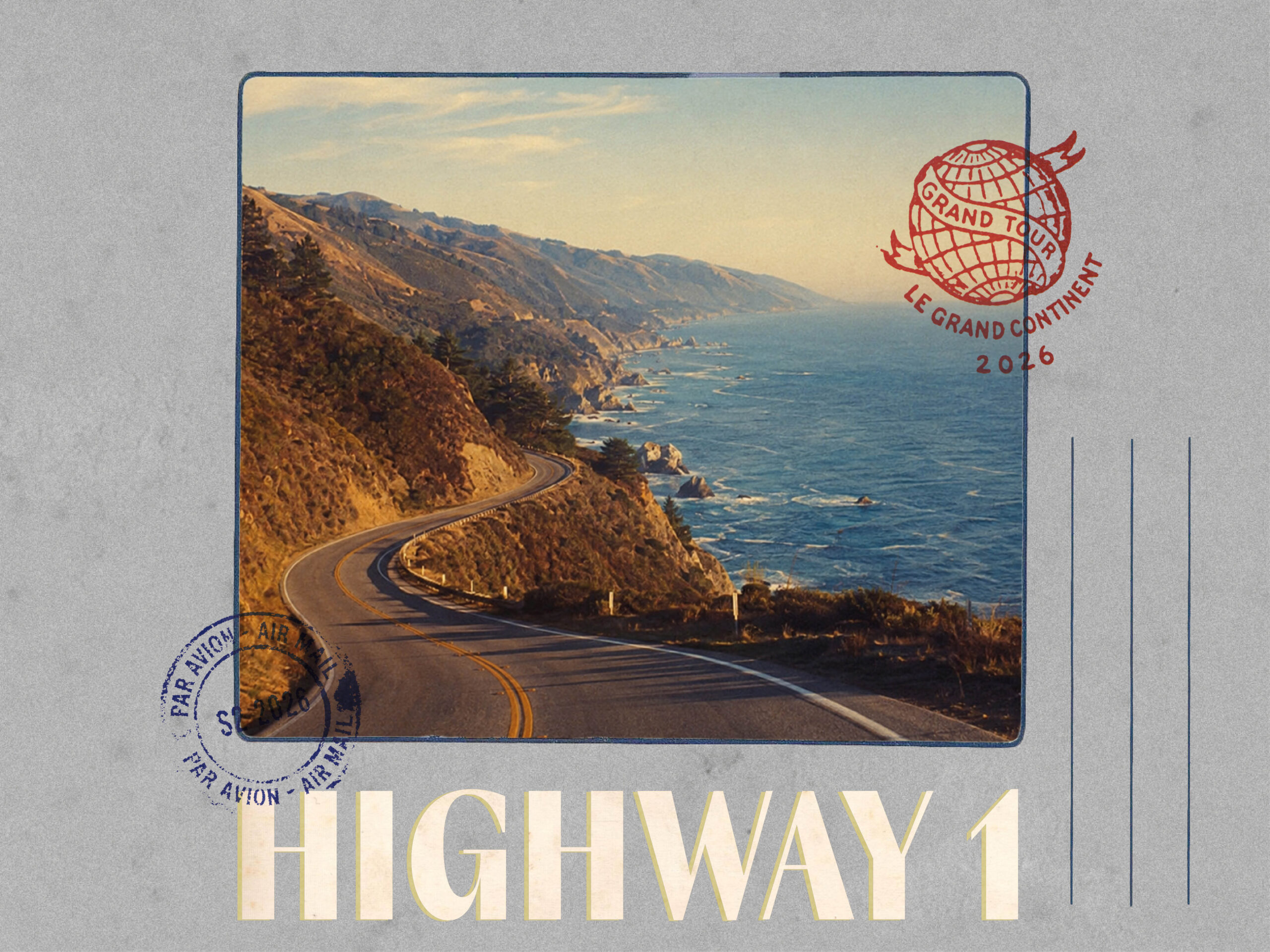
The Highway 1, the national road that links San Francisco to Santa Barbara and down to Los Angeles, California. This road, which has the peculiarity of winding along the Pacific Ocean, was inaugurated in 1937, at the initiative of a physician from Monterey, John L. D. Roberts, who wished to visit his patients more easily.
A road is several places at once. It is a ribbon of asphalt in itself, yet it is also the two destinations it connects. In this case, the two cities connected by Highway 1 are apotheoses of civilization. San Francisco is the city of poets, of the great sanctuaries of knowledge that are the universities. Los Angeles, on the other hand, is a city that seems to belong to the Moon, with its vast avenues, its 200 kilometers of roads: the perfect artificial paradise. The highways and overpasses weave together there with enchantment, while always remaining one-way. The individuals are like atoms or red blood cells, aboard their cars. The loner I am particularly appreciates this aspect: the roads resemble vast plains of asphalt, traversed by angels.
In what vehicle do you traverse Highway 1? And what is your soundtrack?
I descended it once in a Mustang. As for the music, one must be careful. Once, while I fumbled with my phone to assemble a playlist, I nearly got myself killed. The song that best suits this road-poem is It Happened in Monterey, by Frank Sinatra.
Highway 1 runs along the Pacific Ocean. Tell us about this encounter between sea and land.
Precisely because it hugs the shoreline and mirrors its contour, Highway 1 stands among the world’s most beautiful roads, comparable to the Amalfi Coast in southern Italy and the Dalmatian coast along the Mediterranean in Croatia. It is even somewhat dangerous, skirting cliffs and ravines. Besides water and earth, Highway 1 also brushes the air, with certain stretches elevated high above the ground thanks to viaducts. The Americans have a word for landscapes like these: “dramatic.” The force of the waves makes this crossing feel a little “dramatic.” Highway 1, with its twists and the grandeur of the surrounding scenery, has everything it takes to awaken that slightly childish fear that adds to its charm.
It is, moreover, on Highway 1 that you make the main character of your novel A Love Film disappear. Is the road, for you, a place of the end of the world?
Highway 1 is for me associated with the idea of brutal death, because it is there that the character in my novel dies, among sea lions, below a cliff, on a small beach. But not the end of the world. On the contrary, the landscapes it passes through are so elemental, archaic, and primordial that they will survive the end of the world. Humans may disappear, but they will endure.
When I am on this road, I think of American post-apocalyptic films, where human infrastructures are overgrown with vines and uncontrollable vegetation and where cities lie deserted, save for a few tigers and other wild creatures. Highway 1 may let us glimpse the end of the world, perhaps even touch it, but above all it makes us aware of what will vanish and what will endure.
Rather than the end of the world, can we speak of solitude?
On Highway 1, you may encounter only one car per hour. The reason is simple: a faster route sits about twenty kilometers away, allowing Californians to reach Los Angeles or Santa Barbara much more quickly.
One grows to value this intimate dialogue that develops with the landscape. Suddenly, a purple mountain emerges, reminding one of Iran or Saudi Arabia. It is a place on the threshold of the creation of the world. There is little construction, save for a few villages. The hills rolling toward the sea resemble enormous diplodocus legs, with their stony ends.
This impression is, of course, misleading: humans are the ones who created this road; they built it. Yet the sense of witnessing the origin of the world persists. Nature, in a way, makes roads itself, with irregular landscapes, dizzying summits, then whites, and so on.
At what moment during your crossing do you feel the landscape’s strongest literary force?
I was speaking of nature’s emptiness. Nature is imperfect: it holds gaps, silences, blank pages. It is up to literature to fill them, just as a road is laid down. A road is the poetic framework for a disorderly landscape. Literature plays the same role: it tells, it fabulizes, it shapes these virgin lands.
How does this road tell the story of the United States?
Poet Charles Olson once said that the United States did not possess a sense of history; instead, they replaced it with geography, with mastery over space. Highway 1 stands as proof of that. Historians swear only by comforting causality. Americans pay little heed to it: they devour the landscapes, traverse them at a brisk pace, and live them—not necessarily to achieve great things.
Not far from Highway 1 sits William Randolph Hearst’s castle, the press and film magnate who inspired Orson Welles in his film Citizen Kane. It is a monument of bad taste with its fake façade and its pompous, cake-like presence, reminiscent of today’s Trumpian aesthetics. Yet I like this somewhat naïve vanity. Moreover, unlike Florida, for instance, there remain wild areas where one can almost imagine the populations before settlers arrived. That is not the case of the San Francisco Bay Area, where imported vegetation from the late 19th century can be found.
The region is then haunted by the ghost of many great artists. Henry Miller, the cosmic author, lived in Big Sur; Orson Welles and his wife, Rita Hayworth, were not far away. It wasn’t Beverly Hills’ jet set, more aligned with classic Hollywood industry. Orson Welles was even driven out. It is striking to note that Highway 1 has welcomed, within its meanders, the outcasts of mass culture industries.
What about today?
This era is gone. There is little room today for this kind of American intellectual and artistic dissent. I’m surprised, in fact, to see that the leading figures of anti-Trump protests are still very old celebrities, such as Jane Fonda, Bruce Springsteen, Bette Midler, or Julia Roberts. Where is the American rebellious youth? Has the margin been crushed by the capitalist bulldozer?
Can your attachment to Highway 1 be read as a praise of the margins?
Yes, and above all as a utopian vision of a home that can be made to fit. The road is not incompatible with the idea of intimacy and individuality. Those who fit it out, most often for themselves, also offer something to other travelers. In France, for example, Francis I enjoyed passing from one royal château to another. That was before kings settled permanently in one place with their court. He complained a lot about the heat during these crossings and, to refresh his retinues, he asked that plane trees be planted along the French roads.
The road is not merely a utilitarian lane. It is also the reflection of a vision.
Have you ever found happiness on Highway 1?
I find pleasure with people, but happiness I discover on my own. Solitude fits me like a glove. The little happiness I have truly touched was on this Californian road. I rarely return to the places where my best memories crystallized, perhaps out of superstition.
But on Highway 1, I permit myself to hope that this spark of happiness might rebound. I believe that this spark is linked to the solitude of this journey.